|
If you want to gauge the trickle down of technology from
development to consumer availability, the automotive industry is a good test
subject. Huge research budgets, extensive supply networks, cutthroat
competition and big name partnerships means car companies maintain appeal by
staying on the cutting edge of modern innovation and development.
And the auto industry is certainly one in upheaval.
Staggering fuel mandates loom heavily. Aluminum alloys represent the future of
automotive materials. Smaller engines are being super- and turbocharged to
squeeze every engine rotation out of available fuel. Tesla doesn't plan on
being a competitor, but rather a supplier, so other automakers can use their
electric powertrains. Now one knows exactly when sensors and CPUs are going to
drive our cars, but bets placed for sooner rather than later will surely pay
off.
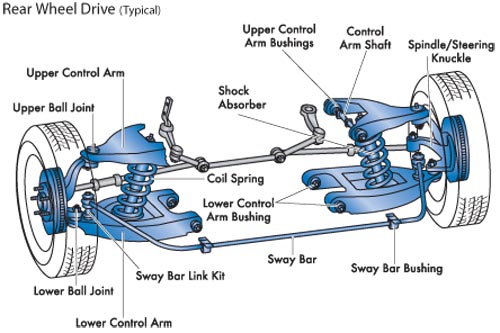 Yet many automotive designs have remained stagnant,
sometimes for over a century. Take your average automobile or light truck
suspension. With some exceptions, the vast majority of auto suspensions in the
past 100 years have either been leaf springs or coil springs. These types of
suspensions are known as passive suspensions, simply because they're reactive
to different grade levels and road conditions. Passive suspensions represented
a major improvement on the suspensions of the 1800s, which were primarily for
carriages and low speed vehicles, and consisted of leather belts slung between mounts
that insulated the cabin via oscillation. Of course, such designs were
unacceptable for automobiles, so early automakers relied on leaf springs (and
still do for heavy cars and trucks), the same suspension principle used on
ancient Egyptian chariots. In this sense, passive springs are a much, much
older suspension technology than what is represented in automobiles. Coil
springs couldn't be accurately produced until industrialization, and still
weren't implemented in significant numbers until post-World War II. Torsion bar
suspensions are primarily used on B-segment European cars, where simplicity and
space savings are a primary concern. Yet many automotive designs have remained stagnant,
sometimes for over a century. Take your average automobile or light truck
suspension. With some exceptions, the vast majority of auto suspensions in the
past 100 years have either been leaf springs or coil springs. These types of
suspensions are known as passive suspensions, simply because they're reactive
to different grade levels and road conditions. Passive suspensions represented
a major improvement on the suspensions of the 1800s, which were primarily for
carriages and low speed vehicles, and consisted of leather belts slung between mounts
that insulated the cabin via oscillation. Of course, such designs were
unacceptable for automobiles, so early automakers relied on leaf springs (and
still do for heavy cars and trucks), the same suspension principle used on
ancient Egyptian chariots. In this sense, passive springs are a much, much
older suspension technology than what is represented in automobiles. Coil
springs couldn't be accurately produced until industrialization, and still
weren't implemented in significant numbers until post-World War II. Torsion bar
suspensions are primarily used on B-segment European cars, where simplicity and
space savings are a primary concern.
So where am I going with all this? Hopefully a new
generation of active and semi-active auto suspensions will reinvigorate an
exhausted product that is easily improved by modern technology. Automakers are
learning how these suspensions can help them in other developments, such as
improving gas mileage, and creating a more enjoyable ride experience as well.
 Active suspensions have force actuators that can both add
and dissipate energy from a vehicle axle, meaning that ride quality and
excellent handling isn't a compromise like it is with a passive suspension. Vehicle
heights can be adjusted according to speed, improving aerodynamics and
therefore gas efficiency. Active suspensions can also eliminate the sway or
pitch resulting from vehicle inertia when in a tight corner, braking, or
accelerating, which significantly improves vehicle safety and also enhances
tire lifespans. Pretty much you would never spill coffee on yourself because of
sudden stops or turns during your morning commute. Active suspensions have force actuators that can both add
and dissipate energy from a vehicle axle, meaning that ride quality and
excellent handling isn't a compromise like it is with a passive suspension. Vehicle
heights can be adjusted according to speed, improving aerodynamics and
therefore gas efficiency. Active suspensions can also eliminate the sway or
pitch resulting from vehicle inertia when in a tight corner, braking, or
accelerating, which significantly improves vehicle safety and also enhances
tire lifespans. Pretty much you would never spill coffee on yourself because of
sudden stops or turns during your morning commute.
Of course, just because they've been used sparingly doesn't
mean active and semi-active suspensions have been ignored. Instead, their use
has been limited for two reasons: additional cost has limited deployment of
expensive vehicles, and standard hydraulic suspensions are slow in response but
high in power consumption.
One of the more intriguing kinds of active suspensions is
the electromagnetic  recuperative suspension. By utilizing a normal passive
spring, an electromagnetic actuator, control unit and batteries, it reportedly
increases ride quality by 60 percent, and also improves safety by eliminating
sway and pitch while cornering and braking. Even if electric power to the
suspension fails, the passive spring can still handle dynamic loads. Furthermore,
some of the power consumed by this can be regenerated by using the motors as
generators. Its small package footprint means it can even be retrofitted for
many cars, according to Bose. The company best known for stereo equipment has sunk over
$100 million in research on an electromagnetic suspension, as a testament to
its belief in the system. Bose has even demonstrated bunnyhops
with the system. recuperative suspension. By utilizing a normal passive
spring, an electromagnetic actuator, control unit and batteries, it reportedly
increases ride quality by 60 percent, and also improves safety by eliminating
sway and pitch while cornering and braking. Even if electric power to the
suspension fails, the passive spring can still handle dynamic loads. Furthermore,
some of the power consumed by this can be regenerated by using the motors as
generators. Its small package footprint means it can even be retrofitted for
many cars, according to Bose. The company best known for stereo equipment has sunk over
$100 million in research on an electromagnetic suspension, as a testament to
its belief in the system. Bose has even demonstrated bunnyhops
with the system.
Magnetorheological dampers are another active type of suspension,
but have seen further implementation than electromagnetic recuperative types.
In this instance, a shock absorber is filled with magnetorheological fluid and
connected to an electromagnet. When the fluid is magnetized, metallic particles
align according to field lines to make the fluid stiff. By controlling this
stiffness with sensors and a PLC, shock and vibration is isolated from the
vehicle chassis. It has been deemed the most advanced suspension control system
in the world.
 Perhaps the last active suspension worth mentioning is only
applicable if some manufacturers implement in-wheel motors, as speculated. It
would be Michelin's Active Wheel. Not only is the wheel itself powered by an
electric motor, but a separate electric motor controls each wheel's torque
distribution, traction and weight distribution. The Active Wheel is perfect for
electric or hybrid drivetrains. This design hasn't been incorporated into a
production vehicle yet, but some analysts believe an in-wheel motor realization
is on the horizon. Perhaps the last active suspension worth mentioning is only
applicable if some manufacturers implement in-wheel motors, as speculated. It
would be Michelin's Active Wheel. Not only is the wheel itself powered by an
electric motor, but a separate electric motor controls each wheel's torque
distribution, traction and weight distribution. The Active Wheel is perfect for
electric or hybrid drivetrains. This design hasn't been incorporated into a
production vehicle yet, but some analysts believe an in-wheel motor realization
is on the horizon.
Of course, all of this development means nothing if it can't
be scaled to an affordable, middle-class targeted vehicle. Even with inflation
accounted for, vehicles are getting more
expensive due to additional creature comforts and tighter government
regulations. Considering that active suspensions can improve MPG, safety,
handling and ride quality, there may be a day where this burgeoning technology
is an inevitable cost of vehicle ownership. For now though, many of us ride around
on a spring that hasn't been improved in 3,000 years.
| 


 Re: The Dawn of Active Suspensions?