|
First let me self-expose a bias: I'm a rail fan. Maybe not
as big a rail fan as this guy,
but a rail fan nonetheless.
It began in the days when I was a young kid and my mom would
take me to the rail yard to see locomotives idle down, detach cars or push
rolling stock over the hump. It continues today, even though most of my current
train experiences are standing-room only, someone smells and the subway car is
invaded by a team of street acrobats.
For most people outside large cities, trains aren't a true
transportation option, but then again neither are cars. For everyone else, there
is seemingly a 'sweet spot' for travelling by train, somewhere between 100
and 600 miles. Anything closer can be trekked by car; anything farther should
require an airplane.
 But even with these considerations, travelling by car is
typically preferred. The advantages are numerous. There is no set itinerary.
You don't have to adhere to luggage limits or fees. No rushing to the station
to make departure. It's comparable in price, and usually faster than a train.
Metrics back up the American penchant for driving over riding. The U.S. has more
than double the rail network size of second-place China, but ridership stats rank behind railroad-deficient
countries such as Egypt and Mozambique. But even with these considerations, travelling by car is
typically preferred. The advantages are numerous. There is no set itinerary.
You don't have to adhere to luggage limits or fees. No rushing to the station
to make departure. It's comparable in price, and usually faster than a train.
Metrics back up the American penchant for driving over riding. The U.S. has more
than double the rail network size of second-place China, but ridership stats rank behind railroad-deficient
countries such as Egypt and Mozambique.
Despite this, investment in railway improvements and
high-speed rail development continues to create political pressure in the U.S.
In many ways it's a foreign issue too--take Britain's own HS2 high-speed rail debate
as evidence that train tickets aren't an easy sell in many places.
So when one of train travel's primary advantages--the
ability to sleep, work, game, watch a video or completely zone out--arrives in
automobiles, by way of autonomous driving, is it the
deathstroke for travel by train?
Seemingly so, according to this
Forbes article that articulates that trains are already approaching
obsolescence, and that the ability to sit down in a privately owned car (either
yours or one you arranged for by emerging ride-sharing programs), travel at 100
mph, and enjoy the time as your own will significantly increase most people's
reliance on and utilization of automobiles. Envisioning a fully-developed
autonomous vehicle market, cars can be complemented by automated tractor
trailers and flatbeds, further devaluing trains as a whole, but this time from
the freight and logistics perspective.
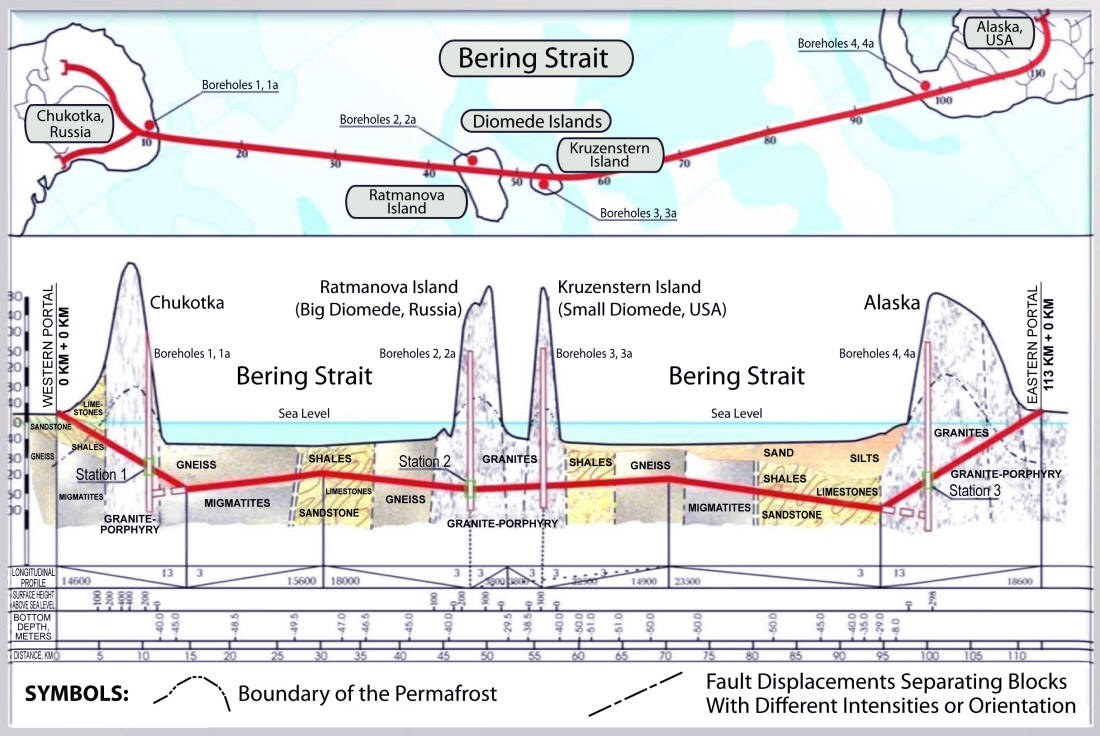 But a few things can keep supply-chain-by-train a thing of
the near-present and forever-future. First, a real, tangible tunnel or bridge
that connects Alaska to Siberia via the Bering Strait would go a long, long way
(figuratively and literally) in keeping locomotives relevant. Foremost, both
Alaska and Siberia have sparse infrastructure, and the ability to keep cars
fueled and serviced in the remote corners of these continents would be an
enormous and expensive challenge. Not only that, but crossing the 125-mile
tunnel or bridge via automobile would be much more risky proposition. When the
first bridge over the Bering was conceptualized in 1890, the engineering was
not up to task, but governments on both sides believed it would be an enormous
economic advantage. One-hundred-twenty-five years later, the engineering is
more than capable of creating such a design, but the political goodwill doesn't
exist anymore. The most recent news on this front comes from China, who wants
to build a
China-Russia-Canada-U.S. high-speed railroad to transport people and goods
from China to the U.S. in just two days. But a few things can keep supply-chain-by-train a thing of
the near-present and forever-future. First, a real, tangible tunnel or bridge
that connects Alaska to Siberia via the Bering Strait would go a long, long way
(figuratively and literally) in keeping locomotives relevant. Foremost, both
Alaska and Siberia have sparse infrastructure, and the ability to keep cars
fueled and serviced in the remote corners of these continents would be an
enormous and expensive challenge. Not only that, but crossing the 125-mile
tunnel or bridge via automobile would be much more risky proposition. When the
first bridge over the Bering was conceptualized in 1890, the engineering was
not up to task, but governments on both sides believed it would be an enormous
economic advantage. One-hundred-twenty-five years later, the engineering is
more than capable of creating such a design, but the political goodwill doesn't
exist anymore. The most recent news on this front comes from China, who wants
to build a
China-Russia-Canada-U.S. high-speed railroad to transport people and goods
from China to the U.S. in just two days.
A separate option is
update trains themselves. First, train engineers can be replaced by
automated systems as well. Though this can be controversial, as since July 2013
freight trains carrying potential hazardous materials have received increased
scrutiny, this is ultimately leveraging the same technology that makes trains
obsolete in the first place. Enormous operational costs can be recouped by
integrating things like automated process controls, remote inputs and advanced ticketing
systems, effectively saving railroads from themselves. Hybrid or
hydrogen-powered trains are viable ways to decrease fuel dependencies.
 Lastly, is to market trains less
as a way to the destination, and more as a destination in itself. Take ocean liners
as an example. Once airplanes turned a 10-day voyage on the open sea into a
10-hour power nap, ocean liners became terribly archaic. But for those who
prefer the scenic route, don't have a schedule or purse strings or don't want
to fly, the Queen
Mary 2 still operates trans-Atlantic voyages for most of the year. Guests
are surrounded by luxury during a seven-night crossing from New York to
Southampton. In many ways, passenger trains could remodel themselves as a
luxurious means to scenic travel. Rail lines like the JR Kyushu have taken this
idea and implemented a four-day sightseeing trip around Japan. The image at
right is from one of the suites on this train, while this
gallery exhibits ideas for future rail liners. Lastly, is to market trains less
as a way to the destination, and more as a destination in itself. Take ocean liners
as an example. Once airplanes turned a 10-day voyage on the open sea into a
10-hour power nap, ocean liners became terribly archaic. But for those who
prefer the scenic route, don't have a schedule or purse strings or don't want
to fly, the Queen
Mary 2 still operates trans-Atlantic voyages for most of the year. Guests
are surrounded by luxury during a seven-night crossing from New York to
Southampton. In many ways, passenger trains could remodel themselves as a
luxurious means to scenic travel. Rail lines like the JR Kyushu have taken this
idea and implemented a four-day sightseeing trip around Japan. The image at
right is from one of the suites on this train, while this
gallery exhibits ideas for future rail liners.
No one can really predict if trains will become outdated or
if autonomous vehicles will even work. But the precedent is there, and now it's
up to the railroad industry to decide how proactive about its fate it needs to
be.
| 


 Re: Driverless Cars vs. Railroads, Round 1


