|
Last spring I was on vacation in Florida and took the hour
drive from the beach into Orlando to visit Universal Studios. Many people elect
for one of Disney's many, many family-oriented theme parks, but with no kids,
and a severe affection for roller coasters and thrill rides, Universal Studios
was my choice.
 After spending, oh, I don't know, about $450 for a
single-day pass for two people (seriously), I was entreated to a theme park
full of movie-oriented attractions and rides representing today's most popular
entertainment brands. Harry Potter. Shrek. Transformers. Despicable Me. Men in
Black. Marvel Comics. The Simpsons. It was an all-out onslaught of merchandise
and marketing. (If you're still with me, I promise, this is getting somewhere.) After spending, oh, I don't know, about $450 for a
single-day pass for two people (seriously), I was entreated to a theme park
full of movie-oriented attractions and rides representing today's most popular
entertainment brands. Harry Potter. Shrek. Transformers. Despicable Me. Men in
Black. Marvel Comics. The Simpsons. It was an all-out onslaught of merchandise
and marketing. (If you're still with me, I promise, this is getting somewhere.)
Yet a few less-popular brands still exist in the park. Twister has its
own ride. Beetlejuice has a
show. I expected these fading brands to be replaced by more popular ones. I
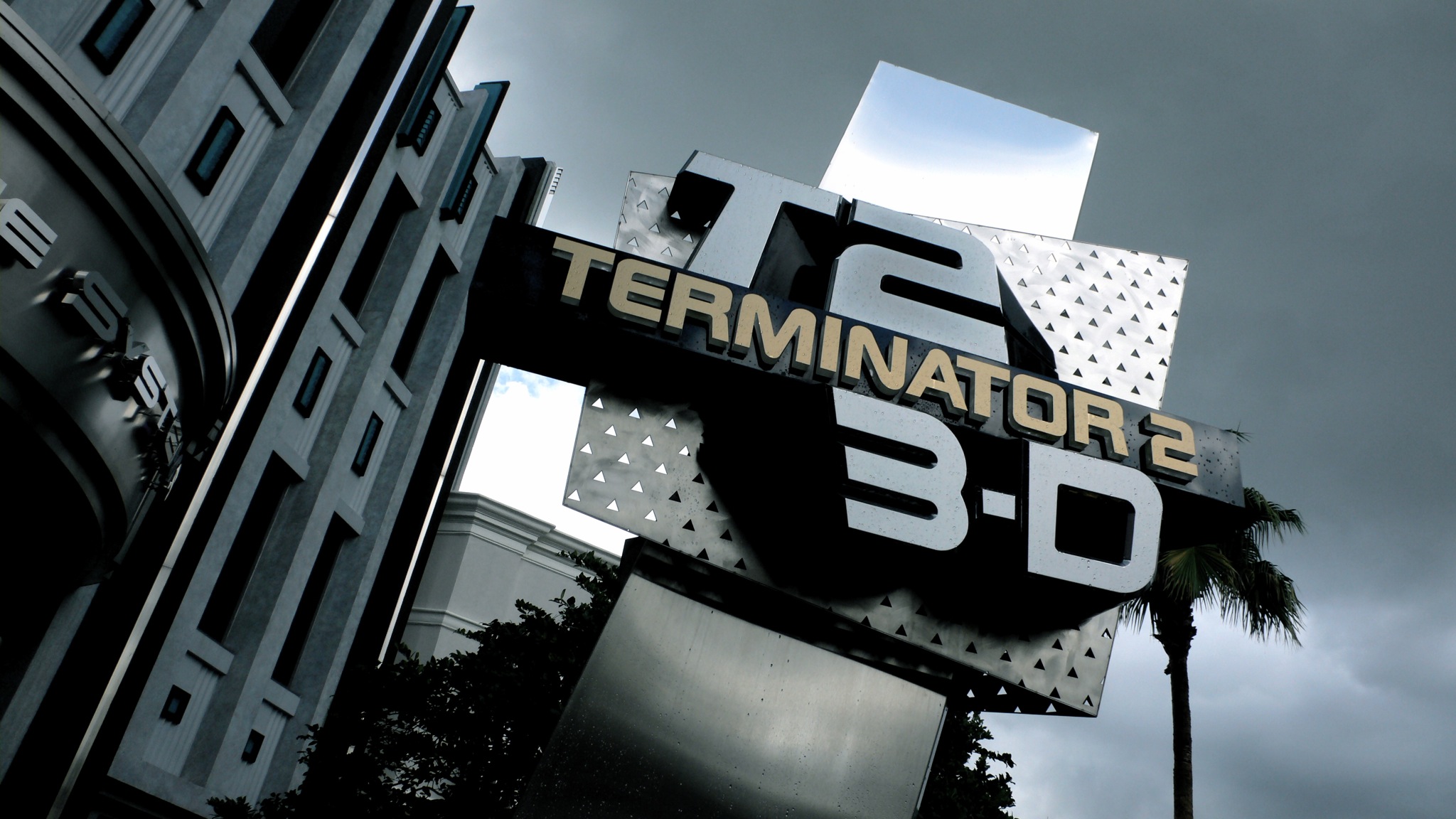
even attended a 3D live show of Terminator 2, complete with a Schwarzenegger
imposter on a motorcycle, animatronic Terminators and mid-1990s 3D technology.
It was obviously a let-down considering how developed 3D technology has become
in the 20 years since the release of T2, and it was no surprise that the
theater was less than a quarter-full during my showing.
So why does Terminator 2
3-D: Battle Across Time still stand as an attraction today? There are
dozens of more profitable replacement options for an overage, unpopular
attraction with a fading brand. Could it be that this live interpretation of
humanity's battle versus Skynet is powerful reminder that the technological
singularity is inevitable? Or is this blogger just grasping at straws while
trying to segue into a post about such a topic?
It's definitely the latter, but at least hear me out.
 You might remember the name Alan Horn--he is best known one
of the lead developers of IBM's Watson, the supercomputer that appeared on
Jeopardy! and is now used to assess treatments for lung cancer. Horn recently
argued that whether humans want it to or not, technology will develop to a
point where it begins to develop itself. It will be a cascading series of
machines building machines, and it will make humans obsolete in every way, an
event known as the technological
singularity. Not only will humanity's thought processes be dwarfed by
artificial superintelligence, but humanity's convictions on art and morality
will be challenged in the name of optimization and efficiency. This will
essentially make humans useless, but significant resources will still be spent
on keeping us all alive, while humans contribute immense waste and pollution. This would be the point
where the T-100s arrive and begin eradicating humanity. Many point out that an
uncontrolled technological ascent has no reason to view humans as helpful or
friendly. It wouldn't be actively malicious, but it would sometimes compete for
the same resources, and would not be interested in furthering humanity's goals. Perhaps the best way of aligning our goals would be transhumanism, the concept of blending human physiology with bioengineering developments to create superhumans. You might remember the name Alan Horn--he is best known one
of the lead developers of IBM's Watson, the supercomputer that appeared on
Jeopardy! and is now used to assess treatments for lung cancer. Horn recently
argued that whether humans want it to or not, technology will develop to a
point where it begins to develop itself. It will be a cascading series of
machines building machines, and it will make humans obsolete in every way, an
event known as the technological
singularity. Not only will humanity's thought processes be dwarfed by
artificial superintelligence, but humanity's convictions on art and morality
will be challenged in the name of optimization and efficiency. This will
essentially make humans useless, but significant resources will still be spent
on keeping us all alive, while humans contribute immense waste and pollution. This would be the point
where the T-100s arrive and begin eradicating humanity. Many point out that an
uncontrolled technological ascent has no reason to view humans as helpful or
friendly. It wouldn't be actively malicious, but it would sometimes compete for
the same resources, and would not be interested in furthering humanity's goals. Perhaps the best way of aligning our goals would be transhumanism, the concept of blending human physiology with bioengineering developments to create superhumans.
Futurologists have attempted to predict exactly when the
singularity will occur. The median seems to be 2045, but the consensus is that
it would definitely happen by 2100. This is based on the rate at which
computational capacities compound, heavily influenced by Moore's law. Several
things could slow down the rate of growth, such as software bottlenecks.
Software has different development timescales than hardware, and even a
superintelligent machine that is writing code would be playing catch-up to more
advanced hardware. Also, according to
other experts, eventually hardware reaches an upper threshold in computational
speed--a threshold that would be reached in due time even with humans building
machines.
 Even if slowed, the singularity
appears inevitable. For it to not occur, the Singularity
University believes that intelligence augmentation needs to fail on six
different impeding innovations: bioengineering, genetic engineering, nootropic
drugs, AI assistants, brain-computer interfaces, and brain uploading. Even the
success of one of these will lead to a singularity. It's so unavoidable, that
Stephen Hawking believes superintelligence needs to be planned for today,
because it could lead to lead to "technology outsmarting financial markets,
out-inventing human researchers, out-manipulating human leaders, and developing
weapons we cannot even understand." Even if slowed, the singularity
appears inevitable. For it to not occur, the Singularity
University believes that intelligence augmentation needs to fail on six
different impeding innovations: bioengineering, genetic engineering, nootropic
drugs, AI assistants, brain-computer interfaces, and brain uploading. Even the
success of one of these will lead to a singularity. It's so unavoidable, that
Stephen Hawking believes superintelligence needs to be planned for today,
because it could lead to lead to "technology outsmarting financial markets,
out-inventing human researchers, out-manipulating human leaders, and developing
weapons we cannot even understand."
Should we be worried about
becoming obsolete ourselves, or is the concern of a technological singularity
the stuff of science fiction?
| 

 2
2


 Re: Skyney is Coming, No Really (Technological Singularity)


Good Answers:
"Almost" Good Answers: