|
Where do you want to live? Only two weeks into another New
York winter, let's just say I'm ready for Florida. Or at least Florida weather,
even if the humidity seems to drive
people insane. But why confine your habitation choice to a country,
hemisphere or even planet?
 After all, a Mars colony seems to be a forgone, inevitable
conclusion. Mars One plans to
send four people every two years to the red planet beginning in 2024. Even if
the planned advertising revenues and reality TV show make the program seem like
a publicity stunt and an MIT
engineering report concludes that participants will die less
than 70 days into their Mars odyssey. As long as you have one billionaire ready
to throw gobs of money at a technology deficiency, it will be overcome. Mars
exploration has been so overplayed, NASA is now looking at opportunities to send humans
to Venus (in the blimp-like crafts at right) instead. After all, a Mars colony seems to be a forgone, inevitable
conclusion. Mars One plans to
send four people every two years to the red planet beginning in 2024. Even if
the planned advertising revenues and reality TV show make the program seem like
a publicity stunt and an MIT
engineering report concludes that participants will die less
than 70 days into their Mars odyssey. As long as you have one billionaire ready
to throw gobs of money at a technology deficiency, it will be overcome. Mars
exploration has been so overplayed, NASA is now looking at opportunities to send humans
to Venus (in the blimp-like crafts at right) instead.
These missions are mighty ambitious for a race that has, to
greatly oversimplify, essentially driven some high-tech RC cars around from 225
million km away. And there are many other planets that would better serve as
humanity's first space outpost.
Planet habitability is evaluated by several criteria. The
Earth similarity index (ESI) rates a planet's size, density, gravity and
temperature, with Earth having a default value of 1. Other parameters consider
suitability for vegetation; how far from a star the planet is; what the planet
is composed of, as well as its atmosphere; common climates; and how adaptable
resources are for human use.
In consideration of these variables, there are an estimated
8.8 billion habitable, Earth-like planets orbiting Sun-like stars in our galaxy
alone. So, let's hypothetically fulfill any doomsday prophecy you wish, and see
what new planets might serve as the first extrasolar incarnation of human life.
KOI-4878.01
This
unconfirmed planet has an ESI rating of .98, making it the most Earth-esque
replica yet discovered. Despite being unconfirmed, the Kepler telescope has
recorded three transits to date, and another one is expected in July 2015. It
has an orbit time equivalent to 449 Earth days. Its mass, radius and mean
temperatures are also incredibly similar to Earth's, and 4878.01 is almost a
sure bet to be an ocean planet. All of these factors mean an incredibly high
likelihood of life on the planet. Its star, KOI-4878, is 1075.2 light years
away, meaning that we'll never get there in our lifetimes. But a future race
with the right technology could make it Earth 2. The only questions are: does
anything live there? And if it does, are we willing to become the planetary
invaders if it means saving our species and threatening others?
 Gliese 667 Cc (artist rendering on left) Gliese 667 Cc (artist rendering on left)
Several other planets are more suitable for human life than this one, which has
an ESI of .85, but this is the highest-rated confirmed planet to date. It's
also much, much closer to home than 4878.01, at [only] 22.7 light years away.
Gliese 667 Cc has an orbit that is 28.155 days long (enjoy figuring out that
leap year). Gliese 667 Cc exists in a triple-star solar system and receives 90%
of the light that Earth does. However, the majority of the light is infrared;
in fact Gliese 667 Cc would be 80% dimmer than the Earth. Despite this, it
would also be quite hot, so hot that it borders on uninhabitable. If you picked
climate change as your preferred Earth doomsday scenario, Gliese 667 Cc is an
unlikely pick as home number two. Several other planets might also exist in the
Gliese system that can sustain humanity, but are also unconfirmed.
Tau Ceti e and Tau Ceti f
Tau Ceti e is included as it is the
closest
potential extrasolar real estate. At 11.9 light years away, it will likely
be one of the first 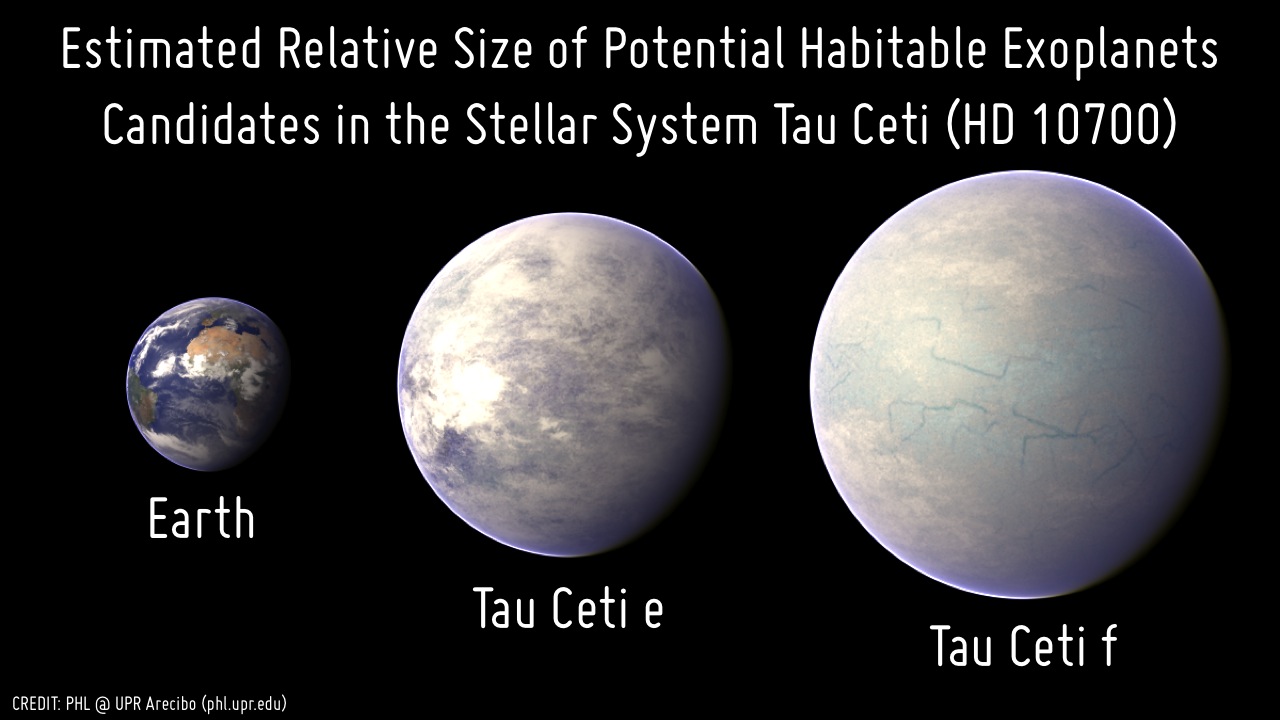 planets investigated for life once we initiate the search.
It has an ESI of .77 and a year of 168 days. Also notable about Tau Ceti e is
its size: as it has 4.3 times more mass than the Earth, and is almost twice as
big overall. This makes it a 'super-Earth.' Tau Ceti e is very hot though, as
it orbits its star Tau Ceti at a distance closer than Venus orbits our Sun.
Surface temperatures average around 70°C, so it's unlikely to be a permanent
home. Its neighbor, Tau Ceti f, is worth mentioning only because it's much
colder (about -40° C) than Tau Ceti e, but a gaseous atmosphere may warm the
planet enough to sustain complex life. planets investigated for life once we initiate the search.
It has an ESI of .77 and a year of 168 days. Also notable about Tau Ceti e is
its size: as it has 4.3 times more mass than the Earth, and is almost twice as
big overall. This makes it a 'super-Earth.' Tau Ceti e is very hot though, as
it orbits its star Tau Ceti at a distance closer than Venus orbits our Sun.
Surface temperatures average around 70°C, so it's unlikely to be a permanent
home. Its neighbor, Tau Ceti f, is worth mentioning only because it's much
colder (about -40° C) than Tau Ceti e, but a gaseous atmosphere may warm the
planet enough to sustain complex life.
For reference, Venus and Mars grade a .78 and .64 on the ESI
scale, respectively. ESI isn't a perfect grade for habitability--many variables,
perhaps ones not even quantified, effect the suitability of a planet for
colonization.
Perhaps this is putting the cart in front of the ox. Until
lightsails or warp drives are invented, we're stuck on this ball of mud. But
one very distant day retirees may live out their golden years in the oven of
Venus, instead of the stickiness of Sarasota.
| 


 Re: Moving On from Planet Earth


