|
In Japan, a 25,000 square foot facility is dedicated to
an indoor
farming endeavor that is 100 times more productive than its outdoor
counterpart. The space is producing 10,000 heads of lettuce per day (100 times
more per square foot than traditional methods) with 40% less power, 80% less
food waste, and 99% less water usage than outdoor fields.
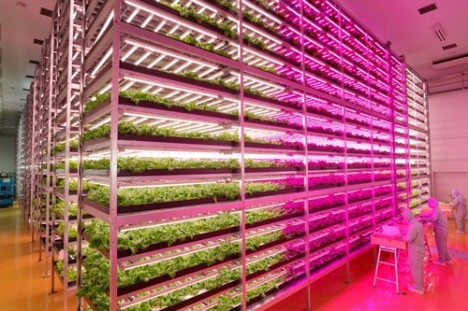
The idea for the facility came from Shigeharu Shimamura
after the 2011 earthquake and tsunami that destroyed parts of Japan and caused
food shortages throughout the island nation. The building itself was an
abandoned semiconductor factory. Image Credit
Shimamura has had passion for produce production ever
sense visiting the Expo '85 world's fair in Tsukuba, Japan as a teenager. He
studied plant physiology at Tokyo University of Agriculture and in 2004 started
an indoor farming company called Mirai, which in Japanese means "future."
The technology used in the indoor farm includes
customized LED lighting developed with GE. The lights help plants grow up to
two and a half times faster. Shimamura
shortened the cycle of days and nights in this artificial environment, growing
food faster, while optimizing temperature, lighting and humidity, and
maximizing vertical square footage. No water is lost to soil and a core-less
lettuce reduces waste. As of now picking is done manually but machines automate
some parts of the process.
What makes the most economic sense is to produce
fast-growing vegetables that can be sent to market quickly, but Shimamura
thinks that they can produce any kind of plant in the factory. And due to the
climate-controlled space and replicable conditions, this solution can be
deployed anywhere in the world. The need for fresh produce is especially prevalent
in high-cost urban areas, which will also benefit from the reduction in power
usage and waste. New facilities utilizing this technology are being constructed
in Hong Kong, and soon Mongolia, Russia, and mainland China.
Watch the video here.
| 


 Re: Indoor Farming


