|
Last weekend
the 2015 North American International Auto Show wrapped up, and on display were
many innovations and trends, as noted by this
Eng360 article.
 To optimize
vehicle performance and efficiency, many manufacturers have implemented driving
modes for traffic jams, city stop-and-go, highway cruising, off-roading and
every other terrain scenario imaginable. Some vehicles promised
park-and-retrieve technology: the car drops you off at the door, parks itself,
and can then be recalled with a few swipes on a smartphone. Other cars promised
seamless HUDs, advanced lightweight materials or a new spree of Ferrari murders
(looking suspiciously at you 2017 Ford GT). To optimize
vehicle performance and efficiency, many manufacturers have implemented driving
modes for traffic jams, city stop-and-go, highway cruising, off-roading and
every other terrain scenario imaginable. Some vehicles promised
park-and-retrieve technology: the car drops you off at the door, parks itself,
and can then be recalled with a few swipes on a smartphone. Other cars promised
seamless HUDs, advanced lightweight materials or a new spree of Ferrari murders
(looking suspiciously at you 2017 Ford GT).
Yet few
vehicles featured quiet cabins. No truck model offered the most tranquil
driving experience yet. There were no sports car advertisements of sleeping
newborns in rush-hour traffic congestion. And no manufacturer promised, "The
most realistic fake motor sounds in the industry."
Yet that's
exactly what's being sold, and it's not really a bad thing.
Recent media
hot air tries to portray manufacturers who amplify or falsify engine sounds as
dishonest, when there are about a hundred better examples of automaker deceit. Modern motor vehicle cabins have
become increasingly soundproof, and the natural purr of an engine has been
reduced as fuel economy and power density become more important considerations.
Some automotive engineers implement "order content" audio to mimic the cylinder
firing sounds of V6 or V8 engines, while others purposefully run exhaust
components through the cabin to increase engine noise.
Here are just a few of the order content offenders
- Ford surveyed Mustang fan clubs to
find which engine sound seemed the most Mustang-y, according
to the Washington Post. The winning engine sound is played at low frequency
in 2015 Ford Mustangs equipped with EcoBoost engines, because they're almost
impossible to hear from inside the car. Older mustangs were known to
route a second exhaust that made the car sound more powerful to the driver.
A similar technique is used on
the 2015 F-150. Apparently Ford thought the turbocharge Ecoboosts were too
whiny.
- The BMW F10 M5 has used a
throttle-responsive engine play track since
2011.
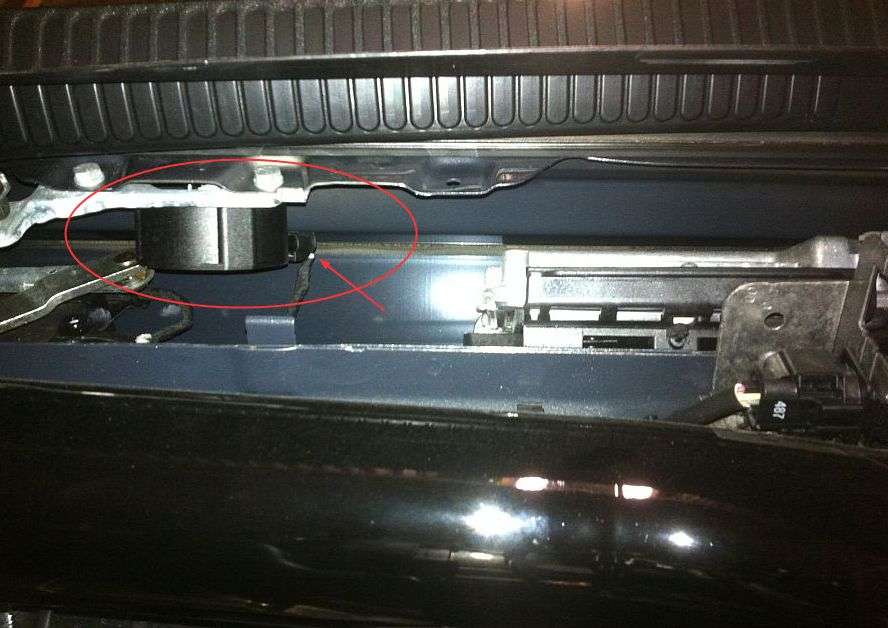 The VW GTI uses the Soundaktor, a
hockey puck-sized speaker mounted to the firewall that
VW says amplifies the engine's real sound. It's circled in the image at right. The VW GTI uses the Soundaktor, a
hockey puck-sized speaker mounted to the firewall that
VW says amplifies the engine's real sound. It's circled in the image at right.- Harley Davidson admitted that a
mid-90s redesign eliminated the "potato-potato-potato" sound of a classic
Harley. In conjunction with Porsche, Harley tuned the air intake, tri-pass
muffler and transmission gears to provide the iconic Harley
sound.
- Practically every hybrid or
electric vehicle.
And then there's my favorite, the upfront Renault Clio 200
Turbo. It allows drivers to customize how their order content sounds, including
like a GTR,
motorcycle, spaceship or a classic Renault.
Really, all these automakers are trying to do is meet
customer expectations. Even the youngest current car buyer was raised when cars
sounded like cars. What that exactly
means is completely subjective. Ten years from now, are car buyers going to
expect the whirr of a hybrid or EV? Who can rightfully complain about fake
engine sounds when car buyers might downright dismiss a vehicle for being too
quiet?
There is the argument that listening to the real engine
might help diagnose engine issues, but outside the folks at Hemmings,
very few drivers are capable of identifying these nuances.
 Ultimately, a quiet car is an advanced car. It means that
technology and materials have progressed to the point that we're able to
eliminate something that our automotive ancestors would have eliminated if they
could. In a decade, we won't even care about what sounds the engine makes and
how it feels because we won't be driving at all. Ultimately, a quiet car is an advanced car. It means that
technology and materials have progressed to the point that we're able to
eliminate something that our automotive ancestors would have eliminated if they
could. In a decade, we won't even care about what sounds the engine makes and
how it feels because we won't be driving at all.
This is like the shutter sound when you take a digital
photo--why synthesize something that so feels archaic?
| 


 Re: Faked Engine Noise is Overhyped


