|
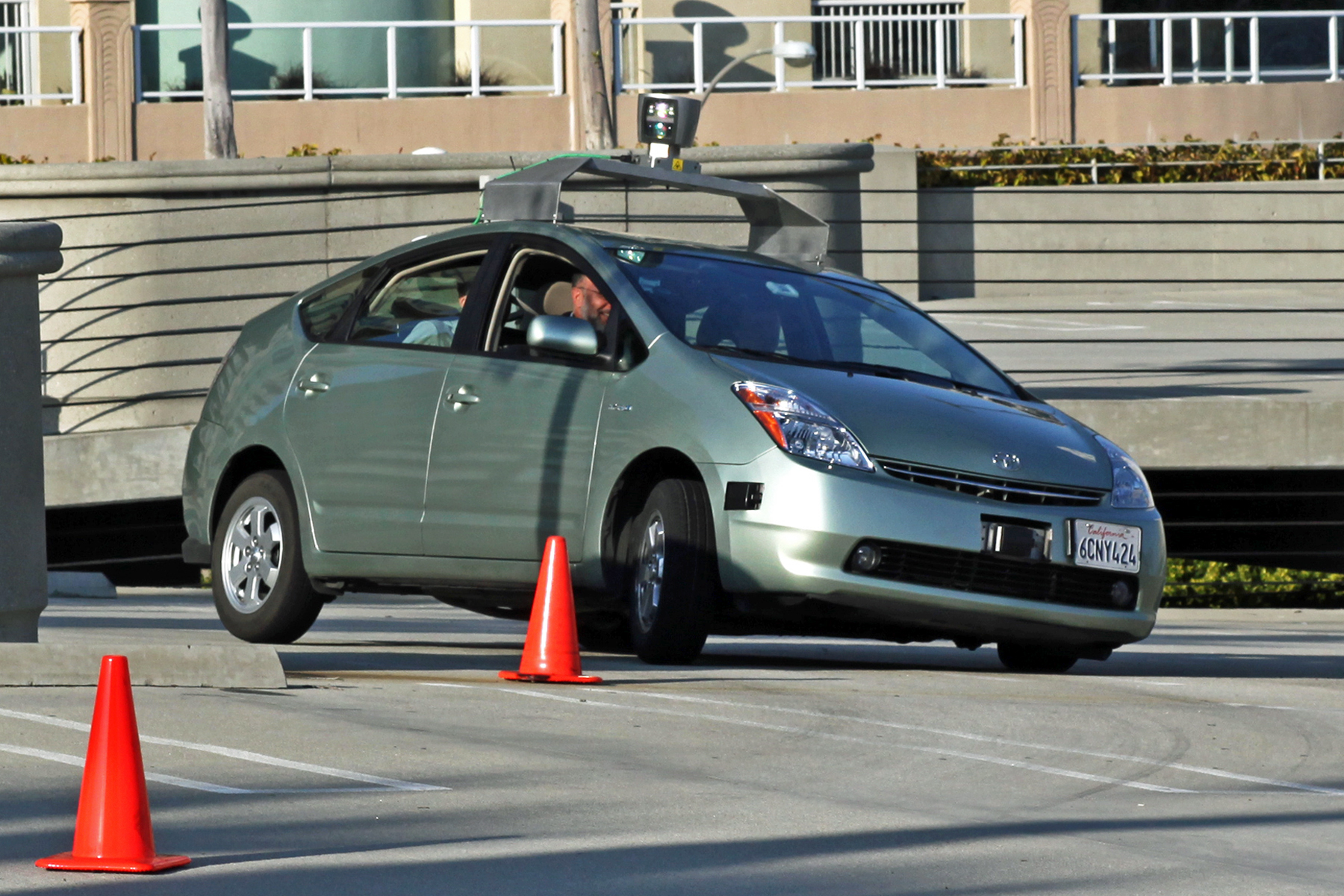 The
Google Self-Driving Car, powered by Google's innovative program Google
Chauffeur, is certainly making waves in the driving world. With human error
accounting for the vast majority of automobile crashes, as well as older
drivers losing the ability to drive as well with confidence, it seems like the
Google Self-Driving Car is the all-around cure for human-on-human road rage and
traffic accidents. The
Google Self-Driving Car, powered by Google's innovative program Google
Chauffeur, is certainly making waves in the driving world. With human error
accounting for the vast majority of automobile crashes, as well as older
drivers losing the ability to drive as well with confidence, it seems like the
Google Self-Driving Car is the all-around cure for human-on-human road rage and
traffic accidents.
Sebastian
Thrun, Google engineer, is the current Self-Driving Car project leader, former
director of the Stanford Artificial Intelligence Laboratory, and co-inventor of
Google Street View. He created the robotic vehicle "Stanley" back in 2005,
winning that year's DARPA Grand Challenge and its $2 million prize from the
United States Department of Defense. The team that developed that particular
system consisted of 15 Google engineers, including Chris Urmson, Mike
Montemerlo, and Anthony Levandowski.
State
legislation has been successfully passed to make Google Self-Driving Cars
street legal for four U.S. states (California, Nevada, Florida, and Michigan),
as well as Washington, D.C., with a third state legislation currently in review
for stating criteria in the state of Texas.
Google
engineer and project team member Urmson says, "We're spending less time in
near-collision states. Our car is driving more smoothly and more safely than
our trained professional drivers." This statement was prompted by the official
road test in which the Google Chauffeur program was placed in the computers of a
Prius and Lexus, and proved that while the professional drivers had sharper
turns and brakes, the Google Self-Driving Car program proved to run more safely
and smoothly through common road obstacles and general routes through a closed
test driving course.
Despite
the promising applications for people everywhere who are unable or otherwise
gradually losing the ability to drive to remain mobile, there are safety
concerns among the general public about how truly safe the Google Self-Driving
Car will be in the long run. Seapine Software composed a study in February
among 2,000 U.S. adults, and the results revealed that about 88% of them would
be concerned about driving in a self-driving car, with the main cause for concern
being a software malfunction or safety glitch. "We found, not surprisingly,
that safety was the number one concern that survey respondents noted for their
reluctance to adopt driverless technology," said president and CEO of Seapine
Software, Rick Riccetti. "That means that until manufacturers - in this case
Google - can prove, without a doubt, that their product is free from software
glitches or failures there simply won't be a market for them for the average
consumer."
Despite
the obvious questions of safety, as well as more liability-related issues, such
as who would be at fault in the case of a potential collision between two
driverless vehicles, it's clear that only time will tell in the case of this
new technological innovation.
As
it is, prices are expected to be sky high for the potential first prototypes to
be sent off the assembly line, which means that wealthier people with higher
vehicular budgets will be more likely to experience it first before the average
American gets a shot at it. The technology alone is estimated to cost more than
$250,000 per vehicle - but like with the smart phone, perhaps we do need the
wealthy to test the newest and latest gadgets for bugs before we get our hands
on them.
Despite
the negativity surrounding the cost affordability and potential safety bugs,
the general buzz and excitement surrounding the unveiling of the Google
Self-Driving Car is a good sign that, once we've reached a point that the
appeal of the driverless vehicles is virtually flawless, more and more
Americans will gradually begin to adopt this groundbreaking technology.
image
| 


 Re: A Look at Google Driverless Cars


