Happy National Pi Day!
 Today, 3/14, is National Pi Day, an annual celebration of that most famous of mathematical constants, Pi. The celebration is said to have started in 1988 at the San Fransisco Exploratorium, a science museum (image to the left). A physicist named Larry Shaw, who worked there, organized a celebration that consisted of a march around a circular space at the Exploratorium, followed by the consuming of fruit pies. The tradition at the Exploratorium continues today and the celebration of Pi day has spread across the world. The festivities have expanded to include recitations of the digits of Pi, raffles to throw pies at professors, and presentations on the mathematical significance of Pi and sometimes just on mathematics in general. Even the U.S. House of Representatives went so far as to pass a nonbinding resolution that recognized March 14 as National Pi Day in 2009. So yeah, it's kind of a big deal.
This particular Pi day is a very special one. That's because Pi is equal to 3.141592653..., and this being 2015, this year's Pi day 3/14/15 is the most precise in a century! Better still, if you time your celebration for 9:26:53 (AM or PM), you've achieved a Pi day celebration to 9 decimal places! Well done! You'll have to wait till 3/14/2115 to celebrate with this sort of precision again. Who knows...maybe we convert to metric time before then...this could be the last Pi day of this precision!!!
What Is This "Pi" Of Which You Speak?
So now is the part where I tell you some stuff about Pi. This is actually the whole point of Pi day, though some insist it is eating pies (they have a delicious argument).
 Pi is the ratio of a circle's circumference to its diameter.

Though we all usually first experience the above equation in this form,

and are told that,

which we all accept quite willingly (they get us when we are young and impressionable) and so Pi becomes an accepted part of our life. Known to most of us as "that circle number/constant/thing...", which truthfully isn't really that bad of a description.
Some of us who pursue science or engineering degrees run into Pi a few more times. It shows up in useful ways that baffle and intrigue us:


We learn these formulas (and many others), pass our tests, graduate and move on. To us in the know, Pi is "that circle number/constant/thing...it's irrational..."
The truth is almost everybody has heard of and has a notion of what Pi is, but are hard pressed to describe it. That's because all the heavy lifting on Pi was done long before our time.
The Life of Pi
There's a very old story about one of the first great Renaissance artists, Giotto di Bondone. The story goes that one day the Pope sent a messenger to Giotto, asking him to send back with the messenger a drawing demonstrating his exceptional skill. Giotto drew, freehand, a simple, perfect circle, and gave it to the messenger.
Sometimes you'll hear that story with the artist as Michelangelo, but it always ends the same. That's because it's very hard to draw a perfect circle without help. The reason is because a circle is a constant curve. It has no sides and if your curvature deviates from constant, the end wont meet the beginning. It succinctly demonstrates the artistic skill of the artist as effectively as laboring over a painting for hours.
Great art is a status symbol, and a perfect circle is great art. Ancient civilizations recognized this and sought to produce architecture and art with perfect circles, or spheres. So how to determine the accuracy of a circle? How do you know you don't just have an oval? The answer was to figure out the ratio of the circumference of a circle to its diameter. In other words, the answer was to figure out the value of Pi.
 As you can imagine, Pi became a bit of an obsession for ancient civilizations and their philosophers. The earliest written approximations of Pi were in Egypt and Babylon dating to the second millennium B.C., both within 1% of Pi's actual value. In India there are records of Pi from around 600 B.C. Archimedes is attributed to determining the first algorithm for determining Pi in 250 B.C., from 0 to around 500 AD the Chinese used ever improving methods to obtain the most accurate value of Pi for about 800 years. It's important to remember that everything I just mentioned was from the written record. There are hints in ancient architecture and stories of a rudimentary knowledge of Pi dating back thousands of years earlier. It is possible (likely?) that people had a basic idea of what Pi was 5000 years ago, just that there is no written evidence.
In the 16th and 17th centuries, improving the accuracy of Pi was achieved through the introduction and refinement of the Infinite Series. Here are some examples:


The trick soon became trying to find the infinite series that described Pi that converged the fastest. As faster and faster converging series were found, the precision by which Pi was known increased dramatically.
In the 18th and 19th centuries, the nature of Pi was examined. For millennia mathematicians had tried to find the ratio (i.e. fraction) that described Pi exactly. In 1761, Swiss Scientist Johann Heinrich Lambert proved that this was impossible, i.e. that Pi was an irrational number. In 1882, Ferdinand von Lindemann proved that Pi was a transcendental number. In the meanwhile, the known accuracy of Pi continued to improve.
 It was also around this time that Pi became, well, Pi. You see, up until about the mid-18th century, there were all kinds of ways of representing Pi. Back then the circumference of a circle was sometimes called the perimeter (like we do with polygons today). That gave the following equation,

Which rewritten in terms of the constant is,
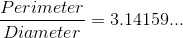
That was a bit bulky though, so why not just use the corresponding Greek letters for the first letters of Perimeter and Diameter giving,

Much better, but mathematicians and scientists are lazy (Look at Einstein notation if you have any doubts), so better to just drop the delta under the "you know what I'm trying to say so it's ok" statute of mathematics

Very convenient, right? And so forever the irrational circle number/constant thing was known as "Pea".
Wait, what?
Oh yeah, the English pronounce Pi as "pie," not "pea," so although the symbol remains the same, the name actually changed along the way to the "pie" we know today, and it's a good thing too, because otherwise how else could we justify having delicious fruit pies on Pie Day?
Why Must There Be Only One Pi Day Per Year?
I know what you're thinking reader. You're thinking "I wish there was more than just one Pi day per year!" Ok, let's just pretend that was what you're thinking rather than "How long is this blog post?" The answer (to the first question) is that with a little effort we can have a few more Pi days! After all, this is math, if we can't take an immutable constant and change its value, what's the point?
The trick we'll use to change the constant Pi is to go to a different numeral system. Technically Pi hasn't changed, just the numeral system used to represent it. Everything is consistent, above board, and the like. Using that trick, here are some other values of Pi,
Binary (Base 2) -11.00100100001111...
Ternary (Base 3)-10.01021101222201...
Quatenary (Base 4) - 3.02100333122220...
Septenary (Base 5) - 3.03232214303343...
Senary (Base 6) - 3.05033005141512...
Septenary (Base 7) - 3.06636514320361...
Octal (Base 8) - 3.11037552421026...
Nonary (Base 9) -3.12418812407442...
Decimal (Base 10) - 3.14159265358979...
Undecimal (Base 11) - 3.16150702865A48...
Duodecimal (Base 12) - 3.184809493B9186...
Tridecimal (Base 13) - 3.1AC1049052A2C7...
Tetradecimal (Base 14) - 3.1DA75CDA813752...
Pentadecimal (Base 15) - 3.21CD1DC46C2B7A...
Hexadecimal (Base 16) -3.243F6A8885A300...
So there you have it, sorry if you missed 3/2, 3/3, 3/5, 3/6, 3/11, and 3/12, but you still have today, 3/16, 3/18, 3/21, 3/24 and 10/1 ahead of you! I say, go to the store, by some pies, and celebrate! And whatever you do, avoid curved spaces!
Happy Pi Day From CR4!!!!!!!
| 




 Re: The Pi Day of the Century


"Almost" Good Answers: