|
When it comes to choosing a lithium-ion (Li-ion) battery pack for your portable application, whether for a smart watch or an e-bike, the task is not as daunting as it seems. A Li-ion battery pack has three basic functions: to protect, monitor and gauge. These functions are usually handled by individual devices; however, some devices can tap into multiple functions for a more integrated solution. A battery pack with the right components and these three functions will actually help your system perform better, offer more protection, and allow longer runtimes. In part 1 of this series, I'll take an in-depth look at battery protection. In conjunction to the information below make sure you take a look at the selection guide above to help in choosing the right devices based on the size of your batteries where 1S means = 1 series cell, 2S = 2 series cells, etc.
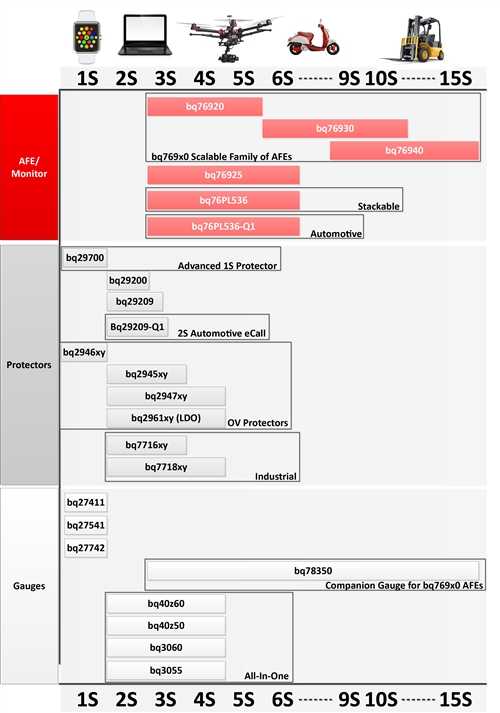
Figure 1: TI Battery pack selection guide based on function and series cell configuration (click to view larger)
Protection
Battery-pack devices contain a variety of features; however, protection is their primary function, which should be your primary focus when choosing devices. There are two different types of protection:
- Voltage protection consists of internal comparators constantly measuring individual cell voltages to compare against overvoltage (OV) and undervoltage (UV) thresholds. Voltage protection is considered first-level protection and a must-have for any Li-ion battery pack.
- Current protection works similarly to voltage protection except that a sense resistor calculates current passing through the battery pack, and compares the current value to current thresholds to detect either overcurrent or short-circuit conditions, depending on polarity. If the current of the battery exceeds the threshold, then either a charge (CHG) field-effect transistor (FET) or discharge (DSG) FET opens to disconnect the battery and prevent further damage.
Protection is not always limited to voltage and current; for example, some high-cell-count applications need open-wire detection (OCD). This type of protection confirms that the monitor is always connected to each cell. Devices such as the bq76925 battery monitor, equipped with OCD, are very popular for power-tool applications.
When choosing protection for your battery pack, consider:
- A stand-alone protector (which only provides hardware protection).
- A monitor with hardware protection features.
- A gauge with firmware protection features.
- A combination of all three.
Choosing the right components for your battery pack to give you the right protection features will depend on your application requirements.
For redundancy purposes, simple protectors such as OV protectors give last-resort protection. Applications with secondary protection include notebook PCs, e-bikes, e-scooters and power tools. In some single-cell devices like smart watches and phones, you don't need a monitor, since there is only one cell. In these single-cell applications, a gauge with a built-in firmware protection is a good option. If you prefer having hardware protection, then a simple gauge paired with a single-cell advanced protector such as the bq29700 is even better.
Between hardware and firmware protection, there are a few key things to keep in mind. Both protection types are effective, but you will have to make certain trade-offs when choosing. Firmware-based protection is usually found in gauges or MCUs, and hardware protection is usually found in stand-alone protectors or monitors but a few gauges can also have this. The key difference between the two is that hardware protection actually uses internal circuitry (such as comparators) to compare with internal registers or, Electrically Erasable Programmable Read-Only Memory (EEPROM) memory that holds the threshold values to see if a fault has occurred. Firmware-based protection uses the gauge's internal algorithm to compare what the cells are measuring to the threshold written in the code. Sometimes having both types of protection allows for redundancy as well.
A Li-ion battery pack needs protection to ensure that applications can run for longer periods while maintaining battery safety. A good protection solution can benefit your system greatly by preventing the battery from degrading or worse, exploding. In part 2 of this series, I'll discuss the more in depth about monitors and gauges, and their role in the battery pack.
Additional resources
Editor's note: This is a sponsored blog post brought to you by Texas Instruments.
| 


 Re: Get to Know Your Battery Pack


