|
 Rubber part tolerances are allowable size variations for industrial rubber products. Known also as dimensional tolerances, these numbers are given as plus or minus (±) values for a range of part sizes. Engineers routinely put dimensions on drawings, but did you know that rubber part tolerances and metal part tolerances aren’t the same? If you design a rubber part with the same engineering tolerances as a metal one, you may have to revise your seal design. Rubber part tolerances are allowable size variations for industrial rubber products. Known also as dimensional tolerances, these numbers are given as plus or minus (±) values for a range of part sizes. Engineers routinely put dimensions on drawings, but did you know that rubber part tolerances and metal part tolerances aren’t the same? If you design a rubber part with the same engineering tolerances as a metal one, you may have to revise your seal design.
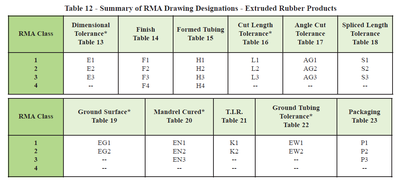
The RMA Handbook, a publication from a leading trade group, can help you to avoid this situation. This technical publication defines part tolerances and arranges them into classes so that material suppliers, rubber fabricators, and product engineers all speak a “common language”. The RMA Handbook contains tables with the dimensions you can expect for each class of molded or extruded rubber products. There are also different tables for different processes, such as angled cuts vs. spliced lengths.
Still, many engineers still know less about rubber part tolerances than they do about metal ones. That can present a challenge when it’s time to design rubber seals, gaskets, or insulation. Metals have different material properties than rubber, and metal part tolerances are tighter or finer. There are several reasons for this. First, rubber is more sensitive than metal to changes in temperature and humidity. Rubber fabrication also uses different tooling and equipment than metalworking.
Are you used to working with sheet metal or metal profiles? Then you may find there’s a learning curve with rubber – a group of materials that includes synthetic thermosetting elastomers as well as natural rubber. You may also experience some confusion or frustration if you submit a drawing that requires revisions because of the tolerances that are listed. To ensure a smoother design process then, it helps to understand a few basics about what inside the RMA Handbook. Here’s what you need to know.
Learn More
| 


