Previous in Forum: Intricacies of Wiring of a Research Vessel   Next in Forum: CBCT Connection
Close
Close
Close
44 comments
Rate Comments: Nested
Active Contributor

Join Date: Mar 2015
Posts: 11

Battery Bank Sizing

03/20/2015 3:14 PM

Hi!, suppose you have the following system;

How can you determine the battery size if the load has to work for 12hrs?

Register to Reply
Interested in this topic? By joining CR4 you can "subscribe" to
this discussion and receive notification when new comments are added.

Good Answers:

These comments received enough positive votes to make them "good answers".

"Almost" Good Answers:

Check out these comments that don't yet have enough votes to be "official" good answers and, if you agree with them, vote them!
4
Guru

Join Date: Mar 2007
Location: by the beach in Florida
Posts: 33392
Good Answers: 1817
#1

Re: Battery bank sizing

03/20/2015 3:58 PM
__________________
All living things seek to control their own destiny....this is the purpose of life
Register to Reply Good Answer (Score 4)
Active Contributor

Join Date: Mar 2015
Posts: 11
#2
In reply to #1

Re: Battery bank sizing

03/20/2015 4:16 PM

I want to calculate the battery capacity in Amp- hour (Ah) at a system voltage of 12volts, then after having Ah, I select the battery from the available batteries in the market.

Register to Reply
2
Guru

Join Date: Mar 2007
Location: by the beach in Florida
Posts: 33392
Good Answers: 1817
#3
In reply to #2

Re: Battery bank sizing

03/20/2015 4:32 PM

That's why I posted links....to enable you to do that....

__________________
All living things seek to control their own destiny....this is the purpose of life
Register to Reply Good Answer (Score 2)
Guru
Hobbies - Target Shooting - New Member

Join Date: Jan 2011
Location: Indiana
Posts: 558
Good Answers: 14
#18
In reply to #1

Re: Battery bank sizing

03/21/2015 5:33 AM

Solar Eagle, also don't forget to take into consideration environmental temperatures as that has some effect on amp/watt hour ratings. As the temps go down the amount of energy to consume is diminished as well as when temps rise it also has a detrimental effect on amp /watt hrs. And on lead acid you never want to go below 50% state of charge. Most of the people I deal with will not allow a system to be designed that will allow a lead acid system to go below a 30% depth of discharge as the number of cycles will go up in the long run. Thus saving money in the future. It just means designing a system for longevity a little denser on stand by power, just more batteries or larger amp hour draw batteries. I currently run 24 285 amp hr Deka AGM for my solar system that is 6840 amp hrs. that will last me several days with no sunlight and not throttling back on power usage.

__________________
Four boxes keep America Free The soap box, The ballot box, The jury box, & The cartridge box.
Register to Reply
Guru
Hobbies - Target Shooting - New Member

Join Date: Jan 2011
Location: Indiana
Posts: 558
Good Answers: 14
#36
In reply to #18

Re: Battery bank sizing

03/23/2015 9:57 AM

There is something we all missed the O/P did not state battery formula. Unless I missed it somewhere along the line. He never stated Pb/Acid (Lion, Lithiun Polymer, or Lithium air?). Most of those chemistry's can go to 80% depth of discharge without damage to their cycle life or did we just assume that he was going to use lead acid and start this long conversation on a guess?Just saying

__________________
Four boxes keep America Free The soap box, The ballot box, The jury box, & The cartridge box.
Register to Reply
Guru

Join Date: Aug 2014
Location: Port Macquarie N.S.W. Australia
Posts: 1071
Good Answers: 225
#38
In reply to #36

Re: Battery bank sizing

03/23/2015 5:57 PM

Maybe you missed this comment in reply#10.

"By comparison (as the OP hasn't mentioned battery chemistry) a 120Ah LiFePo4 battery would provide the 8A continuous for 12hrs and still maintain 12v terminal".

Register to Reply
Guru
Hobbies - Target Shooting - New Member

Join Date: Jan 2011
Location: Indiana
Posts: 558
Good Answers: 14
#40
In reply to #38

Re: Battery bank sizing
03/24/2015 11:40 AM

Thank you I missed that part of your response I probably got in a hurry and just glossed over it. I have been studying the different chemistry's now for a while, for when I am going to replace my current battery bank. I was looking at lithium as a replacement, then I ran upon Trojens new RE (Renueable Energy)They currently have a 1075 Amp hour Battery In 4v or 6v that has a 20 year cycle life according to the current info That I have been able to find which puts it in the arena of lifespan and cost of lithium. Do you have an opinion on the subject.

__________________
Four boxes keep America Free The soap box, The ballot box, The jury box, & The cartridge box.
Register to Reply
Guru

Join Date: Aug 2014
Location: Port Macquarie N.S.W. Australia
Posts: 1071
Good Answers: 225
#41
In reply to #40

Re: Battery bank sizing
03/24/2015 6:00 PM

The Trojan RE range are just flooded Lead acid deep cycle batteries, nothing special about them, and many manufacturers have similar ranges.

They will produce that life span only if used as standby batteries.

If you look at their data sheets, you will see that they typically list a cycle life graph which will show somewhere around 2500 to 3000 cycles @ C20 50% discharge. If you cycle once every day, then the life span is closer to just 8 years.

Normally, where 12v output is required, the reasons for selecting multiple smaller voltage batteries is due to weight (handling ability), footprint (space it occupies on the floor of the battery room), Ah requirements, cycle life and price.

Looking at 2 options from their range, the IND23-4V and the J185h-AC you can compare pros and cons.

1. IND23-4V A 4 volt battery, 1270Ah @ C20, AU$1600 ea. So three in series will give you 12v 1270Ah @C20 for a footprint of 0.45m² and weight of 504kg. Cycle life @C20 50% discharge is 2700 cycles, total cost $4800, Cost per cycle = $1.78.

2. J185h-AC A 12v battery, 225Ah @ C20, AU$310 ea. So 6 in parallel will give you 12v 1350Ah @C20 for a footprint of 0.4m² and weight of 348kg. Cycle life @C20 50% discharge is 1000 cycles, total cost $1860, Cost per cycle = $1.86.

They are the trade offs to consider.

By comparison, a typical AU$650 100Ah LiFePo4 12v battery will provide around 2000 cycles to 100% discharge (they don't give C20 50% rates, but is normally expected to be +70% or 3400 cycles) and will remain above 12v for most of its discharge, General rule of thumb is that for C20 use, half the Ah capacity of that for LA chemistry is required. So 3 in parallel will give you the equivalent Ah capacity for a smaller footprint and half the weight, Cycle life @C20 50% discharge is 3400 cycles, total cost = ((3 x $650) + 25% for auxiliary control equipment) = $2430, cost per cycle is $0.71

Hope this helps.

Register to Reply
Guru
Hobbies - Target Shooting - New Member

Join Date: Jan 2011
Location: Indiana
Posts: 558
Good Answers: 14
#42
In reply to #41

Re: Battery bank sizing

03/24/2015 8:01 PM

Do you have a favorite supplier of lithium that you would prefer if you were going to buy them like Snyopoly, Winston, Heter or some other brand that you know of that might work out as well. I have an importer that can transport from Asia with other products that a friend has made in Shangdong Provence.Thanks for any info you may have.Duke

__________________
Four boxes keep America Free The soap box, The ballot box, The jury box, & The cartridge box.
Register to Reply Off Topic (Score 5)
Guru

Join Date: Aug 2014
Location: Port Macquarie N.S.W. Australia
Posts: 1071
Good Answers: 225
#43
In reply to #42

Re: Battery bank sizing

03/24/2015 9:33 PM

Winston is probably the best known of them, at least here in Aus.

Register to Reply
Guru
Engineering Fields - Power Engineering - New Member

Join Date: May 2007
Location: NYC metropolitan area.
Posts: 3230
Good Answers: 444
#4

Re: Battery bank sizing

03/20/2015 4:40 PM

You also have to account for the battery chemistry, low voltage cutoff point, and how deep a discharge state your batteries can tolerate. Remember, during the discharge-only phase the battery voltage will always be dropping under load; discharge them too heavily or too fast and their life will be shortened considerably. Good luck on your assignment.

__________________
“Tell me and I forget. Teach me and I remember. Involve me and I learn.” Ben Franklin.
Register to Reply
Active Contributor

Join Date: Mar 2015
Posts: 11
#5
In reply to #4

Re: Battery bank sizing

03/20/2015 5:24 PM

Thanks Solar Eagle for the links you have sent. I have gone through them but the examples given already have Amps hours.

Can i use the formula used to size the battery in solar system for THIS SYSTEM? in connection to RAMConsult comment..

Register to Reply
Guru

Join Date: Oct 2008
Posts: 42355
Good Answers: 1693
#6

Re: Battery bank sizing

03/20/2015 5:31 PM

Given the dearth of information you provided, you should just buy the big one.

Register to Reply
Guru
Safety - Hazmat - New Member Engineering Fields - Retired Engineers / Mentors - New Member Engineering Fields - Piping Design Engineering - New Member Hobbies - DIY Welding - New Member Fans of Old Computers - PDP 11 - New Member

Join Date: Feb 2007
Location: Stronger Than The Storm
Posts: 2394
Good Answers: 203
#11
In reply to #6

Re: Battery bank sizing

03/20/2015 11:54 PM

lyn-

CONGRATULATIONS ON THE 1,2OOTH GA. Wasn't long ago that I congratulated you on the 1,000th. You're doing something right!

On behalf of many others and myself, please keep on going at it. You add a lot to this forum.

Good Luck, Old Salt

__________________
Any day on the green side of the grass is a GREAT DAY!, --- me +++++++++. I believe creativity is an inherent part of everyone. --- Kermit T. Frog
Register to Reply
Guru

Join Date: Oct 2008
Posts: 42355
Good Answers: 1693
#12
In reply to #11

Re: Battery bank sizing

03/21/2015 12:05 AM

Gee. Thanks.

When you shoot 30,000 arrows into the air, some of them are bound to hit something.

I enjoy this forum and the interchanges we regulars have.

I appreciate that IHS lets us play here.

Register to Reply
Guru

Join Date: Aug 2014
Location: Port Macquarie N.S.W. Australia
Posts: 1071
Good Answers: 225
#7

Re: Battery bank sizing

03/20/2015 5:46 PM

This site Smartgauge will tell you all you can ever want to know about batteries.

You will likely be about as old as the rest of us by the time you finish reading and understanding it all, but it's good stuff.

Tell your teacher about it too.

Register to Reply
Guru

Join Date: Mar 2011
Location: Sebastopol, California
Posts: 1205
Good Answers: 54
#20
In reply to #7

Re: Battery bank sizing

03/21/2015 11:07 AM

OOOH! I bookmarked it. Thanks for the link.

__________________
Most people are mostly good most of the time.
Register to Reply
Guru
Hobbies - Target Shooting - New Member

Join Date: Jan 2011
Location: Indiana
Posts: 558
Good Answers: 14
#21
In reply to #7

Re: Battery bank sizing

03/21/2015 12:04 PM

Thanks Spades a really good site I will bookmark as well for future reference.

__________________
Four boxes keep America Free The soap box, The ballot box, The jury box, & The cartridge box.
Register to Reply
Guru

Join Date: Nov 2007
Location: Eastern Arizona mountains on Route 666 about a mile from God's country
Posts: 1676
Good Answers: 122
#8

Re: Battery bank sizing

03/20/2015 6:58 PM

P=EI

I=P/E = 96/12=8 amp

Ampere-Hours = Amps x Hours = 8 Amps x 12 Hours = 96AH

Any/All power consumption questions can be solved using E=IR (Ohm's Law) or a simple deviation of the equation.

Research it on line and learn which equation to use to solve your questions.

Good luck!

__________________
They said; "Brain size?" I heard; "Train size?" so I said: "I'll take a small one, thank you."
Register to Reply
3
Guru

Join Date: Aug 2014
Location: Port Macquarie N.S.W. Australia
Posts: 1071
Good Answers: 225
#10
In reply to #8

Re: Battery bank sizing

03/20/2015 8:36 PM

It's not quite that simple with lead acid chemistry as the rate at which the energy is removed makes a difference to real capacity (blame Mr. Peukert for that), as does the fact that more energy needs to be replaced than was taken out to return to the same state of charge.

For instance - a new, fully charged 100Ah (@C20) battery with a Peukert's exponent of 1.3 and a constant drain of 8 amps will have a real capacity of just 86.8Ah. At 4 amps continuous discharge, the real capacity would be closer to 107Ah. These figures imply that capacity is fully expended when individual cell voltages fall to 1.75v or 10.5v for a 12v battery.

This means that to be able to draw 8 amps from a 12v battery for 12 hours and still maintain a terminal voltage of at least 12v at the 12hr point will require a 200Ah battery capacity.

A 100Ah L/A battery with a continuous discharge of 8 amps would fall below 12v SOC at around the 5hr mark.

By comparison (as the OP hasn't mentioned battery chemistry) a 120Ah LiFePo4 battery would provide the 8A continuous for 12hrs and still maintain 12v terminal.

Register to Reply Good Answer (Score 3)
Guru

Join Date: Apr 2007
Location: Buenos Aires, Argentina
Posts: 1679
Good Answers: 33
#34
In reply to #10

Re: Battery bank sizing

03/22/2015 11:09 PM

Oh, now I get it! This is the reason for which Lyn recommended to get the BIG ONE! ;-)

__________________
the more I move, the deeper I get stuck !
Register to Reply
Guru
Hobbies - DIY Welding - Don't Know What Made The Old Title Attractive... Popular Science - Weaponology - New Member United States - US - Statue of Liberty - 60 Year Member

Join Date: Apr 2009
Location: Yellowstone Valley, in Big Sky Country
Posts: 7425
Good Answers: 295
#37
In reply to #34

Re: Battery bank sizing

03/23/2015 5:52 PM

Well, that and the fact that LynDoor Industries sells the BEST big batteries on the market. Which market you may ask? Why, all of them. The LynDoor BAB* (patent pending... sort of) is without equal anywhere in the known universe.

BAB = Big Ass Battery
36,903 Amp hour @ 12VDC @ 105o F @ 377 metres above MSL (estimate)
12, 24, and 48 volt taps (close to 12, 24 and 48 anyway)
Approx size 11'-7" X 9'-3" X 4'-1"
Approx weight 7,791 Lbs (dry)
Some assembly required; Not sold where regulated by Thermodynamic law; Must be 21 years old to purchase; Functional operation in Southern Hemisphere and Northern Hemisphere has not yet been demonstrated - Actual installed performance may vary from specifications.

__________________
Semper Ubi Sub Ubi
Register to Reply
Guru

Join Date: Nov 2007
Location: Eastern Arizona mountains on Route 666 about a mile from God's country
Posts: 1676
Good Answers: 122
#39
In reply to #10

Re: Battery bank sizing

03/24/2015 10:41 AM

Good point!

I was just stating the minimum Ah requirement with the hope that the OP would catch on and use it in addition to/with all information posted in other replies. I did not take into consideration anything other than basic functional requirements.

Thanks for expounding on my reply and posting the good information.

__________________
They said; "Brain size?" I heard; "Train size?" so I said: "I'll take a small one, thank you."
Register to Reply
Guru

Join Date: Aug 2014
Location: Port Macquarie N.S.W. Australia
Posts: 1071
Good Answers: 225
#9

Re: Battery bank sizing

03/20/2015 7:37 PM

For that setup, provided the power supply/charge controller/charger, or whatever else you wish to call that converter-charge controller combination is of sufficient output to manage the 96w load, and that the AC supply is constant for the duration, then any size battery bank will suffice as the load demand will be adequately handled by the charger without any input from the battery.

If the charger is not of sufficient capacity, or is not continuous, then the batteries will be required to contribute the difference, and what that will be will depend on the actual charger specs. and on time.

Register to Reply
Guru
Safety - Hazmat - New Member Engineering Fields - Retired Engineers / Mentors - New Member Engineering Fields - Piping Design Engineering - New Member Hobbies - DIY Welding - New Member Fans of Old Computers - PDP 11 - New Member

Join Date: Feb 2007
Location: Stronger Than The Storm
Posts: 2394
Good Answers: 203
#13

Re: Battery bank sizing

03/21/2015 12:07 AM

Just as important as size is the type of battery. Although they are presently very expensive in the size you would need, look into some of the more efficient chemistry ones.

If you are planning on using this for more than a couple of times, strongly suggest you utilize deep cycle lead-acid batteries such as used on small boat electric trolling motors, battery operated lawn mowers, etc. These will handle deep discharges of the battery without shortening the available life of the battery as much as standard batteries such as used in vehicles for starting. They should be sized according to your needs and usage.

If necessary, consider using several deep cycle ones in parallel if the total charge exceeds the available battery sizes or if there is a poor configuration of the area to locate them in..

Good Luck, Old Salt

__________________
Any day on the green side of the grass is a GREAT DAY!, --- me +++++++++. I believe creativity is an inherent part of everyone. --- Kermit T. Frog
Register to Reply
Guru

Join Date: Jul 2007
Location: Commissariat de Police, Nouvions, occupied France, 1942.
Posts: 2599
Good Answers: 77
#14

Re: Battery bank sizing

03/21/2015 3:59 AM

A battery bank holding something over 96*12 Watt-hours would do it. 96*12 Watt-hours divided by 12 Volts would be 96 Amp-hours, or two large car batteries. You're there for a little over £100.

__________________
Good moaning!
Register to Reply Score 1 for Off Topic
Commentator

Join Date: Nov 2008
Location: Bohol Island, Philippines
Posts: 65
#15

Re: Battery bank sizing

03/21/2015 5:00 AM

Because you are discharging the battery bank at a constant 8AH over a period of 12 12hrs I would initially try using 2 x 100AH Deep Cycle bank. But its boarderline.... If those batteries are discharged down to 12v or less everyday they will not last more than 2 or 3 yrs max. Over the first month I would be monitoring the battery state at the end of every 12 hour discharge (Once the load is off). If the readings are 12.1v or above then ok. If the readings are less than 12.1v then I would add an extra (identical) 100AH deep cycle battery.

Your system needs to replace the 100 amps in a period of 12 hours. Choose your charge controller carefully.

__________________
Green to Brown & Blue to Bits
Register to Reply Score 1 for Good Answer
Active Contributor

Join Date: Mar 2015
Posts: 11
#17
In reply to #15

Re: Battery bank sizing

03/21/2015 5:27 AM

How do you know that i have to use 2x 100Ah?

Register to Reply
Guru

Join Date: Aug 2014
Location: Port Macquarie N.S.W. Australia
Posts: 1071
Good Answers: 225
#19
In reply to #17

Re: Battery bank sizing

03/21/2015 8:42 AM

A lead acid cell is considered to be fully charged at 2.1 volts and, contrary to intuition, it is not considered discharged at 0v, but at 1.75v.

This means that a 12v battery will consist of 6 series connected cells. The unique number and size of parallel connected plates in each of those cells determines the amphour rating of a deep cycle battery - which has a lesser number of heavier plates to enable low levels of discharge for longer periods of time, or the cranking ability of a starting battery which has a greater number of thinner plates to enable rapid release of power).

A fully charged 12v battery will have a rested terminal voltage of 12.7 volts and a rested discharged voltage of 10.5 volts. "Rested" implies no charge or discharge for at least 4 hours.

The amphour (Ah) rating of a 12v deep cycle lead acid battery is the amount of amps that it can supply for a given amount of time until it has discharged from 12.7v down to 10.5v.

The Ah rating for every battery is stated as being at a definite time frame. The most common is the C20 or 0.05C rate which simply states that a 100Ah C20 battery can supply 5 amps for 20 hours, it does not mean that it can supply 20 amps for 5 hours or 100 amps for 1 hr.

Because the chemical reaction in a lead acid cell is far from ideal the actual figures for that battery will be closer to 5 amps for 20 hrs, 20 amps for 3.5hrs, and 100 amps for just 25 minutes. As you can see, the smaller the current drain the larger the Ah capacity of the battery. This is due to the maximum speed with which the chemical reactions can take place in the cells and energy losses in the form of heat at higher discharge rates.

That same 100Ah battery would supply 8 amps for just 9 hours, but by that time the rested terminal voltage will be down to 10.5v and even lower under load. It will have passed through the 12v level at about the 5 hr mark and will be pretty useless for running any 12v load.

Reducing the current draw to just 4 amps from that battery will give you 27 hrs of operation down to 10.5v and it will pass through 12v at about the 13 hour mark, so 2 x 100Ah batteries in parallel will get you the 8 amps for 12 hrs with just a little reserve, but don't expect the batteries to last very long with that treatment.

I repeat my earlier observation (reply#9) that your diagram shows a connected mains charger, so if that is continuously energised, then the battery could be considerably smaller dependent on the charger capacity.

Register to Reply
Active Contributor

Join Date: Mar 2015
Posts: 11
#22
In reply to #19

Re: Battery bank sizing

03/21/2015 1:04 PM

Thanks Spades;

What if I use the following formula Suggested by Mr. Juma (reply #17) to calculate the amps-hours of the battery for this system?

Note; the battery for this system have to used only when no mains...

Register to Reply
Guru

Join Date: Aug 2014
Location: Port Macquarie N.S.W. Australia
Posts: 1071
Good Answers: 225
#23
In reply to #22

Re: Battery bank sizing

03/21/2015 6:05 PM

I don't see that formula as being of any benefit at all.

First problem is with the battery loss bit. How is that to be entered in the formula? What unit denotes it, is it watts, Ah, BTUs etc.? If you can decide that, how is it to be determined? No manufacturer provides that information in a form that could be used in that formula. For instance, they may tell you that the battery will lose 40% of its capacity if left idle for 12 months, but the battery is not idle, so how do you use that?

Even if we use their shelf life figures the formula has problems. Typical shelf loss for a battery will be 40% over 12 months, so 40%=40Ah/365 = 0.11Ah per day

Let's try it and see:-

Battery cap (Ah) =(Wh/day x days)/(dischargeV x losses x systemV)

Assume you are only going to use it for 12 hours for 1 day.

Wh/day = 96w x12hrs = 1152

Discharge voltage = 10.5v

System Voltage = 12v

Losses = 0.11

So battery cap(Ah) = (1152 x 1)/(10.5 x 0.11 x 12) = 83.12Ah

Now we already know that 96w @ 12v = 8amps, and 8amps x 12hrs = 96Ah

So that formula, apart from providing the wrong answer, also fails to take into account the fact that the battery voltage will fall below the required system voltage long before it is flat.

Below is a typical discharge graph. The 0.05C curve is equal to 5 amp draw from a 100Ah battery, the 0.1C is equal to a 10 amp draw from a 100Ah battery. Your 8 amps fall between the two.

Note the times at which both curves fall below 12v and you will see why you need a larger battery.

Register to Reply
Active Contributor

Join Date: Mar 2015
Posts: 11
#25
In reply to #23

Re: Battery bank sizing

03/22/2015 2:44 AM

Thanks Spades for your explanation about the formula suggested by Mr.Juma.

Can you please tell me the BEST FORMULA to be used in calculating the amp-hour of the battery..

Register to Reply
Guru

Join Date: Aug 2014
Location: Port Macquarie N.S.W. Australia
Posts: 1071
Good Answers: 225
#26
In reply to #25

Re: Battery bank sizing

03/22/2015 4:32 AM

You don't need a formula.

Simply find the current requirements in amps for each item of equipment and the time for which it will operate in hours between recharges and multiply the two figures together.

Add all of the item requirements together to get the total Ah requirements of the system.

Then consult a discharge chart similar to the one that I have posted to find a suitable battery.

Reading the chart is easy if you understand the basic concept.

For that earlier chart, every one of their batteries, no matter their capacity is represented there.

Look at the 1C curve, that 1C is telling you what you can expect from the battery if you discharge it at its Ah capacity, for example if it is a 100 Ah battery then 1C will show you how it will respond to a 100 amp continuous discharge.

If it is a 50 Ah battery, then 1C is showing how that will respond to a 50 amp discharge and so on. Both batteries will display the same discharge characteristics albeit at different current draws.

By extension of those rules, 0.5C means that the discharge rate is at 50% of the Ah rating of the battery, 0.05C is a discharge at 5%. Looking at those figures you will see that if you multiply 0.5 or 0.05 by 100 you will get 50% and 5% respectively.

Some manufacturers will use a slightly different display method called the hour rate, for example, the battery might be listed as 100Ah @ C20 rate (note the C is now before the number), this tells you the number of hours (20) for which you can draw a certain level of continuous current from the battery until it is flat (10.5v for a 12v battery). So if you divide the 100Ah by the 20 hrs you will get 5 amps (5%).

You should now see that the C20 rate is identical to the 0.05C rate, C10 would be 10 amps for 10 hours and is equivalent to 0.1C etc.

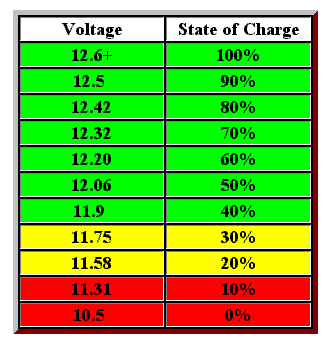
Looking at the chart you take note of where the curve crosses the 12v line and that should be the absolute minimum voltage that you draw the battery down to with any chance of longevity, 12.1v is considered 50% discharged, there are plenty of charts available to give you this information, the chart below is one.

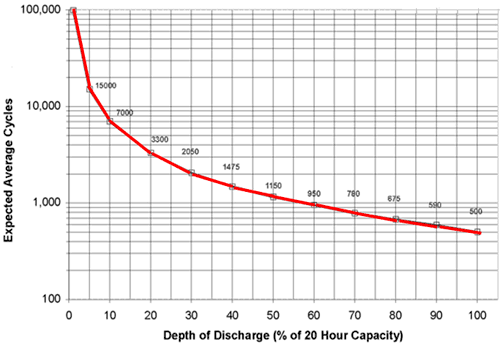
It is important to consider the degree of discharge to which you regularly subject the battery as it has a large effect on battery life.

Cycle life is the number of full charge/discharge cycles that the battery can sustain until its Ah capacity has diminished to 80% of original specs, the below chart displays the effect of continuous deep discharges on the battery's life span.

If you now correlate all of that information you should come to a conclusion that you will need at least 200Ah capacity to maintain 12v over the 12 hr period @ 8 amps, the battery will finish just below 50% SOC at the end, which is OK as that is the most economical region to use your battery - Google "50% rule for batteries" for more on that subject.

Hope this helps.

Register to Reply
Active Contributor

Join Date: Mar 2015
Posts: 11
#44
In reply to #26

Re: Battery bank sizing

03/28/2015 3:23 AM

Thank you so much SPADES

Register to Reply
Guru
Safety - Hazmat - New Member Engineering Fields - Retired Engineers / Mentors - New Member Engineering Fields - Piping Design Engineering - New Member Hobbies - DIY Welding - New Member Fans of Old Computers - PDP 11 - New Member

Join Date: Feb 2007
Location: Stronger Than The Storm
Posts: 2394
Good Answers: 203
#28
In reply to #25

Re: Battery bank sizing

03/22/2015 11:27 AM

Consider using a "dc switching voltage boost power supply" between the batteries and the load. These increase the voltage applied to it and the output voltage to the load. They with a dc supply and a dc output. They are very inexpensive and millions are in use in all types of devices. They are especially popular in vehicles with extremely powerful (and loud) audio amplifiers to use a 12v supply and apply greater voltage to the amp to reduce the necessary current draw.

With this, if the battery voltage decreases below the voltage necessary for the load, the dc switching booster will increase the lower battery voltage to the required 12 volts or greater. As the batteries go through their gradual decline in output voltage as they are discharged, the voltage to the load remains the same.

An example would be: fully charged battery, 13.2 volts from battery, 12.0 volts out; 10.0 volts from partially discharged battery, 12 volts to load. This could be changed to a supply voltage either above or below the required load voltage if a different switching boost power supply were used.

Another way would be to use a battery with a higher voltage, 24-48 volts or so, and reduce the voltage to 12 volts with either a voltage regulator (possibly a LM317 and a few 2N3055's) or a buck switching power supply (reduce voltage).

Good Luck, Old Salt

__________________
Any day on the green side of the grass is a GREAT DAY!, --- me +++++++++. I believe creativity is an inherent part of everyone. --- Kermit T. Frog
Register to Reply
Guru

Join Date: Aug 2014
Location: Port Macquarie N.S.W. Australia
Posts: 1071
Good Answers: 225
#29
In reply to #28

Re: Battery bank sizing

03/22/2015 5:29 PM

Shades of perpetual motion

Unless we can reinvent Ohms law, a voltage booster will increase the current draw from the battery in order to maintain output voltage, and kill it even faster.

Whilst a higher voltage battery/2 or more 12v batteries in series will reduce the amps draw from them, the Wh capacity will still be the same - 2 x 12v 100Ah in series = 24v 100Ah = 2400Wh, 2 x 100Ah in parallel = 12v 200Ah = 2400Wh.

Then you need to reduce that voltage to the correct value for the device. So what's the gain? You still have to provide the same battery capacity whatever battery voltage you decide on, and then factor in the losses in the regulator, and then you need a higher voltage charger.

Register to Reply
Guru
Safety - Hazmat - New Member Engineering Fields - Retired Engineers / Mentors - New Member Engineering Fields - Piping Design Engineering - New Member Hobbies - DIY Welding - New Member Fans of Old Computers - PDP 11 - New Member

Join Date: Feb 2007
Location: Stronger Than The Storm
Posts: 2394
Good Answers: 203
#31
In reply to #29

Re: Battery bank sizing

03/22/2015 8:41 PM

Don't want to reinvent Ohms law. Georg Ohm did a good enough job 160 years ago. Unless some one changed it on me, I think it is still I=E/R. Yes? No? Maybe?

My suggestion for using the boost switching power supply was not to lower the necessary battery capacity but to a maintain a constant voltage so the load receives a sufficient voltage & current as the voltage of the battery(s) lowers since, as others have noted, As the Pb-acid battery discharges, the voltage reduces a few volts and although it has some power left it is not useable. It would also probably (guess-tament) reduce the number of batteries slightly since the useable range of voltage from them would be wider. What good is 6 volts out of a 12 volt battery if the load needs at least 9 volts or greater? For example, a boost switching (power supply) charger running with a 90% efficiency would put out an almost constant 12 volts from a 24v battery. If the input is 26.4v, 12v out. 13.2 volts in, 12 volts out. 6.6 volts in, 12 volts out. 3.3 volts in, 12 volts out. Not magic, not voo-doo, just application of currently available equipment.

Also the OP did not specify that he wanted to use the least power, just the battery size--> "How can you determine the battery size if the load has to work for 12hrs?"

Batteries with a switching power supply will be more efficient since the range of usable voltage from them is wider. A linear supply would be much less efficient due to its inherent lower operating efficiencies.

Good Luck, Old Salt

__________________
Any day on the green side of the grass is a GREAT DAY!, --- me +++++++++. I believe creativity is an inherent part of everyone. --- Kermit T. Frog
Register to Reply
Guru

Join Date: Aug 2014
Location: Port Macquarie N.S.W. Australia
Posts: 1071
Good Answers: 225
#32
In reply to #31

Re: Battery bank sizing

03/22/2015 10:30 PM

I agree that it's not magic, although it would be if it were sustainable. While you could employ this method to obtain a bit more from a battery that is just a little under capacity, it won't work for a large discrepancy.

This is a common misconception of lead acid battery chemistry which differs greatly from a common power supply where you can boost voltages quite readily by simply drawing more power from the mains.

This is not the case with a lead acid battery. As the battery voltage falls, the booster will demand ever more current from it to maintain its output voltage and current.

This extra current will further depress the battery's terminal voltage due to both the continuing decline in the chemistry's ability to maintain its activity and the increasing voltage drop across the internal resistance of the battery. The internal resistance will also be rising as the electrolyte gets weaker and the plates become coated with an increasing layer of lead sulphate.

As the battery voltage falls and current draw increases due (in this scenario) to the demand of the booster, the increased chemical action, which can only take place at the plate surfaces, causes the electrolyte in contact to become almost pure water, internal resistance soars, and voltage drop across it rapidly increases. The booster demands more current, the surface charge on the plates is further depleted, and on it goes. The battery will just not be able to sustain this activity and will fail. At rest IR will almost double between 12v and 10.5v and be even worse under load.

I pointed out earlier (evidenced by a graph) that with an 8 amp draw, a 100Ah battery's terminal voltage would fall below 12v at a point less than half way through the 12 hr. required time period. Increasing the current draw will further reduce that time, and you will never sustain 8 amps at 12v from that battery for 12 hrs. no matter what boost methods you employ.

Increasing Ah capacity is the only way to ensure the amps and volts required, along with a reasonable life span from the battery.

Register to Reply
Guru
Safety - Hazmat - New Member Engineering Fields - Retired Engineers / Mentors - New Member Engineering Fields - Piping Design Engineering - New Member Hobbies - DIY Welding - New Member Fans of Old Computers - PDP 11 - New Member

Join Date: Feb 2007
Location: Stronger Than The Storm
Posts: 2394
Good Answers: 203
#35
In reply to #32

Re: Battery bank sizing

03/22/2015 11:17 PM

Not that I disagree with you, I don't. I too am familiar with the "guts" operation of pb-acids but happily don't have to do it as part of the reason why I had a salary. Now it is only for the fun uses of it. I believe the difference between your conception and mine is I am basing my comments on apparently higher voltage and higher capacity batteries. I have always preferred to "be prepared" than having to use the PANIC BUTTON.

I have seen the system I suggested in operation and I and several others were impressed with its operation and the operation of the equipment it provided power to. It was used in a larger sailboat where the owner didn't want to have an auxiliary diesel generator operating when he wanted to use certain electronics for extended periods of time. It worked. We were impressed with his "home built" equipment, that looked better than many professional ones, and he was kind enough to provide a deep explanation and demonstration of the system.

The volume and weight of the batteries was not a problem since they were substituted for ballast near the keel. With that said, your system works with the right equipment, his worked with the right equipment. I'm going to bow out now, its going to seem too much like the old work if we keep this up. Thank you for the interesting and courteous discussion.

Good Luck, Old Salt

__________________
Any day on the green side of the grass is a GREAT DAY!, --- me +++++++++. I believe creativity is an inherent part of everyone. --- Kermit T. Frog
Register to Reply
Member

Join Date: Feb 2015
Posts: 7
#16

Re: Battery bank sizing

03/21/2015 5:26 AM

Try to use this formula Battery capacity (Ah) = (total watt - hrs per day x days of storage) / (dead of discharge x battery loss x system voltage) Good luck....

Register to Reply Score 1 for Off Topic
Guru
Engineering Fields - Mechanical Engineering - New Member

Join Date: May 2008
Location: CHENNAI, TAMIL NADU, INDIA.
Posts: 1851
Good Answers: 65
#24

Re: Battery Bank Sizing

03/22/2015 2:28 AM

Dear Mr. Kyoma,

You have not indicated the voltage of the Battery. Is it 12 V or 24 V or 48 V.?

You have referred 96 W, hence the current will be 96/12 = 8 Amps., or 96/24 = 4 Amps., or 96/48 = 2 Amps. This ampereage will have effect on the size of the Battery.

You know that the Battery Capacity is referred in terms of AH i.e., AMPERE HOURS. You have specified the duration 12 Hrs . Hence Power drawn in 12 Hrs will be 96 x 12 = 1152 Watt Hours. This Watage devided by Hours will be Amperes i.e. 1152/12 = 96 Amperes. add 50% and hence you have to have a Battery of 144 AH say 150 AH battery will be sufficient.

DHAYANANDHAN.S

Register to Reply
Guru

Join Date: Aug 2014
Location: Port Macquarie N.S.W. Australia
Posts: 1071
Good Answers: 225
#27
In reply to #24

Re: Battery Bank Sizing

03/22/2015 4:49 AM

That's not quite correct.

This part:- "This Watage devided by Hours will be Amperes i.e. 1152/12 = 96 Amperes."

Should read This wattage divided by volts will be amperes.

Your figures also don't take into account the falling terminal voltage of the battery which, if it were of just 150Ah capacity, would be below 12v at around 10 hours and close to 11.7v (30% SOC) at 12 hrs. That's pretty drastic deep discharge for cycle life concerns.

Register to Reply
Associate

Join Date: Mar 2015
Location: Iraq- hot Middle East
Posts: 30
#30

Re: Battery Bank Sizing

03/22/2015 5:43 PM

you have to have the knowledge about this term "battery capacity" which its unit A/h

batt. capac. is labled for many batteries of different types .

for example if you have a load draws a current 50A from battery with 50A/h "b.c " under a good conditions (full charged ,25C temp.) the load will be powered for one hour . so in your case the battery bank should be of the same type of batteries .why if this bank is of batteries are connected in parallel the bank capacity will be the sum of the batteries capacity and if they are connected in series the bank capacity is the same the one battery.

Register to Reply Score 1 for Off Topic
Guru

Join Date: Oct 2008
Posts: 42355
Good Answers: 1693
#33

Re: Battery Bank Sizing

03/22/2015 10:48 PM

After listening to the OP want, "to calculate the battery capacity in Amp- hour" and hearing the responses, OP says "Can i use the formula"?

Then, after hearing much back and forth from members, OP says, "What if I use the following formula?"

More back and forth, then"Can you please tell me the BEST FORMULA?".

After more back and forth, all miles over the OP's head, I direct OP's attention to my #6, with this addition, just buy the BIGGEST battery you can find and don't waste any more time.

Register to Reply Score 1 for Off Topic
Register to Reply 44 comments

Good Answers:

These comments received enough positive votes to make them "good answers".

"Almost" Good Answers:

Check out these comments that don't yet have enough votes to be "official" good answers and, if you agree with them, vote them!
Copy to Clipboard

Users who posted comments:

classic (1); Crabtree (1); Deefburger (1); dhayanandhan (1); Doorman (1); Juma Ganiyu (1); kebang (1); Kyoma (6); LOCKDUKE (5); lyn (3); old salt (5); r&ddoc (1); RAMConsult (1); SHOCKHISCAN (2); SolarEagle (2); spades (12)

Previous in Forum: Intricacies of Wiring of a Research Vessel   Next in Forum: CBCT Connection

Advertisement