Previous in Forum: Issue with Samsung S3 Phone   Next in Forum: Sound Traveling Faster Than C?
Close
Close
Close
14 comments
Rate Comments: Nested
Participant

Join Date: Apr 2015
Posts: 4

Waste Heat Conversion

04/28/2015 1:41 PM

I have read the previous posts on using fridge waste heat conversion. The conclusion was that it is not viable unless you have many fridges. I would like to pre heat water.

I have many fridges and would like to know which thin pipes would be the best ones to mount between the fridges and the refrigerant pipes?

I do not think a large tank etc is necessary?

I would not want to rest the pipes on the fridge pipes so the pipe has to be sturdy/ with a firm wall.

I live in a very hot place so any cooling done by the pipes would be welcome. The fridges have to be turned on the coldest setting in summer and even then the milk goes sour after 3 days.

In winter (which is about two month long) I would divert the water so that it does not go behind the fridges, because the fridges then heat up my kitchen nicely.

Register to Reply
Interested in this topic? By joining CR4 you can "subscribe" to
this discussion and receive notification when new comments are added.

Good Answers:

These comments received enough positive votes to make them "good answers".

"Almost" Good Answers:

Check out these comments that don't yet have enough votes to be "official" good answers and, if you agree with them, vote them!
Guru
Hobbies - DIY Welding - Wannabeabettawelda

Join Date: May 2007
Location: Annapolis, Maryland
Posts: 7940
Good Answers: 458
#1

Re: WASTE HEAT CONVERSION

04/28/2015 3:24 PM

A little more information about your fridges would be helpful. In some instances, refrigerant-to-air-to-water maybe the way to go because getting water in intimate contact with the refrigerant can be challenging because of packaging issues. If you have the ability to 'break into' your refrigerant loops, then a brazed plate heat exchanger is one way get excellent heat transfer from the refrigerant to the water.

http://www.globalspec.com/search/all?query=brazed+plate+heat+exchanger&newSearch=new

Tube and shell is another approach.

http://www.globalspec.com/search/all?query=tube+and+shell+heat+exchanger&newSearch=new

If the pre-heating of water will be for personal consumption then local codes may dictate a double-walled solution.

You can also look up desuperheater

http://standards.globalspec.com/standards/detail?docid=1599149&familyid=UKSGHAAAAAAAAAAA

https://www.google.com/?gws_rd=ssl#q=desuperheater

Good luck with your quest.

Register to Reply
Participant

Join Date: Apr 2015
Posts: 4
#9
In reply to #1

Re: WASTE HEAT CONVERSION

04/29/2015 6:18 PM

Thank you.

Register to Reply
Guru
Engineering Fields - Optical Engineering - Member Engineering Fields - Engineering Physics - Member Engineering Fields - Systems Engineering - Member

Join Date: Apr 2010
Location: Trantor
Posts: 5363
Good Answers: 647
#2

Re: Waste Heat Conversion

04/28/2015 4:08 PM

I had one of these systems

http://techcrunch.com/2011/06/12/air-conditioning-water-heater/

installed when I lived in Florida. It provided essentially 'free' hot water year-round by using the waste heat from my heat-pump HVAC system.

In northern cities a geothermal heat-pump would be needed for wintertime heating, but I imagine this type of waste heat system could still be used most of the year.

__________________
Whiskey, women -- and astrophysics. Because sometimes a problem can't be solved with just whiskey and women.
Register to Reply
2
Guru

Join Date: Mar 2007
Location: by the beach in Florida
Posts: 33392
Good Answers: 1817
#3

Re: Waste Heat Conversion

04/28/2015 4:32 PM

This doesn't sound like a good idea to me. I would use a fan to assist the condensers and clean them regularly with a brush and mild detergent and water. Better to preheat water with a solar water system. Some refrigerators have a pan that collects the condensate during defrost and run a stainless steel hot gas line off the compressor into the bottom of the pan to evaporate the water. That's the closest thing I've ever seen to what you're talking about....It also sounds like your refrigerator is not properly set up, it should cycle between ~34-38°F.

__________________
All living things seek to control their own destiny....this is the purpose of life
Register to Reply Good Answer (Score 2)
Guru

Join Date: Feb 2011
Posts: 1119
Good Answers: 11
#4

Re: Waste Heat Conversion

04/28/2015 8:15 PM

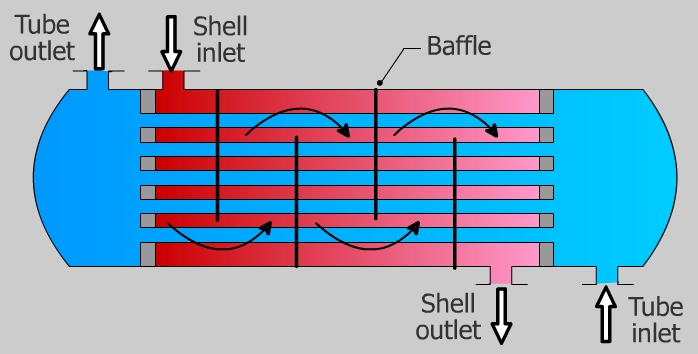
Try converting or modifying your condenser using the below(shell & tube), this will be a convenience, have someone to compute the right size specs for you --

__________________
" To infinity and beyond" - Buzz Lightyear
Register to Reply Score 1 for Good Answer
Participant

Join Date: Apr 2015
Posts: 4
#10
In reply to #4

Re: Waste Heat Conversion

04/29/2015 6:24 PM

Thx for the modification drawing. I think i am going for the solar conversion.

Register to Reply
2
Guru
Australia - Member - New Member

Join Date: Feb 2008
Location: Australia
Posts: 2181
Good Answers: 255
#5

Re: Waste Heat Conversion

04/28/2015 9:49 PM

CAUTION!!

Any attempt to remove the heat from the refrigerator unit might make it's performance even worse than you have noted.

To get your hot water, you will need to create an environment where the heat exchange can happen. This will impede the release of heat from the refrigerator pipes. Thus the return gas will be at higher temperature, leading to less cooling.

Does not look like a good idea to me.

Go solar as previously suggested.

__________________
Just an Engineer from the land down under.
Register to Reply Good Answer (Score 2)
Power-User
Hobbies - Musician - New Member

Join Date: Dec 2014
Posts: 418
Good Answers: 3
#8
In reply to #5

Re: Waste Heat Conversion

04/29/2015 10:52 AM

Epic fail. Review ideal carnot cycle, the reverse carnot cycle, you see cop will drastically improve minimizing the difference between hot and cold reservoir. Practical example. Take for instance your car air conditioning unit, when do you think is it operating smoothly? Night time or noon time?

__________________
"When I thought I exceeded to be wise but wisdom was far from me" -King Solomon
Register to Reply Score 1 for Good Answer
Guru

Join Date: Jun 2010
Posts: 1296
Good Answers: 104
#6

Re: Waste Heat Conversion

04/28/2015 10:02 PM

I agree with Solar Eagle that this is not a good idea. If you are indeed wanting to pre-heat water, presumably above ambient temperature, you will increase the condensing temperature (and pressure). This will a) increase the power consumed by the compressor, and b) decrease the cooling duty of the unit. Depending on your alternate source of energy used to heat water, the first result might be advantageous. But, since you stated that your capacity is already limited, the second result would worsen the problem.

On the other hand, if you have a good supply of cool (below ambient temperature) water which could be used to reduce the condensing temperature, then that would reduce your power consumption and increase the cooling duty. However, if your fridges are ordinary domestic refrigerators, I don't think this is very viable. Your best bet would be to, as others have mentioned, keep the condensers clean, the evaporators defrosted, air circulating around the units, gaskets sealed, and minimize the opening of refrigerator doors (frequency and duration).

Register to Reply
Participant

Join Date: Apr 2015
Posts: 4
#11
In reply to #6

Re: Waste Heat Conversion

04/29/2015 6:39 PM

They are all domestic fridges. You mentioned i should keep air ciculating around the units. Could i then use an extractor fan to remove all hot air ( and have that air go over the pipes / through the water, i want to pre heat ) and a polystyrene product to seal around and between all fridges so only the hot air goes out, not the (air conditioned) air in the room?

Register to Reply
Guru

Join Date: Jun 2010
Posts: 1296
Good Answers: 104
#12
In reply to #11

Re: Waste Heat Conversion

04/30/2015 12:06 AM

Based on your statement that your problem is worse in the summer, I was under the impression that your refrigerators were in un-conditioned space. If you exhaust the hot air, it has to be made up from somewhere. If you make up from outside, you will have a higher temperature than you have now. As Rixter has said, you would get better performance with air conditioning capable of maintaining the desired room temperature.

There is another system which has not been discussed - heat pump or hybrid water heaters. These use a vapor-compression cycle to pump heat from the room air into water in the heater tank. They have the side effect of cooling the room air. But they only heat the water to about 120 - 135 degF. And they are expensive. Without knowing what your alternative fuel (to electricity) is and the relative cost, and your hot water needs, it's impossible to select the optimum system.

Register to Reply
Guru

Join Date: Apr 2010
Location: About 4000 miles from the center of the earth (+/-100 mi)
Posts: 9913
Good Answers: 1141
#7

Re: Waste Heat Conversion

04/29/2015 8:54 AM

In addition to cleaning dust away from condenser coils and adding fans to circulate air, you might try adding air conditioning to the room where the fridges are located to lower the ambient air temperature.

I suspect that any attempt to capture the heat will be counterproductive. It would be difficult to make the condenser coils more efficient without a complete redesign.

Register to Reply
Guru

Join Date: Nov 2007
Location: Eastern Arizona mountains on Route 666 about a mile from God's country
Posts: 1676
Good Answers: 122
#13

Re: Waste Heat Conversion

04/30/2015 9:47 AM

The heat exchanger tubing should be copper so that electrolysis is minimized and heat exchange is maximized.

Using a heat exchanger on the high pressure side of the compressor to supplement heating water is possible however the amount of refrigerant is small and will severely limit the process efficiency.

Adding a heat exchanger on the return (low pressure) side to supplement cooling of the area will disrupt the operation of the compressor and may cause poor operation of the compressor and/or failure.

As far as running the temperature setting of the refrigerator at a lower setting when the ambient temperature is high during summer months:

If the refrigerator cannot maintain whatever setting is stamped on the dial then lowering the temperature setting will not make the machine reach a lower temperature.

In other words the temperature setting should be set and never tampered with summer or winter.

By lowering the temperature setting to an unattainable temperature the frost line will most likely travel back from the evaporator to the compressor which will cause worse compressor performance and will not lower the temperature.

Adding cooling on the high pressure discharge piping will somewhat improve the situation but it is not a long term solution.

As others have already stated;

The condenser(s) need to be kept clean and adding a forced air fan to cool the condenser(s) would be the most cost effective method of improving the cooling capacity.

Lowering the area (room) ambient temperature with HVAC will also improve the refrigerator performance.

There are "severe duty" refrigerators available in the marketplace but they are rather expensive. You must know the ambient temperature range in order to select a properly designed unit.

__________________
They said; "Brain size?" I heard; "Train size?" so I said: "I'll take a small one, thank you."
Register to Reply
Guru

Join Date: Apr 2011
Posts: 8006
Good Answers: 286
#14

Re: Waste Heat Conversion

05/02/2015 12:35 AM

How are the seals on the doors to the refrigerators? When the doors are closed can you feel cool air near the edge of the door?

.

As others have stated, clean the coils and fans. Make sure the path for airflow is as unobstructed as possible. Also look at the interior surfaces, make sure cooling surfaces are clean, are not blocked, and are not covered in ice.

.

How do the bodies of the refrigerators look? Is there any indication of damage to the shell or to the underlying insulation? Could the insulation have become soaked with water or other liquids?

.

How often are the refrigerator doors opened? How long do they stay open when they are opened? How full are the refrigerators? Are hot items regularly placed in the refrigerator before being allowed to cool? Is the building infested with one of more teenagers?

.

The answers to the above questions may help identify the reason for the poor refrigerator performance. If the problem can be corrected or mitigated, not only will you refrigerator work better, but less heat will be introduced into your kitchen.

__________________
Eternal vigilance is the price of knowledge. - George Santayana
Register to Reply
Register to Reply 14 comments

Good Answers:

These comments received enough positive votes to make them "good answers".

"Almost" Good Answers:

Check out these comments that don't yet have enough votes to be "official" good answers and, if you agree with them, vote them!
Copy to Clipboard

Users who posted comments:

bigg (2); Brave Sir Robin (1); Just an Engineer (1); Kulas (1); LE GREE (3); Noudge79 (1); Rixter (1); SHOCKHISCAN (1); SolarEagle (1); truth is not a compromise (1); Usbport (1)

Previous in Forum: Issue with Samsung S3 Phone   Next in Forum: Sound Traveling Faster Than C?

Advertisement