Previous in Forum: Apollo 11 Hoax   Next in Forum: Building a Scale Model of the Solar System
Close
Close
Close
7 comments
Rating: Comments: Nested
Guru

Join Date: Feb 2011
Posts: 7025
Good Answers: 207

See This Next Month

08/30/2015 10:17 AM
Reply
Interested in this topic? By joining CR4 you can "subscribe" to
this discussion and receive notification when new comments are added.

Good Answers:

These comments received enough positive votes to make them "good answers".

"Almost" Good Answers:

Check out these comments that don't yet have enough votes to be "official" good answers and, if you agree with them, vote them!
Guru
Popular Science - Evolution - New Member Popular Science - Weaponology - New Member

Join Date: May 2006
Location: The 'Space Coast', USA
Posts: 11119
Good Answers: 918
#1

Re: see this next month

08/30/2015 10:59 AM

The things about articles like these is they are so disorganized in their approach to where to view the eclipse.

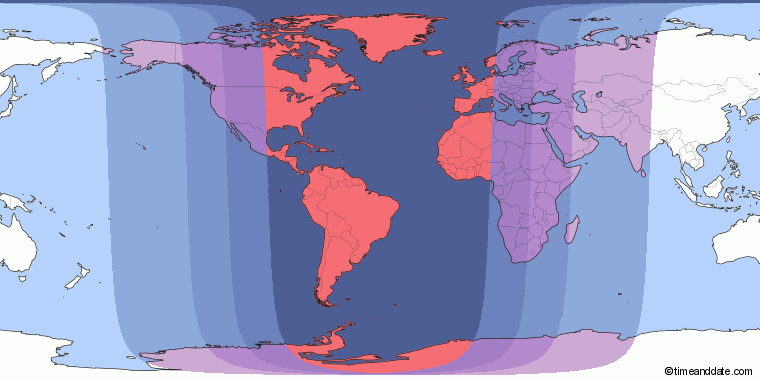
Rather than spending or wasting time trying to dig the information out of their chatter they could just as well present the information in a meaningful form like this:

Date: September 27, 2015. The center region is where 100% totality is visible and each gradient is about 25% less.

Brevity is the soul of wit here.

Specifics should be available at NASA websites.

Reply
Anonymous Poster #1
#4
In reply to #1

Re: see this next month

08/30/2015 11:27 AM

you could always just go to a forum where people type slowly so you could keep up

Reply
Guru
Popular Science - Evolution - New Member Popular Science - Weaponology - New Member

Join Date: May 2006
Location: The 'Space Coast', USA
Posts: 11119
Good Answers: 918
#6
In reply to #4

Re: see this next month

08/30/2015 1:45 PM

My beef was that a well written article should be well organized, succinct, and meaningful.

Reply
4
Guru
Engineering Fields - Optical Engineering - Member Engineering Fields - Engineering Physics - Member Engineering Fields - Systems Engineering - Member

Join Date: Apr 2010
Location: Trantor
Posts: 5363
Good Answers: 647
#2

Re: see this next month

08/30/2015 11:04 AM

Here's a tip for anyone wanting to photograph the lunar eclipse using a DSLR camera and a standard tripod -- use the '500 Rule'.

Due to the Earth's rotation, any long exposure of the moon and stars will cause the image to move across the camera's CMOS sensor during the exposure, resulting in a streaky image. A too-short exposure will yield an image too dark to see.

To find the maximum exposure time, in seconds, that will produce a useable image without streakiness, divide 500 by the focal length of the camera lens in millimeters. So for example, if your camera lens has a focal length of 50 mm, the maximum exposure can be 500/ 50 = 10 seconds long and still give you stars that look like points.

For capturing stars you'll want to try using the highest ISO setting your camera has, to get the brightest star images. If you get a lot of stars and the image is too grainy, you can then lower the ISO setting, using the '500 Rule' as a guide for the maximum exposure time. (Of course, you can use a shorter exposure time if you want to. The shorter the exposure, the sharper the image will be.)

For the lunar eclipse, the full moon will be very bright at the start, so you'll want to start with a short exposure time and a low ISO value. Perhaps start with an ISO setting of 100 and an exposure time of 1/50th of a sec. If the image is underexposed adjust your ISO higher; if overexposed, shorten the exposure time.

When the eclipse is at total phase, the moon may be very dark. This is when you'll want to use the '500 Rule' to set the maximum exposure time, and adjust your ISO as high as needed to get a bright enough image.

Finally - for anyone who wants to take longer exposures than the '500 Rule' allows, with spending a lot of money on expensive equipment, you can trying making a 'barn door tracker'. (Google that term.) For a few bucks and an hour or two of your spare time, your can make a simple device that will allow you to compensate for the Earth's rotation and take long exposures.

__________________
Whiskey, women -- and astrophysics. Because sometimes a problem can't be solved with just whiskey and women.
Reply Good Answer (Score 4)
Guru
Popular Science - Evolution - New Member Popular Science - Weaponology - New Member

Join Date: May 2006
Location: The 'Space Coast', USA
Posts: 11119
Good Answers: 918
#3
In reply to #2

Re: see this next month

08/30/2015 11:16 AM

Excellent!

Also, setting the aperture to its lowest number (wide open) will increase light capture ability and reduce your shutter time.

Reply
Guru
Engineering Fields - Optical Engineering - Member Engineering Fields - Engineering Physics - Member Engineering Fields - Systems Engineering - Member

Join Date: Apr 2010
Location: Trantor
Posts: 5363
Good Answers: 647
#5
In reply to #3

Re: see this next month

08/30/2015 11:32 AM

Thanks. Yes, I forgot to add two things:

1) Keep your f/stop between f/2.0 and f/4.0. (Some lenses lose edge sharpness 'all the way open'. It's better to go 1 or 2 stops less than full aperture.)

2) Don't trust the infinity ∞ setting on the lens. Most lenses will actually go slightly beyond the infinity setting, which would cause the stars to be out of focus. Go outside during the daytime and focus on an object a mile or two away, then mark the 'true' ∞ settings with a pencil. Use that mark when trying to image the moon or stars at night.

__________________
Whiskey, women -- and astrophysics. Because sometimes a problem can't be solved with just whiskey and women.
Reply Score 1 for Good Answer
Guru
Popular Science - Weaponology - New Member Safety - ESD - New Member Hobbies - Fishing - New Member

Join Date: Sep 2006
Location: Near Frankfurt am Main, Germany. 50.390866N, 8.884827E
Posts: 17996
Good Answers: 200
#7

Re: See This Next Month

08/31/2015 2:24 AM

Many thanks Guys especially USBPort, it all made good sense to me, so you did a good job of explaining it, seldom seen on CR4!!

__________________
"What others say about you reveals more about them, than it does you." Anon.
Reply
Reply to Forum Thread 7 comments

Good Answers:

These comments received enough positive votes to make them "good answers".

"Almost" Good Answers:

Check out these comments that don't yet have enough votes to be "official" good answers and, if you agree with them, vote them!
Copy to Clipboard

Users who posted comments:

Andy Germany (1); Anonymous Hero (3); Anonymous Poster (1); Usbport (2)

Previous in Forum: Apollo 11 Hoax   Next in Forum: Building a Scale Model of the Solar System

Advertisement