Previous in Forum: VTs & CCVTs Secondary Winding Resistance & Insulation Resistance Tests   Next in Forum: Grounding, Bonding & Parallel Paths
Close
Close
Close
27 comments
Rating: Comments: Nested
Active Contributor

Join Date: Mar 2012
Posts: 15

Induction Motor Question

01/29/2016 1:50 PM

RESPECTED SIR,

WHAT IS THE EFFECT OF OVERLOAD ON POWERFACTOR OF

THREE PHASE INDUCTION MOTOR.

Register to Reply
Interested in this topic? By joining CR4 you can "subscribe" to
this discussion and receive notification when new comments are added.

Good Answers:

These comments received enough positive votes to make them "good answers".

"Almost" Good Answers:

Check out these comments that don't yet have enough votes to be "official" good answers and, if you agree with them, vote them!
2
Guru
Technical Fields - Project Managers & Project Engineers - New Member

Join Date: Aug 2006
Location: Midwestern United States
Posts: 843
Good Answers: 76
#1

Re: INDUCTION MOTOR
01/29/2016 2:13 PM

Zero, because your induction motor should have adequate and functional overload protection.

__________________
Reuters - Investigators found that the recent thread derailment in CR4 was caused by over-weight creatures of lore and request that membership DON'T FEED THE TROLLS.
Register to Reply Good Answer (Score 2)
Guru
Technical Fields - Project Managers & Project Engineers - New Member

Join Date: Aug 2006
Location: Midwestern United States
Posts: 843
Good Answers: 76
#2

Re: INDUCTION MOTOR

01/29/2016 2:30 PM

But, if by overload, you're talking 'overvoltage' the power factor will decrease.

And, since we're on the topic, the power factor will increase for under-voltage.

__________________
Reuters - Investigators found that the recent thread derailment in CR4 was caused by over-weight creatures of lore and request that membership DON'T FEED THE TROLLS.
Register to Reply
Guru

Join Date: Mar 2007
Location: by the beach in Florida
Posts: 33392
Good Answers: 1817
#3

Re: INDUCTION MOTOR

01/29/2016 2:39 PM

Well an overloaded motor heats up, that should be your first clue...

__________________
All living things seek to control their own destiny....this is the purpose of life
Register to Reply
Guru
United Kingdom - Member - New Member

Join Date: Aug 2010
Location: Resting under the Major Oak
Posts: 4347
Good Answers: 181
#4

Re: INDUCTION MOTOR

01/29/2016 2:57 PM

Is the motor to be supplied from this?

http://cr4.globalspec.com/thread/76700

Hire a consultant and then resign.

__________________
The reports of my death are greatly exaggerated.
Register to Reply
Guru
Engineering Fields - Electrical Engineering - Been there, done that. Engineering Fields - Control Engineering - New Member

Join Date: Dec 2008
Location: Long Island NY
Posts: 15603
Good Answers: 982
#5

Re: INDUCTION MOTOR

01/29/2016 4:13 PM

Mechanical overload to the point of a stalled rotor. Electrical overload in the form of excessive voltage causing stator winding arcing. Thermal overloading to the point of burning insulation. Which these types of an overload are you talking about?

__________________
"Don't disturb my circles." translation of Archimedes last words
Register to Reply
Guru

Join Date: Apr 2010
Location: About 4000 miles from the center of the earth (+/-100 mi)
Posts: 9914
Good Answers: 1141
#6

Re: INDUCTION MOTOR

01/29/2016 5:03 PM

As mechanical load increases, slip increases, motor rpm decreases. The graph below shows the resulting power factor. http://what-when-how.com/induction-motor/steady-state-characteristics-induction-motor/

Register to Reply
Guru
Engineering Fields - Electrical Engineering - Been there, done that. Engineering Fields - Control Engineering - New Member

Join Date: Dec 2008
Location: Long Island NY
Posts: 15603
Good Answers: 982
#7
In reply to #6

Re: INDUCTION MOTOR

01/29/2016 10:34 PM

Your curve is true for only one of the many different rotor designs. (Looks like a NEMA A or B type) There are many different rotor designs.

__________________
"Don't disturb my circles." translation of Archimedes last words
Register to Reply
Power-User

Join Date: Jun 2010
Location: Canada
Posts: 139
Good Answers: 6
#8

Re: INDUCTION MOTOR

01/29/2016 10:36 PM

An induction motor runs at very low power factor when unloaded, . . . it power factor improves - increases - as the motor is loaded.

It will have the highest power factor at its rated load.

Register to Reply Score 1 for Good Answer
Guru

Join Date: Oct 2008
Posts: 42355
Good Answers: 1693
#9

Re: INDUCTION MOTOR

01/29/2016 11:31 PM
Register to Reply
Guru

Join Date: Oct 2012
Location: 100 miles North from the World Center
Posts: 879
Good Answers: 42
#10

Re: INDUCTION MOTOR

01/30/2016 12:29 AM

In my opinion, from 0.5 to 1.25 p.u. the power factor will rise a bit[1-2%]-the resistance grows up with temperature and the reactance will stay constant [if the voltage will be -approx.-constant].

__________________
Julius
Register to Reply
Guru

Join Date: Jan 2006
Location: Tamworth, UK.
Posts: 1782
Good Answers: 45
#11

Re: INDUCTION MOTOR

01/30/2016 7:53 AM

As a rule-of-thumb PF gradually improves as it speeds up to rated output then reduces when speed drops due to excess load (on the shaft) and then to zero effect when it trips out.

If it does not trip then it will heat up. I'm not sure what actually happens to the PF during the minutes it takes to burn out when it catches fire.

__________________
When arguing, remember mud-slinging = lost ground.
Register to Reply
Guru
Engineering Fields - Mechanical Engineering - New Member

Join Date: May 2008
Location: CHENNAI, TAMIL NADU, INDIA.
Posts: 1851
Good Answers: 65
#12

Re: INDUCTION MOTOR

01/30/2016 11:02 AM

Dear Mr.magdumshirish,

The three phase Induction Motor - the load current will follow the CIRCLE DIAGRAM.

The DC Motor, where the load current is a linear function of the load - it will foppow the pattern of y = m.x + c.

Induction Motor load current will follow the locii of a circle in which the Power Factor will be poor at no-load say 0.35 to 0.4 (approximately 35 t0 40 percent of full load current) and at short circuit current level (say 4.5 to 6 times of the full load current) the Power Factor will be still poorer.

The sort circuit current is calculated, by locking the rotor and inject low voltage so that the full load current is circulated in the winding, and the ratio of the rated voltage to this low voltage is to be multiplied by the full load current.

These two current value points lie on the circle, join these two points and draw a bisector and draw a circle. This circle is the locii for the load current.

Refer the link below and know more about Circle Diagram. You can also refer Standard Text Book.

http://kbreee.blogspot.in/2013/08/circle-diagram-of-induction-motor.html

Circle Diagram of Induction motor

By using the data obtained from the no load test and the blocked rotor test, the circle diagram can be drawn using the following steps :

Step 1 : Take reference phasor V as vertical (Y-axis).

Step 2 : Select suitable current scale such that diameter of circle is about 20 to 30 cm.

Step3 : From no load test, Io and are Φo obtained. Draw vector Io, lagging V by angle Φo. This is the line OO' as shown in the Fig. 1.

Step 4 : Draw horizontal line through extremity of Io i.e. O', parallel to horizontal axis.

Step 5 : Draw the current ISN calculated from Isc with the same scale, lagging V by angle Φsc, from the origin O. This is phasor OA as shown in the Fig. 1.

Step 6 : Join O'A is called output line.

Step 7 : Draw a perpendicular bisector of O'A. Extend it to meet line O'B at point C. This is the centre of the circle.

Step 8 : Draw the circle, with C as a center and radius equal to O'C. This meets the horizontal line drawn from O' at B as shown in the Fig. 1.

Step 9 : Draw the perpendicular from point A on the horizontal axis, to meet O'B line at F and meet horizontal axis at D.

Step 10 : Torque line.

The torque line separates stator and rotor copper losses.

Note that as voltage axis is vertical, all the vertical distances are proportional to active components of currents or power inputs, if measured at appropriate scale.

Thus the vertical distance AD represents power input at short circuit i.e. WSN, now which consists of core loss and stator, rotor copper losses.

Now FD = O'G = Fixed loss

Where O'G is drawn perpendicular from O' on horizontal axis. This represents power input on no load i.e. fixed loss.

Hence AF α Sum of stator and rotor copper losses

Then point E can be located as,

AE/EF = Rotor copper loss / Stator copper loss

The line O'E under this condition is called torque line.

Fig. Power scale : As AD represents WSN i.e. power input on short circuit at normal voltage, the power scale can be obtained as,

Power scale = WSN/l(AD) W/cm

where l(AD) = Distance AD in cm

Location of Point E : In a slip ring induction motor, the stator resistance per phase R1 and rotor resistance per phase R2 can be easily measured. Similarly by introducing ammeters in stator and rotor circuit, the currents I1 and I2 also can be measured.

K = I1/I2 = Transformation ratio

Now AF/EF = Rotor copper loss / Stator copper loss = (I22R2)/(I12R1) = (R2/R2)(I22/I12) = (R2/R2).(1/K2)

But R2'= R2/K2 = Rotor resistance referred to stator

AE/EF = R2'/R1

Thus point E can be obtained by dividing line AF in the ratio R2' to R1.

In a squirrel cage motor, the stator resistance can be measured by conducting resistance tset.

Stator copper loss = 3ISN2 R1 where ISN is phase value.

Neglecting core loss, WSN = Stator Cu loss + Rotor Cu loss

Rotor copper loss = WSN - 3ISN2 R1

AE/EF = (WSN - 3ISN2 R1)/(3ISN2 R1)

Dividing line AF in this ratio, the point E can be obtained and hence O'E represents torque line.

Note: I tried to put the diagram but not depicting. Pl. open the link above and you can find the diagram.

DHAYANANDHAN.S

Register to Reply Score 1 for Good Answer
Guru

Join Date: Jan 2006
Location: Tamworth, UK.
Posts: 1782
Good Answers: 45
#14
In reply to #12

Re: INDUCTION MOTOR

02/01/2016 8:49 AM

A great deal of information and good of you to take the trouble to present it.

But where does the OP find the applicable overload conditions - and the accompanying power factor.

__________________
When arguing, remember mud-slinging = lost ground.
Register to Reply
Guru
United Kingdom - Member - Indeterminate Engineering Fields - Control Engineering - New Member

Join Date: Jan 2007
Location: In the bothy, 7 chains down the line from Dodman's Lane level crossing, in the nation formerly known as Great Britain. Kettle's on.
Posts: 32175
Good Answers: 839
#15
In reply to #14

Re: INDUCTION MOTOR

02/01/2016 9:53 AM

<...applicable overload conditions...>

Overload is not applicable, because if the installation is correctly installed and the protection arrangements are correctly set up, overload simply will not happen.

If overload were applicable, then the original poster risks being unpopular with the facility's fire insurance company.

__________________
"Did you get my e-mail?" - "The biggest problem in communication is the illusion that it has taken place" - George Bernard Shaw, 1856
Register to Reply
Guru

Join Date: Jan 2006
Location: Tamworth, UK.
Posts: 1782
Good Answers: 45
#16
In reply to #15

Re: INDUCTION MOTOR

02/01/2016 11:51 AM

Yes....but during 'overload' what effect does it have on the power factor - is what the OP asked. Although the circle diagram provides lots of information - it is not at all clear where overload occurs and what the PF is.

Overload needs to be defined. In this context here, overload to me is the motor not being able to deliver the required mechanical shaft power and thus slows down under load.

To my mind, motor rating is a matter of opinion, backed up by appropriate facts, and boils down to safe dissipation of heat

I learn't this lesson many years ago and was chatting to an aero engineer when he showed me a small transformer. It was only about one inch cube and rated at 2 kw he said. I said I did not believe it because at that load it would surely burn out in a few minutes. He said it does. So I asked what use it was. He said it was used in an air-to-air missile - it didn't have to last long - it would be destroyed when it hit the target - keeping the weight down was most important.

Pure anecdote of course - no supporting facts - but I like the story.

__________________
When arguing, remember mud-slinging = lost ground.
Register to Reply
Guru
United Kingdom - Member - Indeterminate Engineering Fields - Control Engineering - New Member

Join Date: Jan 2007
Location: In the bothy, 7 chains down the line from Dodman's Lane level crossing, in the nation formerly known as Great Britain. Kettle's on.
Posts: 32175
Good Answers: 839
#27
In reply to #16

Re: INDUCTION MOTOR

09/25/2024 3:10 AM

<...during 'overload' what effect does it have on the power factor...>

It's like asking what is further north than the North Pole. The question is nonsense.

A correctly-set overload protection device will disconnect the <...overload...> from the supply, at which point the concept of <...power factor...> is irrelevant.

<unsubscribes>

__________________
"Did you get my e-mail?" - "The biggest problem in communication is the illusion that it has taken place" - George Bernard Shaw, 1856
Register to Reply
Guru
Engineering Fields - Electrical Engineering - Been there, done that. Engineering Fields - Control Engineering - New Member

Join Date: Dec 2008
Location: Long Island NY
Posts: 15603
Good Answers: 982
#19
In reply to #12

Re: INDUCTION MOTOR

02/02/2016 8:01 AM

I've now glanced at the blog location link you posted and have some apprehensions in this analysis technique. There are several entries that bother me :

  • Slip s = Rotor Cu loss = QR/PR
    • Slip is defined as a percentage difference between synchronous speed and running speed divided by synchronous speed. This page implies that slip is constant. It is not constant.
  • The torque is the rotor input in synchronous watts.
    • Wrong units. Also to get an induction motor to be perfectly synchronous ( 0% slip) an external torque must be applied.
  • Location of Point E : In a slip ring induction motor, the stator resistance per phase R1 and rotor resistance per phase R2 can be easily measured.
    • Induction motors do not have slip rings. The current in the rotor gets there by induction coupling (like a transformer). Synchronous motors have slip rings.

This might be a valid technique for some application but it does not explain that application well.

__________________
"Don't disturb my circles." translation of Archimedes last words
Register to Reply
Guru

Join Date: Oct 2012
Location: 100 miles North from the World Center
Posts: 879
Good Answers: 42
#20
In reply to #12

Re: INDUCTION MOTOR

02/02/2016 9:27 AM

The circle diagram is well known for many years-I learned it 50 years ago in the college. It is interesting of course. But are some limits.

The circle diagram is based on Steinmetz induction motor equivalent circuit. The motor parameters are considered constant. Actually, the rotor resistance and leakage reactance are variable as the slip changes-the rotor frequency changes.Even in the normal bar case-not considered dip-bars-the resistance presents skin effect and the reactance changes all the time.

In order to overcome this phenomenon some authors purpose two circle diagram as in the double-cage case. See- for instance:

http://machineryequipmentonline.com/electric-equipment/computations-and-circle-diagramsdouble-squirrel-cage-motor/

By the way it is difficult to see from this diagram how the power factor behaves in an overload case.

__________________
Julius
Register to Reply
Guru

Join Date: Jan 2006
Location: Tamworth, UK.
Posts: 1782
Good Answers: 45
#21
In reply to #20

Re: INDUCTION MOTOR

02/02/2016 10:30 AM

...back in those days I recall hours of study on the subject where magnetic flux distribution around the teeth of the slots in the rotor and stator and across the air gap was covered - boring, boring, boring - no doubt important at the time (to pass exams) but something never ever used by me since leaving school - until this OP popped up.

I have forgotten most of it, but I do remember the circle diagram was constructed using basic principles (Steinmetz you say - I've forgotten) - so you end up with results extracted from the arc that are no more accurate than your basic assumptions about Steinmetz.

Better than nothing I suppose. But as you say it is not clear how the power factor performs - where you have to make assumptions to work it out.

__________________
When arguing, remember mud-slinging = lost ground.
Register to Reply Score 1 for Good Answer
Guru
Engineering Fields - Electrical Engineering - Been there, done that. Engineering Fields - Control Engineering - New Member

Join Date: Dec 2008
Location: Long Island NY
Posts: 15603
Good Answers: 982
#22
In reply to #21

Re: INDUCTION MOTOR

02/02/2016 12:38 PM

As I thought the text from the earlier blog using the circle diagram is flawed. For those who wish to make a circle diagram the instructions and methodology to use for analysis can be found here. This graphical analysis technique is based on Steinmetz model but is attributed to A. Heyland and B. A. Behrend.

__________________
"Don't disturb my circles." translation of Archimedes last words
Register to Reply Score 1 for Good Answer
Guru

Join Date: Oct 2012
Location: 100 miles North from the World Center
Posts: 879
Good Answers: 42
#24
In reply to #22

Re: INDUCTION MOTOR

02/02/2016 4:32 PM

Thank you redfred!

__________________
Julius
Register to Reply
Guru

Join Date: Jan 2006
Location: Tamworth, UK.
Posts: 1782
Good Answers: 45
#25
In reply to #22

Re: INDUCTION MOTOR

02/02/2016 7:22 PM

Thanks Redfred

The link was a trip down Memory Lane .... brought back distant memories of burning the midnight oil drawing circle diagrams with the aid of a ruler, protractor, compass, slide-rule, trig and log tables, drawn on graph paper using pen and pencil....and definitely a rubber...

...and in the lab measuring LRA and torque etc to construct the circle - and then later to measure brake hp and speed under load etc to check out homework results....and then to explain why sometimes there big variation in theory and practice.

It's surprising how much 'forgotten' detail came back after 50 years....but don't ask me to sit an exam.

But back to the OP - your link tells how to work out the power factor --- Great.

But without all this theory, I know from my work with air compressors over the years that PF is very low when compressors run off-load - thus getting better on full load - but as to what the PF actually is in overload conditions I can't say, I've used my supply of midnight oil already.....so I leave the OP to play with the circle diagram.....

Perhaps the OP can come back and tell us.

__________________
When arguing, remember mud-slinging = lost ground.
Register to Reply
Active Contributor

Join Date: Mar 2012
Posts: 15
#23
In reply to #12

Re: INDUCTION MOTOR

02/02/2016 1:21 PM

Respectd sir,

Thanking you for guiding me in understanding induction

motor.

s s magdum

Register to Reply
Guru

Join Date: Jul 2007
Location: Commissariat de Police, Nouvions, occupied France, 1942.
Posts: 2599
Good Answers: 77
#13

Re: Induction Motor Question

01/31/2016 4:10 PM

The only people who want motors to run in overload are the motor manufacturing companies and the motor rewinding companies. It's so good for business! Motors should never be run in overload!

Seriously, who gives a damn about power factor other than those trying to shave a few quid from their payments to the utilíty company?

If you think you've got a problem, hire a consultant to investigate, and to recommend the solution.

__________________
Good moaning!
Register to Reply
Guru
United States - Member - New Member Engineering Fields - Power Engineering - New Member

Join Date: Sep 2006
Location: California, USA, where the Godless live next door to God.
Posts: 4665
Good Answers: 804
#17

Re: Induction Motor Question

02/01/2016 4:57 PM

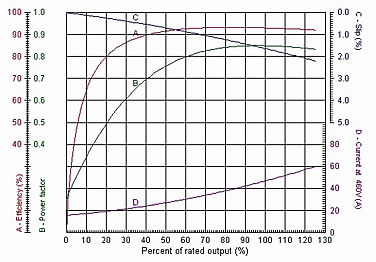
Here is a typical chart that includes the effect of overloading the motor on the power factor.

It only goes to 120% load, but as you can see, the slip increases, efficiency drops slightly, the the current rises rapidly, and the PF stays relatively flat. I have an old book version that takes this out beyond 120% to 150%, and the curves continue on those trends, with current increasing more rapidly and efficiency dropping more rapidly, but PF remaining relatively flat.

No idea why this is important to anyone, given that overloading a motor is dangerous to begin with, so what the power factor does is somewhat moot. It's kind of like asking about what effects being submerged had on the furniture polish used on the Titanic. But here you go.

__________________
** All I every really wanted to be, was... A LUMBERJACK!.**
Register to Reply
Guru

Join Date: Jan 2006
Location: Tamworth, UK.
Posts: 1782
Good Answers: 45
#18
In reply to #17

Re: Induction Motor Question

02/01/2016 5:51 PM

....what effects being submerged had on the furniture polish used on the Titanic....

...or the toxic risk of using lead bullets

---------------------

__________________
When arguing, remember mud-slinging = lost ground.
Register to Reply
Active Contributor

Join Date: Dec 2015
Posts: 11
#26

Re: Induction Motor Question

02/03/2016 1:24 AM

Power factor of the motor reduces with overload or underload. It is maximum when the motor is loaded to rated capacity.

Register to Reply
Register to Reply 27 comments

Good Answers:

These comments received enough positive votes to make them "good answers".

"Almost" Good Answers:

Check out these comments that don't yet have enough votes to be "official" good answers and, if you agree with them, vote them!
Copy to Clipboard

Users who posted comments:

7anoter4 (3); Crabtree (1); dhayanandhan (1); horace40 (6); JavaHead (2); johnmarsh11 (1); JRaef (1); lyn (1); magdumshirish (1); olehwi (1); PWSlack (2); redfred (4); Rixter (1); SolarEagle (1); TonyS (1)

Previous in Forum: VTs & CCVTs Secondary Winding Resistance & Insulation Resistance Tests   Next in Forum: Grounding, Bonding & Parallel Paths

Advertisement