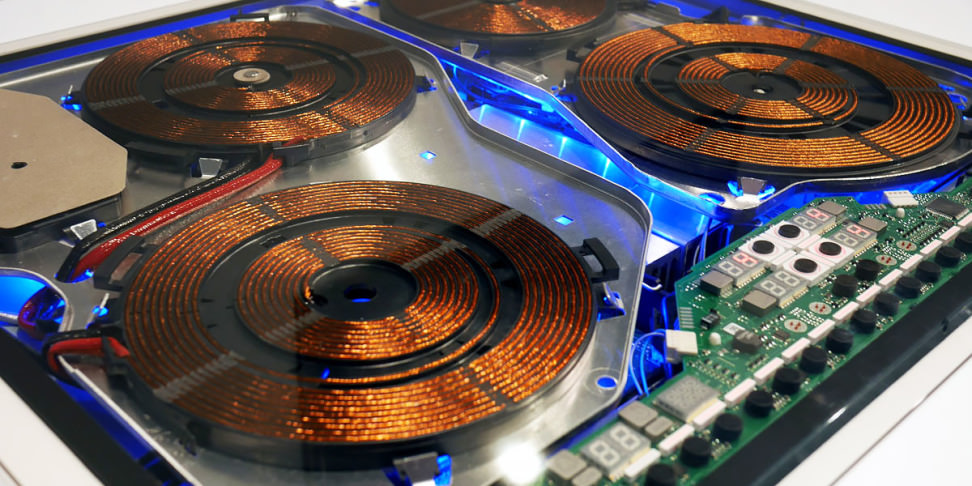
This is a bit more sophisticated design, and high efficiency lightweight insulation that keeps the pan cool...and I think the oven with induction and infrared combo is a first....
__________________
All living things seek to control their own destiny....this is the purpose of life
Keeps the pan cool and cooks more efficiently, and QUICKLY?
I want some of what you are smoking.
The cook top itself doesn't get very hot, I'll give you that.
BUT, The cost of the induction unit, and the specialized cookware you will need is a major investment when compared to conventional cook top and cookware.
My wife bought a countertop unit and special pans. Not sure where they went, but she doesn't use them any more. The pans can be used with other types of heating elements.
I am also wondering how it cooks without the pan getting hot too!!! Our pans get hot!! (having read the explanation later, I am sure that those pans are REALLY pricey, I personally would not waste my money on them!)
We started in around 2003 with induction, I have documented it here on CR4, we have never looked back, and since 2006 (or thereabouts), our stovetop is ONLY induction. In our caravan we have both gas and induction, gas is only for when we are off grid!! Which happens quite often, also when "underway" but parked!!
Most pans here in europe are also induction compatible, have been for years. They are not expensive, same as any other. There are also less pricey ones around now, I bought a cheap set for the caravan in 2007, works perfectly, stainless and easy to clean.....
Many forget, you will not have a chip pan fire as before the oil/fat self ignites, the induction stove top switches off and posts an error that it has exceeded 240°C!
Try getting any other electric or gas stovetop to do that!!
The other features of cooking by temperature or power plus timer control, I would not be without today.....
I wonder how the oven works and how well......
Have a great day!
__________________
"What others say about you reveals more about them, than it does you." Anon.
For some reason, I understand that it is much more common in Europe. Andy Germany got me into induction cooking around 6 years ago, Now, the only time I (or my wife) use a standard heating element is when all the induction elements are already in use. And for what it's worth, the majority of our cooking is in the same tri-ply stainless pots we bought 48 or 49 years ago.
The real reason is, of course, cost. They are more expensive. The energy they save would not have a reasonable payback period (I'm guessing here - I haven't done the energy measurements yet.) One of these days I will! I now have an energy logger available some of the time, but hadn't yet thought of this application....
All the other advantages make it worthwhile in my mind!
__________________
Teaching is a great experience, but there is no better teacher than experience.
An induction cooker is faster and more energy-efficient than a traditional electric cooking surface. It allows instant control of cooking power similar to gas burners. Other cooking methods that use flames or hot heating elements have a significantly higher loss to the ambient; induction heating directly heats the pot. Because the induction effect does not directly heat the air around the vessel, induction cooking results in further energy efficiencies. Cooling air is blown through the electronics beneath the surface but is only slightly warm.
__________________
"What others say about you reveals more about them, than it does you." Anon.
I have to question the last sentence of the second paragraph of the Wiki article: "This produces large eddy currents in the pot, which because of the resistance of the pot, heats it."
If it were eddy currents that caused the majority of the heating, then it seems like aluminum and probably copper would work, although at the 20-40kHz frequencies used, the skin effect would reduce the heating effect of the eddy currents.
I suspect that it is the repeated reversals of magnetic field direction in the magnetic domains of the steel that does most of the actual heating, but I'm certainly open to learning more about it!
At my workplace, a couple of months ago, we purchased an electric energy logger. It is currently being used for a series of energy audits at work, but once those are completed, I will be able to bring it home and actually measure the energy consumption of the induction and radiant heating processes. I'm in a somewhat unique position, since we have a cooktop/hob with both types of heating elements. When I am able to gather some data, I'll share it here on CR4.
Of course in the summertime, for people who, like us, cool their houses with A/C, the energy savings will roughly triple, since energy not lost to the kitchen will not have to be removed by the A/C.
__________________
Teaching is a great experience, but there is no better teacher than experience.
If I remember correctly, the middle frequencies for the various metals are quite different for maximum heating, which is really the impedance. To achieve maximzúm power transfer, it has to be impedance matched to a degree at least.
It appears that most hobs are "tuned" to iron and steel.
The hobs we have are particularly effective with cast iron pans....several settings lower appears to heat just as well.....
You see this with quality metal detectors, that can indicate which metal they are detecting and how large it is.....
If you do the energy comparison, may I request that you also time say for a liter of water, at a specific start temperature, in the exact same pot, with the lid on, to bring it to boiling, in comparison to the energy used from both?
That would be very interesting for many of us here I feel.....
__________________
"What others say about you reveals more about them, than it does you." Anon.
We agree that cast iron works very well. My wife uses a little 12cm cast iron frying pan for her morning eggs. Most of our cooking is in Stainless of one form or another.
For the energy comparison, I will definitely do as closely controlled experiments as possible. One of the things we do very commonly is to cook artichokes in the pressure cooker, so I plan to cook a couple each way, for one of the tests.
The logger we have (a DENT Elite pro XC, with Rogowski Current Transformers) is set up to record voltage and current for three phase circuits, and can also record power, both real and reactive, power factor, energy, and something else that escapes me at the moment. It can record values at least as frequently as once per second, so the data can be used to create very interesting graphs. It is rare for homes in the US to have three phase power, but I'll set it up to measure the two phases and neutral (which should be close to zero).
__________________
Teaching is a great experience, but there is no better teacher than experience.
Here we go again! NO! We have the standard 240V connection for the USA. There are three wires coming from the circuit breaker panel to the cooktop. One of them is connected to ground/neutral, which is our reference zero pint for measuring voltage, and is connected to the center tap of the transformer up on the pole outside. The other two wires come from the two halves of the circuit breaker, which are connected to the two end points of the same winding on that transformer. If you measure the voltage between ground and either of those wires you find roughly 120V (yesterday and today 121.4V ±0.1V, which is about two volts less than it had been for years at my house).
If you measure between the two hot wires, you measure roughly 240V. The only way 120VAC - 120VAC = 240VAC (you must subtract, because they are measured in opposite directions, ground on the left side of one and on the right side of the other), is when the 2-120V sources are 180° out of phase. That they are indeed 180° out of phase is easily observed by connecting each side of the 240V line to one of the inputs of a dual-trace oscilloscope, The signal of one side goes up when the other goes down; the peak of one corresponds precisely to the valley of the other.
I know a lot of people prefer to call this a single-phase system, but it can only be considered single phase if you place zero at one end, and we don't!
This is a two-phase, 3 wire, system.
__________________
Teaching is a great experience, but there is no better teacher than experience.
It is single phase 240V as it is taken from one phase of the distribution leg. The fact that our houses are wired to a center-tapped secondary where the center tap becomes the grounded conductor does not make it two-phase. That is done as a safety feature ensuring that both 'hot' legs remain at a 'safer' voltage.
It is absolutely true that the incoming voltage supplying the primary of the transformer out there on the pole (at something around 12kV in my case, if I'm not mistaken) is definitely single phase.
...but once you assign zero to the center tap, then the output of that transformer is two wires that are 180° out of phase with each other. I have a great deal of faith in the correctness of the display of my faithful Tektronix™ at power line frequencies, and I've observed those two voltages MANY times.
No person nor organization is going to convince me otherwise! I guess I'm just a stubborn old fart, by many people's standards.
__________________
Teaching is a great experience, but there is no better teacher than experience.
I actually find the US system to be far more dangerous to life and limb than the system used in most of the rest of the world.
If you have followed some of the other blogs here, it is possible to have units, often water heaters or similar, have a damaged heater element, that cannot be switched off without removing the fuses, or dropping the breaker......that is basically criminal.
It simply cannot happen on a 240 VAC system.....due to its intrinsic design.
That is not the only danger either......it seems that Code only requires having RCDs (the Wiki name, not the US name!) for wet areas, which is so short sighted as to be almost criminal too...
I am reliably told....Lyn I think... or Old Salt....I forget, sorry.
__________________
"What others say about you reveals more about them, than it does you." Anon.
I recently bought a copy of the US NEC, and so far have used it exactly once. Next time I'm at the shop, I'll look that up...
I believe what you call an RCD is essentially the same device that we call a GFI (Ground Fault Interrupter), or GFCI (Ground Fault Circuit Interrupter). Is that correct?
I have a gas (Propane) water heater, so I can't reply to that, but the only way to shut off the power to my cooktop or in-wall oven is to go outside and turn the breaker off. Do you have another way?
The code has changed a number of times during my lifetime. My home was constructed in 1962. At that time, grounded outlets were required near wet places; all the other outlets were 2-prong. And of course fault detectors didn't exist...
__________________
Teaching is a great experience, but there is no better teacher than experience.
A 3 phase supply has for example 3 windings or fields, whether on the alternator or a standard motor, or a transformer.
This domestic pole transformer you mention has only one secondary winding with a center tap.
If you checked with an ohmmeter, there would be the resistance of the whole winding between the two hot legs. They are one phase.
Therefore it is single phase or split-phase, it is not two phases.
Cutaway of a single-phase transformer. The single-phase primary wire is seen on the right toward the front. Split-phase secondary wires are toward the back of this transformer.
Many areas, such as the USA, which use (nominally) 120 V make use of three-wire, split-phase 240 V systems to supply large appliances. In this system a 240 V supply has a center-tapped neutral to give two 120 V supplies which can also supply 240 V to loads connected between the two line wires.
You can read more detail on domestic mains voltage in the USA here:-
A split-phase or single-phase three-wire system is a type of single-phase electric power distribution.
The only major difference between USA and Europe is that in Europe, one end of the single phase winding is grounded and also called neutral, whereas in the USA, it is center tapped to ground and neutral.
Its simply a difference of "where" the ground/neutral is applied.....its really that simple!!
I am simply ignoring the frequency differences as it has no bearing on this issue....
I rest my case.
By the way, many Americans mistakenly take their household electrics as being two phases, you are far from alone.
I have even met US electricians that also believe it!! This miss belief may actually be even widespread than the true facts!!
If you need further explanation, I or anyone of many others here who understand the US electrical system fully can assist you if need be....simply ask, we are all happy to help a colleague. But the weblinks say it all, you can read it there.
If you wish, I can also supply more such links if needed....
__________________
"What others say about you reveals more about them, than it does you." Anon.
Thanks, but like I just said to Sir Robin, I'm a stubborn old fart!
I can accept the concept of split phase, IFF you place zero at one end.
I see what I see, and at least in this case, I'm pretty sure I'm not seeing an illusion, especially after seeing it dozens (I doubt if hundreds would be an exaggeration) of times.
When I connect that energy logger, I am going to connect three current transformers, not two, one on neutral, and one on each phase, and I guarantee the voltages on those two phases will have opposite signs. I'll show the results on CR4 once I can bring the logger home.
I guess we have to agree to disagree.
__________________
Teaching is a great experience, but there is no better teacher than experience.
I guess you're right. My training was electronic engineering, in a college where electrical engineering was a separate department, with which I had no contact.
If you only have two wires, phase is meaningless for a single sine wave. When you have three wires, suddenly it takes on meaning. If you place zero at one end of a center-tapped 240V transformer, you have 120V on one hot wire (the center tap), and 240V of the same phase in the other hot wire. If you place zero at the center, then you have 120V of one phase in one hot wire, and 120V of the opposite phase in the other. End of story for me!
Although several have tried, no one is going to convince me that I'm wrong on this matter. There are lots of things I'm ready and willing to be educated about, and will gladly admit it when I'm wrong, but this isn't one of those!
__________________
Teaching is a great experience, but there is no better teacher than experience.
Stubbornness and a closed mind, lead on only one path.......
Over many years on CR4, I was usually pleasantly surprised at:-
a) the sheer amount of knowledge here
and
b) the flexibility of the clever Guys.....
You belie that statement completely.....sadly! I took you for one of the clever Guys, still able to pick up on some new infos when needed. I hope that I am still able to do that. I am also always prepared to read supplied links and make a judgement when new information is supplied, but I am far from perfect.
You even tell us where your education was totally lacking:-
My training was electronic engineering, in a college where electrical engineering was a separate department, with which I had no contact.
Confucius say… man who put foot in mouth get athlete's tongue........
Confucius say… he who thinks only of number one, must remember, it is next to nothing..........
__________________
"What others say about you reveals more about them, than it does you." Anon.
A closed mine, is just a hole in the ground waiting to cave in. A sealed mind cannot exist in a vacuum, but might contain a vacuum.
ON the other hand, we have a saying in the U.S.of A.: "stick to your guns" - meaning you can be stubborn when you know you are right. If you are off-target or can't hit the target, it might be best to leave those guns at home, don't take your guns to town, son.
Confucius say in Texas: Cowboy who shoot from hip, likely to shoot foot.
I agree that the American system of 120 VAC 1Ph, 60 Hz is one of the more dangerous ones out there. If you ever make a solid connection with it through your body, on a high current breaker circuit, you will not be thrown clear, and it is not survivable current. Higher voltage will produce some serious burns, and may kill you, but is also known to throw a human body clear of the short. Operation success, patient still dead, mostly. If someone out there has a better mouse trap, (even better than GFCI) let me know.
Eventually, we will know better how to use magnetic coupling of circuits way more efficiently, and outlets will be a thing of the past.
__________________
If it ain't broke, don't fix it. Just build a better one.
Does this not have to do with magnetic saturation and hysteresis, and less to do with hysteria? I feel in a jovial mood today, so watch it, buster.
There is something else to this than eddy currents, although if sufficient eddy current can be induced in aluminum, then perhaps it will also heat up and work. I have zero experience with this type of heating, but have read enough about it to be dangerous when wet.
__________________
If it ain't broke, don't fix it. Just build a better one.
Yes, they could be designed to work on most metals, but as you know for example, a piece of copper wire has a very low resistance, as does wire made from aluminium, silver or gold.
To easily produce heat in a wire, it needs to either have a resistance or a massive current passed through it.
The electrical resistance of iron or steel works in its favour!!
In a transformer or electric motor, we build the iron/steel parts to reduce the eddy currents as far as possible as they are losses, but for cooking, we want them!!
We also need its magnetic qualities too of course...its another useful part!
I believe that is why they picked iron and steel for induction cooking pots.....
__________________
"What others say about you reveals more about them, than it does you." Anon.
Well, if camping isn't as much fun anymore, an RV is one way to get out in the woods but with the comforts of a much smaller home. Still have nice fires, grilling and all that good stuff, plus bring a bunch of friends and some beer and lots of food . . . . . I'm older too and the prospect of sleeping in a pup tent on a thin foam mattress doesn't hold the appeal it used to.
We have two now. A trailer (caravan for those over the pond) and a Class C RV. My wife uses the RV as a mobile office, motel, restaurant when she takes her insurance adjusting business on the road.
All the induction units I've seen have some form of indication to show lack of an appropriate pan. My cooktop flashes a Letter "F" for Fail. ...and it's NOT on full power. In the absence of an appropriate magnetic material, it puts out only enough energy to detect when such material IS placed correctly on the element.
One of the videos I saw associated with the Panasonic Induction oven also indicated the same "F".
__________________
Teaching is a great experience, but there is no better teacher than experience.
4 months ago I purchased a single hob induction cooker 'American Heritage', Cost 1,600 pesos (approx 23.00 GBP/ 32$ US). I use a very cheap set of stainless steel pans (Set of 5 for around 11.00GBP)
The results are excellent both from a cooking & economic perspective.
Wow! that's a fantastic price (close to 1/10 of the price I paid a few years ago for my single element unit. At the time, I was in an extreme hurry, and had to buy whatever was available locally, so I know I paid too much, but it provided the needed service, so I'm not complaining...
What is the home voltage and frequency in the Philippines? (In other words, would that work on 120V, 60 Hz?)
__________________
Teaching is a great experience, but there is no better teacher than experience.
I forgot to add, though I have no proof, is that such voltages and frequencies (240 VAC 60 Hz) are possibly from a US manufactured Generator and at installation, the Ground/Neutral links were placed on one of the "hot phase lines" to bring it down to ground potential, not on center taps as in the USA. But its just an educated guess..........
So its the best of both worlds to my mind......
The higher, slightly more effective frequency and the far more useful mains voltage, with none of the water heater possible problems that I mentioned previously, though not limited to them of course..........
60 Hz, alone for the fact that it is "related" better to minutes and hours and you only need to divide it down to have possibly a useful digital timebase, always made it more attractive to me years ago, but with the advent of accurate digital clocks and chips, less need....
I found this, which shows that the 240 volt 60 Hz is slightly more "widely" installed than I remembered. It also shows Japan to be also undecided frequency wise!!!:-
(For some reason, under Chrome web browser, the CR4 editor will not allow me to resize this! If anyone knows why, please let me know. I know how it is done, it worked fine with Mozilla, but clicking on the image does not bring the box and the little circles to "pull". Thanks in advance!)
__________________
"What others say about you reveals more about them, than it does you." Anon.
Usually, once you paste an image like that in the reply window, it is way large, and has the item selected with small boxes at the periphery and corners. One can drag the bottom right corner toward the upper left to re-size the object, in most cases. Did that not work this time?
What I still don't understand: Power company generates 3Ph power. Industrial customers usually absorb the lion's share of 3Ph power using Delta or Y configured transformers. Yet in the alleyways of residential areas are pole transformer (or ground level if serviced by underground transmission), with only one phase incident per transformer. Does this mean my power is out of phase with someone else a block away on a different transformer? If I am the "A" phase, Joe in on the "B" phase, and Mildred is on the "C" phase, who the hell is on first? What's on second? I dunno is on third...
__________________
If it ain't broke, don't fix it. Just build a better one.
What browser do you use? I'm using FireFox on a Mac, because Safari has no tool bar. I did download Chrome a while back, but never got around to installing it.
The Editor box does not resize when I resize the window, and is pretty close to half of the screen width (600/1440, in the units used by the screen capture function, which is 2 pixels per unit). Most JPGs that I add are initially about 2/3 of the editor width, and I usually drag them out to close to full editor width, of course using the little boxes, usually the lower-right one.
To me, "way large" would be wider than the editor box, but then the little boxes would be off the edge of the screen, so I don't know how you would resize the image.
__________________
Teaching is a great experience, but there is no better teacher than experience.
Firefox on MS7.0. When I said "way large" I meant that it took up most of the editing window, but did not leak over the edges, but I still have to scroll around until I locate the object controls.
__________________
If it ain't broke, don't fix it. Just build a better one.
Good Answers: