Dear All
Mine is chemical and fertilizer plant. We use Epoxy paint when there is dusty environment and CR paint where there is dust free environment. Why? IS EPoxy better for corrosion resistance than CR paint.? Please guide me
.
Regards
I have never heard of it and even tried to look up CR paint. I am going to assume it is less durable and cheaper then epoxy based paints, hence the reason they use it in the clean environment. Epoxy has great abrasion and chemical resistance and is more suited to be in a harsh environment. Most of our dry film lubricants are single component, thermally cured, epoxy based and we coat helicopter gears with it, they have to be recoated every engine overhaul but that says a lot for that epoxy binder. Once cured, no solvent will touch it, even our 50% hydrochloric acid does nothing to it. If we need to remove it, we have to blast it, if blasting is not an option, we send it out to be stripped in a molten salt bath.
I installed a burn off oven to clean the tooling we use, 800 degrees f for 12 hours barely removes it. Most of the time we have to cycle the tooling twice before the coating is removed.
__________________
How we deal with death is at least as important as how we deal with life. --CAPTAIN KIRK, Star Trek II: The Wrath of Khan
We generically call it plastisol, I am familiar with it, never heard it referred to as CR paint. Why would you use it in a clean, dust free, environment? Obviously more info is needed from the O.P.
Maybe there is no dust because there is more chemicals?
__________________
How we deal with death is at least as important as how we deal with life. --CAPTAIN KIRK, Star Trek II: The Wrath of Khan
That is the one point of this question I think I understand, If you have a harsh environment then you need a durable coating (more $$$). If you have a less harsh environment and can get away with a less durable coating (less $$$), then you use it.
Most people complain when they go to Home Depot and spend $30 on a gallon of paint, most of our coatings are manufactured by Curtiss-Wright (our own company) and cost us $100 to $150 a gallon. The new job that you may of heard me talk about that I just built and designed the process for, cost $10K for 55gal of a coating that is sacrificial. We coat axel stub forgings, the coating is for lubricating a cold extruding process, once done, is useless.
__________________
How we deal with death is at least as important as how we deal with life. --CAPTAIN KIRK, Star Trek II: The Wrath of Khan
It's a water based polyethylene dispersion. I am new to it and still learning it. The process is a dip drain process, similar to the Surefire 60 and 100 round 5.56 magazines we do, except that is a conventional solvent based dry film lubricant.
__________________
How we deal with death is at least as important as how we deal with life. --CAPTAIN KIRK, Star Trek II: The Wrath of Khan
We coat Surefire's 60 and 100 round AR15 rifle magazines.
The magazines are loaded on a rack then dipped into a tank of the coating, slowly removed then thermally cured. This process coats the inside as well as the outside. These are all civilian, as the military thought they were too heavy.
__________________
How we deal with death is at least as important as how we deal with life. --CAPTAIN KIRK, Star Trek II: The Wrath of Khan
Yes there are some ridiculously priced coatings out there. But the dip coating that costs 10K for a 55 gallon drum goes into a 380 gallon tank, at an 80% coating / 20% water mixture, you do the math. We have to add about 55gallons a week to it.
It costs about 55k to charge, and 10k a week to maintain.
But it is worth it, we get about $2.25 per part and can do 6000 a day.
__________________
How we deal with death is at least as important as how we deal with life. --CAPTAIN KIRK, Star Trek II: The Wrath of Khan
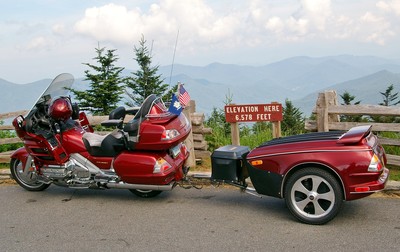
At $640 per quart a 55 gallon drum would set you back $140,800 although I'm sure you would get a better price at that volume. Fortunately it only takes a quart of this to paint
__________________
Common sense is an oxymoron and the world is full of morons. (I am not one of them)!!!
No argument from me, that looks sweet. Out coatings are not for looks, the one I just spoke of is sacrificial, gone after extrusion. The only coatings we use that are any way decorative are the CARC coatings, but they still have an engineered reason...
__________________
How we deal with death is at least as important as how we deal with life. --CAPTAIN KIRK, Star Trek II: The Wrath of Khan
Thanks. The day after I rode it home we ordered a trailer for it. Ordinarily color matching is included in the price of the trailer but this color cost us $600 more.
__________________
Common sense is an oxymoron and the world is full of morons. (I am not one of them)!!!
What is dry film lubricant in Epoxy paint? And you mean to say chlorinated Rubber paint(CR) is less durable and and has lesser corrosion and abrasion resistance than EPoxy paint?
If he comes back.... not holding my breath. Most epoxy coatings are chemical resistant. As I said, most of ours are epoxy based thermally cured coatings. Once cured, MEK, acetone, toluene, pretty much any solvent won't touch it. (have not found one that will.) Also goes for 50% hydrochloric acid, 50% sodium hydroxide, and 90% sulfuric acid. The only way we can remove our coatings is with aggressive 54 grit blasting, thermal destruction at 800 degrees F. for 12 hours, or molten salt bath for 8 hours.
I can dissolve the steel before the coating comes off.
Not sure how much more chemical resistance you can get......
We have coating processes that exceed 2000 hours salt spray tests.
__________________
How we deal with death is at least as important as how we deal with life. --CAPTAIN KIRK, Star Trek II: The Wrath of Khan
"I can dissolve the steel before the coating comes off."
That's an interesting point: paint some complex 'sacrificial' part with that paint, then etch away the part leaving only the paint to show customers how tough it is. Would the paint deform without its substrate, or would it remain rigid?
I've done similar with the copper-plated zinc pennies; file away the copper plating at the edge and then soak the penny in hydrochloric acid until all the zinc's gone.
That thermal cure stuff is the berries! Back in the State Police crime lab, we used to test paint exemplars, and evidence chips with various solvents, none of which one wanted to breathe in. One of the solvents I think was some sort of fluorinated acid, and sometimes it would break up paints and disperse old dried chips that nothing else would touch. This was merely a screening technique.
The ability to use pyrolysis-GC (or other hyphenated technique) on paint chips has advanced over the years such that paint "fingerprint" comparisons are quite valuable to investigators, especially when speaking of automotive paints, or paint picked up during contact transfer some other way at a crime scene.
__________________
If it ain't broke, don't fix it. Just build a better one.
Somewhere in the documentation for that plant will be a standard for application of paint. The correct person to ask is the one who wrote the standard. Alas, the standard cannot be seen from here.
__________________
"Did you get my e-mail?" - "The biggest problem in communication is the illusion that it has taken place" - George Bernard Shaw, 1856
Just how is a bunch of anonymous strangers across the globe supposed to know what the local practices are in this particular plant, without the original poster stating them (rhetorical question - NNTR)?
__________________
"Did you get my e-mail?" - "The biggest problem in communication is the illusion that it has taken place" - George Bernard Shaw, 1856
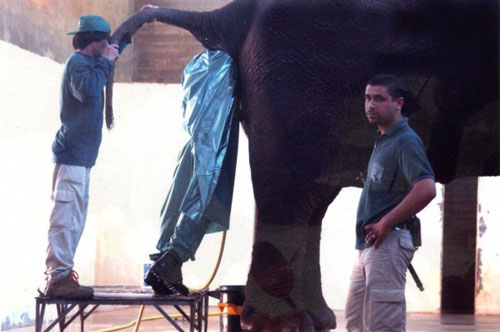
Most of us are feeling the elephant, searching for clues on here, I in particular seem to have my arm up in a dark stinky place, and my arm is green upon removal, therefore the elephant must be green and stinky, from my point of view.
The thing I don't get, how does a blind engineer see the color green? Or does it just smell green?
__________________
If it ain't broke, don't fix it. Just build a better one.
There is a palpable air of discontent brewing, or was that pachyderm alimentary discomfort syndrome? This could give birth to whole new branch of respiratory therapy.
Statistics: Of 17 patients given the placebo, all suffocated in a pachyderm's interior places (choose your words carefully). The one control subject took one sniff on entering the test area, and fled.
__________________
If it ain't broke, don't fix it. Just build a better one.
E = 1/2 m V2, thus it rightly depends on the energy of the flattus, and the mass of the landscaper.
If m = 72.5 kg, and E = 1 MJ, then V = 166.1 m/sec (totally out of the question).
0.1 MJ, with the same mass gives us V = 52.5 m/s, certainly within the realm of pachyderm performance propulsion. It requires the elephant in question be fed a special secret diet, only gutmonarch knows, as he is the world record speed holder.
__________________
If it ain't broke, don't fix it. Just build a better one.
Btw, did you even see the last 'Caption this' on the main page? I didn't; I saw it only when I clicked on 'See all blog entries' (which I don't do very often). I suspect it was pushed off by all those Engineering360 articles that nobody comments on.
They've already got a panel featuring Engineering360 News.
Why do they feel the need to clutter-up the Blog column with what are basically adverts for this product or that? 'Caption this' is one of the most popular blogs on this forum. Who cares about Ikea's Smart Home Lighting Products or some Reinforced Isolator? They can list those in the panel.
That's what happens when you ask a question then don't show up for ages to answer requests for clarification, more info, etc. For all anyone else knew you'd left the bluddy planet. Don't get all pissy, mate, when you weren't here to mind the store. Next time maybe stick around a bit to field legitimate questions which were asked. That's just common courtesy.


 CR Paint Vs Epoxy Paint


 Re: CR PAINT VS EPOXY PAINT






"Almost" Good Answers: