We are mostly all aware of the high charge efficiency of Li+ ion batteries, 99% or thereabouts. That seems pretty hard to beat.
It is only when you start looking at the costs of scalability compared with other known or proposed energy storage schemes, does the real world comparison kick in.
For example:
Tech A: 99% stored eff.; Cost factor: 10; Specific Energy 0.2 Kwh/Kg; Volumetric Energy: 0.7 KWh/L
Tech B: ~37% (based on BAT); Cost factor: 1; Specific Energy 12.9 KWh/Kg; Volumetric Energy: 9.5 KWh/L
Tech C: ~72% net efficiency; Cost factor: ~1-1.5; Specific Energy: 1.41 KWh/Kg, alt. ; Volumetric Energy: 1.46 KWh/L.
The three technologies can be readily compared based on energy storage factors to hand: Q() = Cost Factor / Volumetric Energy Factor / Efficiency.
Q(A): 14.430 - Lithium Ion Battery large scale bank
Q(B): 0.284 - Large gasoline storage tank with jet engine
Q(C): 1.426 - Molten Silicon (once the TPV energy coupling is worked out)
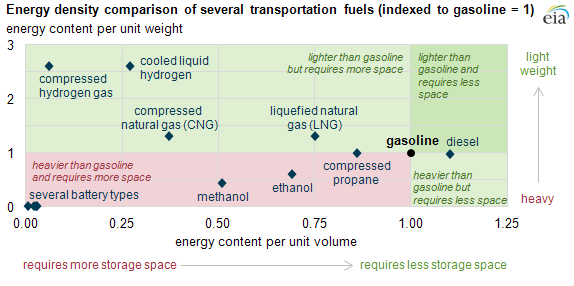
Gasoline is still (and probably always will be) the clear winner simply due to its immense volumetric energy density, reasonable efficiency (although lowest of the three), and cheap cost.
With more and more pathways to gasoline presenting themselves now and into the future, and with its transportability, you almost need "fusion pellets" to beat it.
Even if gasoline does not come from fossil deposits of oil and gas in the future, we already have other pathways to gasoline from renewable energy, and other abundant molecules, or coal (until coal runs out).


 3
3


 Energy Storage Efficiency Compared to Scalability Volume
 Re: Energy Storage Efficiency compared to scalability volume





Good Answers:
"Almost" Good Answers: