..."Anyone who’s taken any sort of physics knows that light can travel as photons or particles as well as waves. It may be hard to imagine, but under certain conditions, light can actually be turned into another form, a superfluid. In liquid form, instead of halting at an object and illuminating it, light flows around objects, just like water. This state is sometimes called the fifth state of matter or more formally, the Bose-Einstein condensate.
Light as superfluid has many strange and useful properties. For instance, it has no bends or waves, and experiences no friction or viscosity. As a result, this breakthrough could revolutionize any technology based on the transfer of light or electricity, and perhaps even launch the next generation of superconductors. Liquid light has been exceptionally rare up until now. It has only been seen under extreme conditions, in sealed lab chambers set to a temperature a few degrees above absolute zero.
Before, due to the need of such extreme conditions, its use wasn’t practical. Not only that, light would only exist in that form for a few fractions of a second. In this study, miraculously, scientists were able to achieve the same state at room temperature over a sustained period. The results were published in the journal Nature Physics."...
..."The breakthrough could revolutionize lasers, solar panels, computers, and even launch the next generation of superconductors. The study of superfluids may even help us solve some of the stubborn problems physics is coming up against, such as the mystery of dark matter. According to physicist Justin Khoury, it may in fact be a superfluid."...
So, to sum it up, we have matter which has these dipole quasiparticles called excitons. Light photons strongly couple with these excitons to create quasiparticles called polaritons, and these polaritons flow through the lattice freely and act like a frictionless fluid.
What can we do with this? Analogous to electronics, the technique of using polaritons is termed "Polaritonics", and will be useful in the terahertz frequency regime between electronics and photonics.
..."Daniele Sanvitto of CNR Nanotec was the lead researcher.He said, "The extraordinary observation in our work is that we have demonstrated that superfluidity can also occur at room temperature, under ambient conditions, using light-matter particles called polaritons."
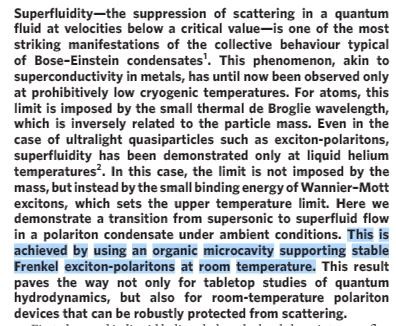
To create a “frictionless flow” of light, scientists took two special mirrors that were ultra-reflective. In between, they placed an extremely thin layer of organic molecules, just a 130-nanometers thick. They shot this with a laser pulse lasting 35-femtoseconds.
One femtosecond equals a quadrillionth of a second. This process allowed them to create a hybrid of light and matter. Instead of photons, you get polaritons. Stéphane Kéna-Cohen was the top Canadian researcher on this project.
He said in a statement,
Under normal conditions, a fluid ripples and whirls around anything that interferes with its flow. In a superfluid, this turbulence is suppressed around obstacles, causing the flow to continue on its way unaltered. Particles in this state behave like a single macroscopic wave, oscillating at the same frequency, and paradoxically combining the attributes of liquids, solids, and gases.
The properties of polaritons are astounding. It combines the lightness and speed of a photon with the strong bonding power of an electron, giving the superfluid some really unique features. Light that can move superfast without waves or friction, could cause the field of quantum hydrodynamics, allowing it to take off in new and exciting directions.
Researchers from École Polytechnique de Montreal said in a statement that they were excited to work on the project, “Not only to study fundamental phenomena related to Bose-Einstein condensates, but also to conceive and design future photonic superfluid-based devices where losses are completely suppressed and new unexpected phenomena can be exploited.” "...
Top: regular light, in waves. Bottom: light as a superfluid. École Polytechnique de Montreal.
__________________
All living things seek to control their own destiny....this is the purpose of life
It is surface plasmon polaritrons of metals that account for their reflectivity.
This topic about excitons (electron hole pairs) is what I find even more interesting.
The entire field on PV generation relies on the formation of excitons within the material through interaction with photons. Can we use this to learn how better to prevent electron-hole (charge carrier) recombination?
__________________
If it ain't broke, don't fix it. Just build a better one.
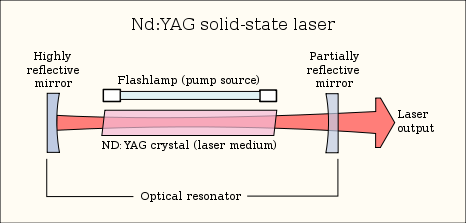
Have used those in research. Interestingly enough, one uses a non-linear cavity to frequency multiply the primary 1064 nm beam to 532 nm, or other. This can be then utilized with a dye laser to make other tunable wavelengths. Thus, there are devices that can produce two-photon effects and also three photon effects, and also there are mode switches that make optical pulses that are ultra-short duration, such as femto-seconds.
Back to surface plasmon polaritrons, there is some evidence that carbon (graphene??), and maybe GPO (graphene oxide), have an unusual ability to go into room temperature superconductivity once removed from a submerged state in water, and while still moist. I think it may have something to do with protons conducted to just below the surface GP layer (rather through the first GPO layer), thus easily becoming the "hole" part of an exciton.
The phenomenon was reported last year, so I recall, and was transitory in effect (not permanent).
If I can ever figure out a salt material that is somewhat hygroscopic, but not too hydrated, that can produce excitons when placed between plates of magnesium and copper, I will have a phonon battery of excellent properties (far lower output impedance) than what I have yet achieved in my home work shed. I managed one that was 3 Ω and produced 1.5-1.6 V open circuit, using about 250 cm2 each of magnesium ribbon and copper strips. Phonon cells require heat and thrive in heat (below the rapid dehydration threshold temperature, typically where my materials are dissolving in their own hydration water), which is about the temperature where normal galvanic cells give up, and fail.
These are not the same as thermal cells used by the military where rocket exhaust heats up the cell and melts the actual electrolyte, allowing the cell to function for a short period of time, but those can be quite energetic in output as needed for guidance functions.
__________________
If it ain't broke, don't fix it. Just build a better one.
Fascinating idea, and one that has possibilities. I am somewhat familiar with liquid helium. But what is the picture supposed to represent? It looks like a cloud and rain.
__________________
“I would rather have questions that can't be answered than answers that can't be questioned.” - Richard Feynman


 Polaritons, Light of the Future


 Re: Polaritons, Light of the Future