Previous in Forum: SOS Call Before Factory Rebooting Phone   Next in Forum: Project GRACE (Gravity Recovery and Climate Experiment) Data Usage
Close
Close
Close
26 comments
Rating: Comments: Nested
The Engineer
Engineering Fields - Engineering Physics - Physics... United States - Member - NY Popular Science - Genetics - Organic Chemistry... Popular Science - Cosmology - New Member Ingeniería en Español - Nuevo Miembro - New Member

Join Date: Feb 2005
Location: Albany, New York
Posts: 5060
Good Answers: 129

Observing a Star from 9 Billion Lightyears Away

04/03/2018 8:40 AM

I found this article interesting. Basically, a large galaxy (B) passed in front of another galaxy (A) and through gravitational lensing, a star from (A) could be observed many billions of lightyears away. However, it was still too far for us to observe. It took a third galaxy (C) to pass in front of (B) and lens the star from (A) again. Thus astronomers from Earth in Galaxy (D) could observe the star from (A), which was 9 billion lightyears away.

What I found fascinating about this article is the four galaxies needed to line up in space-time, not just space at the same time. In other words, it took several billion years for the light from the star in (A) to reach (B) and then several more billion years for the lensed image in (B) to reach (C) and then several more billion years for the lensed image in (C) to reach (D). Given the vastness of space, and the fact all of these galaxies are moving, this is not an easy feat. Just very cool that it all worked out so that we can observe a star so far beyond what we normally can see.

Here is the article talking about it:

https://www.popularmechanics.com/space/deep-space/a19660234/astronomers-gravitational-lensing-spot-a-star-9-billion-light-years-away/

Register to Reply
Interested in this topic? By joining CR4 you can "subscribe" to
this discussion and receive notification when new comments are added.

"Almost" Good Answers:

Check out these comments that don't yet have enough votes to be "official" good answers and, if you agree with them, vote them!
Guru

Join Date: Apr 2010
Location: About 4000 miles from the center of the earth (+/-100 mi)
Posts: 9912
Good Answers: 1141
#1

Re: Observing a star from 9 billion light-years away

04/03/2018 9:14 AM

When Einstein first predicted gravitational lensing, he doubted that the exact required alignment would occur.

http://www.einstein-online.info/spotlights/grav_lensing_history.1.html

Register to Reply
The Engineer
Engineering Fields - Engineering Physics - Physics... United States - Member - NY Popular Science - Genetics - Organic Chemistry... Popular Science - Cosmology - New Member Ingeniería en Español - Nuevo Miembro - New Member

Join Date: Feb 2005
Location: Albany, New York
Posts: 5060
Good Answers: 129
#4
In reply to #1

Re: Observing a star from 9 billion light-years away

04/03/2018 9:25 AM

It's just fortunate that there are so many galaxies floating along out there.

Register to Reply
Guru

Join Date: Apr 2010
Location: About 4000 miles from the center of the earth (+/-100 mi)
Posts: 9912
Good Answers: 1141
#11
In reply to #4

Re: Observing a star from 9 billion light-years away

04/03/2018 3:13 PM

I'm thinking that at the time Einstein predicted gravitational lensing, our galaxy was thought to be the entire universe and external galaxies were thought to be "nebulae" within our galaxy. Only a few years later, Hubble discovered redshift and proved that the universe was much larger than had been thought.

Einstein was thinking of one star in our galaxy lensing another star. A star's mass is very much less than a galaxy and a lensing event from a star would require a very fortuitous alignment.

https://www.windows2universe.org/the_universe/uts/timeline.html

Register to Reply
The Engineer
Engineering Fields - Engineering Physics - Physics... United States - Member - NY Popular Science - Genetics - Organic Chemistry... Popular Science - Cosmology - New Member Ingeniería en Español - Nuevo Miembro - New Member

Join Date: Feb 2005
Location: Albany, New York
Posts: 5060
Good Answers: 129
#12
In reply to #11

Re: Observing a star from 9 billion light-years away

04/03/2018 3:28 PM

I think you're right. I've occasionally wondered if we could somehow exploit several stars in a row to get a better image of a star system in our own galaxy. The idea being it may be easier to view details about exoplanets in that system. Unfortunately, the star's gravitational lensing may still be too small even in that situation.

Register to Reply
Guru
Engineering Fields - Electrical Engineering - Been there, done that. Engineering Fields - Control Engineering - New Member

Join Date: Dec 2008
Location: Long Island NY
Posts: 15602
Good Answers: 982
#5
In reply to #1

Re: Observing a star from 9 billion light-years away

04/03/2018 9:48 AM

With the gravitational lens effect there's been a question I've often wondered if anyone has ever attempted to measure.

The graphic from your link provides exactly the image for my question. The top light ray path is longer than the bottom light ray path. In any terrestrial optics this difference in path length is ignored. But with an astronomical size lens this distance difference may be noticeable. Will the light following the lower path exhibit more of a red shift than the top path?

This might be an imperceptible tiny difference, even with an astronomic lens, because the total path length is an even bigger astronomic length. Then again as your link points out, at one time Einstein thought this lens effect would never be noticed at all. Now we have two gravitational lenses aligning in space for us to see even farther.

__________________
"Don't disturb my circles." translation of Archimedes last words
Register to Reply
Guru

Join Date: Apr 2010
Location: About 4000 miles from the center of the earth (+/-100 mi)
Posts: 9912
Good Answers: 1141
#10
In reply to #5

Re: Observing a star from 9 billion light-years away

04/03/2018 2:47 PM

For illustration, the graphic, of course, is far out of scale. A scaled drawing would be impossible to draw that would show the deflection.

If the lensed object is a quasar, its size is small enough that fluctuations can occur on a fairly short time period, and cross-correlation between the images can reveal the difference in travel time.

Here is some actual data:

Table 1. Time Delay Measurements


System

Nim

t (days)

AstrometryModelRef.

HE1104-1805

2161 ± 7+"simple"1

PG1115+080

425 ± 2+"simple"2

SBS1520+530

2130 ± 3+"simple"3

B1600+434

251 ± 2+ / -"simple"4

HE2149-2745

2103 ± 12+"simple"5

RXJ0911+05514146 ± 4+cluster/satellite6

Q0957+561

2417 ± 3+cluster7
B1608+656477 ± 2+ / -satellite8

B0218+357

210.5 ± 0.2-"simple"9

PKS1830-211

226 ± 4-"simple"10

B1422+231

4(8 ± 3)+"simple"11

Nim is the number of images. t is the longest of the measured delays and its 1 error; delays in parenthesis require further confirmation. The "Astrometry" column indicates the quality of the astrometric data for the system: + (good), + / - (some problems), - (serious problems). The "Model" column indicates the type of model needed to interpret the delays. "Simple" lenses can be modeled as a single primary lens galaxy in a perturbing tidal field. More complex models are needed if there is a satellite galaxy inside the Einstein ring ("satellite") of the primary lens galaxy, or if the primary lens belongs to a cluster. References: (1) Ofek & Maoz 2003, also see Gil-Merino, Wistozki, & Wambsganss 2002, Pelt, Refsdal, & Stabell 2002, and Schechter et al. 2002; (2) Barkana 1997, based on Schechter et al. 1997; (3) Burud et al. 2002b; (4) Burud et al. 2000, also Koopmans et al. 2000; (5) Burud et al. 2002a; (6) Hjorth et al. 2002; (7) Kundic et al. 1997, also Schild & Thomson 1997 and Haarsma et al. 1999; (8) Fassnacht et al. 2002; (9) Biggs et al. 1999, also Cohen et al. 2000; (10) Lovell et al. 1998; (11) Patnaik & Narasimha 2001.

https://ned.ipac.caltech.edu/level5/March04/Kochanek/frames.html

The simplest explanation I've seen of redshift is that the light has been stretched by the universal expansion over the time period from when it was emitted to when it was detected. So the difference in redshift can be estimated by the difference in travel time.

The largest value I see from the table above is 417 days, so the difference in redshift would be negligible.

Register to Reply
Guru

Join Date: May 2006
Location: Placerville, CA (38° 45N, 120° 47'W)
Posts: 6215
Good Answers: 248
#20
In reply to #10

Re: Observing a star from 9 billion light-years away

04/04/2018 1:18 PM

"The simplest explanation I've seen of redshift is that the light has been stretched by the universal expansion over the time period from when it was emitted to when it was detected."

Is that simpler than the Doppler effect?

__________________
Teaching is a great experience, but there is no better teacher than experience.
Register to Reply
Guru

Join Date: Apr 2010
Location: About 4000 miles from the center of the earth (+/-100 mi)
Posts: 9912
Good Answers: 1141
#24
In reply to #20

Re: Observing a star from 9 billion light-years away

04/04/2018 7:54 PM

My understanding is that there are three types of redshift -- gravitational, doppler, and cosmological. Light emitted from deep in a gravity well will be reddened due to loss of energy "climbing out". Doppler, of course, is due to relative motion between the source and detector. Cosmological redshift is due to the expansion of space itself. Cosmological expansion can permit the distance between two galaxies far apart to increase greater than 3 x 10⁸ m/s.

According to Wiki:

"There is a distinction between a redshift in cosmological context as compared to that witnessed when nearby objects exhibit a local Doppler-effect redshift. Rather than cosmological redshifts being a consequence of the relative velocities that are subject to the laws of special relativity (and thus subject to the rule that no two locally separated objects can have relative velocities with respect to each other faster than the speed of light), the photons instead increase in wavelength and redshift because of a global feature of the spacetime metric through which they are traveling. One interpretation of this effect is the idea that space itself is expanding.[27] Due to the expansion increasing as distances increase, the distance between two remote galaxies can increase at more than 3×10⁸ m/s, but this does not imply that the galaxies move faster than the speed of light at their present location (which is forbidden by Lorentz covariance)"

https://en.wikipedia.org/wiki/Redshift

Register to Reply
Guru

Join Date: May 2006
Location: Placerville, CA (38° 45N, 120° 47'W)
Posts: 6215
Good Answers: 248
#19
In reply to #5

Re: Observing a star from 9 billion light-years away

04/04/2018 12:54 PM

"The top light ray path is longer than the bottom light ray path."

I assume that's an "Oops".

I believe you must be correct about the greater red shift for the longer path, but whether the difference is measurable, I have no idea.

__________________
Teaching is a great experience, but there is no better teacher than experience.
Register to Reply
Guru
Engineering Fields - Electrical Engineering - Been there, done that. Engineering Fields - Control Engineering - New Member

Join Date: Dec 2008
Location: Long Island NY
Posts: 15602
Good Answers: 982
#22
In reply to #19

Re: Observing a star from 9 billion light-years away

04/04/2018 3:11 PM

It's amazing the various ways lysdexia dyslexia can manifest.

__________________
"Don't disturb my circles." translation of Archimedes last words
Register to Reply Off Topic (Score 5)
Guru

Join Date: May 2006
Location: Placerville, CA (38° 45N, 120° 47'W)
Posts: 6215
Good Answers: 248
#21
In reply to #5

Re: Observing a star from 9 billion light-years away

04/04/2018 1:49 PM

Clearly, a telescope would have to be pointed in one direction to have the image formed by the upper path centered in the field of view, and a slightly different direction to have the image formed by the lower path centered in the field of view. If the orientation of the telescope is halfway between those two positions, can both images be seen in a single field of view at the magnification used?

Also, if S is directly centered behind M, as observed from O, then both paths would be the same length, and they would be only two of an infinite number of paths following all sides of M, so it seems to me that S would appear as a continuous ring with M at its center. Is this the "Einstein Ring" referred to somewhere in this blog?

I assume that when S is just slightly off-center, that ring would be brighter on on one side than the other, and that at greater deviation, part of the ring would disappear, so S would appear as an arc. Thus, for S to appear as a single point of light, it would have to be significantly off center. Are my assumptions correct?

Finally, I know that all objects involved are moving through space-time, but I have no knowledge of the apparent speed of motion. In other words, how long does the alignment remain useful? Based on Rixter's data, I gather that st least some of these alignments must last for more than a year.

__________________
Teaching is a great experience, but there is no better teacher than experience.
Register to Reply
Guru

Join Date: Apr 2010
Location: About 4000 miles from the center of the earth (+/-100 mi)
Posts: 9912
Good Answers: 1141
#23
In reply to #21

Re: Observing a star from 9 billion light-years away

04/04/2018 4:36 PM

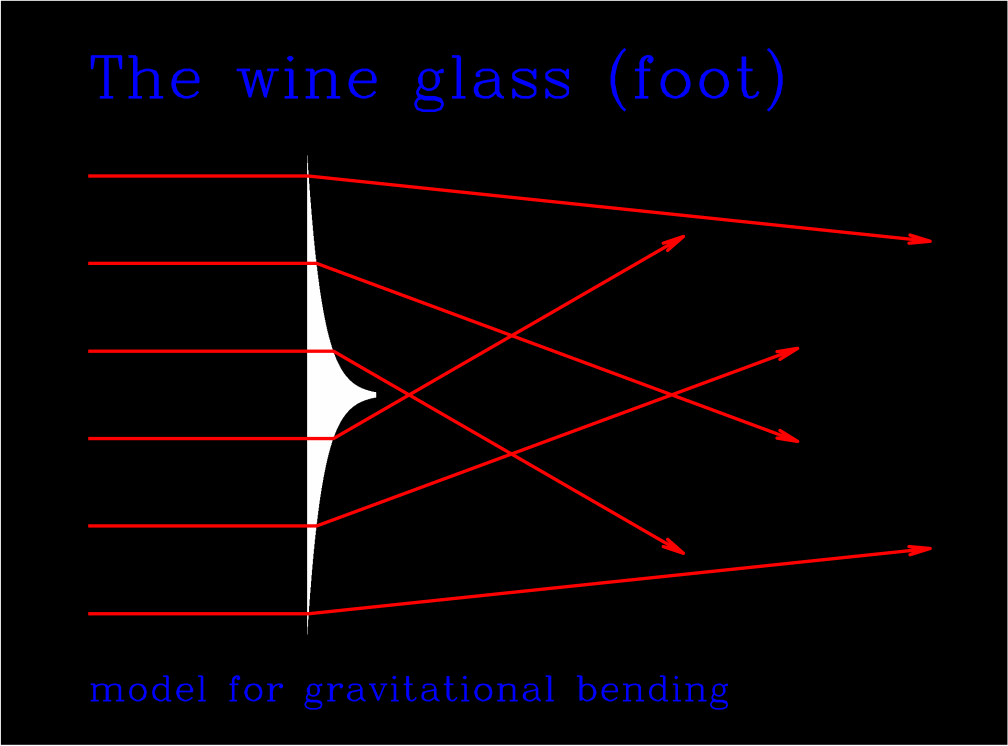
There are all sorts of effects, depending on the strength of the lens and the relationship of the object, lens, and observer, and a description does not do it justice. The point is that instead of acting like a simple magnifying glass, a gravitational lens acts more like the base of a wine glass, where the bending is greatest toward the center and least at the edges.

Go grab a glass of wine, finish the wine, and look through the base. A small object held behind it, depending on its position, may be seen multiple times or magnified into a ring. This is a good model for a gravity lens.

An illustration might help. Here is a simulation of a gravity field and its effect on background objects.

Register to Reply
Power-User

Join Date: Mar 2017
Posts: 191
Good Answers: 9
#17
In reply to #1

Re: Observing a star from 9 billion light-years away

04/04/2018 12:27 AM

Rixter,

how do you differentiate gravitiational lensing from density lensing?

I asked a woman who gave a talk on black holes (her speciality) this question and got an unsatisfactory answer.

I don't know why this effect is never mentioned, but imagine a star floating in space, as they are wont to do, gravity ensures there is a gradient in gas density in some proportion to the gravity but also due to the efflux of matter.

Surely this gradient of matter (both atmospheric and efflux combined) results in a lensing device.

How do you show the gravitational component versus the "matter" component, or dare I ask, does the gravitational component actually exist at all (sorry Einstein) and it is all "matter" lensing instead?

Register to Reply
Guru

Join Date: Apr 2010
Location: About 4000 miles from the center of the earth (+/-100 mi)
Posts: 9912
Good Answers: 1141
#18
In reply to #17

Re: Observing a star from 9 billion light-years away

04/04/2018 9:12 AM

That's a very good question. I think the answer is that the spectrums of the light from multiple images of the same object are virtually identical. Refraction caused by matter affects different wavelengths differently. I think you might also see absorption lines in the spectrum (probably hydrogen) if it were refraction rather than gravitational.

Someone else with the same idea:

https://physics.stackexchange.com/questions/7250/gravitational-lensing-or-cloud-refraction

Register to Reply
Guru
Engineering Fields - Electrical Engineering - Been there, done that. Engineering Fields - Control Engineering - New Member

Join Date: Dec 2008
Location: Long Island NY
Posts: 15602
Good Answers: 982
#2

Re: Observing a star from 9 billion light-years away

04/03/2018 9:22 AM

So the universe gave us an accidental, extraterrestrial telescope. I wonder what the f number for this telescope would be?

__________________
"Don't disturb my circles." translation of Archimedes last words
Register to Reply
The Engineer
Engineering Fields - Engineering Physics - Physics... United States - Member - NY Popular Science - Genetics - Organic Chemistry... Popular Science - Cosmology - New Member Ingeniería en Español - Nuevo Miembro - New Member

Join Date: Feb 2005
Location: Albany, New York
Posts: 5060
Good Answers: 129
#3
In reply to #2

Re: Observing a star from 9 billion light-years away

04/03/2018 9:24 AM

Exactly! And good question, I'd like to know too. That would really give us an idea of how hard it is for something like this to happen.

Register to Reply
Guru

Join Date: Apr 2010
Location: About 4000 miles from the center of the earth (+/-100 mi)
Posts: 9912
Good Answers: 1141
#6
In reply to #2

Re: Observing a star from 9 billion light-years away

04/03/2018 10:23 AM

f-number is the ratio of a lens diameter to the focal length.

A gravitational lens is much different from an optical lens in that it doesn't focus light the way an optical lens does. The light rays that originate from a point and pass through an optical lens converge to a second point, the focal point. Light rays are deflected less from the center of a gravitational lens than near the center.

So, f-number does not apply to gravitational lenses.

Register to Reply
Guru
Engineering Fields - Electrical Engineering - Been there, done that. Engineering Fields - Control Engineering - New Member

Join Date: Dec 2008
Location: Long Island NY
Posts: 15602
Good Answers: 982
#8
In reply to #6

Re: Observing a star from 9 billion light-years away

04/03/2018 10:53 AM

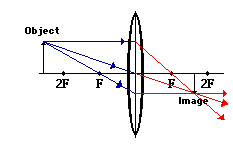
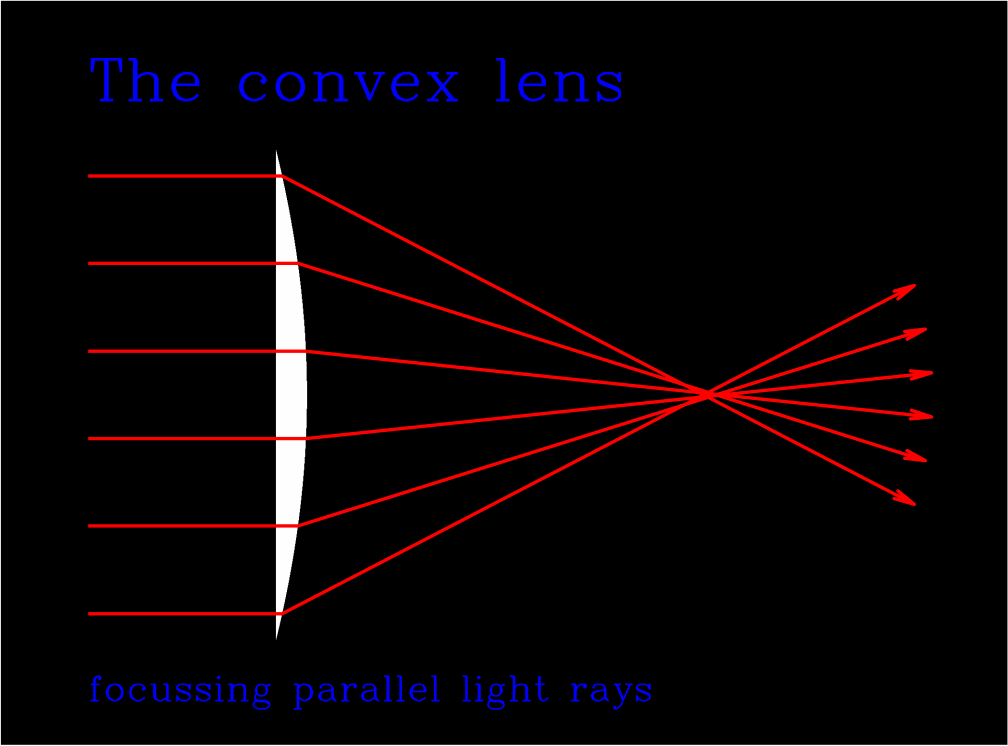
Here's a converging lens ray trace and the gravitational lens ray trace from your link.

To me these ray diagrams look similar enough, they both converge, that I don't see why an f number analogy cannot be pondered. While it is true that a gravitational lens has no physical lens edge to measure an aperture there surely must be a measurable optical angle at O and a distance between O and M to make a virtual aperture.

__________________
"Don't disturb my circles." translation of Archimedes last words
Register to Reply
Guru

Join Date: Apr 2010
Location: About 4000 miles from the center of the earth (+/-100 mi)
Posts: 9912
Good Answers: 1141
#9
In reply to #8

Re: Observing a star from 9 billion light-years away

04/03/2018 2:15 PM

Gravity fields make very poor optical lenses.

Here's another way to look at it...

A ray passing near the center of an optical lens is hardly bent at all. Those rays passing through near the edge are bent more, so that all rays converge on the image.

A ray passing near the center of a gravitational lens is bent the maximum amount whereas a ray passing at some distance is bent very little.

http://www.artemis-uk.org/Microlensing_physmath.html

Register to Reply
Guru
Hobbies - CNC - New Member Hobbies - DIY Welding - New Member Engineering Fields - Electromechanical Engineering - New Member

Join Date: Aug 2007
Posts: 23647
Good Answers: 420
#7

Re: Observing a Star from 9 Billion Lightyears Away

04/03/2018 10:29 AM

that scenario almost sounds like a type of game of chance like a lucky shell game to be able to see it.

__________________
“ When people get what they want, they are often surprised when they get what they deserve " - James Wood
Register to Reply
Guru
Hobbies - HAM Radio - New Member Hobbies - Model Rocketry - New Member

Join Date: Jan 2007
Posts: 787
Good Answers: 52
#13

Re: Observing a Star from 9 Billion Lightyears Away

04/03/2018 4:24 PM

I have always found the idea of gravitational lensing interesting. Does a gravitational lens work with more than just optical? I only hear it mentioned in relation to the optical spectrum but I would imagine it would lens over all frequencies.

Register to Reply
Guru

Join Date: Apr 2010
Location: About 4000 miles from the center of the earth (+/-100 mi)
Posts: 9912
Good Answers: 1141
#15
In reply to #13

Re: Observing a Star from 9 Billion Lightyears Away

04/03/2018 5:29 PM

Yes, but it is considerably easier at optical wavelengths.

The deflection of gravitational lenses is on the order of an arcsecond. The resolution of a receiver is a ratio of the wavelength to the size of the receiver. To get this resolution with radio waves requires a connected array of radio telescopes connected as an interferometer.

https://www.cfa.harvard.edu/news/su201608

Register to Reply
Guru
Hobbies - CNC - New Member Popular Science - Biology - New Member Hobbies - Musician - New Member

Join Date: Dec 2008
Location: Canada
Posts: 3523
Good Answers: 146
#14

Re: Observing a Star from 9 Billion Lightyears Away

04/03/2018 5:27 PM

Very cool that this happened, but sure makes you think about how much we are missing. The blind men and the elephant comes to mind.

__________________
incus opella
Register to Reply Score 1 for Good Answer
Guru

Join Date: Apr 2010
Location: About 4000 miles from the center of the earth (+/-100 mi)
Posts: 9912
Good Answers: 1141
#16

Re: Observing a Star from 9 Billion Lightyears Away

04/03/2018 10:08 PM

Here's the original paper. I haven't had time to digest it.

https://www.nature.com/articles/s41550-018-0430-3

Register to Reply
Guru

Join Date: Jan 2006
Location: Tamworth, UK.
Posts: 1782
Good Answers: 45
#25

Re: Observing a Star from 9 Billion Lightyears Away

04/06/2018 6:37 AM

Lots of replies are very interesting but do not say how the bending of light by gravity makes it possible to see further into space - unless it also acts as a powerful magnifier of everything beyond.

I can understand how something hidden behind a dense object can be bent into view but it would be more or less the same size I guess.

__________________
When arguing, remember mud-slinging = lost ground.
Register to Reply
Guru

Join Date: Apr 2010
Location: About 4000 miles from the center of the earth (+/-100 mi)
Posts: 9912
Good Answers: 1141
#26
In reply to #25

Re: Observing a Star from 9 Billion Lightyears Away

04/06/2018 5:50 PM

Light intensity decreases with the square of the distance. There is a limit to the minimum amount of light we can see. A star at 9 billion lightyears distance, even a giant star, would be too faint to be detectable.

A gravity field bends light and acts like a lens, not a perfect lens like a magnifying glass, but more like the bottom of a wine glass. If the source is in the right place, the gravity lens is in the right place, and the observer is in the right place, more light from the distant source will arrive at the observer making the otherwise invisible object visible.

Register to Reply
Register to Reply 26 comments

"Almost" Good Answers:

Check out these comments that don't yet have enough votes to be "official" good answers and, if you agree with them, vote them!
Copy to Clipboard

Users who posted comments:

artsmith (1); Bayes (3); dkwarner (3); frankd20 (1); GJM (1); horace40 (1); phoenix911 (1); redfred (4); Rixter (11)

Previous in Forum: SOS Call Before Factory Rebooting Phone   Next in Forum: Project GRACE (Gravity Recovery and Climate Experiment) Data Usage

Advertisement