Previous in Forum: Transmission Line Design   Next in Forum: Query About Voltage Drop in Impedance
Close
Close
Close
22 comments
Rate Comments: Nested
Anonymous Poster #1

Exciter Winding Resistance Unbalance

07/16/2018 6:28 AM

what happen in our generator if we found that our exciter winding resistance is unbalance??,

Reply
Interested in this topic? By joining CR4 you can "subscribe" to
this discussion and receive notification when new comments are added.

Good Answers:

These comments received enough positive votes to make them "good answers".

"Almost" Good Answers:

Check out these comments that don't yet have enough votes to be "official" good answers and, if you agree with them, vote them!
Guru
United Kingdom - Member - Indeterminate Engineering Fields - Control Engineering - New Member

Join Date: Jan 2007
Location: In the bothy, 7 chains down the line from Dodman's Lane level crossing, in the nation formerly known as Great Britain. Kettle's on.
Posts: 32175
Good Answers: 839
#1

Re: exciter winding resistance unbalance

07/16/2018 6:37 AM

Well, it's rather difficult to see the <...our generator...> from here.

What one would need, ideally, is the original equipment manufacturer's telephone number off it and a call to that body's Technical Helpline to answer that question.

__________________
"Did you get my e-mail?" - "The biggest problem in communication is the illusion that it has taken place" - George Bernard Shaw, 1856
Reply
Guru
Engineering Fields - Power Engineering - New Member

Join Date: May 2007
Location: NYC metropolitan area.
Posts: 3230
Good Answers: 444
#2

Re: Exciter Winding Resistance Unbalance

07/16/2018 10:12 AM

It depends upon the type of exciter, but generally speaking as long as the DC exciter's field current keeps up with the demand of the operating point the generator won't care.

Depending upon the exact cause and degree of imbalance, the exciter may overheat, become magnetically/mechanically unbalanced, and trip causing the loss of the main generator. Turn to turn shorts will cause a slow degradation, turn to ground will instantaneously become severe when the second fault occurs.

__________________
“Tell me and I forget. Teach me and I remember. Involve me and I learn.” Ben Franklin.
Reply
Guru
Engineering Fields - Electrical Engineering - Been there, done that. Engineering Fields - Control Engineering - New Member

Join Date: Dec 2008
Location: Long Island NY
Posts: 15602
Good Answers: 982
#3

Re: Exciter Winding Resistance Unbalance

07/16/2018 3:55 PM

Everything depends on what you mean by "imbalance". A 0.01% difference in the series resistance for only one rotor pole will not make much of a difference. Having two of the three exciter rotor poles open circuit will make one hell of a difference. (I'm not sure why anyone would make separate rotor windings but it can be done.)

__________________
"Don't disturb my circles." translation of Archimedes last words
Reply
Active Contributor

Join Date: Aug 2013
Posts: 10
#4

Re: Exciter Winding Resistance Unbalance

07/16/2018 9:19 PM

after communication with vendor, at early commissioning we got balance resistance 7 mOhm, then when we perform resistance test (preventive) we got one winding imbalance (11 mOhm), we've been measure more than 4 times, and using more than one metering and still get this result.

Reply
Guru
Engineering Fields - Electrical Engineering - Been there, done that. Engineering Fields - Control Engineering - New Member

Join Date: Dec 2008
Location: Long Island NY
Posts: 15602
Good Answers: 982
#5
In reply to #4

Re: Exciter Winding Resistance Unbalance

07/16/2018 9:38 PM

Assuming your tiny resistance numbers are accurate, I suspect the contact area between brushes and that rotor winding are out of round. A film maybe on the contact, too.

__________________
"Don't disturb my circles." translation of Archimedes last words
Reply
Active Contributor

Join Date: Aug 2013
Posts: 10
#6
In reply to #5

Re: Exciter Winding Resistance Unbalance

07/16/2018 9:47 PM

thank's for your comment refred, and what will happen if we still running Generator???

Reply
Guru
Engineering Fields - Power Engineering - New Member

Join Date: May 2007
Location: NYC metropolitan area.
Posts: 3230
Good Answers: 444
#7
In reply to #6

Re: Exciter Winding Resistance Unbalance

07/16/2018 11:25 PM

That was answered in post #2, and until you provide much more information regarding the generator and exciter, no further analysis is possible.

__________________
“Tell me and I forget. Teach me and I remember. Involve me and I learn.” Ben Franklin.
Reply
Active Contributor

Join Date: Aug 2013
Posts: 10
#8
In reply to #7

Re: Exciter Winding Resistance Unbalance

07/17/2018 2:50 AM

imbalance it's about 25% , below is data that we measure

using DLRO

ROTOR EXCITER

DLRO

Winding 1 - 38.90 mili Ohm
Winding 1 - 28.64 mili Ohm
Winding 2 - 311.35 mili Ohm
Reply
Guru
United Kingdom - Member - Indeterminate Engineering Fields - Control Engineering - New Member

Join Date: Jan 2007
Location: In the bothy, 7 chains down the line from Dodman's Lane level crossing, in the nation formerly known as Great Britain. Kettle's on.
Posts: 32175
Good Answers: 839
#9
In reply to #8

Re: Exciter Winding Resistance Unbalance

07/17/2018 2:58 AM

So what did the original equipment manufacturer say during the telephone calls made to its Technical Helpline?

__________________
"Did you get my e-mail?" - "The biggest problem in communication is the illusion that it has taken place" - George Bernard Shaw, 1856
Reply
Anonymous Poster #2
#11
In reply to #9

Re: Exciter Winding Resistance Unbalance

07/17/2018 9:55 PM

this is the reply from manufacture

"The higher resistance on the one phase of the exciter armature indicates that something has changed since originally manufactured. What has caused the higher resistance is unknown.

If you decide to use the exciter armature as is *a** would recommend doing so only as a temporary back-up basis until a new exciter armature can be ordered and this exciter armature can be rewound. Higher excitation will most likely be required to maintain rated voltage."

Reply
Guru
United Kingdom - Member - Indeterminate Engineering Fields - Control Engineering - New Member

Join Date: Jan 2007
Location: In the bothy, 7 chains down the line from Dodman's Lane level crossing, in the nation formerly known as Great Britain. Kettle's on.
Posts: 32175
Good Answers: 839
#13
In reply to #11

Re: Exciter Winding Resistance Unbalance

07/18/2018 9:31 AM

So the answer to Anonymous Poster #1's question, <...what happen in...generator if...exciter winding resistance is unbalance?...> is that the original equipment manufacturer's statement <...would recommend doing so only as a temporary back-up basis until a new exciter armature can be ordered...> would suggest that the happening "some replacement parts need to be ordered and fitted as a matter of urgency" will take place, otherwise another happening, a "significant malfunction might ensue that might affect the ability of Anonymous Poster #1's facility to stay in business" would be the reasoned alternative.

__________________
"Did you get my e-mail?" - "The biggest problem in communication is the illusion that it has taken place" - George Bernard Shaw, 1856
Reply
Guru
Engineering Fields - Power Engineering - New Member

Join Date: May 2007
Location: NYC metropolitan area.
Posts: 3230
Good Answers: 444
#10
In reply to #8

Re: Exciter Winding Resistance Unbalance

07/17/2018 10:05 AM

If these measurements were taken with the windings separated and at the winding terminations, then it appears that either one of the coils was wired in series with its group, or a coil in a parallel group has a poor joint and/or has failed open.

__________________
“Tell me and I forget. Teach me and I remember. Involve me and I learn.” Ben Franklin.
Reply Score 1 for Good Answer
Guru

Join Date: Dec 2010
Posts: 1686
Good Answers: 116
#12
In reply to #8

Re: Exciter Winding Resistance Unbalance

07/18/2018 6:05 AM

My best interpretation of your measurement is that you have two windings per phase, Δ connected & one is open circuit - running the machine would overheat & damage the remaining winding.

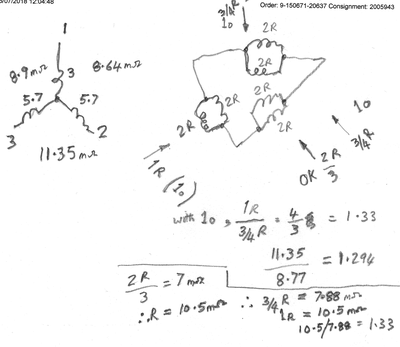
Please excuse graffitti - for free advice you have to accept whatever piece of scrap paper was to hand! Figures "OK" are no-fault resistances, 2R each winding, while "1o" indicates with 1 winding Open. A "star" connection is unlikely, one half-winding would have to be shorted to match your measurements [3 ~ 5.7/2].

The 7mohm is your OK previous measurement [1R in parallel with 2 x 1R in series - 2 x 2R parallel = 1 R :all windings equal resistance 2R], while 8.77 mohm is average of your measure of two phases (third, 11.35 mOhm).

Your actual measurements high/(average of two others) gives 1.294, compared to 1.33 theoretical with 1 winding "open".

Reply Score 1 for Good Answer
Anonymous Poster #2
#15
In reply to #12

Re: Exciter Winding Resistance Unbalance

07/19/2018 9:32 AM

Thank you for your calculation, but I still confused with the calculation if you assume it as a delta connection. I agree if it's star connection with one winding turn to turn short as describe in the picture.

Reply
Guru

Join Date: Dec 2010
Posts: 1686
Good Answers: 116
#16
In reply to #15

Re: Exciter Winding Resistance Unbalance

07/19/2018 1:28 PM

Dear Anonymous,

I assume you have 3 sets of phase windings on the rotor, which pass a DC field from windings fixed in the stator. These phase windings will each have two parts, diametrically opposite on the rotor. The two parts could be wired in series or parallel by design and then connected to make star or delta to connect to the rotating diodes. Since you do not tell us how the windings are arranged, one has to guess!

With a series connection, it is unlikely you could get a low resistance short directly across one of the windings with a low voltage test - it would take a metal-metal weld.

With parallel windings, it is possible a crack has spread across one winding conductor or a weld has broken at junction point - open circuiting one of the two windings which are supposed to be paralleled.

My calculation found the resistance between any two corners of the Δ with all windings connected [OK] and then with one 2R winding open circuit [1o]. With 1o, two measurements are the same & third is high. I then calculated the ideal ratio "same" to "third" as 4/3 = 1.33. This is close to the ratio of your "fault" 1o measurements 11.35/8.77 = 1.294 [getting 8.77 as mean of your measurement (8.9 + 8.64)/2 ]. Finally, I took your OK measurement (at commissioning?) of 7 mohm & equated it to the OK value of 2R/3 by the diagram to get 10.5 mohm, not far from 11.35 you measured "with fault".

It does not take long to calculate that if you have two windings 2R ohms in // in each leg of star, then, if one winding is open, you will get two readings of 3R ohms and one of 2R ohms - ratio of 3/2 = 1.5 - compared to measuring 2R three times if OK. N.B. that is two high & equal, one low, ratio 1.5 with star - it was two low & equal, one high, ratio 1.33 for Δ.

So my best shot is that you have two windings in parallel per phase with Δ connection by design, but one winding is open circuit.

Also, if you measured 7 mohm 3 times when OK, then, if you had a short in a winding, you would measure less than 7 ohms. Since your measurements are now all > 7 mohm, that is further reason to suspect a disconnection, not a short.

If you are still confused, please indicate what is confusing.

67model

Reply
Anonymous Poster #1
#17
In reply to #16

Re: Exciter Winding Resistance Unbalance

07/19/2018 8:38 PM

67model

sorry for late reply , i still confusing with your calculation, can you give me reference for me to read that , and then finally understand your calculation,

understand your calculation is very important , cause in the future when we meet with same problem i can manually calculate and found where the problem is..

thank you

Reply
3
Guru

Join Date: Dec 2010
Posts: 1686
Good Answers: 116
#20
In reply to #17

Re: Exciter Winding Resistance Unbalance

07/20/2018 9:51 AM

I have marked-up the Δ diagram with numbers for terminals, to help description. No textbook reference to give - it is all Ohm's Law, each winding 2 x R ohms = 2R. R ohms will depend on actual power of winding.

A/ All OK, no open or short, measuring 1 to 3.

  • First directly between terminals, 2R//2R. Two equal resistors in parallel are half resistance of one [2x current at same volts], 2R/2 = 1R.
  • By same method, Terminal 1 to 2 is 1R, terminal 2 to 3 is 1R. Their combined value in series is 1R+1R = 2R.
  • so circuit is reduced to "equivalent" 2R in parallel with 1R. But you could see it as 1-3, as diagram, 2 of 2R in parallel; plus another 2R in parallel. That is 3 of 2R in parallel, which will be 1/3 of resistance of each - so combined value is 2R/3 as "OK 2R/3" on diagram. The arrow means "looking into those terminals".
  • If you "look into" terminals 1-2 or 2-3, you will see identical equal values & arrangement; and calculate same OK value.

B/ Now calculate resistance looking into 1-2, with one (1) winding close to 1-2 open (o), marked (1o).

  • There is now just 2R directly between 1-2. The 2-3 + 3-1 contribution is 1R + 1R = 2R, similar to above. So circuit is reduced to 2R//2R which is 1R - as marked 1R (1o) on diagram.
  • Looking into 1-3, there is 2R (1-2)[one winding O/C] in series with 1R (2-3), a total of 3R - in parallel with 1R. But you could replace the 1R by 3 parallel resistors of 3R, so there are, in effect, 4 resistors of 3R in parallel, with value 3R/4 - as marked 3/4 R on diagram.
  • Looking into 2-3, there is a similar arrangement to 1-3, so you again get 3R/4.

All that without using the standard formula for 2 resistors in parallel.....

Rp = (R1 x R2)/(R1 + R2)

Re-arranging gets R2 = (Rp x R1)/(R1-Rp) which gives the resistance R2 to put in parallel with R1 to get a desired smaller resistance Rp.

Noting that is the (Known Value x known value)/(known value minus known value), to reduce a resistor's value [without getting a negative value "underneath"] is my way of remembering formula as similar to the usual one.

This is usefull when you want a resistor which is not a standard manufactured value or if you have packets of resistance R1 & R2 but none Rp. Sometimes you have to put 3 resistors in parallel or "two series in parallel with one" to get the +/-0.1% tolerance value needed.

In practice, you may not know the value 2R, so you only have two similar resistances and one different to work with. So the ratio high/low is calculated as the "flag" number to indicate if you have a problem & if star or Δ applies. If you have a "short" then some resistance readings must be lower than OK commissioning measurements, you cannot have two distinctly higher values as for O/C winding.

Practically, all windings need to be at same temperature when measured and a variation of +/- 5% can be expected due to wire tolerances of diameter & length [making it difficult to confirm a short of a few turns by DC resistance - but applying low voltage AC would show current difference from good winding/phase.

Reply Good Answer (Score 3)
Active Contributor

Join Date: Aug 2013
Posts: 10
#22
In reply to #20

Re: Exciter Winding Resistance Unbalance

07/20/2018 8:32 PM

OK Now i got it

thank you for your detail explanation

Reply
Participant

Join Date: Jul 2018
Posts: 1
#19
In reply to #12

Re: Exciter Winding Resistance Unbalance

07/20/2018 8:37 AM

thank you! I got your point. The measurement ~ the calculation result as you assume 1 one winding open.

Reply
Guru

Join Date: Dec 2010
Posts: 1686
Good Answers: 116
#21
In reply to #19

Re: Exciter Winding Resistance Unbalance

07/20/2018 10:28 AM

Correct, mantij. And by your own method.

67model

Reply
Member

Join Date: Jul 2018
Posts: 6
#14

Re: Exciter Winding Resistance Unbalance

07/18/2018 4:12 PM

I would suggest that most motors would have a phase current imbalance of at least 3%. This can be caused by many things other than a phase resistive imbalance. I would also say that a 5% difference in resistance would not be that unusual either.

Most of the impedance in an electric motor gen is inductance so whilst some resistance imbalance might cause some phase imbalance , possibly a little more current, some extra heating, slight change in power factor and in theory a slight distortion in the rotating magnetic field i would not be concerned.

Reply
Participant

Join Date: Sep 2015
Posts: 4
#18

Re: Exciter Winding Resistance Unbalance

07/20/2018 5:08 AM

Hi there,

first sry for my bad english.

try to say it in a few simple words.

first for understanding: you have a rotating 3 phase exciter, right?

and you have measured resistance 3 times, so if i understand it right, you have lower resistance in phase 1, (1-2 is lower and 1-3 is lower), other two phases have higher value (2-3)

so it couldnt be a poor contact in a phase. (so you should measure 2 higher values for that problem)

i think it could be a shorten turn problem in phase 1.

Did you have a surge voltage or rso test equipment at site ?

best regards

Alex

Reply
Reply to Forum Thread 22 comments

Good Answers:

These comments received enough positive votes to make them "good answers".

"Almost" Good Answers:

Check out these comments that don't yet have enough votes to be "official" good answers and, if you agree with them, vote them!
Copy to Clipboard

Users who posted comments:

67model (4); Anonymous Poster (3); hariymi (4); JohnyWalter (1); mantij (1); PWSlack (3); RAMConsult (3); redfred (2); testfieldman (1)

Previous in Forum: Transmission Line Design   Next in Forum: Query About Voltage Drop in Impedance

Advertisement