Previous in Forum: Danfoss Compressor   Next in Forum: API 650 Material Groups
Close
Close
Close
26 comments
Rate Comments: Nested
Participant

Join Date: Jul 2018
Posts: 4

Pump Low Capacity

07/17/2018 6:01 AM

I have an issue on our customer jockey pump which is cannot achieve rated flow as per required.

Test at site: Discharge pressure 5.3 barg, flow 7 m3/hr

Factory test: Discharge pressure 49.4 m, flow 26 m3/hr (operation condition required)

-They tries to increase the flow by opening the spill back but the flow maintain at 7 m3/hr.

-They also perform the shutoff test. Discharge pressure recorded at 7.2 barg. Then try fully open the spillback valve but flow still cannot achieve. Discharge pressure 5.2 barg and flow 7 m3/hr.

Could share what the possible causes? What other need to be check?

Register to Reply
Interested in this topic? By joining CR4 you can "subscribe" to
this discussion and receive notification when new comments are added.

"Almost" Good Answers:

Check out these comments that don't yet have enough votes to be "official" good answers and, if you agree with them, vote them!
Active Contributor
Netherlands - Member - New Member Engineering Fields - Mechanical Engineering - New Member

Join Date: Jun 2018
Location: The Netherlands
Posts: 17
#1

Re: Pump low capacity

07/17/2018 6:08 AM

Can you provide more information?

What type of pump is your jockey pump? (e.g. centrifugal)

Are there any differences in inlet/outlet conditions between the Factory test and the Site test?

Register to Reply
Participant

Join Date: Jul 2018
Posts: 4
#3
In reply to #1

Re: Pump low capacity

07/17/2018 6:36 AM

The jockey pump is centrifugal pump.

Piping configuration of suction and discharge at site i think slightly different from factory test.

Register to Reply
Guru
United Kingdom - Member - Indeterminate Engineering Fields - Control Engineering - New Member

Join Date: Jan 2007
Location: In the bothy, 7 chains down the line from Dodman's Lane level crossing, in the nation formerly known as Great Britain. Kettle's on.
Posts: 32175
Good Answers: 839
#5
In reply to #3

Re: Pump low capacity

07/17/2018 6:50 AM

In what way is it <...slightly different...>?

Help the forum to provide the help needed!

__________________
"Did you get my e-mail?" - "The biggest problem in communication is the illusion that it has taken place" - George Bernard Shaw, 1856
Register to Reply
Guru
Australia - Member - New Member

Join Date: Feb 2008
Location: Australia
Posts: 2181
Good Answers: 255
#2

Re: Pump low capacity

07/17/2018 6:25 AM

Initial thought with that level of flow difference is rotation is phase reversed.

Obvious assumption is that rpm is same at both sites and thus not cavitating/churning at client location.

Otherwise it relates to the associated plumbing. Inlet restriction, suction head etc, though these are ruled out by the spillback test.

__________________
Just an Engineer from the land down under.
Register to Reply Score 1 for Good Answer
Guru
United Kingdom - Member - Indeterminate Engineering Fields - Control Engineering - New Member

Join Date: Jan 2007
Location: In the bothy, 7 chains down the line from Dodman's Lane level crossing, in the nation formerly known as Great Britain. Kettle's on.
Posts: 32175
Good Answers: 839
#4

Re: Pump low capacity

07/17/2018 6:47 AM

Was a direction-of-rotation test carried out? Is it running sdrawkcab?

__________________
"Did you get my e-mail?" - "The biggest problem in communication is the illusion that it has taken place" - George Bernard Shaw, 1856
Register to Reply
Power-User

Join Date: Feb 2007
Location: Aberdeen, Scotland
Posts: 393
Good Answers: 21
#6

Re: Pump Low Capacity

07/17/2018 8:19 AM

Has the pump been run dry? I've seen numerous single stage centrifugal pumps run dry and the impeller has rubbed against the wear plate then when started correctly there is too big a gap between the impeller and wear plate resulting in loss of head and flow rate.

Also if there is a leak on the inlet to the pump you can get the same effect.

And then there is the obvious, is there anything stuck in the inlet to the pump?

And are your valves working correctly, just because the actuators or levers work doesn't mean they have moved.

Just some things which come to mind from personal experience.

Register to Reply Score 1 for Good Answer
Guru

Join Date: Mar 2007
Location: by the beach in Florida
Posts: 33392
Good Answers: 1817
#7

Re: Pump Low Capacity

07/17/2018 10:00 AM

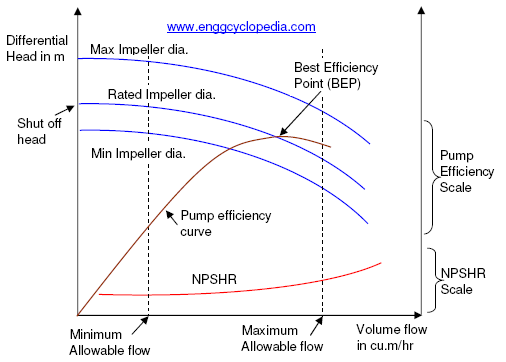
I would check the amp draw on the pump to see if it is fully loaded, under loaded or overloaded...check from startup, look at startup demand, compare to proper performance curve....check operating temperature...If everything checks, then it's time to start rechecking pump performance specs compared to the old pump...

https://www.waterworld.com/articles/print/volume-32/issue-6/departments/pump-tips-techniques/troubleshoot-pump-problems-like-a-best-in-class-pump-user.html

https://www.waterworld.com/articles/print/volume-28/issue-2/departments/pump-tips-techniques/how-to-select-the-most-reliable-pump-for-an-application.html

http://www.enggcyclopedia.com/2011/09/pump-performance-curves/

__________________
All living things seek to control their own destiny....this is the purpose of life
Register to Reply
Guru

Join Date: Mar 2007
Location: by the beach in Florida
Posts: 33392
Good Answers: 1817
#8
In reply to #7

Re: Pump Low Capacity

07/17/2018 10:24 AM

If this is a booster pump, do you have the main pump on?

__________________
All living things seek to control their own destiny....this is the purpose of life
Register to Reply
Guru

Join Date: Oct 2008
Posts: 42355
Good Answers: 1693
#9

Re: Pump Low Capacity

07/17/2018 10:36 AM

Factory tests are run under ideal conditions. Your pump is plumbed to accommodate your plumber's plumbing.

Have you checked rotation; checked proper wiring (assuming 3 phase, for proper rotation and phasing) checked performance curve in your system? Amp draw? Is the pump (not the motor) getting hot?

Have you included elevation difference in your numbers? Also each fitting/elbow/valve adds to pump losses.

Register to Reply Score 1 for Good Answer
Participant

Join Date: Jul 2018
Posts: 4
#10

Re: Pump Low Capacity

07/17/2018 10:44 AM

Thanks all for advises and ideas to troubleshoot the pump. Will come back to share with your all what the result for the next pump test.

Register to Reply
Guru

Join Date: Oct 2008
Posts: 42355
Good Answers: 1693
#22
In reply to #10

Re: Pump Low Capacity

07/24/2018 12:49 AM

We're still waiting.

Register to Reply Score 1 for Good Answer
Power-User

Join Date: Nov 2008
Location: Port Glasgow, Free Republic of Scotland
Posts: 360
Good Answers: 30
#11

Re: Pump Low Capacity

07/17/2018 7:59 PM

Have you tried running the jockety pump with the flow into the main system open (which I would expect to give the 7m3/hr at 5.3barg you have noted) and then start opening the spill back control valve. This should allow you to increase the flow while maintaining the discharge pressure and see if you can get 7m3/hr forward and 19m3/hr through spillback.

You don't say but I assume this is a firewater system. Is it fresh or seawater?

49.4m would be 4.8bar in fresh water and lower for seawater. If the performance curve is very flat the increase in head from 4.8barg to 5.3 barg.

Also there might be a slight mixing of concepts here. I would normally consider a head in m as the differential pressure of the pump and not its discharge pressure. So the problem be the differential in which case I wuld be lookng at the suction. What level in the suction vessel was assumed for the pump preformance and what pressure. If this is a firewater system then if the tank is still being filled then the suction head is not available and so the pump has to deliver a greater differential and so will be operating to the right of it design point on the performance curve at a lower differential but the same discharge pressure.

__________________
Free advice guaranteed or your money back
Register to Reply
Guru

Join Date: Apr 2011
Posts: 8006
Good Answers: 286
#12
In reply to #11

Re: Pump Low Capacity

07/17/2018 8:25 PM

"..49.4m would be 4.8bar in fresh water and lower for seawater. ..."

Nope. It would be higher for seawater...somewhere around 4.9 barg maybe closer to 5.0 barg. Seawater being more dense leads to more pressure for the same column height.

__________________
Eternal vigilance is the price of knowledge. - George Santayana
Register to Reply
Power-User

Join Date: Nov 2008
Location: Port Glasgow, Free Republic of Scotland
Posts: 360
Good Answers: 30
#13
In reply to #12

Re: Pump Low Capacity

07/17/2018 8:38 PM

Man I need more coffee this morning

Yes you are completely right

However the issues around the use of terms or head and discharge pressure is a concern and the point about the suction side is still applicable.

I still cant believe I actually wrote that 30 years I have been doing this shit. Shows you should always check your submissions first

__________________
Free advice guaranteed or your money back
Register to Reply
Guru

Join Date: Oct 2008
Posts: 42355
Good Answers: 1693
#14
In reply to #12

Re: Pump Low Capacity

07/17/2018 8:58 PM

And more work for the motor.

Register to Reply
Guru
Engineering Fields - Mechanical Engineering - New Member

Join Date: May 2008
Location: CHENNAI, TAMIL NADU, INDIA.
Posts: 1851
Good Answers: 65
#15

Re: Pump Low Capacity

07/17/2018 11:57 PM

Dear Mr.tenveng

You have not mentioned about the suction lift and foot valve of adequate flow area for foot valve.

If suction lift is is near 34 feet then you will have the problem, in which case you have to lower the pump

confirm the direction of rotation/

DHAYANANDHAN.S

Register to Reply
Guru
United Kingdom - Member - Indeterminate Engineering Fields - Control Engineering - New Member

Join Date: Jan 2007
Location: In the bothy, 7 chains down the line from Dodman's Lane level crossing, in the nation formerly known as Great Britain. Kettle's on.
Posts: 32175
Good Answers: 839
#21
In reply to #15

Re: Pump Low Capacity

07/18/2018 11:49 AM

Please desist with the assumption that all contributors to this forum are male; this is not the case.

__________________
"Did you get my e-mail?" - "The biggest problem in communication is the illusion that it has taken place" - George Bernard Shaw, 1856
Register to Reply Off Topic (Score 6)
Guru

Join Date: Oct 2009
Location: sometimes Wales,UK.. was Libya, now Oman!
Posts: 1715
Good Answers: 117
#16

Re: Pump Low Capacity

07/18/2018 1:56 AM

Have you checked the voltage and Hz of the supply?

Also you could have an internal problem within the pump, where its passing fluid back on itself.

However...... It has been mentioned that you check the rotation of the pump!
That would be the first thing I check, as i can tell you from years of installing big pumps, that they do flow when in reverse, but the symptoms you describe is that of a reversed pump!

All the other suggestions are good to follow, but if you cannot get a result then call the manufacturer, his pump, he can fix it!

__________________
The square root of nothing is what you make it!
Register to Reply
Guru
Engineering Fields - Mechanical Engineering - New Member Hobbies - CNC - New Member

Join Date: Aug 2006
Location: Western Australia
Posts: 767
Good Answers: 58
#17

Re: Pump Low Capacity

07/18/2018 4:38 AM

To compare present performance to the factory test curve you need to ascertain the differential head across the pump in meters (as mentioned by simonsd).

The shutoff head is quite high, so you do not have a particularly flat curve. Where are you measuring the flow - discharge of the pump before or after the spill back or do you have flow measurement in both lines?

Many have quite rightly suggested checking direction of rotation.

This would also be my first check as a centrifugal pump running in reverse will achieve pretty much the same differential head at zero flow (shutoff) as one running in the right direction, but the curve falls off rapidly with increase in flow. If rotation is correct then you need to plot the curve you are achieving against the shop test curve (Head, flow and power). The results of this test should help you diagnose your problem - let us know how you go.

__________________
If you can't explain it simply, you don't understand it well enough. (A.E.)
Register to Reply
Guru

Join Date: Apr 2017
Location: Southern Illinois
Posts: 627
Good Answers: 13
#18

Re: Pump Low Capacity

07/18/2018 8:08 AM

Is this a new problem in an old installation, or just after some new maintenance/mods on the system? Sometimes after maintenance, you have to vent the lines to ensure proper priming of the pump.

__________________
Science is the "cookbook" for making things.
Register to Reply
Guru

Join Date: May 2016
Posts: 1746
Good Answers: 87
#19

Re: Pump Low Capacity

07/18/2018 10:45 AM

Check your suction conditions. The factory test did not indicate the inlet suction pressure and you didn't indicate the installation suction head. You could also have an inlet restriction at the pump or in the suction hose or piping.

If your suction head is too low, you will cavitate the pump and not achieve flow rate. You also may have an inlet leak somewhere and are also sucking air, which will limit pump flow rate. If you have an inlet air leak, you will see it at the discharge. If you are cavitating, you will not see air in the discharge, but may see cloudiness due to very small bubbles from separated dissolved gasses in the discharge flow.

if the pump is electrically driven, one indication would be to measure operating current and calculate power draw under the various operating conditions. You may have serious leakage internal to the pump, as in a damaged seal or a sprung clearance that happened after the factory test. In that case, the pump will draw full power, but will not deliver rated flow. You may be able to see the volute area warm up after running a while due to friction heating of the internally leaking fluid to the tune of a few tenths of a degree. A power calculation for imbalance between current draw and delivered flow would give you an idea as to how much warming to expect.

Register to Reply
Power-User

Join Date: Sep 2012
Location: Brecksville, OH, USA
Posts: 230
Good Answers: 1
#20

Re: Pump Low Capacity

07/18/2018 11:23 AM

If you have the pump curves, you should be able determine whether the pump was truly designed for your conditions at all relative flows (measure output flows for all discharge conditions of pressure). Do you have the correct impeller? The comments on this forum are all accurate.

Register to Reply
Participant

Join Date: Jul 2018
Posts: 4
#23

Re: Pump Low Capacity

08/09/2018 2:00 AM

Dear all, the latest update from our pump test today is the pump had improvement on the flow after our customer change non return valve at discharge side. Now the flow can achieve to 15.4m3/hr at 5.5bar. Previous pump test is 6-7m3/hr at 5.3 bar. Anyway our pump still cannot achieve the rated flow which is 27m3/hr at 4.7bar.

-Pump rotation checked correct rotation.

-Pump suction is 2 inch and discharge is 1 inch. Piping arrangement at side is suction (4 inch to 2 inch) and discharge (1 inch to 4 inch). Referring to discharge piping arrangement this could cause pump loss it discharge pressure. But seem like this pump can achieve the pressure. Any idea. Sorry I cannot upload the pump site condition.

Below is our pump test result. By referring to the spillback opening at 10% and 100%, a bit weird that the flow and discharge pressure is same no changing. Any idea and advise.

We still waiting from our customer to confirm the suction strainer condition. Only this item not yet checked.

Flow (m3/hr)Discharge Pressure (bar)Spillback %Remarks
15.75.510
15.45.5100
20.54.7100Open hydrant to simulate get more flow
Register to Reply
Guru

Join Date: Aug 2005
Location: Hemel Hempstead, UK
Posts: 5826
Good Answers: 322
#24
In reply to #23

Re: Pump Low Capacity

08/09/2018 5:59 AM

15.4 m³ through a 1" diameter pipe is about 30 km/hr (~19 mph).

I'd have thought that that (1") was much too small.

__________________
If you spend all your time looking for people and things to complain about: trust me, you will find plenty to complain about.
Register to Reply
Guru

Join Date: Apr 2017
Location: Southern Illinois
Posts: 627
Good Answers: 13
#25
In reply to #23

Re: Pump Low Capacity

08/09/2018 8:03 AM

I'm going on a wild guess here. Could it be that when the pump was being re-assembled, the mechanic turned around to grab a wrench, the key fell out while he wasn't looking, and now the impeller slowly slips around the shaft as the flow increases?

__________________
Science is the "cookbook" for making things.
Register to Reply
Guru
Engineering Fields - Mechanical Engineering - New Member Hobbies - CNC - New Member

Join Date: Aug 2006
Location: Western Australia
Posts: 767
Good Answers: 58
#26
In reply to #23

Re: Pump Low Capacity

08/10/2018 3:16 AM

Do you have the shop test curves for this pump. If you gave us this and converted all your pressures into differential head in meters/ft (or just gave us the suction pressure and whether you are pumping fresh or sea water) then we would have a better chance of understanding what might be going on. Also if you measured/calculated power at all the measured flow points including shutoff on site you could see where you are on the curve and work out what's going on. Without that information we can only guess. Even the make and model of the pump would help.

__________________
If you can't explain it simply, you don't understand it well enough. (A.E.)
Register to Reply
Register to Reply 26 comments

"Almost" Good Answers:

Check out these comments that don't yet have enough votes to be "official" good answers and, if you agree with them, vote them!
Copy to Clipboard

Users who posted comments:

brich (1); Dennis R. Levesque (2); dhayanandhan (1); Dr. Harry (1); Jpfalt (1); Just an Engineer (1); lyn (3); MACA (1); PWSlack (3); Randall (1); simonsd (2); SolarEagle (2); TdZeeuw (1); teveng (3); The Prof (2); truth is not a compromise (1)

Previous in Forum: Danfoss Compressor   Next in Forum: API 650 Material Groups

Advertisement