Previous in Forum: How to Increase the Power Output of a 300 Watt Broadcast Amplifier?   Next in Forum: UPS Input Power
Close
Close
Close
27 comments
Rating: Comments: Nested
Commentator

Join Date: Jun 2018
Posts: 57

How to Choose A Suitable Sampling Frequency for this Current Sensor?

10/14/2018 1:07 AM

I'm using this current sensor TLI4970-D050T4 located at the emitter leg of a power IGBT. This transistor is being switched at 10 kHz. How do I choose the convenient sampling frequency for the sensor? My bandwidth is 18 kHz. The IGBT is used in low side switching application to control a DC motor. How fast should I sample the current to get valuable information?

Register to Reply
Interested in this topic? By joining CR4 you can "subscribe" to
this discussion and receive notification when new comments are added.

Good Answers:

These comments received enough positive votes to make them "good answers".

"Almost" Good Answers:

Check out these comments that don't yet have enough votes to be "official" good answers and, if you agree with them, vote them!
Guru

Join Date: Mar 2007
Location: by the beach in Florida
Posts: 33392
Good Answers: 1817
#1

Re: How to choose a suitable sampling frequency for this current sensor?

10/14/2018 2:37 AM
__________________
All living things seek to control their own destiny....this is the purpose of life
Register to Reply
Guru

Join Date: Apr 2010
Location: About 4000 miles from the center of the earth (+/-100 mi)
Posts: 9910
Good Answers: 1141
#2

Re: How to Choose A Suitable Sampling Frequency for this Current Sensor?

10/14/2018 11:08 AM

For starters, your sampling frequency should be a divisor of your switching rate, i.e., 10 kHz/N, where N is a whole number. The will prevent switching transients from contributing noise.

The optimum sampling rate depends on your application. The most demanding application that comes to mind is a drone control circuit, and the smaller the drone, the higher the sampling rate needed. Maybe this will give you an idea.

https://robotics.stackexchange.com/questions/231/what-frequency-does-my-quadcopter-output-sense-calculate-output-update-loop-need

Register to Reply
Commentator

Join Date: Jun 2018
Posts: 57
#3

Re: How to Choose A Suitable Sampling Frequency for this Current Sensor?

10/14/2018 2:05 PM

I'm learning how to use this sensor. So, I appreciate any guidance. The sensor is physically located at the emitter leg of the IGBT as said before. So, what useful information about the current can I obtain with this sensor and how? The sensor has overcurrent detection. I'm using this feature through an interrupt routine as pointed out in the datasheet. But, how can I get the actual motor's current? I mean, my original question was about how fast I should sample the current so I get useful information. For example, I was sampling every 10 ms, but someone told me it's too slow.

Register to Reply
Guru

Join Date: Mar 2007
Location: by the beach in Florida
Posts: 33392
Good Answers: 1817
#4
In reply to #3

Re: How to Choose A Suitable Sampling Frequency for this Current Sensor?

10/14/2018 3:08 PM

What exactly are you trying to build? What is the goal?

__________________
All living things seek to control their own destiny....this is the purpose of life
Register to Reply
Commentator

Join Date: Jun 2018
Posts: 57
#5
In reply to #4

Re: How to Choose A Suitable Sampling Frequency for this Current Sensor?

10/14/2018 3:13 PM

To use this sensor to measure the current of a motor which is being PWM controlled. The physical circuit is already made (PCB). It's a software issue.

Register to Reply
Guru

Join Date: Mar 2007
Location: by the beach in Florida
Posts: 33392
Good Answers: 1817
#8
In reply to #5

Re: How to Choose A Suitable Sampling Frequency for this Current Sensor?

10/14/2018 3:46 PM

So you're looking for a software program that will monitor the current use of a motor...? Do you intend to write a program, or are you looking for one already written?

Freemaster makes a monitor and control program...

https://www.nxp.com/docs/en/application-note/AN2955.pdf

http://forum.arduino.cc/index.php?topic=231766.0

__________________
All living things seek to control their own destiny....this is the purpose of life
Register to Reply
Guru

Join Date: Apr 2010
Location: About 4000 miles from the center of the earth (+/-100 mi)
Posts: 9910
Good Answers: 1141
#6
In reply to #3

Re: How to Choose A Suitable Sampling Frequency for this Current Sensor?

10/14/2018 3:36 PM

But, how can I get the actual motor's current?

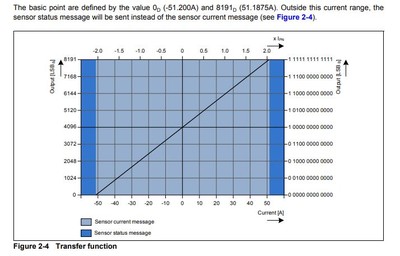
You read the binary data over the SPI interface. The 13 bit binary number translates to -51.200 to +51.1875 A as shown in the graph above.

https://www.infineon.com/dgdl/Infineon-TLI4970-D050T4-DS-v01_01-EN.pdf?fileId=5546d4625607bd1301562c43e04f38ad

https://en.wikipedia.org/wiki/Serial_Peripheral_Interface

Register to Reply
Commentator

Join Date: Jun 2018
Posts: 57
#7
In reply to #6

Re: How to Choose A Suitable Sampling Frequency for this Current Sensor?

10/14/2018 3:42 PM

Thank you. I'm actually reading the current. I'm okay with the SPI interface. My question is basically about how fast I should sample that current. As I'm measuring a switching element, I will get non zero values when the transistor is ON, and zero values when it's off. It's actually how I'm going to handle the data obtained, that's where I'm a bit lost.

Register to Reply
Guru

Join Date: Apr 2010
Location: About 4000 miles from the center of the earth (+/-100 mi)
Posts: 9910
Good Answers: 1141
#9
In reply to #7

Re: How to Choose A Suitable Sampling Frequency for this Current Sensor?

10/14/2018 5:31 PM

OK, I think I understand your question. If you are driving a motor with pwm, you need a flyback diode in series with the motor. (If you try to switch the motor current on and off at a rapid rate, you would get severe voltage spikes on the turn off.) The flyback diode allows current to flow through the motor during the IGBT off period.

So why not put the current sense terminals (7,8) in series with the motor and the flyback diode across the motor and current sensor series combination? It will then read the current through the motor.

This current will fluctuate up and down as the IGBT switches on and off but the average value will be what you are looking for. The higher the switching frequency, the less the variation in motor current. In this case, you might want to sample at a frequency not related to your switching frequency and average.

Here is the same principle, driving a solenoid instead of a motor and with a different type of current sensor.

https://www.edn.com/design/analog/4369564/Monitor-PWM-load-current-with-a-high-side-current-sense-amplifier

Register to Reply
Commentator

Join Date: Jun 2018
Posts: 57
#10
In reply to #9

Re: How to Choose A Suitable Sampling Frequency for this Current Sensor?

10/14/2018 5:50 PM

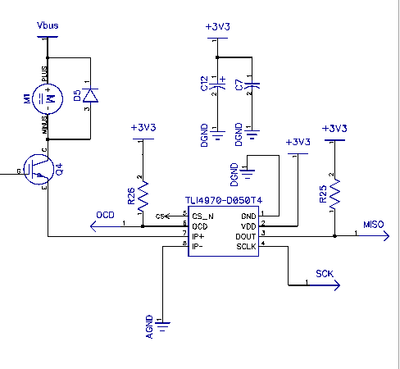
This is the circuit. I thought of placing the sensor in series with the motor after I got my PCB. Unfortunately, I have to use it like that for now. For a future design, I will consider putting it in series with the motor. So, how fast would you read the current in this circuit?

Register to Reply
2
Guru

Join Date: Apr 2010
Location: About 4000 miles from the center of the earth (+/-100 mi)
Posts: 9910
Good Answers: 1141
#11
In reply to #10

Re: How to Choose A Suitable Sampling Frequency for this Current Sensor?

10/14/2018 6:31 PM

We're back where we started. Sample at a rate not related to the switching rate so that the sample points will be distributed across the pwm cycle. Sampling as fast as possible will give the most accurate result, but will result in a greater computation load in averaging. In lieu of averaging, you could sample at a time when the IGBT is on and multiply by the pwm ratio. It should give you the same answer.

Changes in motor current will be driven by two factors: pwm variations (drive signal) and change in motor load (change in speed and back emf of motor). How fast these factors change depend on your application. If these change slowly, you may be able to reduce sampling rate and reduce processing load.

It's all a trade-off. What works best for you may require experimentation. If possible, make it a variable that you can change after testing.

Register to Reply Good Answer (Score 2)
Guru

Join Date: Dec 2010
Posts: 1686
Good Answers: 116
#22
In reply to #10

Re: How to Choose A Suitable Sampling Frequency for this Current Sensor?

10/20/2018 4:53 PM

Right from the first, you have had the Hall effect current sensor measuring the FET/IGBT current - not the motor current.

For confusion, as well as serial current value output, the hall sensor has a fast overcurrent detection (analog) with a response time of a few microseconds [activation current settable to 90 amp, presumably greater currents will still activate since it is an analog circuit], which could be used via an interrupt on the microcontroller [or hard wire logic] to save the power switch [FET/IGBT] even from short circuit fault.

In the TLI4970 input ADC [sigma-delta type], a current proportional to Hall output is fed into an integrator [capacitor]. When the integrator output voltage indicates a certain amount of charge Q has been added, a compensating pulse of charge Q is clocked-in. Over 4096 clock cycles, the number of compensating pulses is totalled and is proportional to the measured input. By offsetting the input, the measurement is made bi-directional [+/- polarity].

This works fine if the input is constant during the 4096 cycles. But the data sheet Table 3-3 indicates 80000 updates a second or 12 microseconds between reads. If the Hall current is in 5 μsec pulses every 10 microseconds, there can be [e.g.] 2.5 μsec of input in one measurement & 2.5 μsec in the next - because the input overlaps two measuring periods.

Thus the phasing of time between FET current pulses and the measuring cycle can cause big errors. Practically, this phasing will drift about due to frequency & phase of motor pulses & ADC clock.

Using 5MHz clock [see Table 4-1], the SPI serial connection has a sampling interval of 3 μsec & seems a lesser cause of sampling problems.

The block diagram Fig 2-2 of data sheet shows filters are after ADC or in DSP - so they are not contributing a smoothed input during ADC measurement cycle. However, there may be filters before ADC or due to its integrator capacitor - getting a measurement from SPI & checking its accuracy & fluctuation sample to sample would establish what can be got.

However it seems the SPI output would be usable if the motor current was measured, by relocating primary connection, as suggested by other posts. You will not be able to use sensor for fast overcurrent protection of FET/IGBT.

It is suggested you just cut tracks on PCB & use insulated wires to feed motor current into current sensor till you have got a working design - else you may make several more PCB!!

Note, if the FET current exceeds 52 amps, the SPI output goes into over-range STATUS mode - if motor mean current of 25 amps or more is required at low speed, requiring peak currents over 52 amps this could be a problem.

Register to Reply
Commentator

Join Date: Jun 2018
Posts: 57
#23
In reply to #22

Re: How to Choose A Suitable Sampling Frequency for this Current Sensor?

10/20/2018 5:59 PM

Thank you. I will try to cut PCB traces and move the sensor connections. Now, I just want to be clear in something. How different is the FET current in comparison with the motor current?

Register to Reply
Guru
Engineering Fields - Electrical Engineering - Been there, done that. Engineering Fields - Control Engineering - New Member

Join Date: Dec 2008
Location: Long Island NY
Posts: 15600
Good Answers: 981
#24
In reply to #23

Re: How to Choose A Suitable Sampling Frequency for this Current Sensor?

10/20/2018 10:59 PM

Well, when the transistor turns OFF the transistor current will be zero. When the transistor turns OFF the motor current will initially stay the same but instead of flowing through the transistor it will flow through the flyback path of your snubber network (diode, resistor/capacitor).

__________________
"Don't disturb my circles." translation of Archimedes last words
Register to Reply
Guru

Join Date: Dec 2010
Posts: 1686
Good Answers: 116
#25
In reply to #23

Re: How to Choose A Suitable Sampling Frequency for this Current Sensor?

10/25/2018 10:28 AM

Basically, the motor current is "constant", while FET delivers pulses of microseconds every 10 microseconds - because you programmed the gate drive that way. I will leave out FET currents due to flywheel diode or circuit/motor capacitance or turn-off drain voltage, you need basic information about motor inductance first.

At the first pulse, you are connecting 170V supply to a motor rotor [turns of wire round an iron core] which can be represented as an inductor L Henrys in series with resistor. The motor resistance is about 1 ohm & suppose the inductance is 1 mH N.B. Helix of 54 turns 50mm diameter over 50mm length is about 100 μH in air - you have an iron core, but there are air gaps in magnetic circuit reducing effective permeability. The L/R time constant for that is 0.001Henry/1 ohm = 0.001 seconds. Note that "constant" L at any current is a theoretical convenience for a basic analysis, the effective value will reduce due to saturation, especially if the motor cannot turn & you get currents of 170V/1 ohm =170 amp - many times full load of 25 amps.

Applying a step voltage e to an inductor, the initial current flow is given by...

e = Ldi/dt,

from which di/dt = e/L = 170volts/0.001Henry = 170.10^3 amps/second in this case - or 0.17 amps per microsecond.

So if FET is on for 5 μs, current will be 5 x 0.17 = 0.85 amps at turn-off, when the inductor current will switch to circulating through the "flywheel" diode.

Initially, suppose the rotor is fixed in position [locked-rotor] so it cannot rotate and give a back-emf, which would reduce "e" for calculation purposes. Note this also means there is no additional reduction of inductor current due to the mechanical energy being put into rotor.

N.B. 3000W shaft power is 3000 Joules/second = 15 mJ/5 microsecond - Energy stored in 1 mH @ 25 amp is 0.5L.I^2 : ~= 0.31 Joules - So 15mJ is equivalent to ~ 0.7 amp reduction in current as inductance gives energy while FET is off. Compare power lost in 1 ohm @ 25 amp = 625 watts = 625 J/s = 625/[10^5] J in 10 microsec = 6.25 mJ/10 microsec. So the rough analysis is the motor current is 25 DC amps with a 0.7 amp peak-peak 10 kHz "sawtooth" fluctuation. Note there is a discrepancy between this 0.7 amp & 0.85 amp current rise in 5 μs calculated above, but the required rise is less than possible rise.

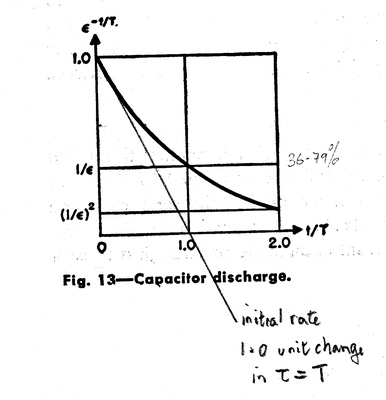
While FET is off, motor current will reduce according to exponential time constant T; L/R = 1ms = 1000 μs.
It is usefull to note the initial fall rate is such that, if maintained, the current would fall to zero in time T & that rate changes little over first 10%-20% of time constant.(the diagram title is capacitor, but it is just as applicable to inductive decay).


So with a time of 5 μs before FET turns on again, current will fall only by 5/1000, or 0.5% of initial value which can be neglected.
The next pulse will increase motor current from 0.17 to 0.34 amps etc, so after 1000 μs the current will be 0.17 x 1000/10 = 17 amps.

At this point, note that if the Hall current measuring IC should sample with 12 μs window, it may include one or "one and a bit" "step ups" of current by 0.17 amp - but the error in measured current will be little more than 1% of 25 amps.

Returning to the question of the sample rate, an immediate limit will depend on the clock of the SPI interface from your microcontroller. Being pessimistic, if L/R = 0.1 ms, current could change 1.7 amp between samples each 12 μs - which is 10% of the 17 amp considered. Such an increase is not insignificant & if samples were measured each 100 μs, current could change by over 10 amp.

So really, you need the fastest sample rate you can get and to make measurements so you can know what size L/R is and also how quickly motor accelerates.
It is not clear if your experiments with 5 μs on/off time were with motor rotor free or with treadmill attached. Obviously you need to be able to measure current often enough to impose a current limit [reduction of on pulse length] before IGBT or motor are overstressed because treadmill is jammed or overloaded.

You need some measurements on the motor. If you do not have an oscilloscope, you need a programme to measure the current from the hall device at known intervals & save it in memory, or if memory is not enough size, send via serial interface to your computer.

You could leave the hall sensor in the FET circuit & programme an interrupt from the overcurrent output to turn off the drive as quick as possible - you would have to change the O/C setting from max until you got an interrupt, an awkward way to measure the max current you are getting - but if you have no better way available, it beats not knowing!

Register to Reply
Commentator

Join Date: Jun 2018
Posts: 57
#26
In reply to #25

Re: How to Choose A Suitable Sampling Frequency for this Current Sensor?

10/25/2018 1:03 PM

I had dropped the current measurement topic for a while. I was paying attention to other weak areas of the project. Now I will get back to the current measurement again. So far, the general idea of the project is working (except for the current sensor). All my tests have been with the treadmill attached. At the end of the day, I decided to go with a PWM frequency of 5 kHz. The controller is an L432KC Nucleo clocked at 32 MHz. The SPI clock is 2 MHz (5 MHz max according to current sensor datasheet). I don't know if you're familiar with STM32 HAL libraries. This is the way I'm reading the sensor:

HAL_GPIO_WritePin(GPIOA, GPIO_PIN_5, GPIO_PIN_RESET); //Bring CS low

HAL_SPI_Receive(&hspi1, (uint8_t *)&SPIRx, 2, 500); //Read SPI data

HAL_GPIO_WritePin(GPIOA, GPIO_PIN_5, GPIO_PIN_SET); //Bring CS high

Now, how fast I'm doing that is the point here. You have told me that I should sample as fast as I can. The advantage here is that the sensor is really fast. According to the datasheet,

If a new sample should be read from the sensor, the CS-pin has to return to the high state for at least the time tCSON before pulling it to low again in order to trigger the next sample readout.

And tCSON = 300 ns min.

To be honest, I'm still not sure about the best way of getting useful information from the sensor based on the project's features. Basically, as you said, I should sample very fast to see if the current goes too high due to high load, as this would allow me to shut down the system, or throw an overcurrent warning. I will carefully analyse all you've stated again. It's useful info.

Register to Reply
Guru

Join Date: Dec 2010
Posts: 1686
Good Answers: 116
#27
In reply to #26

Re: How to Choose A Suitable Sampling Frequency for this Current Sensor?

11/05/2018 5:46 AM

Your procedure seems to match the requirements to read serial output. I assume the machine code called does as your function is named.

I had a look at the data sheet & maker's website. They make a demonstrator board for the TLI4970 IC. It mentions that their software samples at 40000 times/second, while the A/D measures 80000/second.

The reason for this must be that the IC has no interrupt output to tell a microcontroller it has new measurement data, also that 80000/sec has no tolerance but must depend on internal clock of IC [probably R-C oscillator +/- 5% variation] which is not specified on data sheet.

The DSP must output a 16 bit number to the serial register each time it finshes a reading, but that buffer must be locked while sending out data in response to SPI clock so it cannot be overwritten by new measurement. Otherwise, If the CS demand came in the middle of a measurement, what you get could be part old, part new. Also, data sheet does not define what happens if CS/clock demands an output after getting one value, but before a new measurement is available. Will the clock cause random or zero bits to be sent?

Demanding a new value only after sufficient time for two measurements [40000/second] seems to be a way to ensure that there is a new value available each time a send is initiated by CS/SCLK.

A look at the safe area curves for power FET/IGBT shows that with 12V gate drive a short circuit is not survivable for more than about 12 μs - there is no possibility that the amps reading rate [plus time to process any reading & cut-off FET drive] can provide full drive protection - hence the provision of a hard-wired fast output OCD. However, since you have moved current monitor to motor current, this is just information.

I note that the IGBT has specs [p.5 data sheet] for short-circuit withstand & inductive load switching; while IRF250 has just avalanche withstand data for inductive load [500μH]- which show a big fall at hot junction temperature [Fig.17] - as with all switch devices. The reason for survival of your IGBT c.f. FET is probably its much higher output voltage rating. 120V rms x √2, +10% = 187V is close to voltage at which FET capability [Fig.10] declines faster.

The massive effect of junction temperature on microseconds/amps/volts survival makes one ask "how good is your heat-sink"??

Register to Reply
Member

Join Date: Jul 2018
Posts: 5
#13
In reply to #9

Re: How to Choose A Suitable Sampling Frequency for this Current Sensor?

10/14/2018 10:50 PM

so important information ,thank you for your anwser,i have learne a lot

Register to Reply
2
Guru
Engineering Fields - Electrical Engineering - Been there, done that. Engineering Fields - Control Engineering - New Member

Join Date: Dec 2008
Location: Long Island NY
Posts: 15600
Good Answers: 981
#12

Re: How to Choose A Suitable Sampling Frequency for this Current Sensor?

10/14/2018 10:37 PM

Ok, I think you will actually have multiple frequency related problems here but first let me address your actual question. Since your sensor has an 18 kHz bandwidth if you sample at anything slower than 36 kHz then aliasing can occur. This is fundamental Nyquist sampling theory. Now if your sensor's bandwidth is from only a simple single pole filter then higher frequencies than your 3 db corner frequency of 18 kHz can still produce aliasing problems. I see that the current sensor (Fig 2.5) when set to 18 kHz has a steeper roll off than a single pole filter so this might not be a problem.

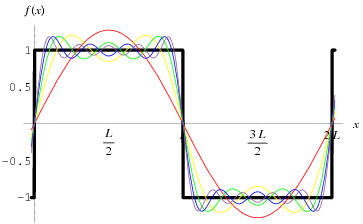
I am concerned that you wish to PWM switching at a frequency so close to the corner frequency. Even if the smallest ON/OFF switching pulse width you can modulate to is 50 microseconds (half the period of a 10 kHz 50% square wave) an 18 kHz filter will be too slow and will distort your signal. Remember your Fourier series for a square wave.

(The red waveform is just the fundamental frequency. The yellow is sum of the fundamental and the third harmonic. Green is first, third and fifth harmonic combined. etc.)

I would switch at a much lower frequency than my feedback bandwidth. You must sample at least twice as fast as your feedback bandwidth to not produce erroneous information.

__________________
"Don't disturb my circles." translation of Archimedes last words
Register to Reply Good Answer (Score 2)
Commentator

Join Date: Jun 2018
Posts: 57
#14
In reply to #12

Re: How to Choose A Suitable Sampling Frequency for this Current Sensor?

10/14/2018 11:04 PM

Good information. Actually, I'm planning to switch now at 5kHz. So, sampling at something greater than 36 kHz is the way to go?

Register to Reply
Guru
Engineering Fields - Electrical Engineering - Been there, done that. Engineering Fields - Control Engineering - New Member

Join Date: Dec 2008
Location: Long Island NY
Posts: 15600
Good Answers: 981
#16
In reply to #14

Re: How to Choose A Suitable Sampling Frequency for this Current Sensor?

10/15/2018 9:48 AM

Your 18 kHz bandwidth limit of your sensor will allow only the fundamental and third harmonic of your 5 kHz switching frequency to pass through. Thus if the current actually looks like a 5 kHz 50% duty cycle square wave then the output of your sensor will be the yellow waveform and not the black waveform. Changing the duty cycle from 50% (PWM) will mean even harmonics (10, 20, 30 kHz, etc.) will appear, too. As a rule of thumb to capture a square wave, one should have a bandwidth ten times the fundamental frequency. This is the lavender waveform from the Mathworld picture.

Now, the inductance of your motor will limit how quickly the emitter current can change so my concerns might be moot. However, if the motor or circuitry starts acting differently than expected I would want my control circuitry to not omit possibly useful information.

__________________
"Don't disturb my circles." translation of Archimedes last words
Register to Reply
Guru
United Kingdom - Member - Indeterminate Engineering Fields - Control Engineering - New Member

Join Date: Jan 2007
Location: In the bothy, 7 chains down the line from Dodman's Lane level crossing, in the nation formerly known as Great Britain. Kettle's on.
Posts: 32175
Good Answers: 839
#15

Re: How to Choose A Suitable Sampling Frequency for this Current Sensor?

10/15/2018 3:31 AM

The sampling rate for most analog-based DC model railway feedback controllers is 100Hz, being twice the frequency of the incoming mains supply in the UK, and related to full-wave rectification of the 16VAC at 50Hz normally supplied to it.

(not an endorsement - other types and makes are available)

The sampling rate and the mechanical inertia in the motor are inter-related. 100Hz is quite satisfactory for most motors, though some coreless types, the Portescap 1219 being the most prominent one for concern that is used in 4mm:1ft scale models, require a slugging resistance wired across their terminals; 75Ω has proven to be satisfactory.

(not an endorsement - other types and makes are available)

If the motor has a significant flywheel effect attached to it mechanically, then a slugging resistance is unnecessary irrespective of motor type.

__________________
"Did you get my e-mail?" - "The biggest problem in communication is the illusion that it has taken place" - George Bernard Shaw, 1856
Register to Reply
Associate

Join Date: Mar 2012
Posts: 42
Good Answers: 5
#17

Re: How to Choose A Suitable Sampling Frequency for this Current Sensor?

10/15/2018 5:27 PM

Not answering your original questions, but making an observation . . .

You may find that a diode across the motor (to eliminate the positive voltage spikes from inductive kickback) will be counter-productive for smooth/quiet motor operation. When the motor drive current from the PWM turns off, the motor becomes a generator and generates current into the now-forward-biased diode (which acts like a short circuit) slowing the motor down fast. It may make sounds like it is growling. You can minimize this generator-into-shorted-load effect by changing to a different type of snubber circuit. You can add a resistor in series with the diode or use a series R-C snubber to minimize the growling effect while limiting the voltage spike amplitude.

Register to Reply Score 1 for Good Answer
Guru
Engineering Fields - Electrical Engineering - Been there, done that. Engineering Fields - Control Engineering - New Member

Join Date: Dec 2008
Location: Long Island NY
Posts: 15600
Good Answers: 981
#18
In reply to #17

Re: How to Choose A Suitable Sampling Frequency for this Current Sensor?

10/15/2018 9:51 PM

A very good point that nonetheless misses a mark but also adds a very critical analysis factor.

The simplified time constant of an inductor is τ= L/R. A diode is a very non-linear device but while it is conducting the current and voltage is in phase and therefore resistive in nature and of a very low resistive value. Thus very little energy will be dissipated on each turn OFF cycle where current flows through this diode. Therefore once the switching transistor does actually turn ON the current through the motor will not be significantly altered. To know how much per cycle will require knowing the parasitic resistance of the coil, the inductance of the coil and the back EMF of the motor at the instant of turning OFF the switching transistor. None of these attributes are given and one attribute cannot even be predicted.

By adding a series resistance to the diode, the energy in the motor on each OFF cycle can become more dissipated, but is this desired or not?

__________________
"Don't disturb my circles." translation of Archimedes last words
Register to Reply
Commentator

Join Date: Jun 2018
Posts: 57
#19
In reply to #17

Re: How to Choose A Suitable Sampling Frequency for this Current Sensor?

10/15/2018 10:03 PM

I spent time researching about the need of a RC/RCD snubber for my application. At the end of the day I came up with not adding the snubber network. I just added the flyback diode. I'm really starting to design, so I found the snubber design kind of complex for now. I wondered myself "Do I need a snubber? I'll see what happens without it first". So far, I've been running the motor well. But I haven't been able to deeply appreciate with a good scope what is really happening.

Register to Reply
Guru
Engineering Fields - Electrical Engineering - Been there, done that. Engineering Fields - Control Engineering - New Member

Join Date: Dec 2008
Location: Long Island NY
Posts: 15600
Good Answers: 981
#20
In reply to #19

Re: How to Choose A Suitable Sampling Frequency for this Current Sensor?

10/15/2018 10:32 PM

You may inadvertently be helping yourself by not using an oscilloscope. What many forget is that most oscilloscope measure the voltage referenced to earth/ground. The magnetic field that drives a motor is the current flowing through the windings.

__________________
"Don't disturb my circles." translation of Archimedes last words
Register to Reply
Associate

Join Date: Mar 2012
Posts: 42
Good Answers: 5
#21
In reply to #19

Re: How to Choose A Suitable Sampling Frequency for this Current Sensor?

10/16/2018 2:45 PM

Continue to make progress until you think you have things working reasonably well, and then consider optimizing with snubber variations. With no series resistance, the motor braking during the "off" times is at a maximum, but the inductive kick-back voltage is minimized. In addition to the inductive kick-back, the inertia of the motor-generator adds an open-circuit voltage that may be very close to the applied voltage (depending on the speed). Adding a series resistor reduces the current that will flow from this generated voltage, reducing the braking forces (and dissipating power in the resistor). You will probably notice a significant reduction in the sound of the motor torque pulses as they couple mechanical vibrations to the chassis. Watch the transistor voltage with a scope to make sure you are not exceeding the voltage breakdown specifications. With low resistance motors, the resistive snubber may allow you to get more torque from the system before it stalls. This is not just an electrical system, but an electro-mechanical system. You can put a switch across the resistor to short it out for progress experiments. Remember: One experiment is worth a thousand expert opinions.

Register to Reply
Register to Reply 27 comments

Good Answers:

These comments received enough positive votes to make them "good answers".

"Almost" Good Answers:

Check out these comments that don't yet have enough votes to be "official" good answers and, if you agree with them, vote them!
Copy to Clipboard

Users who posted comments:

67model (3); Carl Van Wormer (2); PWSlack (1); redfred (5); Rixter (4); SolarEagle (3); williswang (1); XaviPacheco (8)

Previous in Forum: How to Increase the Power Output of a 300 Watt Broadcast Amplifier?   Next in Forum: UPS Input Power

Advertisement