Previous in Forum: Air Expansion in a Sealed Tank   Next in Forum: Trench Heating
Close
Close
Close
15 comments
Rating: Comments: Nested
Member

Join Date: Nov 2018
Posts: 5

Gear Wear Rig Calculations

11/22/2018 9:43 AM

Below I've attached a sketch of the rig designed to wear down the gears.f Firstly my project idea is to test the durability and overall wear of plastic & 3D printed gears however the 3D prints will be electroplated to see what difference it potentially makes. The idea of the rig is to have a motor attached to the two gears which I wanna see being worn down.

In order to do so however I need to determine the load that they'll be working on and I am not sure how to approach it so it's most efficient.

The pulley would have a belt which would be sliding on top with a mass attached on one side this way I can add on more weight to increase the friction and therefore the load if needed, and the other side is would have the belt fixed.

My question is as I feel a bit stuck now for calculations and general of where to start off with the calculations as I will need to work a little backwards.

Should I select the gears first, and find out what the teeth maximum load is? From there determine the friction torque of the pulley and then determine the required motor? I am fairly stuck as to where to start with the calculations and would greatly appreciate help.

Thank you

Link for the design sketch https://imgur.com/a/wvlanDz

Register to Reply
Interested in this topic? By joining CR4 you can "subscribe" to
this discussion and receive notification when new comments are added.

Good Answers:

These comments received enough positive votes to make them "good answers".
Guru

Join Date: Oct 2008
Posts: 42355
Good Answers: 1693
#1

Re: Gear Wear Rig Calculations

11/22/2018 11:59 AM

Forget calculations. Plating a gear radically changes any characteristics of the plastic beneath it. That's a waste of time. You'll be testing the metal and NOT the plastic and the metal is much harder. Your conclusion, no matter the load, will be that the plastic wears out sooner.

Just make the size and pitch match and get on with it.

KISS!

Choose a motor big enough to drive the apparatus under any load and make your apparatus adjustable to apply different friction loads.

Register to Reply
Guru

Join Date: Mar 2007
Location: by the beach in Florida
Posts: 33392
Good Answers: 1817
#2

Re: Gear Wear Rig Calculations

11/22/2018 12:14 PM

You must first determine the load and environmental conditions together with design life to select the material of the gears and the material properties needed to meet the goal....Once you determine the load, operating conditions, and length of service expected, then you can determine which materials will fit this criteria...another critical factor can be lubrication, what type of lubrication, what delivery method and maintenance interval works for this application...needless to say you need people who specialize in each of these fields for efficient results....Your test rig needs a way to accurately measure torque...

https://www.rtpcompany.com/products/product-guide/nylon-6-pa-polyamide-6/

https://www.machinedesign.com/mechanical-drives/plastic-gears-more-durable-ever-plastics-get-gear

https://www.hindawi.com/journals/at/2015/926918/

__________________
All living things seek to control their own destiny....this is the purpose of life
Register to Reply
Member

Join Date: Nov 2018
Posts: 5
#3

Re: Gear Wear Rig Calculations

11/22/2018 12:39 PM

I suppose you're right and that's what I am expecting, however for the project I'll still need to back it up with some calculations for the rig. Unfortunately...

Thank you for the links, I am getting on top of getting info from them now.

What kind of equation should I be looking at to determine torque of a motor / required based off the friction created by the load?

Register to Reply
Guru

Join Date: Mar 2007
Location: by the beach in Florida
Posts: 33392
Good Answers: 1817
#4
In reply to #3

Re: Gear Wear Rig Calculations

11/22/2018 12:59 PM
__________________
All living things seek to control their own destiny....this is the purpose of life
Register to Reply
Member

Join Date: Nov 2018
Posts: 5
#5

Re: Gear Wear Rig Calculations

11/22/2018 1:18 PM

oh, that's a great idea actually. Thank you

Register to Reply
Guru

Join Date: Apr 2010
Location: About 4000 miles from the center of the earth (+/-100 mi)
Posts: 9910
Good Answers: 1141
#6

Re: Gear Wear Rig Calculations

11/22/2018 8:39 PM

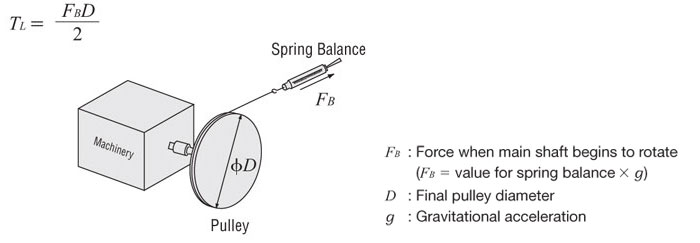
Connect a spring scale between the fixed point (on the right) and the belt. If you subtract the weight of the mass counterweight from the scale reading, you get the force supplied by the friction. Multiply this force by the radius of the pulley to get the load torque.

Register to Reply
Member

Join Date: Nov 2018
Posts: 5
#8
In reply to #6

Re: Gear Wear Rig Calculations

11/23/2018 10:50 AM

Perfect thank you, I will probably use the spring load then, makes it much easier to do any calculations.

Thank you for the book suggestion will be looking for it now and doing further research.

Register to Reply
Guru

Join Date: May 2016
Posts: 1746
Good Answers: 87
#15
In reply to #6

Re: Gear Wear Rig Calculations

11/28/2018 7:41 PM

You can also measure motor voltage and amperage to calculate watts. It will more likely be accurate than the spring scale method since you will have a range for belt/pulley friction coefficients and those coefficients vary quite a bit depending on surface conditions and temperature. You can get further accuracy by putting a permanent magnet motor and variable load instead of the belt and pulley brake and measure watts out as well. Given watts in and watts out you can measure losses and estimate normal forces. You will also be able to measure at which loads the wear mechanism begins to ramp up.

Register to Reply
2
Power-User

Join Date: Jun 2007
Location: Center of the Known Industrial Universe - TUGGERAH 2259 - Australia
Posts: 259
Good Answers: 52
#7

Re: Gear Wear Rig Calculations

11/23/2018 12:46 AM

DuPont published "Zytel Nylon Resins Design Handbook" A-97932 in 1972 which (in my 1974 edition pages 120 thru 129) provides plastic gear design nomographs, graphs for design stress versus life, for design stress versus temperature, for tooth bending stress versus life.

Starting with the Lewis equation, they also offer several useful plastic gear design load equations.

Using those pages, you will be able estimate the parameters you mention, and compare those estimates with your rig results for validation.

Register to Reply Good Answer (Score 2)
Guru

Join Date: Oct 2008
Posts: 42355
Good Answers: 1693
#9

Re: Gear Wear Rig Calculations

11/23/2018 2:34 PM

Before I leave, you said "overall wear of plastic & 3D printed gears however the 3D prints will be electroplated.

3D printed gears ARE plastic." 3D printed gears DO NOT have the same mechanical properties as machined or injection molded gears of the same material.

As I said before plating 3D printed gears renders your entire project invalid! You have NO IDEA what the mechanical properties of the plated gears are, until it is tested.

Finally, Relativity PL is an expert in the field of plastics and processing, but be sure to recognize the fact that his data was for a specific type of Nylon material Zytel - Wikipedia derived before 3D printing was invented. It my still be valid for molded or machined gears, but 3D printed gears? I don't know, maybe he does.
You did not specify the material type. This may help: Online Materials Information Resource - MatWeb

You still have a LOT of work to do.

<unsubscribe>

Register to Reply
Guru
Popular Science - Weaponology - New Member United Kingdom - Member - New Member

Join Date: May 2007
Location: Harlow England
Posts: 16512
Good Answers: 670
#10

Re: Gear Wear Rig Calculations

11/25/2018 10:16 AM

Great, someone with an idea for a project engaging in a sensible discussion.
I've rated this 5 star .
Ive measured toque to turn peristaltic pumps by mounting a long bar to the pump head (or gear in your case) and hanging weights on it until it turns (or shears a tooth in your case?) That would give a max static torque/load maybe, which is prob a good place to start.
Interesting project
Del

__________________
health warning: These posts may contain traces of nut.
Register to Reply
Guru

Join Date: May 2016
Posts: 1746
Good Answers: 87
#11

Re: Gear Wear Rig Calculations

11/28/2018 1:00 PM

You may want to go to a plain bearing manufacturers site and look into CV values for plastic bearings. CV is load times velocity and various materials and plastics types are rated for CV values.Since the gears will experience sliding wear at the contact point, use the CV data.

The electroplated 3d printed gears will have an additional failure mode, specifically low cycle fatigue of the metal film followed by spalling of metal flakes, largely driven by elasic/plastic deformation of the plastic under the metal film. You also do not mention gear lubricants which will have more effect on the wear than any other component in the system.

Register to Reply
Guru
Technical Fields - Technical Writing - New Member Engineering Fields - Piping Design Engineering - New Member

Join Date: May 2009
Location: Richland, WA, USA
Posts: 21017
Good Answers: 795
#12
In reply to #11

Re: Gear Wear Rig Calculations

11/28/2018 3:19 PM

CV is usually a valve term (coefficient of volume). For bearings, the more usual designation is PV (pressure x velocity).

__________________
In vino veritas; in cervisia carmen; in aqua E. coli.
Register to Reply
Guru

Join Date: May 2016
Posts: 1746
Good Answers: 87
#13
In reply to #12

Re: Gear Wear Rig Calculations

11/28/2018 3:36 PM

You're right.

Register to Reply
Member

Join Date: Nov 2018
Posts: 5
#14

Re: Gear Wear Rig Calculations

11/28/2018 6:23 PM

I've the gears now selected and will be sourcing the pulley and belt now. After having a look at an appropriate motor so I've made progress. Still open for any suggestions and discussion. Thank you all.

Register to Reply
Register to Reply 15 comments

Good Answers:

These comments received enough positive votes to make them "good answers".
Copy to Clipboard

Users who posted comments:

Aciek (4); Jpfalt (3); lyn (2); Relativity PL (1); Rixter (1); SolarEagle (2); Tornado (1); user-deleted-1105 (1)

Previous in Forum: Air Expansion in a Sealed Tank   Next in Forum: Trench Heating

Advertisement