While recently watching an episode of Engine Masters, on the YOU Tube, about parasitic drains on the internal combustion engine, like the cooling fan, water pump, alternator, fuel pump, oil pump, power steering pump and assorted others, it occurs to me that a car with a small battery pack, like in a hybrid, could run all the peripherals off that battery pack that could be recharged from time to time, seems a charge would last much longer than if the battery pack was being used as the main motive...a different kind of hybrid....maybe even add an adjustable electric supercharger...
The pretext is that this would be easier and cheaper than a conventional hybrid, and improve performance and gas mileage significantly, while adding some extra benefits...
Feel free to explore, comment, or advise....
__________________
All living things seek to control their own destiny....this is the purpose of life
Electrically powered forced induction sounds like a great idea to me. Throttle position could be the controller and the operator could select different levels of performance. I've never considered an electric oil pump, but this would work too. The oiling system could be set up to where the engine holds as little oil as possible, and the oil tank could be situated higher than the engine. This would allow the motor to flood with oil in the event of an oil pump failure.
Could you use a "turbo charger"like device to re-charge the battery no pun intended? And no, I did not say Turbo Encabulator, but that of course would negate the entire issue. Would the weight of the motor(s) negate any energy savings?
While a traditional battery pack of maybe around 5kw could be expected to add about 200-250 lbs, with the new solid state batteries promise to be lighter and smaller and more energy dense...In either case a side-by-side study would need to be performed....one thing is that the battery could be mounted low, thus lowering the center of gravity and the stability of the vehicle...
Yes you could have the supercharger available for extra power when you need it, or you could use it to charge your battery pack if that became necessary...regenerative braking would be the most efficient option, though not as simple and cheap I think....
__________________
All living things seek to control their own destiny....this is the purpose of life
Still hanging on to the dying internal combustion engine, then?
So, why aren’t vehicle companies doing it already?
Or is this a design job application thrust?
__________________
"Did you get my e-mail?" - "The biggest problem in communication is the illusion that it has taken place" - George Bernard Shaw, 1856
1.5% of car sales are electric...there are 287 million cars on the road here in the US, about 1.2 million of those cars are electric vehicles...You've been looking at overly optimistic market projections....
...."Deriving data from the United States Department of Transportation, Federal Highway Administration, and National Household Travel Survey, Wolf Street found that typical vehicles on America's roads have been getting older since about 1980 when trucks averaged about 6.5 years of age and cars just under seven. Today, they both average more than 11, and according to the most recent data, cars could approach 12 years of age by the end of the decade.
Its prior study, dated 2009, found that there were far more vehicles younger than 10 years of age on the road than older, but the trend has reversed as of 2017 data: cars 10 or more years old now outnumber those newer. Both studies noted fewer eight-year-old vehicles on the road than vehicles aged nine to 11 years of age, 2017's study expanding that group to 14 years. Less than a third of the vehicles in use today are five years old or newer, while less than one percent are 25 years of age or older."...
The data are probably different in countries less addicted to oil.
__________________
"Did you get my e-mail?" - "The biggest problem in communication is the illusion that it has taken place" - George Bernard Shaw, 1856
It not really an addiction to oil but merely logistics. A 500Km one way trip is a doddle to us this side of the pond. For like our American and Canadian cousins we have great distances to travel, distances which would see us fall off the edge of your little island.
I suspect that any gains to be had have already been made by the engineers that work for car manufacturers. They are under a lot of pressure by fleet efficiency mandates. A lot of cars currently have electric cooling fans, electric fuel pumps, and electric power steering.
You still have to drive these loads. The question is whether it is more efficient to drive them directly by the engine or indirectly via an alternator-motor connection. The advantage of the latter is that some loads may not always be needed and can be regulated or disconnected electrically. For example, cooling fans and power steering may not be needed at highway speeds.
Well the electric components you listed are being run by the alternator/battery combo, so not really a hp gain...the thermostatically controlled electric fan is more efficient at providing the proper amount of cooling, so that is a better design, but the power steering I don't see as being more efficient, the fuel pump is a low load, but I think necessary for fuel injection.... but those are only a few of the parasitic loads, when you take them all together, there is a substantial power and subsequent mpg loss...
I think having all these component separate from the engine would make servicing them easier...anybody who has ever changed a water pump, oil pump, fan belt can agree having the component separate would be easier to changeout...try turning an alternator with a substantial load on it....
It takes about 1 hp for every 25 amps from the alternator....so anywhere from 5-7 hp would be typical...probably the same for the A/C compressor....I think a 10% gain in hp could be expected...
__________________
All living things seek to control their own destiny....this is the purpose of life
No-one in Iceland, Scotland, Denmark, Norway, Sweden or Finland needs <...A/C...>.
__________________
"Did you get my e-mail?" - "The biggest problem in communication is the illusion that it has taken place" - George Bernard Shaw, 1856
All the energy ultimately comes from the engine. However, I do see an advantage in that using the battery with electrical auxiliary loads would buffer the demand, allowing the engine to supply more peak hp when it is needed.
Well I guess I wasn't clear, but this car would have a battery pack that is plug-in rechargeable...A small battery pack like in a hybrid...since the peripheral load is small compared to the battery pack being used as main engine drive, this would only need to be charged periodically, or at least less than a typical hybrid....
A version with an electric supercharger would be a performance model...Having the battery pack rechargeable from the engine via turbocharger/generator, might be an option...but all-in-all the range of this hybrid would be increased....
With a dry sump the engine can be lowered contributing to a lower center of gravity, this combined with the battery pack placed under the floor lowers the center of gravity even more, this then adding to the sporty feel of this vehicle...
__________________
All living things seek to control their own destiny....this is the purpose of life
Not sure how this article applies or even if it is accurate as I'm not an engineer so can not intelligently question it. It addresses overall efficiency issues tho. https://www.windtaskforce.org/profiles/blogs/poor-economics-of-electric-vehicles-in-new-england
Seems to me any gains in efficiency here would be lost in the conversion process, not to mention initial cost...This is too much change for too little gain and I don't believe it would be cost effective....
__________________
All living things seek to control their own destiny....this is the purpose of life
Although, if your metric is fuel to wheel efficiency, you have to take into account the efficiency of the electrical generation and losses in the transmission lines and voltage conversions.
__________________
"Did you get my e-mail?" - "The biggest problem in communication is the illusion that it has taken place" - George Bernard Shaw, 1856
...where the weight of all that auxiliary garbage helps with traction and braking.
__________________
"Did you get my e-mail?" - "The biggest problem in communication is the illusion that it has taken place" - George Bernard Shaw, 1856
Do these parasitic loads really mean anything in normal road use? Do we drive all day like we are on a NASCAR track and every bit of HP counted? When was the last time anyone drove a car on the red line.
Like all these "shows" the worse case is shown but in reality at highway speed the normal motor is running in the 1500 to 2000 RPM range not stuck on a dyno at 6000.
There are tests on youtube with electric superchargers to find ones that work and to get a working one is 1500-2000$, what an impost that would be when a turbocharger using waste gas would more than make up for the lost HP.
With a battery pack you would have a lot more juice available to drive an electric supercharger at the voltage that would be necessary to make it work...so that add-on would probably be down the road a ways....the added hp also adds to the mpg...less work for the engine equals more miles to the gallon....Part of the work is being done electrically, it is a hybrid of sorts...If you can ramp your voltage up to 200 vdc on demand and increase boost 12-15psi, a four banger would be like a V-8...just cruisin' maybe a 4-6psi boost is plenty...
__________________
All living things seek to control their own destiny....this is the purpose of life
If you want boost then just add another turbocharger and have two smaller ones spooling up more quickly. Sure electric hybrids work, I have worked on mining trucks with motors driving alternators and electric wheel motors. Trucks to carry 840,000 Lb and they had turbochargers. There is on the internet a Audi Quatro with quad turbochargers, not elect trickery in that beast.
One time a UNI group came and talked about installing batteries in a dragline where the batteries replaced the ballast usually loaded into the rotating frame to balance the bucket and load where the batteries would be charged during the regen cycle and supply power during the loading cycle.
Interesting idea, sort of a hybrid but the batteries would be best installed at time of construction. But batteries, lead acid for the weight, have a finite life where ballast, thousands of washer punchings, have the life of steel, no contest!
We hear the talk of Autonomous vehicles, well back in the late 80s there were trials carried out at the mine on autonomous trucks, loader and even a trial on automatic dragline positioning so nothing new in autonomous vehicles and AI, used to be called fuzzy logic back then.
This may be considered off topic, however it is something I have pondered for some time and a question I was going to ask the group:
Why do we not use the heat of the engine, exhaust, etc. to produce electricity with a bimetallic wire or the such? I know they don't produce much electric, but isn't anything that would be wasted, but converted instead, a gain? I know very little of how this actually works, how heat is converted into electricity with a couple of thermocouples or what ever. Can someone add some insight?
Thanks,
Gary
__________________
If the chips are down, the buffalo must be eating geese.
Interesting, I haven't much explored the Stirling engine, though I seem to remember that a major RV manufacturer was looking into using them for an onboard generator. Now, in cold climates they would function well I can imagine, I like the thought.
__________________
If the chips are down, the buffalo must be eating geese.
As a general rule,the bigger the engine,the more efficient it is.
Consider a container ship.
Based on tons-per-mile moved per pound of fuel,they are more efficient than land vehicles.
One of the most efficient land vehicles using the same criteria,are locomotives.
The ORC should be utilized on these applications to see the fastest reduction in greenhouse gases.
__________________
"A man never stands so tall as when he stoops to help a child." "Never argue with a stupid person.They will drag you down to their level and beat you with experience" "To create an apple pie from scratch, first you must create a universe"
..."To improve the thermal efficiency of an internal combustion engine, an organic Rankine cycle (ORC) can be used to recover the waste heat.
Several studies analyzing the ORC performances have been conducted recently [1–6]. One important challenge is determining how to bottom an ORC to an internal combustion engine to maximize energy efficiency during all operating regions of the engine.
Results have been reported on applications with a gasoline engine [7, 8] and a diesel engine [9, 10].
In this study, the performance of an ORC designed to recover the exhaust waste heat from a diesel engine is evaluated theoretically.
R245fa is selected as the working fluid of the ORC. To evaluate the system performance when combined with a light-duty diesel engine, the waste heat quantities are first calculated using engine test data.
Finally, the performance map of the combined system is calculated and compared to a system with a non-bottoming ORC.
The results show that the net power of ORC is 6.304kW at rated power point and a maximum of 10% reduction in brake specific fuel consumption can be achieved. "...
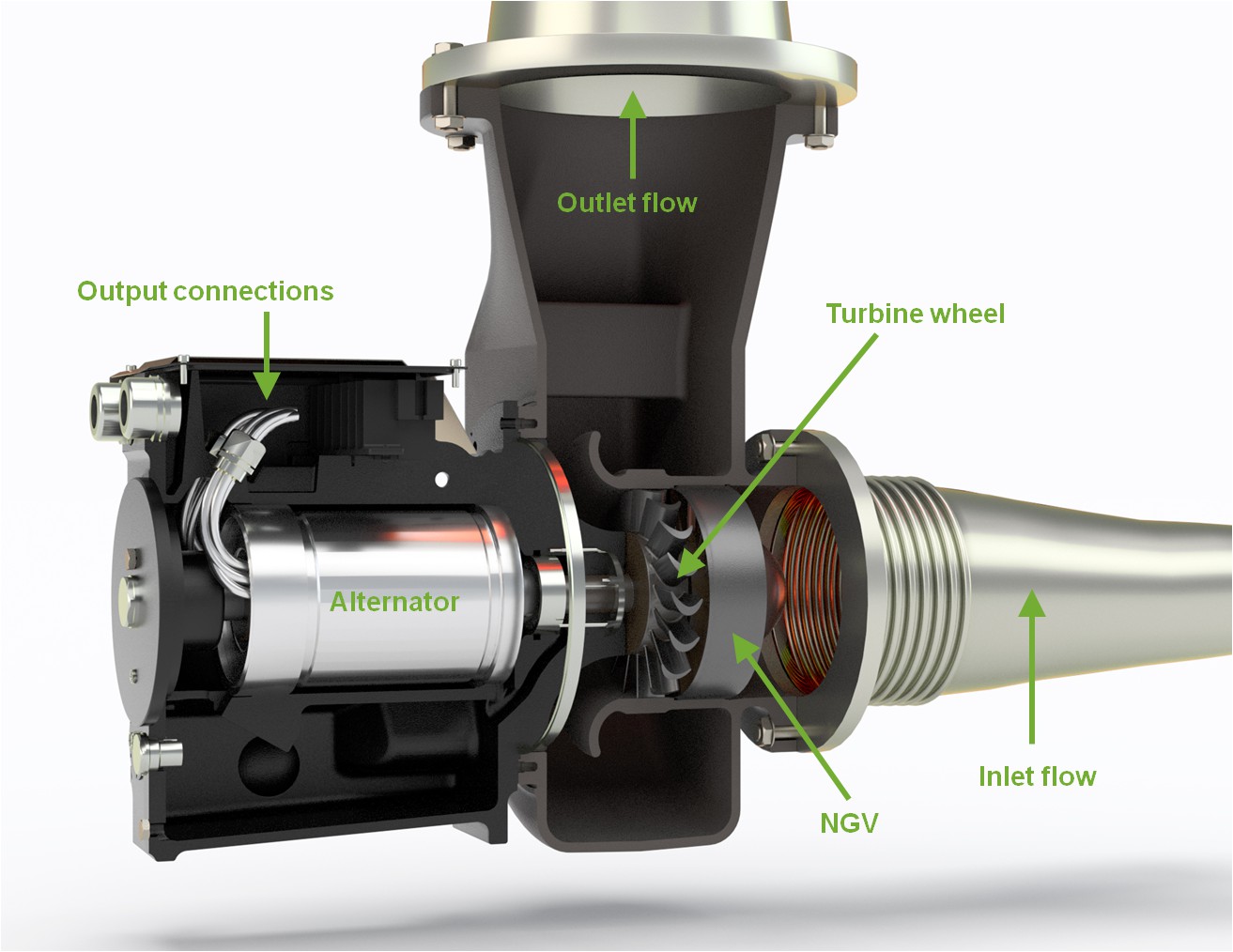
So a 5-6kw charging ability strictly from the heat of the engine, is about equal to most ev chargers, so that would keep the battery pack charged....add to that a 10% gain in mpg and now we are looking at a 20% increase in mpg by driving all the peripherals electrically, the alternator is eliminated, the water pump, oil pump, fuel pump, power steering and brakes pump, the compressor, and radiator fans....25 mpg goes to 30 mpg and performance is enhanced....
__________________
All living things seek to control their own destiny....this is the purpose of life


 Increasing Horse Power and Efficiency in ICE

 Re: Increasing Horse Power and Efficiency in ICE