..."A new wastewater rule authorized by the U.S. Environmental Protection Agency (EPA) earlier this year is leading several coal-fired plants to announce closure plans, according to an analysis of state regulatory filings by the Sierra Club.
The group said at least 26 plants in 14 states have said they will stop burning coal, with 21 facilities closing and another five switching to natural gas-fired generation, according to a report published Nov. 22 by the Associated Press. The EPA has said it expects the rule would impact about 75 coal-fired plants across the country. "...
https://www.powermag.com/more-than-20-coal-fired-plants-will-close-in-wake-of-wastewater-rule/?oly_enc_id=1249D9862912F8V
"
NERC Issues Grim Outlook for Bulk Power System Winter Reliability
The North American Electric Reliability Corp. (NERC) is warning that much of the central U.S.—a region that stretches from the Great Lakes into southern Texas—may face critical power deficiencies during extreme winter weather conditions over the next three months. Natural gas supply disruptions and low hydropower conditions could also imperil power reliability in New England and the West, it said.
In its Nov. 18–issued 2021–2022 Winter Reliability Assessment, the nation’s designated Electric Reliability Organization (ERO) urged generators across the U.S. to take proactive steps to prepare for an eventful winter and keep communications open with grid operators.
NERC also called on grid operators to prepare and implement cold weather operating plans, conduct drills, and poll generators for fuel and availability status. Load-serving entities should review critical loads to prevent disruptions, and regulators should support requested environmental waivers, it said."...
..."The ERO’s dire report echoes its May-issued summer assessment, when it warned of “elevated risks” for energy emergencies in Texas, New England, in the Midcontinent Independent System Operator (MISO) territory, and parts of the West. In its bulk power system (BPS) reliability assessment for the next three months—December 2021 through February 2022—NERC suggests extreme weather risks, including soaring peak demand or generator outages that exceed forecasts, “can be expected to cause energy emergencies” in regions that have previously suffered cold-weather reliability debacles. These include MISO, the Southwest Power Pool (SPP), and the Electric Reliability Council of Texas (ERCOT).
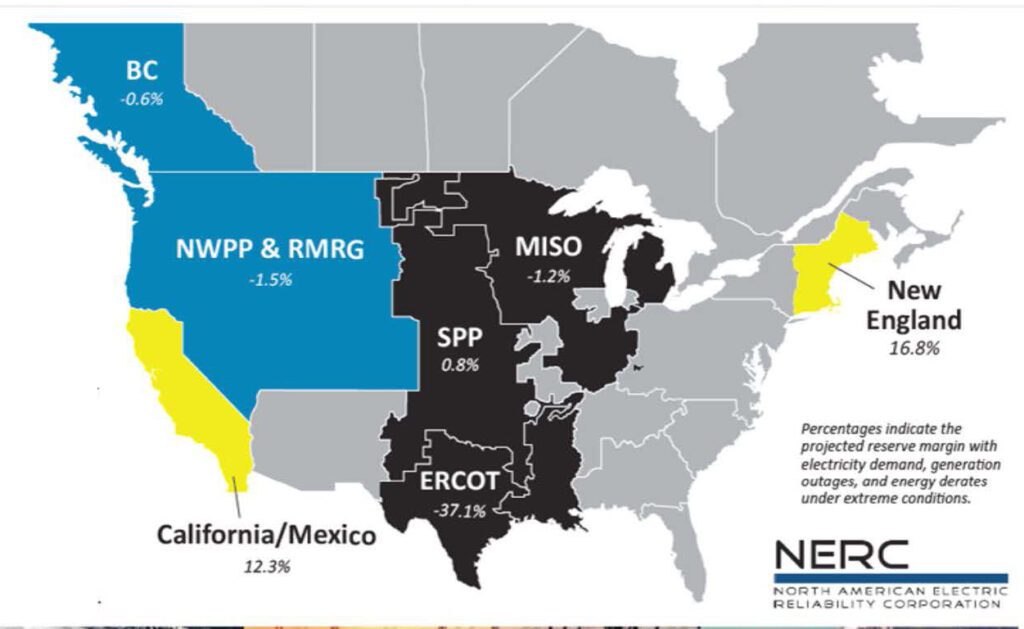
Natural gas supply disruptions, meanwhile, could affect “infrastructure-limited” areas, like ERCOT. And although New England, Southern California, and the Southwest have sufficient planning reserves, fuel supplies to generators in those regions may also face cold-weather vulnerabilities. New England, specifically, faces natural gas transportation constraints while Southern California and the Southwest have “limited natural gas storage and lack redundancy in supply infrastructure,” NERC said.
Continuing drought conditions in the West may also compound supply issues, threatening power transfers throughout the area. “Although resources are expected to be sufficient for peak demand, higher demand from more extreme temperatures in the Northwest could cause a shortfall. Low hydro conditions can reduce transfers needed to mitigate a wide area cold weather event,” NERC warned."....
https://www.powermag.com/nerc-issues-grim-outlook-for-bulk-power-system-winter-reliability/?oly_enc_id=1249D9862912F8V


 2
2

 Will this be the Straw That Breaks the Camel's Back..
 Re: Will this be the Straw That Breaks the Camel's Back..




Good Answers:
"Almost" Good Answers: