...The “duck curve,” a concept that has become emblematic of the challenges associated with integrating variable renewables in the power system, now looks like a “canyon,” illustrating a paramount urgency for adequate flexibility, Arshad Mansoor, president and CEO of the Electric Power Research Institute (EPRI), has warned.
In a recent post on LinkedIn, Mansoor highlighted changes to the “duck curve,” a phenomenon first unveiled by the National Renewable Energy Laboratory (NREL) in 2008 and later coined by the California Independent System Operator (CAISO) in 2013. The duck curve is essentially a 24-hour graph of the electric load met by power generation that assumes a unique shape as increasing levels of solar PV and other variable renewables are added to the system.
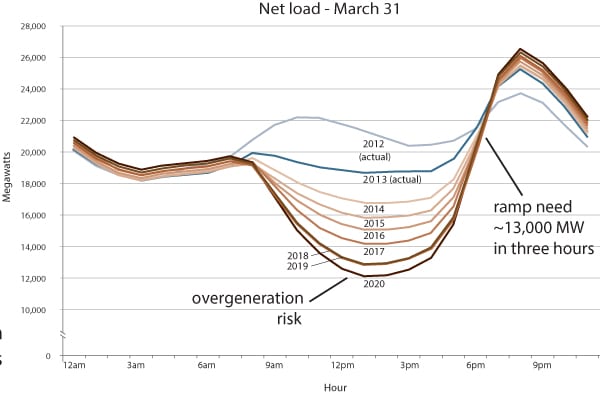
Mansoor suggested risks have been intensifying. “The duck now looks like a canyon,” he said.
Industry has been “working to improve how the grid operates with the duck curve, since the belly can cause both over-generation issues and renewable curtailment, and the neck can make it more difficult for the resource fleet to be flexible enough to ramp up,” he noted. “The need for flexibility is paramount to address these challenges.”
Mansoor said a “canyon curve”—characterized by a deeper “belly”—has now emerged. “Recently, CAISO’s net load has reached zero or gone negative,” he noted. This has repercussions “in sharply reducing dispatchable resources during the daytime. "..
https://www.powermag.com/epri-head-duck-curve-now-looks-like-a-canyon/?oly_enc_id=1249D9862912F8V
Power plants are planned by return on investment, this entails estimating the generation time necessary to hit profitability....curtailing generation and uneven usage will make electric generation less profitable and less desirable as an investment....this will raise prices further to the consumer and add to inflation....it's like putting a 50% tax on the corn crop, that's how you kill an industry, but in this case it's the population that is at risk...


 Duck Curve Now Looks Like a Canyon
 Re: Duck Curve Now Looks Like a Canyon