Previous in Forum: Line to Neutral Fault on TN-S System   Next in Forum: HT Motor with GRR Control Tripping on Over Current
Close
Close
Close
13 comments
Rate Comments: Nested
Anonymous Poster #1

TVS in Series

01/24/2024 1:43 PM

Hi,

Can two TVS diodes 1.5KE600CA (512.00V)be connected in series to protect a 700 VAC device?

Thank you.

Reply
Interested in this topic? By joining CR4 you can "subscribe" to
this discussion and receive notification when new comments are added.

Good Answers:

These comments received enough positive votes to make them "good answers".

"Almost" Good Answers:

Check out these comments that don't yet have enough votes to be "official" good answers and, if you agree with them, vote them!
2
Guru

Join Date: Apr 2010
Location: About 4000 miles from the center of the earth (+/-100 mi)
Posts: 9912
Good Answers: 1141
#1

Re: TVS in series

01/24/2024 2:15 PM
Reply Good Answer (Score 2)
Commentator

Join Date: Apr 2009
Posts: 91
Good Answers: 1
#2
In reply to #1

Re: TVS in series

01/24/2024 4:35 PM

Thank you Guru.

Regards,

Job

Reply
Commentator

Join Date: Apr 2009
Posts: 91
Good Answers: 1
#3
In reply to #1

Re: TVS in series

01/25/2024 11:15 AM

Dear Guru Rixter,

First of all thank you very much for the lead. I have another question for the forum. can six 1200 V MOSFETs be connected in series to switch ON and OFF a solenoid, having a DC resistance of 2K, at at 5,000 VDC?

King regards,

Job

Reply
Guru
Hobbies - DIY Welding - Wannabeabettawelda

Join Date: May 2007
Location: Annapolis, Maryland
Posts: 7940
Good Answers: 458
#4
In reply to #3

Re: TVS in series

01/26/2024 12:41 AM

Yes, but you will need to figure a way to drive gate voltages that are 833 volts different from the next MOSFET in line. This is usually done using gate drivers with transformer isolation rated above 5,000 volts isolation because that is the approximate difference between the MOSFET source at the bottom of the stack and the MOSFET source at the top of the stack.

How long is the solenoid going to be in the ON state? That time duration will make the difference whether you can use a simple pulse transformer or if you will need to use another circuit scheme to keep the FET's on for an extended time period.

Reply Score 1 for Good Answer
Commentator

Join Date: Apr 2009
Posts: 91
Good Answers: 1
#5
In reply to #4

Re: TVS in series

01/26/2024 11:16 AM

Thank you Guru Robin.

I tried copying and pasting a circuit diagram in an attempt to respond to your comment but some how the attempt failed.

Regards,

Job

Reply
Guru
Hobbies - DIY Welding - Wannabeabettawelda

Join Date: May 2007
Location: Annapolis, Maryland
Posts: 7940
Good Answers: 458
#6
In reply to #5

Re: TVS in series

01/26/2024 10:18 PM

I want to caution you that it is not a trivial task to do a series stack of MOSFETs for high voltage switching. The turn-on and turn-off of the FETs must be carefully controlled because if they do not turn on and off exactly at the same time, you can end up with 5,000 volts across the "slow" FET and initiate avalanche in the FET. Some FETs are designed for avalanche duty, but not all.

Take a look at applications note AN-1005 on the Vishay Siliconix website for an introduction into the avalanche issues with MOSFETs.

You might also need to ensure the FETs have roughly equal voltage across them in the OFF state. The FET stack looks like a series connected stack of capacitors in the OFF state. RC snubbers might be needed across each of the FETs to help ensure voltage balancing as well as to temper transients.

Also pay attention to the dV/dt of the FETs. There is a good introduction to the dV/dt issues on the Rohm semiconductor website. Link below:

https://techweb.rohm.com/product/power-device/si/si-evaluation/10772/

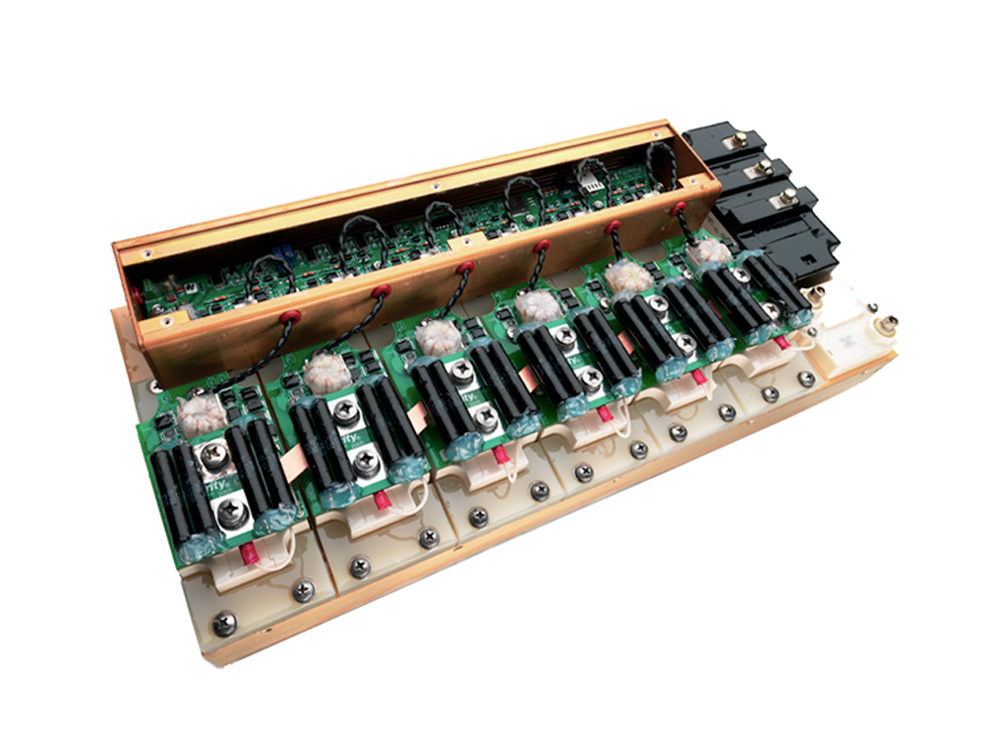
To give you an idea of the complexity of a high voltage switching circuit, take a look at this 4 kV, 600A switch module from Polarity, Inc. Yes, the current rating is much higher than you need, but the only difference is going to be in the size of the FETs. All the gate driver circuitry is going to be roughly the same.

https://www.polarity.net/product/4kv-600a-igbt-switch/#

If this is the first time you have attempted this kind of circuit design, I'm sure you will learn a lot.

Good luck with your quest !!

Reply Score 1 for Good Answer
Commentator

Join Date: Apr 2009
Posts: 91
Good Answers: 1
#7
In reply to #6

Re: TVS in series

01/27/2024 10:59 AM

Thank you Guru Robin for the lead and advise.

Kind regards,

job

Reply
Guru
United Kingdom - Member - Indeterminate Engineering Fields - Control Engineering - New Member

Join Date: Jan 2007
Location: In the bothy, 7 chains down the line from Dodman's Lane level crossing, in the nation formerly known as Great Britain. Kettle's on.
Posts: 32175
Good Answers: 839
#8
In reply to #3

Re: TVS in series

01/29/2024 6:19 AM

A solenoid that consumes (5000v2/2kΩ=) 12.5kVA sounds implausible.

__________________
"Did you get my e-mail?" - "The biggest problem in communication is the illusion that it has taken place" - George Bernard Shaw, 1856
Reply
Commentator

Join Date: Apr 2009
Posts: 91
Good Answers: 1
#10
In reply to #8

Re: TVS in series

01/29/2024 11:54 AM

Dear guru,

Please consider that the question as a hypothetical one. The intent is to find out whether the MOSFETs will standup in this situation. The current through the solenoid and MOSFETs is only 2.5 Amps; but considering one MOSFET switching sooner than the others, so that that one MOSFET which turns first will see multi-folds 5000 V (Due to inductive kickback). Can some sort of balancing resistors & R C networks connected across each MOSFET protect the MOSFETs?

Kind Regards,

Job.

Reply
Guru
United Kingdom - Member - Indeterminate Engineering Fields - Control Engineering - New Member

Join Date: Jan 2007
Location: In the bothy, 7 chains down the line from Dodman's Lane level crossing, in the nation formerly known as Great Britain. Kettle's on.
Posts: 32175
Good Answers: 839
#11
In reply to #10

Re: TVS in series

01/30/2024 6:24 AM

Please post an image of the proposed circuit diagram for the benefit of all CR4 contributors.

__________________
"Did you get my e-mail?" - "The biggest problem in communication is the illusion that it has taken place" - George Bernard Shaw, 1856
Reply
Commentator

Join Date: Apr 2009
Posts: 91
Good Answers: 1
#12
In reply to #11

Re: TVS in series

01/30/2024 11:33 AM

Hi Guru,

Tried to post the circuit; but CR4 is not sending the message. I am getting some error message. Many Gurus suggested different methods but I could not make it work.

Kind regards,

Regards,

Job.

Reply
Guru

Join Date: Dec 2010
Posts: 1686
Good Answers: 116
#13
In reply to #10

Re: TVS in series

02/10/2024 7:59 AM

Even if it is hypothetical....

Is this solenoid in air or on a magnetic core? What is its inductance? 5000 ohm at 2.5 amps must be a lot of turns and considerable dimensions.

Solenoid is a "loose" term. Often it is used for say a solenoid operated valve. This moves something and the magnetic circuit gap changes - having a major effect on the stored energy; which must be diverted into the TVS or circulated in a diode and/or resistor.

Even if there is no movement, a core can have an induced current, which complicates behaviour; e.g. whether core is solid or laminated.

You are correct that the solution lies in RC networks/TVS to avoid any individual MOSFET having too much current or voltage for too long.

You should examine the good references given by other comments.

Reply
Guru
United Kingdom - Member - Indeterminate Engineering Fields - Control Engineering - New Member

Join Date: Jan 2007
Location: In the bothy, 7 chains down the line from Dodman's Lane level crossing, in the nation formerly known as Great Britain. Kettle's on.
Posts: 32175
Good Answers: 839
#9

Re: TVS in Series

01/29/2024 6:31 AM

It depends upon the normal voltage of the supply. The rating of the <...device...> is secondary.

__________________
"Did you get my e-mail?" - "The biggest problem in communication is the illusion that it has taken place" - George Bernard Shaw, 1856
Reply
Reply to Forum Thread 13 comments

Good Answers:

These comments received enough positive votes to make them "good answers".

"Almost" Good Answers:

Check out these comments that don't yet have enough votes to be "official" good answers and, if you agree with them, vote them!
Copy to Clipboard

Users who posted comments:

67model (1); Brave Sir Robin (2); PWSlack (3); Rixter (1); thankan (6)

Previous in Forum: Line to Neutral Fault on TN-S System   Next in Forum: HT Motor with GRR Control Tripping on Over Current

Advertisement