Previous in Forum: Persistent Sparking in Red Phase Electrode Chamber of LRS During Startup of a Newly Installed 3.4 MW, 6.3 KV Wound Rotor Induction Motor Driving a Vertical Mill   Next in Forum: Transformer Coordination
Close
Close
Close
16 comments
Rating: Comments: Nested
Anonymous Poster #1

Speed vs Amperes

05/12/2024 4:29 PM

If a constant load is applied to a 3phase electric motor,and the rpm is decreased by a VFD,will the amps drop accordingly?

There is disagreement in this from several engineers.I think if it is a good VFD, properly programmed,the current will drop and also the voltage will drop to compensate for the lower frequency.

Less work being performed should require less amps/volts:power.

Reply
Interested in this topic? By joining CR4 you can "subscribe" to
this discussion and receive notification when new comments are added.

Good Answers:

These comments received enough positive votes to make them "good answers".

"Almost" Good Answers:

Check out these comments that don't yet have enough votes to be "official" good answers and, if you agree with them, vote them!
Guru
Philippines - Member - New Member Engineering Fields - Instrumentation Engineering - New Member Engineering Fields - Control Engineering - Who am I?

Join Date: Oct 2006
Location: Northern Mindanao, Philippines
Posts: 2147
Good Answers: 53
#1

Re: speed vs amperes

05/12/2024 7:40 PM

Nothing beats actually observing the result. While driving a fan, we reduced the frequency and I saw the current drop (as well as the voltage due to V/F). However, there comes a point when the frequency drops too low and the current starts to rise.

So yes, the current drops but only to a certain point.

regards,

Vulcan

__________________
Miscommunication: when what people heard you say differs from what you said. Make yourself understood.
Reply Score 1 for Good Answer
Guru

Join Date: Mar 2007
Location: by the beach in Florida
Posts: 33392
Good Answers: 1817
#2

Re: speed vs amperes

05/12/2024 11:19 PM

It's the watts that tell the tale, if the load is decreased then the watts will decrease, this then depends on the design of the motor and vfd as the overall efficiency also plays a role...If on the other hand you are increasing the load as you lower the RPM, then the same amount of work is being done...

__________________
All living things seek to control their own destiny....this is the purpose of life
Reply
Guru

Join Date: Jul 2016
Posts: 1367
Good Answers: 105
#3

Re: speed vs amperes

05/13/2024 1:29 AM

The amperes will drop, but not as fast as the work is being reduced. As Solar Eagle notes, the watts tell the tale, less work, less watts. Strictly speaking, the amps include both real current and the reactive current, the amperes required to maintain the magnetic field in the stator. As the speed decreases, the reactive load becomes a larger part of the total, until at no load, just before zero speed, the real is just windage, winding I squared R heat & bearing friction, simply considered. A VFD reduces the voltage with the frequency, but at base speed and below for typical VFD designs, the air gap still develops motor rated torque. The amperes will drop with less work being done, but the magnetic field still needs to be maintained, until you get to the end point where no work is being done, but the air gap is still charged. If a variable torque excitation curve is selected, you still have the endpoint of zero speed, no work, but some lesser reactive ampere draw.

The definition I take of the proposed constant load is a machine such as a fan or a pump coupled to the motor, as opposed to some driven device that consumes the same energy at any speed, unlikely in mechanics.

Reply Score 1 for Good Answer
4
Guru

Join Date: Jul 2005
Location: Stoke-on-Trent, UK
Posts: 4496
Good Answers: 137
#4

Re: speed vs amperes

05/13/2024 4:39 AM

You say constant load, but the load power doesn't stay constant as the speed changes. I assume you mean a particular piece of driven kit.

If the kit is constant-torque (eg positive displacement pump or compressor, or conveyor) the power reduces proportional to speed, so as the VFD reduces voltage proportional to speed, the current stays constant.

If it's a squared-torque load (eg centrifugal pump or fan) power reduces proportional to speed squared. So the current reduces proportional to speed.

Above is theoretical, it might not be exact in practice. Also as others have said, it doesn't apply at very low speed.

__________________
Give masochists a fair crack of the whip
Reply Good Answer (Score 4)
Guru

Join Date: Aug 2005
Location: Hemel Hempstead, UK
Posts: 5826
Good Answers: 322
#5

Re: Speed vs Amperes

05/13/2024 8:02 AM

Depends on your definition of a "constant load".

__________________
If you spend all your time looking for people and things to complain about: trust me, you will find plenty to complain about.
Reply
Guru

Join Date: Jul 2005
Location: Stoke-on-Trent, UK
Posts: 4496
Good Answers: 137
#6
In reply to #5

Re: Speed vs Amperes

05/13/2024 8:46 AM

Whose, mine or the OP's?

__________________
Give masochists a fair crack of the whip
Reply
Guru

Join Date: Aug 2005
Location: Hemel Hempstead, UK
Posts: 5826
Good Answers: 322
#10
In reply to #6

Re: Speed vs Amperes

05/14/2024 5:24 AM

The OP's.

I gave your answer a GA, and, I just tried to make the problem with the OP's question succinct.

__________________
If you spend all your time looking for people and things to complain about: trust me, you will find plenty to complain about.
Reply
Guru

Join Date: Jul 2005
Location: Stoke-on-Trent, UK
Posts: 4496
Good Answers: 137
#11
In reply to #10

Re: Speed vs Amperes

05/14/2024 6:15 AM

OK thanks. Be nice if AP#1 came back to confirm!

__________________
Give masochists a fair crack of the whip
Reply
Guru

Join Date: Apr 2010
Location: About 4000 miles from the center of the earth (+/-100 mi)
Posts: 9910
Good Answers: 1141
#7

Re: Speed vs Amperes

05/13/2024 8:58 AM

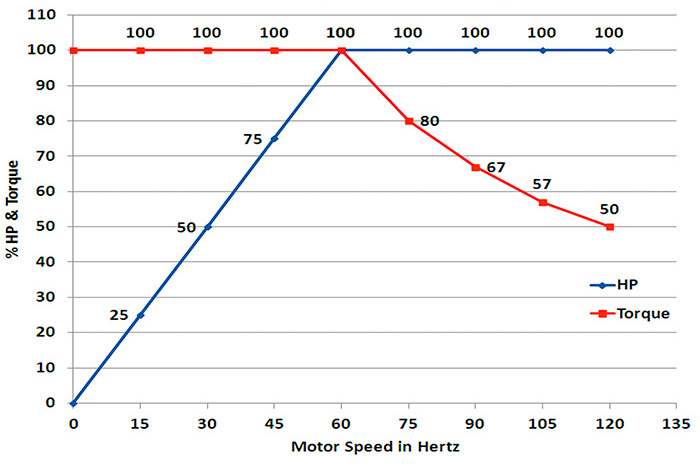
If constant load means constant required torque, amps should remain the same. Torque equates to amps, speed equates to volts. For a motor, input power = volts x amps, output power = speed x torque.

https://www.pumpsandsystems.com/pumps/motor-horsepower-torque-versus-vfd-frequency

Reply Score 1 for Good Answer
Guru

Join Date: Jul 2005
Location: Stoke-on-Trent, UK
Posts: 4496
Good Answers: 137
#8
In reply to #7

Re: Speed vs Amperes

05/13/2024 10:42 AM

Odd that your Pumps&System link only deals with constant-torque applications. There must be far more centrifugal piumps out there than PD.

And it doesn't inspire confidence when you see statements like

"Power is the rate at which torque (work) is performed" and

"...torque produced per unit of time..."

__________________
Give masochists a fair crack of the whip
Reply
Guru

Join Date: Apr 2010
Location: About 4000 miles from the center of the earth (+/-100 mi)
Posts: 9910
Good Answers: 1141
#9
In reply to #8

Re: Speed vs Amperes

05/13/2024 9:29 PM

Odd that your Pumps&System link only deals with constant-torque applications. There must be far more centrifugal piumps out there than PD.

Well, they had the graph I was looking for. I hope they don't mind, I did link the source.

The OP's question:

If a constant load is applied to a 3 phase electric motor, and the rpm is decreased by a VFD, will the amps drop accordingly?

My interpretation of "constant load" is "constant required torque". The torque required by the load is equal to the torque supplied by the motor, which is proportional to the motor current. (An example of a "constant load" might be a motor in a crane lifting a specified weight. The torque required is independent of the speed. Most loads require more torque at greater speed, e.g., when friction is involved.)

So my vote is "Equal Load implies Equal Current."

Reply
Guru

Join Date: Jul 2005
Location: Stoke-on-Trent, UK
Posts: 4496
Good Answers: 137
#12
In reply to #9

Re: Speed vs Amperes

05/14/2024 6:41 AM

If a constant load is applied to a 3 phase electric motor, and the rpm is decreased by a VFD, will the amps drop accordingly?

As I said in #4, that doesn't specify the type of load. You give another example of a constant torque load.

But then you say "Most loads require more torque at greater speed, e.g., when friction is involved.)"! Squared-torque loads also require more torque at greater speed, but not because of friction. My guess is squared-torque is more common than constant.

Until we hear more from the OP we won't know.

__________________
Give masochists a fair crack of the whip
Reply
Participant

Join Date: Nov 2017
Posts: 3
#13

Re: Speed vs Amperes

05/14/2024 1:00 PM

It all depends on what you mean by "constant load". If you mean constant torque, then Amps should remain about the same as Volts are almost invariably linear with frequency. If you mean "attached to the same load device", it depends on the load/speed characteristics of that device.

One person referenced an experiment with a fan, which did see a drop in Amps as its torque requirement can be expected to be quadratic with speed. A hoist likely would not see Amps significantly decline.

BTW, please always CAPITALIZE Amps, Volts, and Ohms, as they are derived from PERSONAL NAMES (André-Marie Ampère, Allessandro Volta, and George Ohm). Capitalization is basic respect.

Reply
Guru

Join Date: Jul 2005
Location: Stoke-on-Trent, UK
Posts: 4496
Good Answers: 137
#14
In reply to #13

Re: Speed vs Amperes

05/14/2024 2:01 PM

That was nearly all covered in earlier posts

__________________
Give masochists a fair crack of the whip
Reply
Participant

Join Date: Nov 2017
Posts: 3
#15
In reply to #14

Re: Speed vs Amperes

05/14/2024 6:25 PM

I had only scanned a couple of the responses at the time, but still maintain my response was useful, especially in that I pointed out that most VFD units are programmed for linear dependency of Voltage to frequency. My point about capitalization is, in my opinion, important. I question the value of your criticism.

Reply
Guru
United Kingdom - Member - Indeterminate Engineering Fields - Control Engineering - New Member

Join Date: Jan 2007
Location: In the bothy, 7 chains down the line from Dodman's Lane level crossing, in the nation formerly known as Great Britain. Kettle's on.
Posts: 32175
Good Answers: 839
#16

Re: Speed vs Amperes

05/15/2024 1:37 PM

If the <...load...> is <...constant...>, then there is no scope for <...the rpm...> to be <...decreased...>.

All rotating mechanical loads have a torque and speed characteristic curve. It is the job of the individual selecting the <...electric motor...> to match its torque and speed characteristic curve to that of the load; the operating point is where these two curves intersect.

Torque and current are almost proportional. Therefore, is the speed <....is decreased by...> any form of speed control, the change will be to a different operating point. Which is why the question is inherently nonsensical.

__________________
"Did you get my e-mail?" - "The biggest problem in communication is the illusion that it has taken place" - George Bernard Shaw, 1856
Reply
Reply to Forum Thread 16 comments

Good Answers:

These comments received enough positive votes to make them "good answers".

"Almost" Good Answers:

Check out these comments that don't yet have enough votes to be "official" good answers and, if you agree with them, vote them!
Copy to Clipboard

Users who posted comments:

Codemaster (6); PWSlack (1); Randall (2); Rixter (2); Ron_L_B (2); rwilliams (1); SolarEagle (1); Vulcan (1)

Previous in Forum: Persistent Sparking in Red Phase Electrode Chamber of LRS During Startup of a Newly Installed 3.4 MW, 6.3 KV Wound Rotor Induction Motor Driving a Vertical Mill   Next in Forum: Transformer Coordination

Advertisement