Previous in Forum: Testing SCRs   Next in Forum: PLC5 Watchdog Timer Issue
Close
Close
Close
9 comments
Rate Comments: Nested
Active Contributor

Join Date: Jun 2008
Location: New Jersey, USA
Posts: 22

Non-Reversing vs. Reversing Contactor

11/12/2008 2:17 PM

I was looking up info on contactors and I came across reversing vs. non-reversing types. I did some web searches and looked at manufacturer's web sites but failed to find a definition of what reversing & non-reversing means. COuld someone please provide a concise definition?

Thanks

Register to Reply
Interested in this topic? By joining CR4 you can "subscribe" to
this discussion and receive notification when new comments are added.

"Almost" Good Answers:

Check out these comments that don't yet have enough votes to be "official" good answers and, if you agree with them, vote them!
Guru
New Zealand - Member - Interested in everything- see my Profile please APIX Pilot Plant Design Project - Member - Member Engineering Fields - Electrical Engineering - Member Engineering Fields - Power Engineering - Member Engineering Fields - Civil Engineering - Member Hobbies - Musician - Autoharp and Harmonica Hobbies - Hunting - Member Hobbies - Fishing - Member

Join Date: Nov 2007
Location: Christchurch, (The Garden City), South Island, New Zealand
Posts: 4395
Good Answers: 230
#1

Re: Non-Reversing vs. Reversing Contactor

11/12/2008 7:27 PM

Hello wjwlitespeed

I list the explanation below, for 3-phase squirrel-cage rotor motors.

DC and single-phase forward/reverse contactor systems all have the mechanical/electrical interlock so that only one contactor switches supply power to the motor at any time.

The wiring diagrams for special motors can be extremely complex.

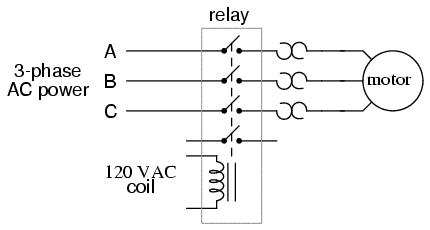
A non-reversing contactor is just a single contactor, with three main switching terminals (1 per phase for a 3-phase supply to the motor.)

A reversing contactor is an assembly of two of the above, with a mechanical and electrical interlock between them, so only one contactor can be closed (giving power supply to the motor) at any time. The Forward/Reverse - Up/Down - Left-right etc. are usually opposite motions, and the opposite motions are obtained via labelled switching buttons which energizes the coil of the correct contactor, mechanically locking the other motion contactor and also electrically preventing it from closing.

In the standard 3-phase squirrel-cage rotor motor, the reverse motion is easily obtained by swapping any two of the 3 phase wires to the motor, which then runs in the opposite direction = reverse.

The schematic (Wiring diagram) of a reversing 3-phase contactor assembly is above.

A 3-phase standard non-reversing contactor wiring diagram is shown below, and has been called "Relay".

The contactor control voltages may be mains voltage or a special Control Voltage, often 24V DC is used as a standard Voltage for control systems in industrial switchboards.

I trust that assists you.

Should you need more information, reply here with

Kind Regards....

__________________
"The number of inventions increases faster than the need for them at the time" - SparkY
Register to Reply Score 1 for Good Answer
Commentator
India - Member - New Member

Join Date: Nov 2008
Location: India
Posts: 72
#2
In reply to #1

Re: Non-Reversing vs. Reversing Contactor

11/12/2008 11:32 PM

Dear sparkstation,

Excellently you explained.Very useful to all

my doubt is:

1) For a given rating of Induction motor,How to decide the rating of contactor and fuses? Please explain and give any thumb rule or formulae or any design data if available.

Kind regards

gova

Register to Reply
Guru
United States - Member - New Member Engineering Fields - Power Engineering - New Member

Join Date: Sep 2006
Location: California, USA, where the Godless live next door to God.
Posts: 4665
Good Answers: 804
#5
In reply to #2

Re: Non-Reversing vs. Reversing Contactor

11/13/2008 1:08 PM

gova1467,

Ratings are specified by each contactor manufacturer and fusing is specific to local installation codes in your area. Please consult with local suppliers for training on that subject.

__________________
** All I every really wanted to be, was... A LUMBERJACK!.**
Register to Reply
Active Contributor

Join Date: Jun 2008
Location: New Jersey, USA
Posts: 22
#3
In reply to #1

Re: Non-Reversing vs. Reversing Contactor

11/13/2008 10:19 AM

Thanks a bunch Sparkstation. That's just what the doctor ordered.

wjwlitespeed

Register to Reply
Anonymous Poster
#8
In reply to #1

Re: Non-Reversing vs. Reversing Contactor

01/17/2009 7:51 PM

Dear Sparkstation,

can you plz give me an explanation on those 53 and 54 numbers regarding the both contactors? what kind of contacts are those, and what is their purpose? (maybe to "hold" the state of contact induced by the pushbuttons?). i seem not to be able to find those types of contacts on contactors i plan to use.

another thing: is there a possibillity of making an reversing contactor assembly without the mechanical interlock between the two (just electrical)?

Iggy

Register to Reply
Guru
Technical Fields - Technical Writing - New Member Engineering Fields - Marine Engineering - New Member

Join Date: Sep 2008
Location: Vancleave, Ms about 30 miles inland from Biloxi and the coast
Posts: 3197
Good Answers: 106
#4

Re: Non-Reversing vs. Reversing Contactor

11/13/2008 11:38 AM

Basically, a reversing contactor is used to reverse the rotation of a motor. A non-reversing contactor just turns the motor on and off.

__________________
Mr.Ron from South Ms.
Register to Reply
Power-User

Join Date: Nov 2008
Posts: 158
Good Answers: 1
#6

Re: Non-Reversing vs. Reversing Contactor

11/14/2008 5:52 AM

A reversing contactor interchanges two poles on a THREE PHASE (typically motor) application, such that the output ( the " T " terminals) are 120 degrees opposed from the input ( the " L " terminals). This is useful in a conveyor, for example. A three phase motor

that ran clockwise, normally, would run counterclockwise, when controlled via reversing contactor.

Register to Reply
Anonymous Poster
#7

Re: Non-Reversing vs. Reversing Contactor

11/14/2008 5:39 PM

Provide HP and voltage, and frequency of motor and I can tell you the appropriate conductor,fuse,contactor, and thermal overload sizes for the USA.

Include service factor data from motor data plate,and the ambient temperature of both the motor location and the contactor location.

Do not know if these will be acceptable in your area or not, but it may be a good starting point.

Register to Reply
Anonymous Poster
#9

Re: Non-Reversing vs. Reversing Contactor

08/16/2009 5:41 AM

A non-reversing DC contactor is a SPST relay that makes a circuit when a coil is energized. When it makes contact, it is dedicated to only one direction of flow. A reversing DC contactor will make contact on electricty flowing in both directions when the coil is energized because it is DPDT. The contactors are completely different from one another. If you want a picture of what they look like, go to http://www.newkellycontroller.com

Register to Reply
Register to Reply 9 comments

"Almost" Good Answers:

Check out these comments that don't yet have enough votes to be "official" good answers and, if you agree with them, vote them!
Copy to Clipboard

Users who posted comments:

Anonymous Poster (3); DRFREON (1); gova1467 (1); JRaef (1); ronseto (1); Sparkstation (1); wjwlitespeed (1)

Previous in Forum: Testing SCRs   Next in Forum: PLC5 Watchdog Timer Issue

Advertisement