Previous in Forum: Speed of Electricity   Next in Forum: November 1st, 1957: The Mackinac Bridge
Close
Close
Close
56 comments
Rating: Comments: Nested
Guru
Engineering Fields - Aerospace Engineering - Retired South Africa - Member - The Rainbow-nation Engineering Fields - Engineering Physics - Relativity & Cosmology Popular Science - Cosmology - The Big Picture!

Join Date: May 2006
Location: Pretoria, South Africa
Posts: 3804
Good Answers: 69

Asteroid Challenge Question

10/30/2006 11:14 PM

There are many asteroids that actually cross the orbital path of Earth - once on the inbound and once on the outbound leg of each of their elliptical orbits. The same asteroids normally also cross the orbital path or Mars.

We know that it takes a huge amount of fuel to propel a spacecraft to achieve escape velocity from Earth and then additionally, provide it with enough kinetic energy to 'climb', relative to the Sun, to the orbital distance of Mars.

Can an Earth-Mars mission save propulsion energy by somehow 'hitching a ride' on an asteroid that crosses the orbital paths of Earth and Mars?

__________________
"Perplexity is the beginning of knowledge." -- Kahlil Gibran
Register to Reply
Pathfinder Tags: Asteroid Challenge orbit
Interested in this topic? By joining CR4 you can "subscribe" to
this discussion and receive notification when new comments are added.
Guru
Popular Science - Evolution - New Member Popular Science - Weaponology - New Member

Join Date: May 2006
Location: The 'Space Coast', USA
Posts: 11119
Good Answers: 918
#1

Re: Asteroid Challenge Question

10/31/2006 8:17 AM

Great question, Jorrie.

I can think of a few ways to do this, but would any of them work?

1) Grab the sucker as it passes by the love handles. Well, if your relative velocity is low compared to the asteroid you are in for one hell of a whiplash once you do! It would be like trying to grab the door handle of a speeding car as you are standing still (actually, much worse). If you manage to grab it you are bound to exit minus a few appendages! If you match the speed of the asteroid to avoid the whiplash, then what would be the point? You are already at that velocity and do not need an assist.

2) Gravity assist. I can't see much advantage there since the mass of the asteroid is insufficient to exchange any momentum via the asteroid's feeble gravity.

3) Fishing Line. What if you "harpoon" it as it passes and let the line reel out with a nominal amount of friction in the reel? This would provide a soft start and allow you to match the velocity of the asteroid in a controlled fashion. The more friction in the wheel, the more grab and acceleration you would get. The problem would be that you need a very, very, very long line to allow enough time and enough line run out so as to accelerate at a rate that is tolerable for the space vehicle without undue stress. You also need to dissipate a lot of heat! The friction generated would be huge, but depends on the mass of the space vehicle and the delta velocities between the space vehicle and the asteroid. You also need to be a pretty good "trap" shooter with that "harpoon" or butterfly net. ;-) This is the best idea I can think of.

This will be good to see what other ideas germinate on this challenge!

Register to Reply
The Engineer
Engineering Fields - Engineering Physics - Physics... United States - Member - NY Popular Science - Genetics - Organic Chemistry... Popular Science - Cosmology - New Member Ingeniería en Español - Nuevo Miembro - New Member

Join Date: Feb 2005
Location: Albany, New York
Posts: 5060
Good Answers: 129
#2

Re: Asteroid Challenge Question

10/31/2006 9:23 AM

The Earths orbit is basically circular whereas these Asteroids have elliptical orbits. The distance between the Sun and Mars is 1.5 AU. The distance between the Earth and Sun is 1.0 AU. Since this is an elliptical orbit (it crosses both Mars and Earths orbit), the asteroid travels faster when it's closer to the sun and slower when it's further away. So the question is, how fast is the asteroid moving when it passes Earth?

I can't remember the equation for velocity as a function of distance from the sun and eccentricity for an elliptical orbit. Can anybody remember this?

Register to Reply
Guru
Popular Science - Evolution - New Member Popular Science - Weaponology - New Member

Join Date: May 2006
Location: The 'Space Coast', USA
Posts: 11119
Good Answers: 918
#3
In reply to #2

Re: Asteroid Challenge Question

10/31/2006 10:58 AM

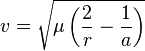
I had to look it up, but...

Where = standard gravitational parmeter

r = radial distance of orbiting body from central body

a = length of semi-major axis

Also, the near miss from that asteroid a few years back (July 2004) had a relative velocity of about 10-15 Km/s if memeory serves.

The escape velocity for Earth is about 11 Km/s, just for comparison.

What we don't know is the mass of the hypothetical asteroid in the challenge, nor do we know the period of the orbit. So, it is really hard to determine what we have to latch onto.

Register to Reply
The Engineer
Engineering Fields - Engineering Physics - Physics... United States - Member - NY Popular Science - Genetics - Organic Chemistry... Popular Science - Cosmology - New Member Ingeniería en Español - Nuevo Miembro - New Member

Join Date: Feb 2005
Location: Albany, New York
Posts: 5060
Good Answers: 129
#4
In reply to #3

Re: Asteroid Challenge Question

10/31/2006 11:11 AM

My guess is it's ok to assume the asteroid is large enough to latch on to. I think the issue may be, is it worth it? Afterall, if the asteroid slows down the further it gets from Earth, it would harm rather than help a spacecraft trying to reach Mars.

Register to Reply
Guru
Popular Science - Evolution - New Member Popular Science - Weaponology - New Member

Join Date: May 2006
Location: The 'Space Coast', USA
Posts: 11119
Good Answers: 918
#5
In reply to #4

Re: Asteroid Challenge Question

10/31/2006 1:07 PM

Wait. So would any spacecraft that matches velocity and trajectory of the asteroid.

So, if the asteroid passes Earth's orbit at 10 Km/s and its trajectory is in the neighborhood of the desired target, any spacecraft that simply fires its main engine to achieve parity with the asteroid's velocity is subject to the same forces of gravity that rule the asteroid.

The original question was is there any way that a Earth-Mars mission could save fuel using an asteroid.

Register to Reply
The Engineer
Engineering Fields - Engineering Physics - Physics... United States - Member - NY Popular Science - Genetics - Organic Chemistry... Popular Science - Cosmology - New Member Ingeniería en Español - Nuevo Miembro - New Member

Join Date: Feb 2005
Location: Albany, New York
Posts: 5060
Good Answers: 129
#7
In reply to #5

Re: Asteroid Challenge Question

10/31/2006 1:30 PM

You wrote: "So, if the asteroid passes Earth's orbit at 10 Km/s and its trajectory is in the neighborhood of the desired target, any spacecraft that simply fires its main engine to achieve parity with the asteroid's velocity is subject to the same forces of gravity that rule the asteroid."

That would be true if the spacecraft had no initial velocity, but the spaceship starts it's trip with the same speed as the Earth. When a spacecraft fires thrusters, it basically increases it's eccentricity about the sun from the near circular Earth orbit it originally was in. The more elliptical you want to make the spacecraft's path, the more fuel you have to burn in order to increase the eccentricity. Here is an image of an unassisted spaceship voyage from Earth to Mars, where the spaceship only slight increases eccentricity of its orbit about the sun to reach its goal.

I wouldn't mind some guidance from Jorrie at this point to see if we're on track or off track.

Register to Reply
Participant

Join Date: Nov 2006
Location: Las Vegas NV
Posts: 2
#13
In reply to #7

Re: Asteroid Challenge Question

11/01/2006 12:38 AM

Some asteroids are very easy (low delta-v) to reach.

An excellent Near Earth Object (NEO) site is

http://neo.jpl.nasa.gov/cgi-bin/db_shm?sstr=2006%20OB5

for an example of one which passed Earth at only 580 meters/sec. Would be very easy to get to. For more on the 3700 or so kinown NEOs, the page http://neo.jpl.nasa.gov lists the just recent and upcoming ones. More than one/day.

For a plan to be able to reach them with micro-spacecraft, see http://www.microlaunchers.com/ The plan here is to create a situation anagolous to that of the start of the microcomputer. Anyone seriously interested in helping or investing, please contact.

Register to Reply
Guru
Engineering Fields - Aerospace Engineering - Retired South Africa - Member - The Rainbow-nation Engineering Fields - Engineering Physics - Relativity & Cosmology Popular Science - Cosmology - The Big Picture!

Join Date: May 2006
Location: Pretoria, South Africa
Posts: 3804
Good Answers: 69
#15
In reply to #7

Re: Asteroid Challenge Question

11/01/2006 3:24 AM

Roger, you wrote: "Here is an image of an unassisted spaceship voyage from Earth to Mars, where the spaceship only slight increases eccentricity of its orbit about the sun to reach its goal."

This is perfectly correct for a minimum energy, 'direct route' orbit. So the question is: can one 'steal' some energy from an asteroid that crosses the two orbits and so reduce your fuel requirements?

The problem is, as Hero analyzed quite well, that the asteroid speed is quite high relative to Earth. Once you have escaped from Earth, you basically have Earth's orbital velocity again and the asteroid will zip past you at high speed.

There have been some interesting suggestions for tapping into that energy in this thread so far. Keep going, guys!

__________________
"Perplexity is the beginning of knowledge." -- Kahlil Gibran
Register to Reply
The Engineer
Engineering Fields - Engineering Physics - Physics... United States - Member - NY Popular Science - Genetics - Organic Chemistry... Popular Science - Cosmology - New Member Ingeniería en Español - Nuevo Miembro - New Member

Join Date: Feb 2005
Location: Albany, New York
Posts: 5060
Good Answers: 129
#24
In reply to #15

Re: Asteroid Challenge Question

11/01/2006 10:11 AM

Are we certain the asteroid speed is fast as compared to Earth? In an orbit, the object continously sweeps out the same area per time. This means that in a circular orbit, the speed stays the same, but in an elliptical orbit, the speed slows the further the object gets from the sun. If this asteroid has an elliptical orbit from the Sun to Mars, when it's passing Earth it will be slowing down and it will continue to slow down the closer it gets to Mars. So I'm not sure it's moving faster than Earth, unless we're saying it's moving faster in a particular direction. Or maybe I'm thinking about this wrong, I"m not sure.

Anyway, why not use the asteroid's gravitation to "deflect" the basic elliptical motion used in the picture below.

In other words, somewhere along this path the ship would pass close enough to the asteroid on the sun side that the asteroid deflects the spaceships orbit outward, which you could time so that it the resulting path is directly toward Mars.

Register to Reply
Guru
Engineering Fields - Aerospace Engineering - Retired South Africa - Member - The Rainbow-nation Engineering Fields - Engineering Physics - Relativity & Cosmology Popular Science - Cosmology - The Big Picture!

Join Date: May 2006
Location: Pretoria, South Africa
Posts: 3804
Good Answers: 69
#27
In reply to #24

Re: Asteroid Challenge Question

11/01/2006 1:41 PM

Roger, you wrote: "Are we certain the asteroid speed is fast as compared to Earth?"

They are pretty fast: I think the slowest asteroid velocity relative to Earth ever measured was some 2 km/s. This sounds slow compared to Earth's 30 km/s orbital speed, but it is still very, very fast!

The asteroids applicable to this thread have aphelions somewhat further than Mars and perihelions somewhat inside Earth's orbit and have velocities relative to Earth of around 4 km/s (when they cross Earth's orbit).

You further asked: "Anyway, why not use the asteroid's gravitation to "deflect" the basic elliptical motion used in the picture below."

Asteroids generally have too small a mass to achieve appreciable gravitational deflections, slingshots or gravity assists. But they still have massive momenta - the quest is how to benefit from that!

__________________
"Perplexity is the beginning of knowledge." -- Kahlil Gibran
Register to Reply
Guru
Engineering Fields - Aerospace Engineering - Retired South Africa - Member - The Rainbow-nation Engineering Fields - Engineering Physics - Relativity & Cosmology Popular Science - Cosmology - The Big Picture!

Join Date: May 2006
Location: Pretoria, South Africa
Posts: 3804
Good Answers: 69
#6
In reply to #3

Re: Asteroid Challenge Question

10/31/2006 1:14 PM

Quoting Hero: "I had to look it up, but..."

Hi Hero, the equation is right, but like the question, some loose ends remain, doesn't it?

OK, mu = GM, where G is the universal gravitational constant, M is the mass of the Sun, r is the distance from the Sun, but the value of "a" we do not know. Like in many engineering problems, we have to take an educated guess and work it out for a reasonable value.

So maybe the 1st assumption would be a reasonable value for "a". But is this really necessary?

__________________
"Perplexity is the beginning of knowledge." -- Kahlil Gibran
Register to Reply
Guru
Popular Science - Evolution - New Member Popular Science - Weaponology - New Member

Join Date: May 2006
Location: The 'Space Coast', USA
Posts: 11119
Good Answers: 918
#8
In reply to #6

Re: Asteroid Challenge Question

10/31/2006 2:20 PM

Jorrie,

I agree. I don't think the equation is needed to answer the challenge question, but Roger had a train of thought and asked a question that I tried to answer. He may have a good point, too!

Back to your point, I am going to make some assumptions. If I am wrong, feel free to spank me! ;-)

1) The mass of the asteroid is not significant to be used as a gravity assist.

2) The trajectory of the asteroid is such that is heading in the general direction we want to go.

3) The velocity of the asteroid is significant.

So, I think the closest possible answer is still some form of tether that would be attached to the asteroid and used to sling the spacecraft along to its destination.

There are two ways that could be done.

1) Use the asteroid as a tow truck to ferry the spacecraft along.

2) Use the asteroid as a fulcrum (is that the right word) to sling the spacecraft like a tetherball around a pole towards its destination.

Both methods need a way to capture the asteroid, probably with a net and a line. If you used a real harpoon and it would for any reason get yanked out you will have an intrasteller missile that will probably be heading back at you! No thank you!

The second thing such a sling would need is a way to unreel the line at a controlled rate once the asteroid was caught for the reasons I cited in my first post. If you could meter out the line and the spacecraft was in the right position you could achieve either of the two methods above depending on where the spacecraft was relative to the asteroid's trajectory.

I fly sailplanes and the towrope can produce some interesting effects to the sailplane if you position your plane correctly. Actually, incorrectly! I remember one of my early attempts where I had a slack rope in tow and got on the inside of the tow plane's turning radius. I soon got snapped to the outside of the turning radius when the rope retightened and found myself performing a four G maneuver like a skater on the end of a chain and pulled the release shortly afterward to spare the tow pilot. My point was, I picked up a lot of energy quickly at the tow plane's expense, but it was fun. ;-)

Register to Reply
Power-User

Join Date: May 2005
Posts: 244
Good Answers: 18
#9
In reply to #8

Re: Asteroid Challenge Question

10/31/2006 2:51 PM

I don't think a well-aimed "harpoon" would be necessary, since a much lighter-weight rocket with the 'tether' behind it could be launched well before the asteroid came close, and all the nice guidance systems we already use for air-to-air intercept could ensure a successful meeting. It would be interesting to see if we could carry out a "landing" on the asteroid, with a small robotic drill that could core into or through, and anchor the tether remotely with lots of time to do so...with telemetry and pics for the folks back home, of course...

Now, as to that tether. Anyone got a thousands-of-miles-long bungie-jumping cable that won't snap in space conditions and is UV stable?

Softer initial acceleration, but much higher (scary) terminal velocity - or is terminal the wrong word here? ;)

Might be safer just trying the sling-launch idea from a moon base, or use something from the moon like those cable launchers with which they launch gliders from the ground - but on a huge scale. Plenty of moon mass as a base, but little gravity to escape. Use the moon as your trebuchet?

__________________
Call it 'half empty' or 'half full' if you must, I've got the other half in a redundant glass...
Register to Reply
The Engineer
Engineering Fields - Engineering Physics - Physics... United States - Member - NY Popular Science - Genetics - Organic Chemistry... Popular Science - Cosmology - New Member Ingeniería en Español - Nuevo Miembro - New Member

Join Date: Feb 2005
Location: Albany, New York
Posts: 5060
Good Answers: 129
#10

Re: Asteroid Challenge Question

10/31/2006 3:14 PM

Something pretty basic just occurred to me. In order for gravity assist to work, you have to use the atmosphere of the planet assisting to slow you down enough so you can get into a stable orbit. Asteroids don't have atmosphere (or do they?), so there would be serious problems trying to use the asteroid in a gravity assist.

Register to Reply
Guru
Popular Science - Evolution - New Member Popular Science - Weaponology - New Member

Join Date: May 2006
Location: The 'Space Coast', USA
Posts: 11119
Good Answers: 918
#11
In reply to #10

Re: Asteroid Challenge Question

10/31/2006 3:28 PM

Um, the Moon has been used as a gravity assist before by spacecraft and we know that the Moon has no atmosphere, so to speak.

I know a number of restaurants that also don't have an atmosphere. Once inside, patrons seem to leave at a much higher velocity then they did upon entry.

Register to Reply
Guru
Engineering Fields - Aerospace Engineering - Retired South Africa - Member - The Rainbow-nation Engineering Fields - Engineering Physics - Relativity & Cosmology Popular Science - Cosmology - The Big Picture!

Join Date: May 2006
Location: Pretoria, South Africa
Posts: 3804
Good Answers: 69
#16
In reply to #11

Re: Asteroid Challenge Question

11/01/2006 4:00 AM

Roger wrote: "Something pretty basic just occurred to me. In order for gravity assist to work, you have to use the atmosphere of the planet assisting to slow you down enough so you can get into a stable orbit."

To which Hero replied: "Um, the Moon has been used as a gravity assist before by spacecraft and we know that the Moon has no atmosphere, so to speak."

Hero is right - the term gravity assist refers to effects without atmospheric influences. The idea is that the trajectory of the craft is changed in such a way that it falls towards the massive body for longer than it climbs away from it, or visa versa, depending on what is to be accomplished.

This is only possible when a massive body is in orbit around a much more massive body, like a planet around the Sun. Asteroids are a bit light for a decent gravity assist, but the effect is not zero, though!

As far as I know, atmospheres are only used for aero-braking to put an object into orbit around a planet. So it is mostly used for robbing some energy from the spacecraft. I suppose, if a planet with an atmosphere passes a spacecraft so that the craft just skims the top of the atmosphere, some kinetic energy can be transferred to the craft.

__________________
"Perplexity is the beginning of knowledge." -- Kahlil Gibran
Register to Reply
The Engineer
Engineering Fields - Engineering Physics - Physics... United States - Member - NY Popular Science - Genetics - Organic Chemistry... Popular Science - Cosmology - New Member Ingeniería en Español - Nuevo Miembro - New Member

Join Date: Feb 2005
Location: Albany, New York
Posts: 5060
Good Answers: 129
#23
In reply to #16

Re: Asteroid Challenge Question

11/01/2006 9:58 AM

You guys are right, there are different types of gravity assists and some don't require atmosphere. My thinking was if you wanted to "hitch a ride" on the asteroid, you'd need to get into orbit around it, where an atmosphere would be needed to slow down the ship so it could get into orbit. I guess you could use boosters but that would probably defeat the purpose.

I agree with you both that the asteroid could be used in some other gravity assist maneuver that didn't require the ship to orbit the asteroid. Which is probably what we want for this problem (a deflection of sorts).

Register to Reply
Power-User
Popular Science - Evolution - New Member

Join Date: Jan 2006
Location: IL
Posts: 312
#12

Re: Asteroid Challenge Question

11/01/2006 12:00 AM

I like Anonymous Hero'z fishing line idea, exept run a generator off the unreeling line instead uv just friction.

__________________
DQ OR DQ NoT. XeR IZ NO TRi. - YODU
Register to Reply
Guru
Australia - Member - New Member Fans of Old Computers - H316 - New Member Hobbies - Model Rocketry - New Member

Join Date: Jun 2006
Location: Port Noarlunga, South Australia, AUSTRALIA (South of Adelaide)
Posts: 3048
Good Answers: 75
#14

Re: Asteroid Challenge Question

11/01/2006 12:52 AM

I think trying to latch onto the asteroid with cables is a no go. I do however believe there is a way. Not all but some asteroids have high metallic contents and if you could find one with a high ferrous content you could latch onto it with a very strong magnetic field. I have no idea of how to do it and you would probably need some way of focusing the magnetic field but it would get rid of the problems with the mechanical tether.

__________________
An elephant is a mouse built to government specifications.
Register to Reply
Guru
Engineering Fields - Aerospace Engineering - Retired South Africa - Member - The Rainbow-nation Engineering Fields - Engineering Physics - Relativity & Cosmology Popular Science - Cosmology - The Big Picture!

Join Date: May 2006
Location: Pretoria, South Africa
Posts: 3804
Good Answers: 69
#17
In reply to #14

Re: Asteroid Challenge Question

11/01/2006 4:19 AM

Masu wrote: "Not all but some asteroids have high metallic contents and if you could find one with a high ferrous content you could latch onto it with a very strong magnetic field."

Progress in a promising direction! Now if the asteroid could just be very, very long!

__________________
"Perplexity is the beginning of knowledge." -- Kahlil Gibran
Register to Reply
Guru
Popular Science - Evolution - New Member Popular Science - Weaponology - New Member

Join Date: May 2006
Location: The 'Space Coast', USA
Posts: 11119
Good Answers: 918
#18
In reply to #17

Re: Asteroid Challenge Question

11/01/2006 6:59 AM

Hmm, maybe an asteroid could be thought of as a roving filling station?

Could some of the raw materials be used to synthesize fuel or could the asteroid provide some other form of energy source?

Register to Reply
Active Contributor

Join Date: Sep 2006
Posts: 21
Good Answers: 1
#19
In reply to #17

Re: Asteroid Challenge Question

11/01/2006 8:12 AM

There certainly seems to be a lot of time and thought in to this topic as with many others in the past. When do you all find time to work?

Any how, here is my input, is it possible to use the magnetic properties of the asteroids to propel the spacecraft in the right direction? Maybe using attraction to passing asteroids to accelrate the spacecraft to asteroid speed then using repulsion to accelerate faster if necessary (although this may be expelling more energy than requried)? I'm not sure though as to whether this would actually save energy since energy expelled in the acceleration process has to be initiated by the spacecraft.

Register to Reply
Guru
United Kingdom - Member - Indeterminate Engineering Fields - Control Engineering - New Member

Join Date: Jan 2007
Location: In the bothy, 7 chains down the line from Dodman's Lane level crossing, in the nation formerly known as Great Britain. Kettle's on.
Posts: 32175
Good Answers: 839
#55
In reply to #14

Re: Asteroid Challenge Question

02/15/2007 7:32 AM
__________________
"Did you get my e-mail?" - "The biggest problem in communication is the illusion that it has taken place" - George Bernard Shaw, 1856
Register to Reply
Associate
Popular Science - Weaponology - New Member

Join Date: Jul 2006
Posts: 48
#56
In reply to #55

Re: Asteroid Challenge Question

02/15/2007 10:01 AM

I like your sense of humor!

Register to Reply
Active Contributor

Join Date: Aug 2006
Posts: 22
#20

Re: Asteroid Challenge Question

11/01/2006 8:13 AM

The problem I see with the tether is that one end of the tether has to latch itself to the asteroid which means it has to achieve a large delta V to attach to the asteroid in the first place. It may be helpul for the tether idea to be very selective about which space rock you go after. Go after a very small (relatively speaking) object, one whose mass or velocity isn't a whole lot greater (mass within one order of magnitude) than the spacecraft and try to attach to it- that way you reduce your "whip lash" effects. Basically transfer enough momentum to make it worth while but no so much you destroy the spacecraft.

Register to Reply
Guru
Popular Science - Evolution - New Member Popular Science - Weaponology - New Member

Join Date: May 2006
Location: The 'Space Coast', USA
Posts: 11119
Good Answers: 918
#22
In reply to #20

Re: Asteroid Challenge Question

11/01/2006 9:38 AM

Well, I would imagine that it may be easier to simply cast a large net in the path of the asteroid and wait for it to be snared.

Once snared, a line (or lines) attached to the net would then reel out of a spool that is attached to the spacecraft.

In order to match speed with the asteroid you simply apply a small amount of braking friction to the spool as it unwinds. This creates enough force to accelerate the spacecraft at a rate that is comfortable for the crew and the craft. You can dial in the amount of friction needed to do the job. Once you have reached the desired velocity you could release the tether and go on your way.

I also like the idea of regenerative braking mentioned earlier and generating power rather than dissipating all the friction as heat. Nice idea!

The idea of using a magnet would seem to be very inefficient. I would think that you would expend more energy creating a strong enough field than you would with a classic chemical propellant burn.

Lastly, while it may be technically possible to harness an asteroid for such a purpose (in a way that has not yet been revealed), it may be very impractical to actually do it. It would be like trying to go to work by catching a bus that only comes by once a year at best. You need to find an asteroid that not only is "going your way", but also at the correct time to rendezvous with Mars, which also needs to be at the right position. You may find launch windows that would work, but it is very doubtful it would be at a schedule that is worth it. Such a window could be years before you are ready and the next one many years after you are ready.

Register to Reply
Associate
Popular Science - Weaponology - New Member

Join Date: Jul 2006
Posts: 48
#21

Re: Asteroid Challenge Question

11/01/2006 9:22 AM

The materials required for a human mission to Mars might be mitigated by making intermediate stop(s) on asteroid(s). This could potentially reduce the energy requirements for leaving earth. Also, robotic missions might be able to prepare, stock, and maintian asteroid rest stops which could include solar collectors, hydroponics, and shelters.

Register to Reply
Guru
Hobbies - HAM Radio - New Member

Join Date: Oct 2006
Location: Vancouver (not BC) Washington (not DC) US of A
Posts: 1261
Good Answers: 12
#25

Re: Asteroid Challenge Question

11/01/2006 12:01 PM

I have two thoughts on the subject:

1. I thought it was primarilly comets that have the deep eliptical orbit... not asteroids. I could be wrong on this though.

2. First you have to find an asteroid which is so accomodating that A: In addition to passing near Earth when it crosses Earth's orbit, it has to be B: Near Mars when it crosses Mars orbit. It is worthless if Mars is on the opposite side of the sun when you get there.

Bill

Register to Reply
Guru
Engineering Fields - Aerospace Engineering - Retired South Africa - Member - The Rainbow-nation Engineering Fields - Engineering Physics - Relativity & Cosmology Popular Science - Cosmology - The Big Picture!

Join Date: May 2006
Location: Pretoria, South Africa
Posts: 3804
Good Answers: 69
#32
In reply to #25

Re: Asteroid Challenge Question

11/01/2006 10:55 PM

Hi Sciesis2, you wrote: "1. I thought it was primarily comets that have the deep elliptical orbit... not asteroids. I could be wrong on this though."

The majority of asteroids have well behaved orbits outside of Mars. There are however thousands that have been disturbed due to collisions and other effects (like getting too close to Mars) and 'fall' deep down towards the Sun and then climbs out again.

"2. First you have to find an asteroid which is so accommodating that A: In addition to passing near Earth when it crosses Earth's orbit, it has to be B: Near Mars when it crosses Mars orbit. It is worthless if Mars is on the opposite side of the sun when you get there."

Your second observation is true, but you do not need such an accommodating asteroid to get some benefit from it! If it takes you to the right 'latitude' so to speak (distance from Sun), your energy requirements are less!

__________________
"Perplexity is the beginning of knowledge." -- Kahlil Gibran
Register to Reply
Power-User

Join Date: May 2005
Posts: 161
Good Answers: 2
#26

Re: Asteroid Challenge Question

11/01/2006 1:31 PM

I have two thoughts really quick and if deemed to have any merit someone else can develop them, I just want to plant a seed and see what yall think:

1. How about a galactic billard shot? The space craft could meet the asteroid on a trajectory that just grazes the asteroid so that a small amount of force in the proper direction is applied to the craft so that it is off to Mars at an increased velocity. Remember that what you rob from the asteroid will affect its future orbit around the sun and may put earth in danger of a hit.

2. How about a space craft designed as a hollow cylinder that the asteroid will pass through? Once the asteroid is in the cylinder you can harpoon it, generate a magnetic field, take pictures, or whatever. The cylinder could be made from anything from tin foil to titanium. Once it has robbed the power needed, it is expendable.

I like the fishing idea and regenerative power scheme also. Just wanted to throw two more into the mix.

Register to Reply
Guru
Engineering Fields - Aerospace Engineering - Retired South Africa - Member - The Rainbow-nation Engineering Fields - Engineering Physics - Relativity & Cosmology Popular Science - Cosmology - The Big Picture!

Join Date: May 2006
Location: Pretoria, South Africa
Posts: 3804
Good Answers: 69
#33
In reply to #26

Re: Asteroid Challenge Question

11/01/2006 11:02 PM

Hi shooter, you wrote: "1. How about a galactic billiard shot? " and "2. How about a space craft designed as a hollow cylinder that the asteroid will pass through?"

I shudder when I read no. 1, but I have a feint smile getting to your no. 2. Make that cylinder long enough, equip it optimally and who knows?

__________________
"Perplexity is the beginning of knowledge." -- Kahlil Gibran
Register to Reply
Guru
Popular Science - Evolution - New Member Popular Science - Weaponology - New Member

Join Date: May 2006
Location: The 'Space Coast', USA
Posts: 11119
Good Answers: 918
#28

Re: Asteroid Challenge Question

11/01/2006 3:26 PM

Okay, let's reach a little bit (maybe a lot)! I have often wondered how you might build a space elevator and hold it up. Obviously, you need the end to be beyond geosynchronous orbit or it will simply collapse. However, a counterweight at the far end would do nicely if that counterweight is far enough beyond geosynchronous orbit. Why not an asteroid or even a chunk of an asteroid that might be captured as it passes Earth for that counterweight? A counterweight at the end of the tether at the right altitude above Earth could maintain the tether both in a geostationary position and keep it taunt.

Now, if you ascend the tether, once you get beyond the geostationary point in the orbit your craft becomes essentially the "stone" in a sling. Centripetal force will now cause you to ascend the tether and at some point if you "let go" of the tether far enough in altitude your craft will essentially fling off and away from the Earth at a velocity that exceeds the escape velocity of the Earth. That is, the higher up you go before release, the greater your exit velocity.

Probably not what you thinking of for a solution, but, remember, I am out of ideas and I am "reaching" at this point!

Register to Reply
Guru
Popular Science - Evolution - New Member Popular Science - Weaponology - New Member

Join Date: May 2006
Location: The 'Space Coast', USA
Posts: 11119
Good Answers: 918
#29
In reply to #28

Re: Asteroid Challenge Question

11/01/2006 3:41 PM

Too funny! A quick search on Wikipedia shows a cartoon of a long cable from Earth to what looks like a giant rock in space! Sure enough, it is an asteroid!

http://en.wikipedia.org/wiki/Space_elevator

I'll bet it would be easier to catch an asteroid than it is for me to catch my dog when she doesn't want to come inside!

Register to Reply
Guru
Popular Science - Evolution - New Member Popular Science - Weaponology - New Member

Join Date: May 2006
Location: The 'Space Coast', USA
Posts: 11119
Good Answers: 918
#30
In reply to #29

Re: Asteroid Challenge Question

11/01/2006 6:11 PM

I ran some numbers and the altitude for the counterweight would need to be well over 100,000 km up to support enough velocity to escape Earth's gravity well, but theory says it can be done.

Register to Reply
Guru
Engineering Fields - Aerospace Engineering - Retired South Africa - Member - The Rainbow-nation Engineering Fields - Engineering Physics - Relativity & Cosmology Popular Science - Cosmology - The Big Picture!

Join Date: May 2006
Location: Pretoria, South Africa
Posts: 3804
Good Answers: 69
#31
In reply to #30

Re: Asteroid Challenge Question

11/01/2006 10:34 PM

Hi Hero, this space elevator is your third promising idea! (40%) You deserve some accolades for that. I would not approve one of them to be built exactly just yet, due to risk and cost. Perhaps some other coffee room 4 engineers can refine the proposals a bit. Which were your other ideas?

"So, I think the closest possible answer is still some form of tether that would be attached to the asteroid and used to sling the spacecraft along to its destination." of your post 8 (70%)

Then the 'fishing line' of post 22: "Once snared, a line (or lines) attached to the net would then reel out of a spool that is attached to the spacecraft." (50%) This, together with Masu's "magnetic dragger" (30%) of post 14 make me most interested.

All project engineers, please note that the same asteroid crosses Earth's orbit every 2 - 4 years, not always close to Earth, but the 'bus' at least climbs the hill! This means any infrastructure build on or with the thing can perhaps be re-used many times over!

PS. The %'s are just my gut-feel/prejudices and not an engineering value system!

Jorrie

__________________
"Perplexity is the beginning of knowledge." -- Kahlil Gibran
Register to Reply
Guru
Popular Science - Evolution - New Member Popular Science - Weaponology - New Member

Join Date: May 2006
Location: The 'Space Coast', USA
Posts: 11119
Good Answers: 918
#37
In reply to #31

Re: Asteroid Challenge Question

11/02/2006 8:09 AM

Jorrie,

This was a really great eye opener for a challenge.

I would love to hear more about the magnetic dragger. I would assume it would require a lot of energy to generate a significant field and given the asteroid passes by quickly would you not need an even larger field to generate enough of an impulse?

My thoughts are that anytime you take a round about route with energy to produce work you loose efficiency with each conversion. That being said, you now have a string of conversions to generate an electric field of enough margin. You need to start with some form of energy and convert it to electricity. So, that was my first thought, but it would be good to hear exactly how such a system would work.

Register to Reply
Guru
Engineering Fields - Aerospace Engineering - Retired South Africa - Member - The Rainbow-nation Engineering Fields - Engineering Physics - Relativity & Cosmology Popular Science - Cosmology - The Big Picture!

Join Date: May 2006
Location: Pretoria, South Africa
Posts: 3804
Good Answers: 69
#41
In reply to #37

Re: Asteroid Challenge Question

11/02/2006 11:46 AM

Quote: "I would love to hear more about the magnetic dragger. I would assume it would require a lot of energy to generate a significant field and given the asteroid passes by quickly would you not need an even larger field to generate enough of an impulse?"

My favourite scheme (not quite the best, I guess), is to use a variant of the Inductrack system. According to Wikiperdia "it is is a completely passive, fail-safe magnetic levitation system, using only unpowered loops of wire in the track and permanent magnets (arranged into Halbach arrays) on the vehicle to achieve magnetic levitation."

On an asteroid that regularly crosses the paths of Earth and Mars, attach a very long 'tail' with a base material that is strong, but with embedded Inductrack type loops of conducting material. On subsequent crosses of the asteroid, send your spacecraft, equipped with a suitable arrangement of Halbach array permanent magnets, to 'dock' to the 'tail' near the asteroid, but at a far lesser speed than the asteroid.

Now obtain acceleration by sliding down the tail. Magnetic levitation is used just to prevent contact (and thus mechanical friction with wear & tear) with the tail, but it provides magnetic 'friction' that makes the asteroid's 'tail' drag the spacecraft along at a controllable acceleration.

When the tail runs out of length, the spacecraft has some kinetic energy that the asteroid once had! Sounds too good to be true? Maybe it is! Should we rush to patent the scheme? I think NASA has it all sewn up already...

__________________
"Perplexity is the beginning of knowledge." -- Kahlil Gibran
Register to Reply
Active Contributor

Join Date: Aug 2006
Posts: 22
#42
In reply to #41

Re: Asteroid Challenge Question

11/02/2006 11:59 AM

When you "slid" off the end of this tail is there a danger of the end of the tail "whipping" and destroying the spacecraft?

Register to Reply
Guru
Engineering Fields - Aerospace Engineering - Retired South Africa - Member - The Rainbow-nation Engineering Fields - Engineering Physics - Relativity & Cosmology Popular Science - Cosmology - The Big Picture!

Join Date: May 2006
Location: Pretoria, South Africa
Posts: 3804
Good Answers: 69
#43
In reply to #42

Re: Asteroid Challenge Question

11/02/2006 12:51 PM

Quote: "When you "slid" off the end of this tail is there a danger of the end of the tail "whipping" and destroying the spacecraft?"

Sure there is! This is only one of many, many engineering challenges - all solvable, I hope!

__________________
"Perplexity is the beginning of knowledge." -- Kahlil Gibran
Register to Reply
Guru
Engineering Fields - Aerospace Engineering - Retired South Africa - Member - The Rainbow-nation Engineering Fields - Engineering Physics - Relativity & Cosmology Popular Science - Cosmology - The Big Picture!

Join Date: May 2006
Location: Pretoria, South Africa
Posts: 3804
Good Answers: 69
#44
In reply to #43

Re: Asteroid Challenge Question

11/02/2006 1:41 PM

This thread is getting a bit long, so maybe it's time to announce the best scheme, in my (perhaps) biased opinion!

Way back in post no 8, Hero wrote: "So, I think the closest possible answer is still some form of tether that would be attached to the asteroid and used to sling the spacecraft along to its destination."

I think this one, properly developed, will be better than the 'Inductract tail' of my post #41! I haven't done the calculations, but if you mechanically rotate a suitably long tether, attached to an asteroid, at a suitable orientation and angular velocity, you can make a spacecraft hook on to the end of this tether with little or zero relative velocity - so no serious jerking!

Think about a spacecraft moving at -2 km/s relative to the asteroid, with the tip of the rotating tether also moving -2 km/s relative to the asteroid in the same reference frame. If the spacecraft is attached at that point, the tether will swing the craft around the asteroid so that at the diametrically opposite point, the craft will have a velocity of +2 km/s relative to the asteroid.

If the spacecraft lets go of the tether at that point, it has a vastly increased kinetic energy relative to the Sun, at the expense of similar kinetic energy lost by the asteroid. This is effectively a 'gravity assist' without gravity, but, with some high "g" thrown in for the spacecraft.

Someone cares to make the calculations? Maybe we should patent this one!

__________________
"Perplexity is the beginning of knowledge." -- Kahlil Gibran
Register to Reply
Anonymous Poster
#48
In reply to #44

Re: Asteroid Challenge Question

11/03/2006 1:59 AM

Jorrie said: "Someone cares to make the calculations?"

For nice round numbers like a speed differential of 4 km/s and allowing 4g maximum acceleration of the spacecraft, you will need a ~400 km long tether (simply r = v2/a). If this length is practical in space, I don't know!

Register to Reply
Guru
Australia - Member - New Member Fans of Old Computers - H316 - New Member Hobbies - Model Rocketry - New Member

Join Date: Jun 2006
Location: Port Noarlunga, South Australia, AUSTRALIA (South of Adelaide)
Posts: 3048
Good Answers: 75
#49
In reply to #48

Re: Asteroid Challenge Question

11/03/2006 5:03 AM

Dear guest,

Given that the asteroid is moving at 4.0Kms-1, the acceleration is limited to 4g then the elapsed time would be v ÷ a so the length of the cable s would be

Me thinks you forgot about the ½ in front of the v2/a

__________________
An elephant is a mouse built to government specifications.
Register to Reply
Anonymous Poster
#50
In reply to #49

Re: Asteroid Challenge Question

11/03/2006 7:11 AM

Dear Masu, you said: "Me thinks you forgot about the ½ in front of the v2/a"

Me thinks you solved a different problem correctly!

My calcs were based on a slingshot around the asteroid, where the g's are due to centripetal force, a = v2/r and r is the length of the cable (radius of curvature). I assumed that the asteroid mass is vastly more than that of the spaceship.

You calculated the distance a linearly accelerated object would need to reach 4 km/s. This is not applicable to this problem, I think.

Register to Reply
Guru
Australia - Member - New Member Fans of Old Computers - H316 - New Member Hobbies - Model Rocketry - New Member

Join Date: Jun 2006
Location: Port Noarlunga, South Australia, AUSTRALIA (South of Adelaide)
Posts: 3048
Good Answers: 75
#51
In reply to #50

Re: Asteroid Challenge Question

11/03/2006 7:29 AM

That's what I thought we were doing. Passing the tether through a device that limited its motion in such a way that it caused a constant force on the spacecraft and hence the standard acceleration calculation. I think we are referring to separate posts and I have gotten things mixed up. I can see what you mean though and its interesting to note that using the tether to pull you along would mean that you could use a tether half the length to achieve the same effect.

__________________
An elephant is a mouse built to government specifications.
Register to Reply
Guru
Engineering Fields - Aerospace Engineering - Retired South Africa - Member - The Rainbow-nation Engineering Fields - Engineering Physics - Relativity & Cosmology Popular Science - Cosmology - The Big Picture!

Join Date: May 2006
Location: Pretoria, South Africa
Posts: 3804
Good Answers: 69
#52
In reply to #51

Re: Asteroid Challenge Question

11/03/2006 8:52 AM

Masu wrote (in response to Guest): I can see what you mean though and its interesting to note that using the tether to pull you along would mean that you could use a tether half the length to achieve the same effect.

A very interesting result from a "mix up"! You are both right, of course - it will depend on what technical challenges of each solution pop up.

Maybe my pet solution (the magnetic levitation 'tail') is not so bad after all, due to the half-length tether. This may be especially significant if one takes note of the fact that according to NASA's 'delta-v' budget, once you have achieved escape velocity from Earth, you need only 600 m/s extra for a Mars transfer orbit. This would reduce the acceleration distance to only 4500 m.

__________________
"Perplexity is the beginning of knowledge." -- Kahlil Gibran
Register to Reply
Associate
Popular Science - Weaponology - New Member

Join Date: Jul 2006
Posts: 48
#39
In reply to #31

Re: Asteroid Challenge Question

11/02/2006 9:38 AM

With all these great ideas we should look for venture capital to begin developing these asteroids!

Register to Reply
Guru
Australia - Member - New Member Fans of Old Computers - H316 - New Member Hobbies - Model Rocketry - New Member

Join Date: Jun 2006
Location: Port Noarlunga, South Australia, AUSTRALIA (South of Adelaide)
Posts: 3048
Good Answers: 75
#34

Re: Asteroid Challenge Question

11/01/2006 11:40 PM

I have reservations about trying to catch something traveling even as slow as 1Kms-1 and personally I believe the only way is either gravitational or electromagnetic.

How about this. We create a really big coil, big enough for the asteroid to pass through the center then pick one that has a nice strong magnetic field and position the coil in the path of the asteroid.. When it passes through the coil it will generate a considerable current in the coil and we can then use this to power an ion drive. The coil wouldn't be that difficult considering that during the second world war they made degaussing coils big enough for air craft carriers and battleships. A coil a couple of kilometers in diameter isn't that much of a stretch..

The advantages would be:

Reusable as there would be no damage to any of the components through use.

Uses current or existing technology.

Technique of intercepting an asteroid has already been used.

The greater the speed differential the better it works.

An after thought is that if the asteroid were spinning we wouldn't even need it to pass through the coil near by would be effective. Also if we were traveling with the asteroid we could still use it to generate power by harnessing is rotational energy.

__________________
An elephant is a mouse built to government specifications.
Register to Reply
Guru
Australia - Member - New Member Fans of Old Computers - H316 - New Member Hobbies - Model Rocketry - New Member

Join Date: Jun 2006
Location: Port Noarlunga, South Australia, AUSTRALIA (South of Adelaide)
Posts: 3048
Good Answers: 75
#35

Re: Asteroid Challenge Question

11/01/2006 11:59 PM

By the way Jorrie are you really at 26ºS 28ºE and is this really your house?

__________________
An elephant is a mouse built to government specifications.
Register to Reply
Guru
Engineering Fields - Aerospace Engineering - Retired South Africa - Member - The Rainbow-nation Engineering Fields - Engineering Physics - Relativity & Cosmology Popular Science - Cosmology - The Big Picture!

Join Date: May 2006
Location: Pretoria, South Africa
Posts: 3804
Good Answers: 69
#36
In reply to #35

Re: Asteroid Challenge Question

11/02/2006 2:28 AM

Masu wrote: "By the way Jorrie are you really at 26ºS 28ºE and is this really your house?"

Not quite, I rounded a bit - it's roughly 30 km NNE from there. Try 25º 51.3' S, 28º 9.4' E.

__________________
"Perplexity is the beginning of knowledge." -- Kahlil Gibran
Register to Reply
Power-User
Popular Science - Evolution - New Member

Join Date: Jan 2006
Location: IL
Posts: 312
#45
In reply to #36

Re: Asteroid Challenge Question

11/03/2006 1:23 AM

How do you type the 'degree' symbol?

__________________
DQ OR DQ NoT. XeR IZ NO TRi. - YODU
Register to Reply
Guru
Engineering Fields - Aerospace Engineering - Retired South Africa - Member - The Rainbow-nation Engineering Fields - Engineering Physics - Relativity & Cosmology Popular Science - Cosmology - The Big Picture!

Join Date: May 2006
Location: Pretoria, South Africa
Posts: 3804
Good Answers: 69
#47
In reply to #45

Re: Asteroid Challenge Question

11/03/2006 1:37 AM

Z asked: "How do you type the 'degree' symbol".

Pick it from the symbols table, hidden under the Omega symbol on the toolbar.

__________________
"Perplexity is the beginning of knowledge." -- Kahlil Gibran
Register to Reply
Guru
Popular Science - Evolution - New Member Popular Science - Weaponology - New Member

Join Date: May 2006
Location: The 'Space Coast', USA
Posts: 11119
Good Answers: 918
#38
In reply to #35

Re: Asteroid Challenge Question

11/02/2006 8:11 AM

If you simply plug those coordinates into Google there is an interesting story about those exact coordinates and someone with a GPS receiver.

Register to Reply
Active Contributor

Join Date: May 2006
Posts: 15
#40

Re: Asteroid Challenge Question

11/02/2006 11:25 AM

My personal thoughts are that the asteroid method would not be cost effctive as a velocity assist method but could be useful for other reasons.

Consider the mass of magnets, harpoons, nets and asteroid vectors, you come up with a very cost not effective way to reach Mars.

The Space Elevator as a sling would work but to develop the elevator such that it could sling a significant mass to Mars would require a truly massive elevator to hold your spaceship until the release point. The amount of nano fiber for the elevator anchor to counterweight, wow! What about the dynamics in the elevator system when the ship is released? Think of 'Twang' on a very large scale, this assumes that there is some elastic quality in the teather.

A 'linear motor' simular to the ones being installed on Americas newest aircraft carrier to launch aircraft, ( mfg. by General Atomics of San Diego, California) www.ga.com , if located near the farside of the moon would be an effective launcher. Solar collectors or a nuclear power plant on the moon could store power over time in order to supply the energy impulse to the linear motor for launch. Such a device could be used for many launches and if it could be aimed in elevation/axis, it could chuck stuff all over space.

An asteroid could provide mass which, if launched from it's surface, could alter it's orbital vector in X,Y, &/or Z axis. The asteroid could also provide shielding from solar radiation, materials (depending on the type of asteroid) to be used at a later time. The big problem is still matching your velocity vectors to match the asteroid, a real Bummer.

Register to Reply
Power-User
Popular Science - Evolution - New Member

Join Date: Jan 2006
Location: IL
Posts: 312
#46
In reply to #40

Re: Asteroid Challenge Question

11/03/2006 1:26 AM

Wut we really need iz a mass nullifier like the alienz have. Hitching a ride on an asteroid woud be then be eazy but unnecassary.

__________________
DQ OR DQ NoT. XeR IZ NO TRi. - YODU
Register to Reply
Anonymous Poster
#53

Re: Asteroid Challenge Question

11/03/2006 1:46 PM

THINK.

If you match orbits with the asteroid, you've already expended
the energy to insert yourself into the orbit.

It might be a useful idea to use the asteroid for solar flare shielding
if you could tolerate the slow orbit.

Register to Reply
Guru
Engineering Fields - Aerospace Engineering - Retired South Africa - Member - The Rainbow-nation Engineering Fields - Engineering Physics - Relativity & Cosmology Popular Science - Cosmology - The Big Picture!

Join Date: May 2006
Location: Pretoria, South Africa
Posts: 3804
Good Answers: 69
#54
In reply to #53

Re: Asteroid Challenge Question

11/03/2006 2:11 PM

Guest wrote: "THINK. If you match orbits with the asteroid, you've already expended the energy to insert yourself into the orbit."

You're quite right, but this is not what we are saying here.

We are talking about having less speed (kinetic energy) than the asteroid and then 'robbing' some kinetic energy from it. This is the purpose of the 'friction tail' or the 'tether slingshot' in the previous posts.

First READ, then THINK .

__________________
"Perplexity is the beginning of knowledge." -- Kahlil Gibran
Register to Reply
Register to Reply 56 comments
Copy to Clipboard

Users who posted comments:

Anonymous Hero (12); Anonymous Poster (3); Bayes (6); cpooley (1); halldavidl (3); Jim Young (1); Jorrie (15); masu (5); PWSlack (1); Sandman (1); Sciesis2 (1); shooter (1); Trinitron (1); wilyecoyote (2); Z man (3)

Previous in Forum: Speed of Electricity   Next in Forum: November 1st, 1957: The Mackinac Bridge

Advertisement