Previous in Forum: dark matter/dark energy... could these be as fictional as the Coreolis force?   Next in Forum: Bicycle Shifters
Close
Close
Close
46 comments
Rate Comments: Nested
Guru
Popular Science - Evolution - New Member

Join Date: Jul 2006
Location: India-Chennai.
Posts: 722
Good Answers: 30

How does an ‘Aperture’ works?

09/26/2009 1:58 AM

How does an 'Aperture' works?

We know that, 'smaller the aperture hole, greater is the clarity of field of view about the subject' and vice versa.

How is this happening?

__________________
A picture worth thousand words: needless to say if it is animated.
Register to Reply
Pathfinder Tags: Aperture
Interested in this topic? By joining CR4 you can "subscribe" to
this discussion and receive notification when new comments are added.

Good Answers:

These comments received enough positive votes to make them "good answers".

"Almost" Good Answers:

Check out these comments that don't yet have enough votes to be "official" good answers and, if you agree with them, vote them!
Guru

Join Date: Oct 2008
Posts: 42355
Good Answers: 1693
#1

Re: How does an ‘Aperture’ works?

09/26/2009 2:34 AM
Register to Reply
Anonymous Poster
#2

Re: How does an ‘Aperture’ works?

09/26/2009 6:43 AM

it may be the word clear that is bringing confusions.

'clear' in this case can be though of as 'with little contrary indication', not necessarily a more acuarte depiction of the physicality of the subject area.

Consider that a wider aperature receives more data. more data means more outliers, and more of a definition of the deviation of the information....blur/pfuzz/real life

a smaller aperature has less data points to conflict, it is sharper and more clear in this respect, and can give the illusion of more accurate, when infact it is probably not..... just tighter grouping.. because fewer data points.

benbenben

Register to Reply
Guru

Join Date: Jul 2007
Posts: 4448
Good Answers: 143
#3

Re: How does an ‘Aperture’ works?

09/26/2009 7:17 AM

Google "f stop". Look at how it works in geometric optics.

__________________
"Well, I've wrestled with reality for 35 years, Doctor, and I'm happy to state I finally won out over it." Elwood P. Dowd
Register to Reply
Guru

Join Date: Dec 2006
Location: Germany 49° 26' N, 7° 46' O
Posts: 1950
Good Answers: 109
#4

Re: How does an ‘Aperture’ works?

09/27/2009 7:50 AM

"smaller the aperture hole, greater is the clarity of field of view"

Hi,

the statement itself is wrong.

There are two effects mixed up:

1. depth of focus with quality of focusing is giving more easily sharp images at low aperture.

2. High aperture or F-ratio, that is diameter/focus-length is giving better resolution.

Depth of focus is better with small aperture, so focusing necessities are low and with bad focusing or deep image scenarios you may get a good sharpness all over your image. This is simply because the contributing light-rays have a smaller angle (with respect to the optical axis) at small aperture.

Resolution (and thus resolution dependent part of sharpness) is better with large aperture.

That is why in semiconductor fabrication (mask-projection) and in optical disc data storage only very large apertures are used.

If you cannot get sharp photos with possible settings then look at Helicon-Focus and download the program that will match multiple still pictures of changing plane of sharpness into one sharp picture. (Intended for use with Microscopes or similar Macro-Photo techniques.) The result will be much better if the individual photos are taken at large aperture.

RHABE

Register to Reply
Guru
United Kingdom - Member - Not a new member!

Join Date: Jun 2008
Location: USA/Europe
Posts: 4547
Good Answers: 68
#26
In reply to #4

Re: How does an ‘Aperture’ works?

09/28/2009 10:16 PM

Hello RHABE,

You wrote:

Depth of focus is better with small aperture, so focusing necessities are low and with bad focusing or deep image scenarios you may get a good sharpness all over your image. This is simply because the contributing light-rays have a smaller angle (with respect to the optical axis) at small aperture.

This is why a basic 35 mm lens and smaller lenses need no focus adjustment.

Often the time when this focus or 'focal length adjuster Ring' is used is in pics taken with a 50 mm lens or larger, or a zoom lens?

Take care.

__________________
Take it easy, bb. >"HEAR & you FORGET<>SEE & you REMEMBER<>DO & you UNDERSTAND"<=$=|O|=$=>"Common Sense is Genius dressed in its Working Clothes"<>[Ralph Waldo Emerson]
Register to Reply
Guru

Join Date: Feb 2007
Location: Israel
Posts: 2968
Good Answers: 24
#31
In reply to #26

Re: How does an ‘Aperture’ works?

09/29/2009 7:40 AM

"...This is why a basic 35 mm lens and smaller lenses need no focus adjustment..."

The shorter the focal length, the more depth-of-field you have - without the use of an aperture. The shortest focal length available is in a "Fish-Eye" lens, where the depth-of-field is from the lens' surface to infinity:

Cheap cameras, use a very short focal length lens and no aperture, to allow for maximum amounts of light, be controlled by the shutter-speed.

They usually take only a portion of the center-field, to be picked-up by the film (or sensor these days) :

so that it appears as a normal view, only with infinite depth of field, hence, no focusing is needed :

Register to Reply
Guru
United Kingdom - Member - Not a new member!

Join Date: Jun 2008
Location: USA/Europe
Posts: 4547
Good Answers: 68
#5

Re: How does an ‘Aperture’ works?

09/27/2009 11:52 AM

Hello yesyen,

I am curious as to whether you refer to 'Optical' Aperture, or the Aperture of an Electronic? Here is a short description........

F-Stop and Aperture

If you see on a camera Lens: "35-105mm / f-3.5-f8".

The "f-3.5-f8" is the F-stop or the maximum aperture of the lens.

This figure is derived from dividing the focal length of the lens by the aperture opening of the lens. The Aperture is the opening formed by a system of metal leaves in the lens, that open up and close down to control the volume of light passing through the lens. It is the lens's equivalent of the iris of our eye.

If you see "open up 1 F-stop," this is making the aperture size larger to allow more light through the lens...........

While "stopping down", means making the aperture size or F-stop smaller to allow less light through the lens.

A larger aperture size is represented with smaller number hence f2.8 is larger f-stop than f5.6.

The standardised F-stop number runs as follows :

>f1.4, f2, f2.8, f4, f5.6, f8, f11, f16, f22, f32, f45, f64<, remember, each number admits half the light of the previous F-stop. So in the example above the f2.8 allows about 8 times more light through than f8.

Makers can often enhance the quality of a poor quality lens by limiting the aperture size of the lens in effect limiting the use of the centre portion of the lens. ................. This is because the centre of a lens has less distortion to the light passing through it than at the fringe of a lens. ............... So limiting the aperture to say f5.6 will improve a cheap lens. Inexpensive 35mm cameras usually have maximum aperture size of f5.6 or f8

When taking pictures in low light the wider Aperture is needed to allow more light (and so information and detail) through the lens.

When choosing a zoom lens camera you can't do much on the aperture figure so, choose as wide an aperture you can for the wide-angle range and, use the telephoto for an outdoor scene.....................

The variation of aperture with a zoom lens can cause problems with a 'flash light', allowing incorrectly exposed pictures at certain zoom ranges, which is sometimes experienced with a cheaper zoom compact camera. With a better designed zoom compact camera, this problem has been solved by limiting the maximum aperture to a narrower range, and using a mechanical zoom link to the aperture, and programming the electronics of the built-in flash light to include this in the exposure. A Camera with Through The Lens (TTL) flash sensor is probably the best solution to this flash exposure problem with zoom lenses.

The problem mentioned above is solved with a digital camera due to the small size of the image sensor or CCD, often just a few mm in area, thus making a large aperture lens less of a problem with digital cameras as compared to film cameras.

You often see a digital camera with specs that say "Lens: 35mm equivalent 35-105mm f2.8-f4.4" or something similar. On a better digital camera you may find something like "Lens: 35mm equivalent 35-105mm f2-f2.5".

Good luck with your Photography, OK? I hope this is a help.

Take care.

__________________
Take it easy, bb. >"HEAR & you FORGET<>SEE & you REMEMBER<>DO & you UNDERSTAND"<=$=|O|=$=>"Common Sense is Genius dressed in its Working Clothes"<>[Ralph Waldo Emerson]
Register to Reply
Guru
Popular Science - Evolution - New Member

Join Date: Jul 2006
Location: India-Chennai.
Posts: 722
Good Answers: 30
#6
In reply to #5

Re: How does an ‘Aperture’ works?
09/27/2009 12:56 PM

Yes, 'Optical' Aperture.

The following pictures and the details are from wikipedia.

Aperture f5 picture:

Aperture f32 picture:

f32 is a smaller opening than f5. My question is not the relation/ration between f32 and f5.

I agree f32 allow less light than f5, obviously due to smaller in size.

My question, in simple form is, "how a small holed aperture gives more clearer picture than bigger holed aperture?"

__________________
A picture worth thousand words: needless to say if it is animated.
Register to Reply
Guru

Join Date: Oct 2007
Location: Transcendia
Posts: 2963
Good Answers: 93
#7
In reply to #6

Re: How does an ‘Aperture’ works?
09/27/2009 1:47 PM

Possibly it would help you to look up pin hole cameras, to get a good grasp of why this is so.

Think also of how your eye works. Lots of bright light and your iris shuts down round.

Not much and it opens up. Cameras pretty much operate same as your eyeball does.

__________________
You don't get wise because you got old, you get old because you were wise.
Register to Reply
Guru
United Kingdom - Member - Not a new member!

Join Date: Jun 2008
Location: USA/Europe
Posts: 4547
Good Answers: 68
#8
In reply to #6

Re: How does an ‘Aperture’ works?
09/27/2009 2:16 PM

Hello yesyen,

Thank you for your reply post.

My question, in simple form is, "how a small holed aperture gives more clearer picture than bigger holed aperture?"

As you can see from your example, the action of a smaller Aperture on a camera lens, is to concentrate to focus on an object and so to blur the background. Where there is enough light to allow the smaller F number, this 'trick' is often used especially when picturing Models on a Catwalk for instance. It focuses the Model in the lens and totally blurs the light, and audience which may be in the background?

You can also check this out. Make an 'iris' by making the smallest 'circle' you can with you first finger and thumb. If you usually have to use spectacles, and cannot see a word, make this 'iris' as small as possible and put your eye really close maybe even touching your hand and a word you cannot read, it readable using this finger trick.

This gives less 'defraction and better focus.

I am trying to find an explanation for this and will let you know if I do, OK? But I think this may work, by focusing the optical vision to a very narrow width, the light rays focus on a much smaller area of the retina and perhaps this makes it easier for the brain to 'interpret' as there is only a fraction of the retina hit by the 'picture' of the letter, (in a similar way to a camera perhaps).

I think your 'simple' question may be a little more complicated than at first it seems. But we will see.............

Take care and please keep in touch. I am researching this subject over the next couple of days. I will also keep an eye on your thread, thank you.

Optimum Aperture - Format size and diffraction

From time to time you see statements posted on web forums complaining about the performance of lenses on DSLRs when they are stopped down to f22 or smaller apertures. Such apertures are often used in macro work in order to maximize depth of field.

So why the complaints? Are these just bad lenses? Are the results of stopping down worse on DSLRs than on film SLRs, and if so why?

Circle of Confusion

The first concept to understand is that of the circle of confusion value. This is dealt with in some depth in the article on Digital Depth of Field, but to briefly recap:

The circle of confusion value is the maximum diameter of the image of a point source which will allow a reasonably sharp 8x10 print to be made from the image. It basically states that if you want a sharp image, it has to be made up of well focused (i.e.small) points (makes sense, no?).

There are two things which affect the size of the image of a point source. The first is focus. Obviously an in-focus image will be sharper (smaller) than an out-of-focus image. The second is diffraction. Diffraction is the name given to the observation that when light squeezes through a small opening it tends to spread out. An analogy (though one based on entirely different physics!) is water running through a garden hose. If the diameter of the hose is large, the water flows out in a narrow stream. However if you squeeze the end of the hose and make it small, the water sprays out in a fan. Light acts the same way. If you force it through a small hole, it spreads out on the other side of the hole.

The size of the image of a point formed by a perfect lens (i.e. one with no other aberrations) can be calculated and is shown in the table below. The image of a point is known as the diffraction limited spot size and the value is given in microns (1 micron is 1/1000 mm).

Lens ApertureDiffraction limited
Spot Size (microns)
f45.4
f5.67.5
f810.7
f1114.7
f1621.5
f2229.5
f3243
f4560
f6486
f90120
f128172

So what has this to do with sharpness and stopping down? Well we've already seen that the COF defines the spot size which is acceptable for reasonably sharp 8x10 prints. In depth of field calculations the COF relates to the maximum amount of defocus that's acceptable (i.e. the range over which images of points look sharp). In diffraction calculations the COF defines the maximum allowable value of the diffraction limited spot size which will result in acceptably sharp prints in the in focus plane. Below is a table which results from comparing the COF with the spot size for a given aperture. The aperture listed is the smallest setting which will not result in an unacceptable loss of sharpness.

Format SizeTypical COF value (microns)Limiting Aperture for a sharp 8 x10 print
8 x10 (203mm x 254mm)250f180
6 x 9 (60mm x 90mm)75f64
35mm (36mm x 24mm)30f22
APS-C (22.5mm x 15mm)20f16
1/1.8" (7.1mm x 5.3mm)6.3f5
1/2.5" (5.7 x 4.3mm)5f4

So the table indicates that for an APS-C DSLR (like the EOS 20D, or in fact any Canon, Nikon, Minolta, Pentax or Sigma DSLR except for the Canon EOS 1D and 1Ds series), the smallest aperture that should be used is f16, assuming you want a reasonably sharp 8x10 print. If you stop down more and still want a sharp print, you may be limited to 5x7 or 4x6 print size.

You can also see why digicams (typically using 1/1.8" or 1/1.5" sensors) don't let you stop down past around f8. For an 8x10 print from them, you really don't want to stop down past about f4 or f5. For smaller prints f8 will be OK, but the camera makers don't let you stop down to f16 or f22 because the results would be pretty bad.

Note that these restrictions have nothing to do with the images being digital. It's purely a consequence of the physical size of the sensor. If you used film with a format size equal to that of the digital sensor, the results would be exactly the same.

Practical Examples

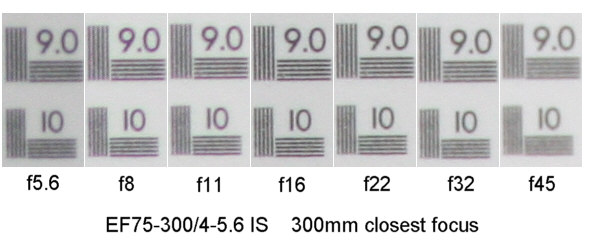
First let's look at a series of images shot using an EOS 20D DSLR (APS-C format sensor) with a 75-300/4-5.6 IS lens at 300mm and minimum focus distance:

You can see here that sharpness increases as you stop down (an indication that aberrations are present at wider apertures). Maximum sharpness seems to be at around f16 under these conditions. Stopping down to f22 gives a small, but acceptable sharpness loss if you need the extra depth of field that f22 can provide. At f32 there's a distinct sharpness loss, though still possibly acceptable if you're not making large prints. It's very clear that stopping down to minimum aperture, f45 in this case, gives a big drop in sharpness and should probably be avoided.

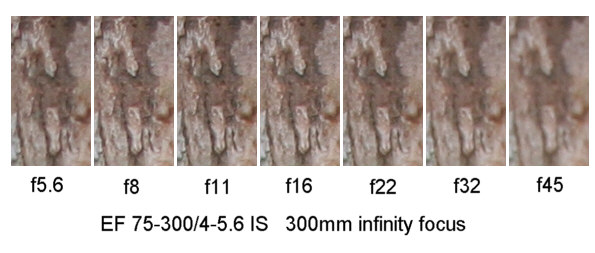
Close focusing a non-macro lens tends to increase basic aberrations (like spherical aberration), so what do we see then the focus is at infinity, when aberrations may be better controlled? The next set of images show this. Again the same lens and camera, but this time focused on a distant object (actually a tree trunk).

In this case it's clear that stopping down from f5.6 to f8 results in a gain in sharpness (due to lessening of aberrations). Sharpness is better at f8 and perhaps just slightly better still at f11. There's a small drop in sharpness at f16, a further drop at f22, f32 and f45. Again f32 and f45 should probably be avoided, and f16 and f22 only used if necessary to give greater depth of field or slow shutter speeds.

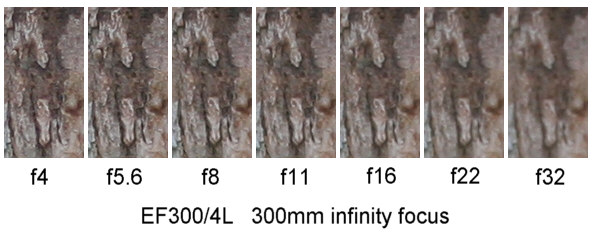
What about a lens that has less aberrations to start with? This time an EOS 20D was used in conjunction with an EF 300/4L lens, again focused on the same distant tree trunk.

It's evident that the 300/4L lens is sharper than the 75-300/4-5.6 IS, but that's really no surprise. f4 is sharp, but f5.6 is very slightly sharper. Sharpness slowly drops as the lens is stopped down past f8. f16 is OK and f22 may be acceptable, but f32 is pretty bad.

Conclusion

If you want to keep your images sharp, don't use f32 with an APS-C DSLR. The effects of diffraction are clearly visible at f32 and significantly degrade the image. Use f22 only if you have no choice. Optimal sharpness depends on the lens. For a lens with significant aberrations (e.g. a consumer zoom at maximum focal length and minimum focus distance), stopping down to f16 may give optimum results. For a lens with less aberrations (e.g. a consumer zoom used at infinity focus), optimum performance is around f11, though both f8 and f16 are very similar. For a really good lens like the EF 300/4L, with well corrected aberrations, performance may peak at f5.6, but be good from f4 to f11. f16 is acceptable, but f22 and smaller apertures should be avoided.

Take care.

__________________
Take it easy, bb. >"HEAR & you FORGET<>SEE & you REMEMBER<>DO & you UNDERSTAND"<=$=|O|=$=>"Common Sense is Genius dressed in its Working Clothes"<>[Ralph Waldo Emerson]
Register to Reply Score 1 for Good Answer
Guru

Join Date: Oct 2008
Posts: 42355
Good Answers: 1693
#13
In reply to #8

Re: How does an ‘Aperture’ works?

09/27/2009 7:14 PM

bb,

GA,

LL

Register to Reply
Guru
United Kingdom - Member - Not a new member!

Join Date: Jun 2008
Location: USA/Europe
Posts: 4547
Good Answers: 68
#16
In reply to #13

Re: How does an ‘Aperture’ works?

09/27/2009 9:47 PM

Hello lynlynch,

Why thank you kind Sir!

Take care

__________________
Take it easy, bb. >"HEAR & you FORGET<>SEE & you REMEMBER<>DO & you UNDERSTAND"<=$=|O|=$=>"Common Sense is Genius dressed in its Working Clothes"<>[Ralph Waldo Emerson]
Register to Reply Off Topic (Score 5)
Guru
Popular Science - Evolution - New Member

Join Date: Jul 2006
Location: India-Chennai.
Posts: 722
Good Answers: 30
#32
In reply to #8

Re: How does an ‘Aperture’ works?

09/29/2009 1:27 PM

"You can also check this out. Make an 'iris' by making the smallest 'circle' you can with you first finger and thumb. If you usually have to use spectacles, and cannot see a word, make this 'iris' as small as possible and put your eye really close maybe even touching your hand and a word you cannot read, it readable using this finger trick."

I have been toying with this 'finger trick' quite some time and wondering about thin translucent band around the finger (any obstruction in general).

This band is translucent.

The vision through this band improves the clarity as you indicated.

The clarity/focus is better at darker portion (closer to finger) than through the more transparent portion (farther to finger).

Is it similar to 'penumbra' for the shadow?

What governs the intensity of this band? What governs the width of this band?

Does the width of this band vary person to person depending upon his eyesight?

__________________
A picture worth thousand words: needless to say if it is animated.
Register to Reply
Guru
United Kingdom - Member - Not a new member!

Join Date: Jun 2008
Location: USA/Europe
Posts: 4547
Good Answers: 68
#33
In reply to #32

Re: How does an ‘Aperture’ works?

09/29/2009 4:00 PM

Hello yesyen,

Many thanks for the reply post.

I think this area as you call it. The distance the fingers need to be apart is directly related to the Human Iris size. It is easier for me to make a circle with my forefinger and thumb and look through the gap which I have measured at ~2 to 3 mm.

Trying to read the writing on the news page on my computer and it is totally blurred. Using the forefinger trick , and I can read the words. To give you another way and some idea at how small the gap needs to be, I can also read the words through my parallel fingers held straight out and together, looking through the slight gap between them.

Not very practical but, it is something that could be useful to read a Menu when you leave your specs' at home?

Take care

__________________
Take it easy, bb. >"HEAR & you FORGET<>SEE & you REMEMBER<>DO & you UNDERSTAND"<=$=|O|=$=>"Common Sense is Genius dressed in its Working Clothes"<>[Ralph Waldo Emerson]
Register to Reply
Guru
Safety - ESD - New Member Popular Science - Cosmology - Amateur Astronomer Technical Fields - Technical Writing - Writer India - Member - Regular CR4 participant Engineering Fields - Optical Engineering - New Member

Join Date: Dec 2007
Location: 18 29 N 73 57E
Posts: 1390
Good Answers: 31
#40
In reply to #6

Re: How does an ‘Aperture’ works?

10/27/2009 1:38 AM

Yes, smaller hole passes less light. But gives sharper picture as depth of focus increases.

But on the other hand to compensate for the less light reaching the film or sensor, you need to increase the eposure timing. With increased exposure time, you allow more light to reach the film/ sensor, and get the equally bright picture, as that of bigger aperture.

But when you increase the exposure time, chances of hand shake/ movement of the object being photographed increases. Hand shake can be avoided by using tripod. But object movement during exposure time depends up on the object itself. Thus the advantage of sharper image by smaller aperture may be lost due to movement of object during longer exposure.

Thus it is always a balance between aperture and exposure time for a situation. Thus, the judgement of photographer is most vital for good photo.

Otherwise, with good instrument, anybody would have achieved always good result. But it doesn't happen

Register to Reply
Guru

Join Date: Oct 2007
Posts: 734
Good Answers: 70
#41
In reply to #40

Re: How does an ‘Aperture’ works?

10/27/2009 11:34 AM

In terms of geometric optics you are correct. But as the size of the aperture decreases, the effects of diffraction become more of a problem. As each light wave passes through the aperture, those rays that just barely make it through create a swarm of 'wavelets' that behave as if they were coming from the edge of the aperture. Because these wavelets originate at the aperture (which is near or within the lens assembly) and not in object space where the subject of the photograph lies, they are unfocused and therefore fall more or less randomly on the film or chip, reducing the overall contrast and resolution. The smaller the aperture the larger the percentage of the light that is mangled in this way. So yes, up to a point a smaller aperture will provide a sharper image (by reducing the aberrations), but beyond that point this diffraction limits the image quality.

For photography this is not a huge problem, since most photographic lenses are far from diffraction limited, meaning that the actual performance of the lens is significantly worse than would be expected from a 'perfect lens'. The design of a photographic lens requires a number of compromises, and each compromise results is poorer image quality. Photography requires that the image be formed on a flat plane (the film or chip is flat), and it also requires that the image quality at the edges of the image not be noticeably worse than the at the center. A further requirement is that light of all colors is focused in the same plane. Since a 'perfect' lens (a lens with no optical aberrations) is only perfect at or near the center of the image field, and since the image field of a perfect lens is curved, each compromise required for photography makes the lens less 'perfect'. As long as the compromised image quality is 'good enough', meaning imperceptible to the person viewing the photograph (or for machine vision, the image of a point source of light size is about the same as the pixel size), the trade-offs required are not a problem. So for a photographic lens you can reduce the aperture size, and reduce the 'diffraction limit' of the lens, but since the diffraction limit is much higher than the actual performance of the compromised lens design, it is generally not noticeable. But if you stop down too far, the image quality will suffer.

Register to Reply
Guru
Safety - ESD - New Member Popular Science - Cosmology - Amateur Astronomer Technical Fields - Technical Writing - Writer India - Member - Regular CR4 participant Engineering Fields - Optical Engineering - New Member

Join Date: Dec 2007
Location: 18 29 N 73 57E
Posts: 1390
Good Answers: 31
#42
In reply to #41

Re: How does an ‘Aperture’ works?

10/27/2009 10:51 PM

Thanks john

Good detailing, I learnt many more things

Register to Reply
Associate

Join Date: Jan 2008
Posts: 35
#9
In reply to #5

Re: How does an ‘Aperture’ works?

09/27/2009 4:24 PM

Dear Baby Bear: Thank you heartily for the wonderful speedy lesson in optics. It helps me to understand some of the problems with my eye cataracts. Thanks again. Al Mond

Register to Reply
Guru
United Kingdom - Member - Not a new member!

Join Date: Jun 2008
Location: USA/Europe
Posts: 4547
Good Answers: 68
#11
In reply to #9

Re: How does an ‘Aperture’ works?

09/27/2009 6:11 PM

Hello Al Mond,

Sorry to hear you have that kind of problem.

I would be interested on anything you care to tell me about your remark you sent that my stuff helped you understand cataracts?

I just have bad eyesight, and either read or heard from somewhere that if you make a tiny hole with your fingers or, in a piece of card perhaps, though I have not tried this, it meads I can read short bits. For instance what is on the TV. Not whole books! But I need specs to find my specs, if you see what I mean............ Sorry no pun intended.

Are you able to read my posts or do you want the Fonts larger?

Take care.

__________________
Take it easy, bb. >"HEAR & you FORGET<>SEE & you REMEMBER<>DO & you UNDERSTAND"<=$=|O|=$=>"Common Sense is Genius dressed in its Working Clothes"<>[Ralph Waldo Emerson]
Register to Reply
Associate

Join Date: Jan 2008
Posts: 35
#12
In reply to #11

Re: How does an ‘Aperture’ works?

09/27/2009 7:07 PM

Dear BB: Even though my age is only two months away from being 89 years old, my jaw drops with amazement when I see such wonderful, knowledgeable information such as yours, given freely for the asking on the internet. When I went to my optomotrist a couple of day's ago, she confirmed that I indeed had a cataract in my right eye. I had conplained about seeing things as though the eye was out-of-focus as in photography. She informed me that an optomologist would operate and remove the cataract if the 'amplication' measurement was 20-50. If it were 20-40 the operation would not be done. (Excuse my misuse of the non-optical measurement term amplification). Probaly insurance company criteria, I don't know. No matter that my complaint to the opthomologist was 'fuzziness', not lack of amplification.......What really brought the matter home is when you spoke of pin-hole viewing. As a concluding test the optometrist put a black plastic shield with many fairly large holes in it, and lo and behold my fuzzy view dissappeared and the letters I was viewing came into sharp dark-letter focus. My optician visit was over. I had no oportunity to quiz her about the pin-hole plastic test. But sitting here at my desk I look over at the piece of cardboard with a bunch of holes in it, my attempt at duplicating the condition at the optomitrist. ....I only read your piece one time and immediately recognized the wonderful knowledge it contained. I will go over it a few more times, maybe pull out old physics books, no, will go to Wikipedea and re-learn stuff like focal length. For wonderful contributors like yourself who make their expertise available, I, We colectively thank you. ..........My eyes are otherwise fairly good and I can read, drive, use the computer and do most ordinary eyesight required functions. No font enlargement required. Feel free to reply. Al

Register to Reply
Guru
United Kingdom - Member - Not a new member!

Join Date: Jun 2008
Location: USA/Europe
Posts: 4547
Good Answers: 68
#15
In reply to #12

Re: How does an ‘Aperture’ works?

09/27/2009 9:35 PM

Hello Dear Friend,

You made me cry! I am glad it helped wake your interest in the subject enough to want to check out other stuff. I offered nothing more than I always do and others here do, which is an attempt to help which just happed to be the right kind to also help you out as well!

Perhaps I should not be advising a man of 89 what to do, but, as you are paying and it is your eyes, I would get any info' I could from the Optometrist.

I love snooker, but cannot play now because though I wear spectacles, I cannot see the end of a full size table 12' x 6' (~4 x 2 m). I can see the close balls with my reading glasses, and the farthest ones with my distance glasses. But I can't find the correct focal length to allow me to see all the table all the time. PITA !

I see you are a new Member. Please allow me to wish you luck and say please get back to the site and or me or others if and when you need to. I know the other Members are very clever and can answer any question you may need. Of course you can alway start your own thread if you wish. Just click one of the two buttons on the right at the top of the page, "Ask a Question", or "Start a Discussion", OK?

I have to say your post was one of the must gracious posts I have received, and it did move me. Many thanks for taking your time to reply to me in such a kind way, thank you.

Take care my friend.

__________________
Take it easy, bb. >"HEAR & you FORGET<>SEE & you REMEMBER<>DO & you UNDERSTAND"<=$=|O|=$=>"Common Sense is Genius dressed in its Working Clothes"<>[Ralph Waldo Emerson]
Register to Reply
Associate

Join Date: Jan 2008
Posts: 35
#17
In reply to #15

Re: How does an ‘Aperture’ works?

09/28/2009 1:27 AM

Dear BB: I was viewing the many replys that were received regarding 'how does and aperature work' and failed to observe that you have personnaly replied to over 3000 discussions and questions. ..What can I say but, Wow... Yes I am new to CR4, haven't even figured out what the CR4 designation represents. I believe my contribution to CR4 will be in the area of audio sound communication, that is, what is the means whereby we humans communicate with one another. ....Once again, because of the deterioration of the human body with the aging process the eyes and hearing are right up there as highly age related. There is a great mis-understanding of the audio communication process and that is where I feel I have a breakthrough idea for correctly understanding of what happens to the hearing - communication problem as we age. Just to briefly clue you into what I am talking about, let me start by saying that that audio speech communication is by its nature two-leveled, two distint sound levels, like bi-focals for eye glasses, we humans use an audio sound communication sytem, call it bi-otal. Don't want to call it bi-otic for obvious reasons.

The way all human beings generate the necessary voice sound consists of two basic techniques. One starts with the vocal chords vibrating away (vibrating membranes) and being hugely ampified by the cavities of the skull. Recall the wailing of a baby to realize just how loud even the new- born learns to make earth shatterng sounds. These wails originate with the vocal chords. The sounds originating at the vocal chords are labeled as VOWELS. However there is a limited amount of information contained in the vowel sounds by themself. Nearly all animal spieces use the vowel sounds for communicatiion. My guess is that our pre-pre-historic humans when we were just another branch of monkeys was that we too communicated with typical squealy monkey sounds. I honor the memory of that pre-ancient genius who recognized that if she put noises with the squeals there were a great many more meanings, ideas that could be conveyed. The first spoken WORD ever generated by our ancients ones might have been MAMA since it combines the opening and closing of the baby' mouth as in sucking the nipple, combined with the loud wailing sound. A noise sound (a consonant) and a wailing sound (a vowel). The creation of speech.

Lesson number one: Speech consists of the combination of noises and tones. Look at an oscilloscope and you can view the repetative vowel frequencies. Not so for the consonants, we can't view them since they aren't repetative. The vowels, as we know, are A,E,I,O,U: all generated starting with the vocal chords and greatly ampified by the head cavities. Consonants on the other hand are NOT Bee, Cee, Dee, etc. as generally stated, but merely the charateristic noise sounds B.C,D generated mostly with the use of tongue and mouth with few exceptions, maybe like L,M and N. Lip reading is based on this mouth-tongue movement. If you try saying the consonants without augmentation with vowels then the volume level is minute compared to the volume which can be generated using vowels. Therein lies the great problem with devices such as hearing aids and for that manner, all audio equipment. ....We, the millions of hard of hearing (HOH) folks can hear, that is detect the sounds of things but fatally we can't understand their meaning. What we are saying in effect, is that we can hear the sounds generated by the vowels but we can't hear the consonants. Without the consonants, we simply do not understand speech. "I hear you but I don't understand you" is the plaintiff cry of the HOH world. It would not be an exageration to say that vowels are typically many thousands of times louder in volume than consonants.... To conclude, my hope is that some electronic circuit expert will take this information and create audio sounds with great consonant amplification or perhaps it may be easier to just reduce the volume level of only the vowel sounds, while leaving the receiving device at full volume in order to maximize the consonant volume level. Next chapter, in the future sometime.

Mr. B. Bear, do not weep over these wonderful science projects that we discuss on CR4, but rejoice in the path to which it is leading mankind. Let us save crying only when our loved ones die like my beloved wife Eleanore on April 15, 2009. Science is our hope for the future. I am old enough to remember looking up whenever we heard the sound of an airplane. I remember seeing the Graf Zepplin when it landed in Chicago's Soldier's Field. We have come a long ways, but the future of science is in its pre-infancy state.

Register to Reply Off Topic (Score 5)
Guru
United Kingdom - Member - Not a new member!

Join Date: Jun 2008
Location: USA/Europe
Posts: 4547
Good Answers: 68
#22
In reply to #17

Re: How does an ‘Aperture’ works?

09/28/2009 7:31 PM

Hello Al Mond,

I hope you are fine?

To start here is a link to the FAQs page which with answer some of your queries.

CR4 is Conference Room #4.

The 3000 plus replies makes me think twice about replying now and then, but, some days and or weeks there is not that many threads or posts I reply to, and, on others there is lots. I can write my own opinion, as can you or anyone here, but the 'reply post number goes up a lot when I answer replies sent to me. That has been the case over the past three weeks or so, and I hardly know I am writing that many when the people , like you, and the subjects are so interesting!. I certainly would not describe it as hard work. As far as I am concerned, I am a Member just like you, and have spoken too and become friends (all be it on-line) with a good number of Members, whom I respect and I would like to think they respect me sometimes also?.

You will find most of the 'regulars' will have at least 2000/3000 replies, and where some have blogs, some have several blogs, they will often have more than others. Of course a reply with a single word 'Yes!' counts as reply as does one with (just a few more) like this!

You will see the true genius' on any particular subject, and they have my respect for sure. They have spent their lives in some kind of specialised Engineering and any answer from those experts you know is the truth! They are not often putting their 'opinion' over, so much as their experience of learning and actually doing the hands on job of Engineering in their own sphere. True respect from me to those who know what they are talking about!!!

http://cr4.globalspec.com/faq

The link above is to the FAQs page where you find most answers to any queries about the site, including the sites name "CR4". It means Conference Room #4. It has been discussed quite a bit and I think the original title was Coffee Room #4. The site is sponsored by a Chinese Engineering Company or Group 'Globalspec.com'.

It is a pretty well run site and the Admin will answer any question you ask. Sometimes they are very busy, perhaps doing stuff we know nothing of at that moment like changing the site slightly or something and you may have to write twice but, they will answer most times. Admin have been very helpful to me, and I think you will find a link to them on the link above. If not here is one: http://cr4.globalspec.com/ This is Admin General.

This is a link to 'Moose', who is a great help to me:

http://cr4.globalspec.com/member?u=39

But, if you write to Admin General it will usually be Moose or Chris Leonard whom reply.

Forgive me for 'teaching granny to suck eggs' OK, but if you are not sure, if you want to write some private stuff or personal oppinions, or your email, click on your name and it will take you to the PM (Private Message) part of the site. Or anyone elses name will also take you to the PM with a window already addressed to them.

Some 'newbies' here or guest' will publish their email address in Open Forum. That is not really the way to go as it invites any spam, not from Members, but from automatic 'trawling of emails and other links' by nasty people who are just out to make a quick buck!

I hope you find this post helpful my friend. I will now read and answer your post proper in a new post, OK?

Take care.

__________________
Take it easy, bb. >"HEAR & you FORGET<>SEE & you REMEMBER<>DO & you UNDERSTAND"<=$=|O|=$=>"Common Sense is Genius dressed in its Working Clothes"<>[Ralph Waldo Emerson]
Register to Reply
Guru
United Kingdom - Member - Not a new member!

Join Date: Jun 2008
Location: USA/Europe
Posts: 4547
Good Answers: 68
#24
In reply to #17

Re: How does an ‘Aperture’ works?

09/28/2009 9:05 PM

Hi Al Mond,

Firstly, let say I am sorry for your loss of your Wife I have lost both Parents, whom by definition are almost bound to love you? But, a Wife or Husband chooses to love and be with you, so that loss, I imagine would be greater? Anyway, CR4 is always here together with the friends you are bound to make.

I too am somewhat HOH especially on the phone, or when someone is talking from another room? I never have learned it 'officially' but realise it is easier for me to understand when I and 'they' are looking at me so must be lip reading in part at least.

Have you thought about this and come to these conclusions, or are you a 'professional' in the voice and hearing field?

Many thanks for your reply post my friend. Anytime, I will answer if it is a day after?

Take care.

__________________
Take it easy, bb. >"HEAR & you FORGET<>SEE & you REMEMBER<>DO & you UNDERSTAND"<=$=|O|=$=>"Common Sense is Genius dressed in its Working Clothes"<>[Ralph Waldo Emerson]
Register to Reply Off Topic (Score 5)
Guru
United Kingdom - Member - Not a new member!

Join Date: Jun 2008
Location: USA/Europe
Posts: 4547
Good Answers: 68
#43
In reply to #12

Re: How does an ‘Aperture’ works?

11/13/2010 2:34 PM

Hi Al Mond,

Just a note to see how you are and to say "hello" again!

This is the first time I have written any post for several months.

I hope your eye problem with 'cataracts' is no worse. Or if it is a problem I hope you have found the 'pin-hole' thing a help still? And or anything else you have been able to glean in your research!

I am writing to say have a great Holiday when it comes, and it will be upon us quicker than perhaps anyone can imagine!

I count the time now in passing months rather days......... They go passed so quickly I just cannot believe it!

__________________
Take it easy, bb. >"HEAR & you FORGET<>SEE & you REMEMBER<>DO & you UNDERSTAND"<=$=|O|=$=>"Common Sense is Genius dressed in its Working Clothes"<>[Ralph Waldo Emerson]
Register to Reply
Anonymous Poster
#10

Re: How does an ‘Aperture’ works?

09/27/2009 5:33 PM

I like simple answers. A wide aperture provides more opportunities for the "parallax errors" in the light path through the lens to become very obvious.

Only light from objects that at the "focal distance" can cross the plane of an open lens as if it was a simple pinhole, and only the center of the lens can behave as a pinhole independently of the distance to the object. That's the problem.

Stopping down the aperture provides a useful compromise for partially resolving every other object not located precisely at the focal distance. If you strongly magnify a photograph that has plenty of depth of field, you will still see that most of the objects which appear to be "in focus" are actually just "less blurred" than the grain of the film (or the pixel count) can resolve.

Register to Reply
2
Guru

Join Date: Feb 2007
Location: Israel
Posts: 2968
Good Answers: 24
#14

Re: How does an ‘Aperture’ works?

09/27/2009 8:48 PM

The aperture controls the amount (intensity) of light which passes through the lens, and applies it's known effect of influencing the "Depth Of Field" of the image.

The intensity of light is an intuitive concept, so it is readily understood.

It is through two physical properties of light, interference and diffraction, that the image passing the lens is able to include or exclude the depth of field, into which sharper focus be applied.

If you look through the teeth of a comb placed in front of your eyes, you can have a physical sense of the effect of interference and diffraction on the image seen.

The teeth "blocking" the sight, aren't really able to mask it totally, somewhat diminishing the amount of light passing through, yet allowing the image seen, become yet to appear sharper, more in focus, than it would, without that interference between your eye and the object in sight.

The explanation of this phenomenon is complex and not yet fully understood, as it is with other aspects concerning the behaviour of light, in terms of particle interaction.

One of the best sources of the attempt to explain fundamental optics in terms of particle interaction, is Richard Feynman's Quantum Electrodynamic "Light and Matter" book. published in 1985.

- - - -

In practical terms it means, that if you leave your aperture wide open, only a 'thin' layer of the captured image will be focused, that to which the lens id tuned to. A short distance in front and behind that given distance will remain blurred.

Now, the more you close the aperture, the more distance from the camera, in front and behind the lens-tuned distance, will become focused.

.

Most traditional camera lenses containing the aperture control-ring, are likely to have a scale etched on control-ring describing the distance ranges, relative to the tuned focus

Register to Reply Good Answer (Score 2)
Guru
United Kingdom - Member - Not a new member!

Join Date: Jun 2008
Location: USA/Europe
Posts: 4547
Good Answers: 68
#25
In reply to #14

Re: How does an ‘Aperture’ works?

09/28/2009 10:05 PM

Hi Yuval,

How are you?

It has been a while since we 'spoke'? I like your clear illustrations using the images and the post looks and is simple to understand!..................

Of course when someone 'knows' something, it is always understandable?

But, as you obviously know, many owners of good cameras, particularly "SLR" (Single Lens Reflex) Cameras, never think to read the details of why certain 'focal lengths' are better at certain distance, and in a lot of cases, that focal length is necessary for good clear pics. Some find their camera is 'intuitive' to use, while others have to 'work' at it!

Your post will refresh minds perhaps who have not realised what the focal lengths are for, even though on Auto-Aperture Setting the Focal length is set for you of course, and help tutor others who have just bought or received a Camera as a gift?

Take care my friend.

__________________
Take it easy, bb. >"HEAR & you FORGET<>SEE & you REMEMBER<>DO & you UNDERSTAND"<=$=|O|=$=>"Common Sense is Genius dressed in its Working Clothes"<>[Ralph Waldo Emerson]
Register to Reply
Guru
United Kingdom - Member - Not a new member!

Join Date: Jun 2008
Location: USA/Europe
Posts: 4547
Good Answers: 68
#30
In reply to #14

Re: How does an ‘Aperture’ works?

09/29/2009 12:53 AM

Hi Yuval,

GA to you Sir.

take care

__________________
Take it easy, bb. >"HEAR & you FORGET<>SEE & you REMEMBER<>DO & you UNDERSTAND"<=$=|O|=$=>"Common Sense is Genius dressed in its Working Clothes"<>[Ralph Waldo Emerson]
Register to Reply
Guru
Hobbies - Musician - New Member Greece - Member - New Member

Join Date: Mar 2007
Location: Greece / Athens
Posts: 722
Good Answers: 28
#18

Re: How does an ‘Aperture’ works?

09/28/2009 3:59 AM

I made a drawing to show you what happens.

It's obvious (see right figure) that a large aperture gives you an image with blurred edges.

I hope that it helps.

__________________
George
Register to Reply Score 1 for Good Answer
Guru
United Kingdom - Member - Not a new member!

Join Date: Jun 2008
Location: USA/Europe
Posts: 4547
Good Answers: 68
#20
In reply to #18

Re: How does an ‘Aperture’ works?

09/28/2009 6:28 PM

Hi G.K.,

Nice drawing there.

And looking at it I can see and already knew, that it is obvious there will be more diffraction interfering with the finished picture on a wide Aperture. The drawing does help make it clearer though for sure.

Nice one.

Take care

__________________
Take it easy, bb. >"HEAR & you FORGET<>SEE & you REMEMBER<>DO & you UNDERSTAND"<=$=|O|=$=>"Common Sense is Genius dressed in its Working Clothes"<>[Ralph Waldo Emerson]
Register to Reply
Guru

Join Date: Oct 2007
Posts: 734
Good Answers: 70
#23
In reply to #18

Re: How does an ‘Aperture’ works?

09/28/2009 7:58 PM

It seems to me that your drawing only makes sense if there is no lens present.

Register to Reply
Guru
United Kingdom - Member - Not a new member!

Join Date: Jun 2008
Location: USA/Europe
Posts: 4547
Good Answers: 68
#28
In reply to #23

Re: How does an ‘Aperture’ works?

09/28/2009 10:23 PM

Hi johnfoti,

With regard to this post only, the 'lens' in the bold | vertical central line in these pics.

Take care.

__________________
Take it easy, bb. >"HEAR & you FORGET<>SEE & you REMEMBER<>DO & you UNDERSTAND"<=$=|O|=$=>"Common Sense is Genius dressed in its Working Clothes"<>[Ralph Waldo Emerson]
Register to Reply
Guru

Join Date: Oct 2007
Location: Transcendia
Posts: 2963
Good Answers: 93
#27
In reply to #18

Re: How does an ‘Aperture’ works?

09/28/2009 10:22 PM

Dear GK, I have been struggling to find the right words to help explain how aperture works without using phrases like lines of convergence.

__________________
You don't get wise because you got old, you get old because you were wise.
Register to Reply
Guru

Join Date: Oct 2007
Posts: 734
Good Answers: 70
#19

Re: How does an ‘Aperture’ works?

09/28/2009 9:44 AM

Aperture size has both positive and negative effects on image quality, so selecting the optimum aperture size for an imaging system requires striking a balance. Usually the object being imaged is an important part of these considerations.

Some advantages to smaller apertures:

  • Greater depth of focus - If the objects being imaged are at various distances from the lens, the need to balance the focus between nearby and more distant objects is minimized, since the difference in focus will be less noticeable. For a pinhole aperture the depth of focus is infinite, and the lens becomes unnecessary.
  • Reduced lens aberrations - All lenses have aberrations, and they almost always become more pronounced for rays that pass through the lens farther from the center. By blocking these outer portions of the lens the worst out of focus rays are eliminated.
  • Increased contrast - As was pointed out in post #2, a reduced aperture reduces the amount of light reaching the image plane, and this means loss of information. If however, you are attempting to image an object with inherently low contrast, this may make the image appear clearer.

Some advantages to larger apertures:

  • More information - Larger apertures mean more light reaches the image, meaning more information is available. Photographs taken with larger apertures have longer gray scales, so you can see more detail in the shadows and highlights.
  • Shorter exposures - More light means that for photography the exposure can be shorter. This means that moving objects will have less blur. For astronomers and others who are attempting to image very dim objects the larger apertures are also a plus, so long as the optical design successfully minimizes aberrations.
Register to Reply
Guru
United Kingdom - Member - Not a new member!

Join Date: Jun 2008
Location: USA/Europe
Posts: 4547
Good Answers: 68
#29
In reply to #19

Re: How does an ‘Aperture’ works?

09/28/2009 11:01 PM

Hello johnfoti,

Some good basic info' in your post well done.

I know that some people are 'scared' by SLR (Single Lens Reflex) camera's but they may have more controls, which can be confusing, but the picture you frame through the lens, is the picture you will get in the finished photo? I love SLR, or another name is TTL, (Through The Lens) photography.

I started photography, and are still learning, but started with a 'box brownie'. I am sure there is not many who know what that is. It was a pretty good basic 'point and shoot' camera with no controls. The problem was in the little square window which was the 'back of the double reflected lens' the object being photographed was up-side-down.

Take care.

__________________
Take it easy, bb. >"HEAR & you FORGET<>SEE & you REMEMBER<>DO & you UNDERSTAND"<=$=|O|=$=>"Common Sense is Genius dressed in its Working Clothes"<>[Ralph Waldo Emerson]
Register to Reply
Guru

Join Date: Oct 2007
Location: Transcendia
Posts: 2963
Good Answers: 93
#21

Re: How does an ‘Aperture’ works?

09/28/2009 7:00 PM

There is light. The light moves in straight lines from where it is.

The light goes through the hole from where it is in a straight line.

Little hole less light, more straight.

Big hole more light, still attempting straight, but useless for focus without lenses straightening out.

__________________
You don't get wise because you got old, you get old because you were wise.
Register to Reply
Guru
Popular Science - Weaponology - Ancient Weapon Enthusiast United States - US - Statue of Liberty - Viva la Revolucion!

Join Date: Dec 2008
Location: In the dark, somewhere in Arizona
Posts: 632
Good Answers: 15
#34

Re: How does an ‘Aperture’ works?

09/30/2009 12:51 PM

The subject of your photograph will generally be lit from multiple angles, passing the light reflected off your subject through an aperture removes some of the light that isn't quite lined up with your image thus removing some 'noise' from your final image. We do this in reverse in theatrical lighting, we can insert a pattern into the focal point of a beam of light, to improve the clarity of this image in the beam we can put a 'donut' (nothing more than a large aperture) out in front of the fixture which simply strips away some of the sloppy photons leaving a nicely aligned set of photons which results in a crisper image. This is similar to polarizing light but not as thorough.

__________________
Education is not preparation for life; life itself is education.
Register to Reply
Power-User

Join Date: Jun 2009
Location: Santa Cruz, CA
Posts: 158
Good Answers: 5
#35

Re: How does an ‘Aperture’ works?

09/30/2009 1:05 PM

If you check Wikipedia under "Hyperfocal Distance", I think you will find what you want, including formulas to find near point and far point of focus.

tommm

Register to Reply Off Topic (Score 5)
Guru

Join Date: Aug 2006
Posts: 4484
Good Answers: 246
#36

Re: How does an ‘Aperture’ works?

10/02/2009 5:43 PM

I didn't have time to do anything other than scan down this thread in a couple seconds... but clearly this is a demonstration of the power and utility of CR4. Great stuff!

__________________
There is more to life than just eating mice.
Register to Reply
Guru
United Kingdom - Member - Not a new member!

Join Date: Jun 2008
Location: USA/Europe
Posts: 4547
Good Answers: 68
#37
In reply to #36

Re: How does an ‘Aperture’ works?

10/02/2009 6:07 PM

Hi Blink,

I know exactly what you mean and very often come to CR4 the same way myself!

ECHO, ECHO, ECHO.................................!

__________________
Take it easy, bb. >"HEAR & you FORGET<>SEE & you REMEMBER<>DO & you UNDERSTAND"<=$=|O|=$=>"Common Sense is Genius dressed in its Working Clothes"<>[Ralph Waldo Emerson]
Register to Reply
Participant

Join Date: Oct 2009
Location: Ningbo - China
Posts: 1
#38

Re: How does an ‘Aperture’ works?

10/24/2009 1:47 AM

Interesting Thread !

As I bought recently a few new stuff and got time today to do a few tests, I took pictures of a building opposite to mine. Same position, same light (sunny) but different apertures (2,8 / 5,3 / 8,0) and of course I had to higher the speed when lowering the aperture.

Then I downloaded the pics on my computer and enlarge the 3 of them at the same scale to see the details on the building wall and the result is interesting.

Test has been done here with Canon G10 but identical results come out with an Olympus E3...

Don't know if my pic will be automatically compress on this forum but maybe you can see the details of the number and the bricks. Much clearer when aperture is 2.8. Here with the originals photos, it is more than obvious.

Interesting result as it goes against what we usually says when we talk of "clearer"...

Register to Reply
Guru
Safety - ESD - New Member Popular Science - Cosmology - Amateur Astronomer Technical Fields - Technical Writing - Writer India - Member - Regular CR4 participant Engineering Fields - Optical Engineering - New Member

Join Date: Dec 2007
Location: 18 29 N 73 57E
Posts: 1390
Good Answers: 31
#39

Re: How does an ‘Aperture’ works?

10/27/2009 1:26 AM

The explanations given in various posts are right.

But in short the basic reason of getting sharper image (and more depth of field) with smaller aperture is " you use smaller area of sphere (of lens), thus you get less spherical abrasion.

Any lens has got spherical abrasion. That means, the image formed by each annular portion of the disc is at different length from the lens. Thus, at a particular distance, only some part of image is very sharp and it is overlapped by other not so sharp images. If you restrict the annular area, you remove all "not so sharp images".

Thus, even if we block central portion of the lens and use very narrow outer edge of the lens, we will get sharp image.

Register to Reply
Anonymous Poster
#44
In reply to #39

Re: How does an ‘Aperture’ works?

11/14/2010 9:54 AM

"Thus, even if we block central portion of the lens and use very narrow outer edge of the lens, we will get sharp image.", is it so!!!

In the same lines, instead of a single holed (inner or outer) aperture, if we restrict the path by a grid, will it work?

Register to Reply
Guru
United Kingdom - Member - Not a new member!

Join Date: Jun 2008
Location: USA/Europe
Posts: 4547
Good Answers: 68
#45

Re: How does an ‘Aperture’ works?

11/14/2010 5:56 PM

Hi all,

It may have already been said, but I am not going to read the full thread to find out so will just add this, especially for those who are real newbies to camera's.

If you are new to photography my advice is this.

You should set the camera to take a photograph of the same picture or just hold and click if you do not have a tripod, on each F stop starting with the most wide aperture your camera has. For most that will be Make a list on paper of the 'F' stop number by looking at the ring that indicates that, and start off from say F.2 and go up to F.16, or as many stops or indicators as is on the 'F ring'.

And start with the lowest or highest, and work your way through take at least one picture and then listing the number of the picture you just took , and the 'F' stop. If you have a camera that prints the time and or other details on the back or front of the picture, write that next to the picture number list on the paper. .Then you can line up the results of the film or Digital image with the list you made of the time and or picture number and see the difference just one F stop will make.

Just as an example here's a list of F stops or F numbers:

F.16, F.11, F.8, F.5.6, F.4, F.2.8, F.2, F.1.8............ These are not all the F numbers just an example. But they are most of what is available on most camera's.

Remember, the higher the F number or 'F.Stop' the smaller the Aperture. Starting at F.1.4 the aperture is fully open on some lenses, then go to F.2, now half of the possible light only is reaching the film. Go to the next F stop or number F.2.8, and again half as much as F.2 reaches the film............. The confusion with these numbers, is not really what they actually mean perhaps, but rather "what they do" to the final image you are taking after the light enters the lens, the aperture, and then onto the film

Talk of the lens being 'wide open' when you use the lowest F number.

F.16--- 0.78125% of available light

F.11--- 1.5625% of available light

F.8--- 3.125% of the available light

F.5.6--- 6.25% of the available light

F.4--- 12.5% of the available light

F.2.8--- 25% of the available light

F.2 --- 50% of the available light

F.1.8 --- 100% of the available light

This list is an example only. If you have a really 'flash' camera, and the F Stops start at say F.1.2, then you will have to move the whole scale (above) (as in good) down. I have not listed the F.1.2 on the list because it means that the 'larger' numbers' (the smaller apertures, remember) become gradually more 'meaningless', at least to read on the page. What those smaller apertures do to the film or the sensor in a Digital Camera.

I mean to say as an example if I said take it down to [0.78125], your answer would probably be: Whhaaat? That is why F numbers, or F stops are used.

The F stops I mention of say F.16, F.11, F.8, are use on a manual setting camera to take distant pictures or 'landscapes' where super detail is not 'that' important, after all, you just want an 'idea' of the 'layout' of the landscape, or a "lay of the land" impression!

You should not get tied up with what these numbers mean, it is just an indicator, what really matters is what comes out the other end....... IE: the picture.

I hope this firstly does not confuse you! And to others on the thread, if you have already mentioned these details, please forgive me for do so again!

Adjusting the "F" ring or changing from say F8 to F 2.8, of course will not give any magnification, such as you would get with a 'zoom', or a 50 mm lens maybe, the frame or picture you are about to take will still be of the same object, but, the difference at F8 and F2.8, is that the 'F2.8' will be sharper. It means that the F.8 with give a good idea of the size of a garden shed and all the detail round it, where the F2.8 will make the detail, say the 'tines' of the fork may be clearly seen and all the detail of the patterns on the wood or brick will be more clearly viewed than a F.8.

But do not get tied up with these figures............What you are doing when taking a photo, and or video, is controlling the amount of light that hits the film or sensor, which in turn gives you the picture.

Other factors are Film 'Speed' and Shutter Speed. The 'ART of photography is combining the 'right' F stop, Film, and Shutter Speed to get the effect or sharpness, or lack of it. That means a 'blur' can still make a great picture! Note for instance picture of roads with lines of red and white lights. They are the blurred streaks of the tail and head lights of vehicles. You do not see the vehicles, only the streaks of the lights, which is similar to the line a firework makes when it goes off.

You could do as I mentioned above take a new picture at each F Stop.

But you can also take the same picture with the camera in the same position, and use a faster or slower film, and the same picture using gradually faster Shutter Speeds. This is not 'geeky', it will actually help you take the right photograph in different light conditions, like the difference between midday and midnight. Just make sure you list the exact settings if you know them, and if your camera allows 'Manual Setting'.

You will come to realise that a given F Stop will 'match a certain shutter speed for 'standard speed film. And will match other F.Stops and shutter speeds when using a faster or slower film. BTW. This referres to the reaction of the 'emulsion' of the film surface.

Film Speed is Measured in 'F Stops', and are referred to as ISO/ASA Rated. Again just as an example, an F.200 Film compared to an F.400, will 'give you', or allow you to take the same picture but you can take it with half the shutter speed, or half the aperture. I am not getting into that because it is too involved.

If you do as I say above and take the same picture with differing shutter speeds, or faster films, or a larger aperture, you will see when you check the actual picture taken, the difference in how much lighter or darker , or whether it is grainier or looks 'smoother'. If you yourself take all possible pictures with all films, shutters speeds, and F stop numbers, you will see that there are certain of these combination which take 'good enough' pictures, and you will also see that some will take amazing pictures! There is always a 'juggling act going between these three factor. The amazingly detailed picture can take several seconds to take, so may need a tripod to to stop 'camera shake', because holding a camera steady for longer than perhaps half a second (shutter speed) is hard to do.

It's all about give and take, OK?

Fast Film reacts faster to light, Slow Film reacts more slowly to the light entering the lens, and so needs a progressively larger (wider) aperture, but this film with give you a more detailed picture.

I would advise anyone to check out the millions of "Camera Instruction Sites" or photography for beginners.

But unless you take the time to get say four different but commonly used Films, and combine those with shutter speeds and aperture's and list them, it is hard to imagine what a combination of particular statistics or figures will give you in a picture. That only comes with experience, but that 'experience can be cut a whole lot by doing as I say and make a list and or a graph listing the setting that were used on that particular picture.

I am beginning to repeat myself so will call it a day there. I wish anyone who reads this thread and ALL the posts on it the best of luck in their new found 'Hobby', OK!

__________________
Take it easy, bb. >"HEAR & you FORGET<>SEE & you REMEMBER<>DO & you UNDERSTAND"<=$=|O|=$=>"Common Sense is Genius dressed in its Working Clothes"<>[Ralph Waldo Emerson]
Register to Reply
Guru
United Kingdom - Member - Not a new member!

Join Date: Jun 2008
Location: USA/Europe
Posts: 4547
Good Answers: 68
#46

Re: How does an ‘Aperture’ works?

11/15/2010 3:31 PM

Hi yesyen,

I forgot to mention in my last post the definitions of ISO/ASA.

ASA, an acronym (American Standards Association), refers to an antiquated scale for film speeds devised by Kodak during the 1940s. Some still use it, and it is often quoted alongside the ISO Film Speed Rating,

ISO (International Organization for Standardization) a standard that includes both linear and logarithmic dimensions.

The ASA and ISO film speed scales are used to indicate the quality of a finished photograph. That is, the 'graininess' of a finished picture. The grain in the Film Emulsion is directly related to the sensitivity to available light, larger grains are more sensitive, small fine grained are not as sensitive, it describes the size of the Silver particles in the coating of any 'roll film'. The term is also used in Digital photography, where it indicates the sensitivity of the CCD (Charges Coupled Device) in a Digital Camera.

Very fine grain equals very detailed picture, and is a slow Film. This is used to take picture like portraits in a studio where the light can be controlled, and is usually very bright. It needs the extra light because the fine grained film emulsion is not as sensitive as larger grained emulsion (faster film).

Large grained film emulsion is very sensitive to light and can take pictures in low light, still using a normal shutter speed. For instance 1/250th of a second, where if you used a fine grained slow film in low light it may need several seconds.

__________________
Take it easy, bb. >"HEAR & you FORGET<>SEE & you REMEMBER<>DO & you UNDERSTAND"<=$=|O|=$=>"Common Sense is Genius dressed in its Working Clothes"<>[Ralph Waldo Emerson]
Register to Reply
Register to Reply 46 comments

Good Answers:

These comments received enough positive votes to make them "good answers".

"Almost" Good Answers:

Check out these comments that don't yet have enough votes to be "official" good answers and, if you agree with them, vote them!
Copy to Clipboard

Users who posted comments:

Al Mond (3); Anonymous Poster (3); babybear (18); Blink (1); G.K. (1); gsuhas (3); hairlesssimian (1); johnfotl (3); lyn (2); RHABE (1); RogerLee (1); tommm (1); Transcendian (3); TVP45 (1); yesyen (2); Yuval (2)

Previous in Forum: dark matter/dark energy... could these be as fictional as the Coreolis force?   Next in Forum: Bicycle Shifters

Advertisement