Previous in Forum: Virtual Image   Next in Forum: A Hypothetical Question???
Close
Close
Close
30 comments
Rate Comments: Nested
Anonymous Poster

Microwaves

10/01/2009 9:49 AM

could anybody tell me if microwaves can boil water under pressure to about 400 celsius, and if there is a relationship between the power of the magnetron and the amount of time it takes to boil water i.e. the amount of time it takes to boil 225 ml of water with a magnetron of 1 Kw, will it be faster with a 5 Kw magnetron

yours sincerely

Terry

Reply
Interested in this topic? By joining CR4 you can "subscribe" to
this discussion and receive notification when new comments are added.
Guru
United Kingdom - Member - Olde Member!! Engineering Fields - Instrumentation Engineering - New Member

Join Date: Jul 2006
Location: Dunstable, England
Posts: 2821
Good Answers: 45
#1

Re: microwaves

10/01/2009 10:51 AM

Your first question is easy to answer, yes! if the water is pressurised and will only boil at 400*C then the microwaves will continue heating the water until this temperature is reached. The water will need to be converted to steam to reach a higher temperature.

As for the power of the magnetron, in general if the magnetron's output is doubled the time taken to boil a volume of water will be halved - assuming the microwaves are all absorbed by the water etc...

__________________
A little knowledge is a dangerous thing - Googling is far worse!
Reply
Guru
Popular Science - Weaponology - Scapolie, new member.

Join Date: Jan 2007
Posts: 1058
Good Answers: 8
#3
In reply to #1

Re: microwaves

10/01/2009 2:53 PM

When they heat water to 400c in an autoclave for the production of synthetic gemstones the water is not turned into steam, under the extreme pressures necessary the water remains liquid! The water will then disolve quartz (Si O2).

Spencer.

Reply
Guru
United Kingdom - Member - Olde Member!! Engineering Fields - Instrumentation Engineering - New Member

Join Date: Jul 2006
Location: Dunstable, England
Posts: 2821
Good Answers: 45
#5
In reply to #3

Re: microwaves

10/01/2009 3:19 PM

Interesting...

Doesn't water still follow the 4 phases though? solid - liquid - gaseous - plasma etc...?

I do seem to remember that water is a peculiar substance, with it having its highest density at +4*C etc...

__________________
A little knowledge is a dangerous thing - Googling is far worse!
Reply
Guru
United Kingdom - Member - Not a new member!

Join Date: Jun 2008
Location: USA/Europe
Posts: 4547
Good Answers: 68
#17
In reply to #5

Re: microwaves

10/02/2009 11:03 AM

Hi Electoman,

Hope you are fine?

As with almost all (if not all) liquids, enough pressure applied as it boils will provent the move to gas and on to plasma. ............... Can you get water plasma?.... Mmmm?

Take care.

__________________
Take it easy, bb. >"HEAR & you FORGET<>SEE & you REMEMBER<>DO & you UNDERSTAND"<=$=|O|=$=>"Common Sense is Genius dressed in its Working Clothes"<>[Ralph Waldo Emerson]
Reply
Guru
Hobbies - HAM Radio - New Member United Kingdom - Big Ben - New Member Fans of Old Computers - Altair 8800 - New Member Canada - Member - New Member

Join Date: Jun 2006
Location: Toronto
Posts: 3968
Good Answers: 120
#18
In reply to #17

Re: microwaves

10/02/2009 11:12 AM

That is not correct. At the critical point the liquid becomes a gas as the mean free path is that of a gas and it is compressible like a gas, not incompressible like a liquid.

Compressed nitrogen is a critical fluid, and not a liquid in a tank with free gas above is as the Tc is well below 0C.

__________________
Per Ardua Ad Astra
Reply
Guru
United Kingdom - Member - Not a new member!

Join Date: Jun 2008
Location: USA/Europe
Posts: 4547
Good Answers: 68
#23
In reply to #18

Re: microwaves

10/02/2009 5:39 PM

Hello aurizon,

Thanks for your reply post my friend.

It has taken me a while to find proof of what I had in my mind but look at post #22 it will give the detail I knew but could not confirm.

I hope you and the OP find them useful. As far as I know the OP has not gotten back to give any more details of why he needs to get to 400 °C ?

Mind you, I doubt this pressure and temperature would make the water he is after usable? Unless he want to build a film covering machine or something?

Take care.

__________________
Take it easy, bb. >"HEAR & you FORGET<>SEE & you REMEMBER<>DO & you UNDERSTAND"<=$=|O|=$=>"Common Sense is Genius dressed in its Working Clothes"<>[Ralph Waldo Emerson]
Reply
Guru
Engineering Fields - Electrical Engineering - Been there, done that. Engineering Fields - Control Engineering - New Member

Join Date: Dec 2008
Location: Long Island NY
Posts: 15600
Good Answers: 981
#2

Re: microwaves

10/01/2009 12:03 PM

For water to be liquid at 400°C (aka 673K) so that it can boil will require considerable pressure. Looking at a water phase diagram the pressure required for this phase state change at this temperature is about 20 mega Pascals. Are you planning on doing this in a diamond anvil?

__________________
"Don't disturb my circles." translation of Archimedes last words
Reply
Guru
New Zealand - Member - Kiwi Popular Science - Weaponology - New Member Engineering Fields - Power Engineering - New Member Engineering Fields - Electrical Engineering - New Member

Join Date: Sep 2006
Location: Auckland, New Zealand
Posts: 8777
Good Answers: 376
#4

Re: Microwaves

10/01/2009 3:06 PM

Since the question has been answered, what's the actual application out of interest?

(I have visions of disassembled microwave oven parts attached to a crazy looking tea kettle).

__________________
jack of all trades
Reply
Power-User
Hobbies - Hunting - Deer and Birds Hobbies - HAM Radio - Achieved Ham Radio license in 2008 Hobbies - Fishing - Fisherman United States - US - Statue of Liberty - Know freedom, no tyranny.  Know tyranny, no freedom. Hobbies - DIY Welding - Beginner

Join Date: Sep 2009
Location: Pacific Northwest USA
Posts: 223
Good Answers: 19
#6

Re: Microwaves

10/01/2009 5:52 PM

Our $85,000 microwave at work can do this...and it also re-heats a cold cup of coffee to scalding hot in less than 2 seconds Yes - I too want to know what the application is for this - I am guessing the gem stone business...

__________________
Go green, use a solar powered light saber...
Reply
Guru
Hobbies - HAM Radio - New Member United Kingdom - Big Ben - New Member Fans of Old Computers - Altair 8800 - New Member Canada - Member - New Member

Join Date: Jun 2006
Location: Toronto
Posts: 3968
Good Answers: 120
#7
In reply to #6

Re: Microwaves

10/01/2009 10:45 PM

when water goes above the critical temperature it becomes a valor. Does it still dissipate microwave energy? or does it become transparent? I know it is not a plasma.

research has been done, look deeper into these search strings and see what you find

http://www.google.ca/#hl=en&source=hp&q=water+%2Bsupercritical+%2Bmicrowave&btnG=Google+Search&meta=&aq=f&oq=water+%2Bsupercritical+%2Bmicrowave&fp=11da210b3e3653dd

http://gow.epsrc.ac.uk/ViewGrant.aspx?GrantRef=EP/D012996/1

http://www.google.ca/#hl=en&safe=off&q=water+%2B%22critical+point%22%2Bmicrowave&meta=&fp=11da210b3e3653dd

__________________
Per Ardua Ad Astra
Reply
Guru

Join Date: Mar 2008
Location: Sebring, Florida
Posts: 923
Good Answers: 25
#9
In reply to #6

Re: Microwaves

10/02/2009 12:44 AM

WOW Mat Skywalker,

I have parted out about a dozen microwave ovens of asst sizes and powers. It seems that they all have capacitors rated at 2100 and or 2200 volts.

Just for the sake of it could you hazard a guess as to just how powerful the capacitor in an $85,000 microwave would be, and just what value could we expect the directional diode to be.

TMF

__________________
The only problem with common sense, is that not very many people have it, or know how or when to use it.
Reply
Guru

Join Date: Jun 2009
Location: Bangalore, India
Posts: 725
Good Answers: 24
#8

Re: Microwaves
10/01/2009 10:57 PM

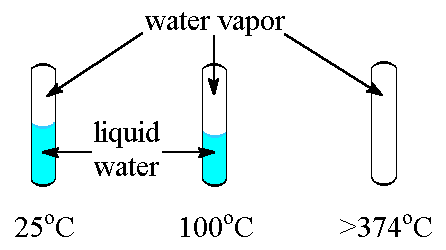
Since water heats by vibration of the molecular dipole, so long as microwaves are applied it will heat. At 400C water cannot exist as liquid as it is above the critical point. The time to heat is given by Q = mCp(DeltaT) If the 225 ml of water is in a shallow large dia vessel it should reach 400C in about 8 minutes at 1 kw delivered power. Since pressures will be high, it may not be possible to get a large cross section vessel. Time could then be longer.
__________________
bioramani
Reply
Guru
Engineering Fields - Electrical Engineering - Been there, done that. Engineering Fields - Control Engineering - New Member

Join Date: Dec 2008
Location: Long Island NY
Posts: 15600
Good Answers: 981
#10
In reply to #8

Re: Microwaves

10/02/2009 12:50 AM

Actually water can exist as a liquid at 400°C but only if the pressure is greater than 20 mega Pascals, 3000 PSI or 200 atmospheres. (Pick your pressure unit.) Look at the phase state link I provided earlier. Now how somebody contains this pressure while permitting microwave energy in, beats the hell out of me.

__________________
"Don't disturb my circles." translation of Archimedes last words
Reply
Guru

Join Date: Jun 2009
Location: Bangalore, India
Posts: 725
Good Answers: 24
#12
In reply to #10

Re: Microwaves

10/02/2009 6:22 AM

I am afraid not. The critical point for water is 374.2C and 218 Atm pressure. Above this temperature water is a gas.

__________________
bioramani
Reply
Guru
Engineering Fields - Electrical Engineering - Analog and Digital Circuit Design Engineering Fields - Electromechanical Engineering - Transformers, Motors & Drives, EM Launchers Engineering Fields - Engineering Physics - Applied Electrical, Optical, and Mechanical

Join Date: Jan 2008
Location: NY
Posts: 1207
Good Answers: 119
#14
In reply to #12

Re: Microwaves

10/02/2009 8:35 AM

Actually, it becomes a Supercritical_fluid

Reply
Guru
Engineering Fields - Electrical Engineering - Been there, done that. Engineering Fields - Control Engineering - New Member

Join Date: Dec 2008
Location: Long Island NY
Posts: 15600
Good Answers: 981
#15
In reply to #12

Re: Microwaves

10/02/2009 9:49 AM

Are you saying that the Water Phase Diagram that I cited is wrong or that I'm reading it wrong? I'll grant you that the critical point is near these pressures and temperatures. Also some would consider a supercritical fluid a liquid but at these temperatures the diagram shows solid states of water at even more ridiculous pressures, notice the Ice VII, X, and XI regions. But these are insane pressures to be asking an open forum blog technical questions about. I'm very concerned about the OP's safety.

__________________
"Don't disturb my circles." translation of Archimedes last words
Reply
Guru

Join Date: Jun 2009
Location: Bangalore, India
Posts: 725
Good Answers: 24
#19
In reply to #15

Re: Microwaves

10/02/2009 12:17 PM

Under normal conditions, in a closed system as the temperature increases above the triple point, there is an equilibrium between water and its vapour. The vapour pressure keeps incresing till 374.2C, the critical temperature, at which the vapour pressure is 218 atm. Above this the separation between the liquid and vapour disappears and only vapour remains. This is said in the first para of the site. It also talks about a possible second triple point but also says that this is disputed. In the present case, since we are starting from cold and gradually heating, we should see the normal behaviour. The quasi states described will not be present. For the indicated volume if the chamber is spherical it will have a diameter of about 7.5cc with a surface area of about 200 sq.cm. The load at critical point will be about 20 tons, which though high is not alarming. I fully agree with you that this is not a problem to be approached casually.

__________________
bioramani
Reply
Guru

Join Date: Dec 2006
Location: Germany 49° 26' N, 7° 46' O
Posts: 1950
Good Answers: 109
#20
In reply to #19

Re: Microwaves

10/02/2009 1:05 PM

Hi,

we are talking here about the critical point (not the triple point).

Vapor and liquid are separated by a boundary.

Above the critical point this boundary is no longer existing (as stated by bioramani),

naming the liquid a gas or liquid is in use but not really correct, superfluid is the adequate word.

Energy content is very high, if the pressure container fails, a complete building may be converted to pieces by less than one liter including any persons.

RHABE

Reply
Guru

Join Date: Jun 2009
Location: Bangalore, India
Posts: 725
Good Answers: 24
#21
In reply to #20

Re: Microwaves

10/02/2009 1:44 PM

Sorry that was an error. I was writing about the critical point only.

__________________
bioramani
Reply
Guru
United Kingdom - Member - Not a new member!

Join Date: Jun 2008
Location: USA/Europe
Posts: 4547
Good Answers: 68
#24
In reply to #20

Re: Microwaves

10/02/2009 9:46 PM

Hi RHABE, Yes as you point out, 374 °C --- 217.7 Atm --- 3200.19 psi./1454.5 Kpsi. /22.063 Mpa. Major pressure danger here, which is why the OP want to know about this specific detail. Actually they asked about getting water to 400°C. Very odd request?

__________________
Take it easy, bb. >"HEAR & you FORGET<>SEE & you REMEMBER<>DO & you UNDERSTAND"<=$=|O|=$=>"Common Sense is Genius dressed in its Working Clothes"<>[Ralph Waldo Emerson]
Reply
Guru

Join Date: Dec 2006
Location: Germany 49° 26' N, 7° 46' O
Posts: 1950
Good Answers: 109
#25
In reply to #24

Re: Microwaves

10/03/2009 3:36 AM

Very odd request?

Hi babybear,

if they know what and how to do, this may be very useful.

At these conditions all hydrocarbons are quickly decomposing into CO2 and simple hydrocarbons and some hydrogen.

So this is one of the emerging methods of detoxifying any nasty stuff: poison gas, dioxines, PCBs, ? certainly some more.

Freed chlorine and oxygen may and will corrode the container walls, so only very few metallic materials are +- stable.

RHABE

Reply
Guru
United Kingdom - Member - Not a new member!

Join Date: Jun 2008
Location: USA/Europe
Posts: 4547
Good Answers: 68
#26
In reply to #25

Re: Microwaves

10/03/2009 12:01 PM

Hi RHABE,

Yes I fully understand what you say. And at this state water is almost acting like something different. With, as you say molecules lasting a fraction of a second and or remixing with the main body of the water liquid which is barely a liquid anyway.

There is so many methods and splutter action for laying thing down in a layer of just a few molecules of a layer. One page I got back on research had 21000000 returns. I do not live enough to check that many!!!!!!

And we have yet to find out what the OP wants to do? Really makes me angry this kind of ignorance, after so much work by all on this thread. It is hardly the type of info' anyone would have in mind ready to trip out right?

Take care

__________________
Take it easy, bb. >"HEAR & you FORGET<>SEE & you REMEMBER<>DO & you UNDERSTAND"<=$=|O|=$=>"Common Sense is Genius dressed in its Working Clothes"<>[Ralph Waldo Emerson]
Reply
Guru

Join Date: Mar 2008
Location: Sebring, Florida
Posts: 923
Good Answers: 25
#27
In reply to #24

Re: Microwaves

10/03/2009 2:32 PM

Hello "babybear & RHABE",

I have followed with some interest the responses that have been forth coming regarding the original post. While I do not pretend to comprehend all of it I do understand the basics regarding fluids, gases and super fluids. I also understand that extreme pressures are need to convert gases to liquids so on.

I am not the original poster and won't even hazard a guess as to just what he was shooting for as a realistic answer or why he posted the question at all, as he hasn't demonstrated the courtesy of further responses.

I know that micro waves generated in a "home makers" oven increase from 110/120 volts through the strength of the step up transformer through the capacitor and raytheon tube and that such micro wave ovens are rated in the amount of watts needed to reach maximum power, such a 500/600 and even 900 watts. Through experience we know that we can boil water, destroy food, and quickly ruin coffee. However, I cannot reasonably even guess how much energy would be needed to cause water to reach the condition one regards as super fluid. I do not expect either of you to do the math, but could you offer a suggestion as the amount of power needed to cause water to "reach the stage that we consider super fluid".

I ask this for the benefit of those of us who don't pretend to be something that we are not, but follow these posts and responses with respect and interest.

TMF

__________________
The only problem with common sense, is that not very many people have it, or know how or when to use it.
Reply
Guru
United Kingdom - Member - Not a new member!

Join Date: Jun 2008
Location: USA/Europe
Posts: 4547
Good Answers: 68
#28
In reply to #27

Re: Microwaves

10/03/2009 7:43 PM

Hi TMF,

Really appreciate your reply post, despite the fact that, so far, the OP has not had the respec' to write in again!

I think you may have missed something, the amount of pressure needed.

It would indeed be more than interesting to hear from a 'Rocket Scientist'? LOL!

The way I see it, there would not need to be hardly any 'extra' power or heat to reach 640 odd - °Kelvin, ....... 374 °C, as apposed to the normal 1Atm, Boiling Point 212 °F (100 °C). (I realise that power and heat are not the same).

The important thing here is the extra, almost 218 atmospheres of pressure.

374 degrees °C (674 °k) a pressure of almost 22 mega-pascals (218 atmospheres). That pressure, is enough to almost make the water reach critical temperature, from fright! And, as I say I do not see much more heat is needed, other than that necessary to heat the container.

The critical state is so ->>>''out there''<<<- and almost unattainable, (as something to aim for) if not so, in real life, it is not surprising there is little evidence of the power or heat necessary to raise water to its critical state. I cannot recall how to reach it myself from written info', sorry. It also has to do with the starting temperature of the liquid and its contained pressure vessel. To a scientist this may be obvious, to me it takes a lot of thought to see 'what happens if'--------?-?-?'. I suppose you may reach the answer through Hydrogen Bonding, but I am still checking that out, if I can figure out how it works?.................. We must be nuts, doing this for our 'entertainment'?

If the water is an ice state, and the pressure vessel has to be several cm thick to contain a (potential bomb) and, this is also very cold, (the power necessary to raise the 'ice' to the critical point and the container to at least a temperature from which the out-landish critical point is attainable), will be more.

The obvious water temperature to start with may be 4 °C, its most dense. But I still have no reference to the heat or power necessary. Please note: My words, not copied, so you can't look for them directly.

Please see the site below, it really only confirms how the critical point or state if you like, is arrived at, and explains that a fraction of a change either way and it goes heywire,........... Into gas or back to water liquid........

http://www.answers.com/topic/critical-point-thermodynamics

I am still looking, even though.

Take care.

__________________
Take it easy, bb. >"HEAR & you FORGET<>SEE & you REMEMBER<>DO & you UNDERSTAND"<=$=|O|=$=>"Common Sense is Genius dressed in its Working Clothes"<>[Ralph Waldo Emerson]
Reply
Guru

Join Date: Dec 2006
Location: Germany 49° 26' N, 7° 46' O
Posts: 1950
Good Answers: 109
#29
In reply to #28

Re: Microwaves

10/04/2009 3:32 AM

Hi babybear,

interesting to hear from a 'Rocket Scientist'?

This was a reality 15 years ago when sounding rockets were tried with supercritical water as propellant. A spherical tank, a heater, a valve (may be a bursting diaphragma) and a nozzle. Simple but not really safe, solid rocket fuel seems to be better.

http://www1.lsbu.ac.uk/water/explan4.html#Cp

At this website (cited above) you will find a lot about the odd physical data of water.

So a plot of the specific heat (at constant pressure) remarks abour specific heat (at constant volume) and a plot of the heat (energy) needed to bring from liquid to steam. Near room temperature the specific heat is near constant but nearer to the critical point the specific heat is rising considerably - may be in relation to the vanishing heat of vaporisation.

So you can make a very rough estimate up to the region where the specific heat starts to rise: specific heat times mass times temperature plus vaporisation energy.

(I will try this evening with a little bit of free time available).

This is high energy physics and technology. Guard yourself first.

RHABE

Reply
Guru
United Kingdom - Member - Not a new member!

Join Date: Jun 2008
Location: USA/Europe
Posts: 4547
Good Answers: 68
#30
In reply to #29

Re: Microwaves

10/04/2009 1:42 PM

Hi RHABE,

thanks so much for getting back to me.

Yes I have always thought 'water' to be very special, but until I read more several years ago, and yet more in detail over the last week, I knew nothing of the more odd and unique abilities. Pretty amazing stuff.

I have yet to find the details of how much Energy it takes to raise water to its critical state though.

I know there is some physicists and others on this site, who may know or be able to extrapolate the answer? Though as I have said in a previous post, this state is so , well, impossible to get to, there may be available info' on machines which can do this, and pretty good details on these machines, but, I have seen a couple and they are really meant for experiment only?

Thank you once again for the post and keep in touch.

Take care.

__________________
Take it easy, bb. >"HEAR & you FORGET<>SEE & you REMEMBER<>DO & you UNDERSTAND"<=$=|O|=$=>"Common Sense is Genius dressed in its Working Clothes"<>[Ralph Waldo Emerson]
Reply
Power-User

Join Date: Mar 2008
Location: MA 01864, USA
Posts: 453
Good Answers: 7
#13
In reply to #8

Re: Microwaves

10/02/2009 8:28 AM

Remeber equation

PV = nRT

If you assume volume 1000 ml and temperature 400C then you can calcualte pressure needed which is

P = nRT/V --> n R 698/1000

and you see pressure is directly related proportional to temperature and inversely proportional to volume of water

n and R are the constant

__________________
Masyood
Reply
Guru
Engineering Fields - Electrical Engineering - Been there, done that. Engineering Fields - Control Engineering - New Member

Join Date: Dec 2008
Location: Long Island NY
Posts: 15600
Good Answers: 981
#16
In reply to #13

Re: Microwaves

10/02/2009 9:51 AM

Sorry but at these pressures you must use Van der Waals equation. The universal gas law will be inacurate.

__________________
"Don't disturb my circles." translation of Archimedes last words
Reply
Guru

Join Date: Dec 2006
Location: Germany 49° 26' N, 7° 46' O
Posts: 1950
Good Answers: 109
#11

Re: Microwaves

10/02/2009 3:19 AM

Hi,

as the density of water near or at boiling temperature is going down with rising pressure and temperature and the density of vapor is going up with the same conditions and these densities meet at the critical point there is no possibility to distinguish between liquid and gaseous above the critical point. Fluid?

Heating a pressure container: why not. Couple the waveguide with a quarter wave (in thickness) ceramic plate to the pressure container, matching impedance will work at any frequency, you certainly know the principle from the anti-reflective coating of lenses.

This ceramic "window" should be designed to withstand the pressure, quartz-glass will dissolve at these temperatures as any other oxides too so not usable, but I suppose that nitrides will work.

Maybe you have to go up to above typical 3 GHz as the minimum cross-section of a waveguide will go down, so the minimum window diameter.

We used diamond windows inside 220°C concentrated sulfuric for acid for optical sensing as no other material seemed to be stable.

RHABE

Reply
Guru
United Kingdom - Member - Not a new member!

Join Date: Jun 2008
Location: USA/Europe
Posts: 4547
Good Answers: 68
#22

Re: Microwaves

10/02/2009 5:20 PM

Hi Guest,

In part answer to your question..................

Every substance has a critical temperature. Some examples are shown below.

As you can see the critical point is 374 °C --- 217.7 Atm --- 3200.19 psi.

substance

critical temperature (oC)

NH

3

132
O

2

-119
CO

2

31.2
H

2O

374
Tubes containing water at several temperatures. Note that at or above 374

oC (the critical temperature for water), only water vapor exists in the tube.

Critical Pressure The critical pressure of a substance is the pressure required to liquefy a gas at its critical temperature. Some examples are shown below.

substance

critical pressure (atm)

NH

3

111.5
O

2

49.7
CO

2

73.0
H

2O

217.7

The Critical Point of water..................

  1. Video results for critical point of water
    Critical point of water with Sunn O)))
    6 min
    www.youtube.com
    Hottest water on Earth discovered
    1 min 11 sec
    www.youtube.com
  2. Critical Temperature and PressureTubes containing water at several temperatures. Note that at or above 374oC (the critical temperature for water), only water vapor exists in the tube. ...
    www.chem.purdue.edu/gchelp/liquids/critical.html - Cached - Similar -
__________________
Take it easy, bb. >"HEAR & you FORGET<>SEE & you REMEMBER<>DO & you UNDERSTAND"<=$=|O|=$=>"Common Sense is Genius dressed in its Working Clothes"<>[Ralph Waldo Emerson]
Reply
Reply to Forum Thread 30 comments
Copy to Clipboard

Users who posted comments:

aurizon (2); babybear (7); bioramani (4); Electroman (2); jack of all trades (1); Masyood (1); Matt Skywalker (1); mjb1962853 (1); redfred (4); RHABE (4); Scapolie (1); Toomuchfun (2)

Previous in Forum: Virtual Image   Next in Forum: A Hypothetical Question???

Advertisement