Previous in Forum: 1993 Jeep Grand Cherokee - How to Disable Security System ?   Next in Forum: Chevy Aveo - Brake Switch Issue
Close
Close
Close
31 comments
Rate Comments: Nested
Power-User

Join Date: Jul 2008
Location: UK
Posts: 142

Making an Older Engine with Disengageable 'Engine Braking'?

10/04/2010 8:55 AM

On a rocker engine I would use a set of 'fingers' that can push down on the inlet rockers to hold the valves open and a valve in the intake to let air flow out as well as in. Giving the motor practically no pumping losses. I would appreciate ideas on how to apply this for a DOHC instead.

I see it being used in combination with a 'mild' hybrid (like GM's BAS system) to dynamically 'pulse-and-glide' the vehicle (but at a rate to be almost imperceptible by the driver). The lighter load for a engine start-stop system could be good also.

Register to Reply
Interested in this topic? By joining CR4 you can "subscribe" to
this discussion and receive notification when new comments are added.

"Almost" Good Answers:

Check out these comments that don't yet have enough votes to be "official" good answers and, if you agree with them, vote them!
Power-User

Join Date: Jul 2008
Location: UK
Posts: 142
#1

Re: Making an Older Engine with Disengageable 'Engine Braking'?

10/04/2010 9:32 AM

Personally, I would prefer to come up with a way to do this on a SOHC with tappets (inlet & exhaust on same side), but this is looking very squashed.

The idea is to hold the valves open as far as possible, but without (of course) risking them hitting the piston at TDC. I'm ignoring the possibility of holding the exhaust valves open as well as this would cool the exhaust too quickly and cause pulsation issues.

I can picture a method where the cam gear is disengaged, but the oppotunity to permantly throw out the timing (& even wrech the engine) seems too risky.

Register to Reply
Guru

Join Date: Jan 2010
Posts: 2446
Good Answers: 60
#2
In reply to #1

Re: Making an Older Engine with Disengageable 'Engine Braking'?

10/04/2010 3:39 PM

what are you talking about ?

Register to Reply
Power-User

Join Date: Jul 2008
Location: UK
Posts: 142
#3
In reply to #2

Re: Making an Older Engine with Disengageable 'Engine Braking'?

10/04/2010 7:47 PM

What causes engine braking? - pumping losses mostly.

I want a modification that can take away the resistance of turning an engine over when it's not making power - like the resistance of cold cranking... So, valves held open = no pumping losses.

Register to Reply
Commentator

Join Date: Sep 2009
Location: Brisbane, Australia
Posts: 91
Good Answers: 3
#4
In reply to #3

Re: Making an Older Engine with Disengageable 'Engine Braking'?

10/05/2010 12:49 AM

G'day,

Just as a point of information, GMH's variable engines close both inlet and exhaust valves when disengaging four cylinders (of 8). The losses on compression are balanced by the gains due to expansion after TDC. Net loss? about zero.

Best Regards,

Royce R. Vines

"In a time of drastic change it is the learners who inherit the future. The learned usually find themselves equipped to live in a world that no longer exists." - Eric Hoffer"

__________________
If thou cannot win by fair means ... cheat!
Register to Reply Score 1 for Good Answer
Power-User

Join Date: Jul 2008
Location: UK
Posts: 142
#9
In reply to #4

Re: Making an Older Engine with Disengageable 'Engine Braking'?

10/05/2010 4:58 AM

Thanks for the info. I have heard of this approach also - using the principle of a gas-spring I think. There must still be higher losses here than a totally open 'route' for air in & out, and the fact that 4 cylinders are still active changes the balance too I would think.

Register to Reply
Guru

Join Date: Aug 2007
Location: London England.
Posts: 583
Good Answers: 10
#7
In reply to #3

Re: Making an Older Engine with Disengageable 'Engine Braking'?

10/05/2010 3:49 AM

Be careful most modern engines don't have mutch clearence between the top of the piston & the valve head hence the cost when a timing belt snaps & all the valves that are open hit the pistons and bend, So be sure to check how far you can depress the valve without hitting the piston.

Bazzer

__________________
When I die I'd like to go peacefully in my sleep like my dad,not shouting and screaming like his passengers.
Register to Reply Score 1 for Good Answer
Power-User

Join Date: Jul 2008
Location: UK
Posts: 142
#10
In reply to #7

Re: Making an Older Engine with Disengageable 'Engine Braking'?

10/05/2010 5:02 AM

Cheers Bazzer.

I wd be going with a '60s engine and I'm sure most of those are less tight. I;m still not sure if a broken chain will wreck it though (?).

Register to Reply
Guru
Popular Science - Weaponology - New Member Safety - ESD - New Member Hobbies - Fishing - New Member

Join Date: Sep 2006
Location: Near Frankfurt am Main, Germany. 50.390866N, 8.884827E
Posts: 17996
Good Answers: 200
#31
In reply to #10

Re: Making an Older Engine with Disengageable 'Engine Braking'?

10/08/2010 8:57 AM

If the engine has enough clearance for between valves and piston, what difference will a broken chain make????? Other than the obvious of course!!

__________________
"What others say about you reveals more about them, than it does you." Anon.
Register to Reply
Guru
Popular Science - Weaponology - New Member Safety - ESD - New Member Hobbies - Fishing - New Member

Join Date: Sep 2006
Location: Near Frankfurt am Main, Germany. 50.390866N, 8.884827E
Posts: 17996
Good Answers: 200
#30
In reply to #3

Re: Making an Older Engine with Disengageable 'Engine Braking'?

10/08/2010 8:55 AM

I doubt that.....

I am sure the big companies thought that through carefully first.....less loss with closed valves is my personal bet!!!

__________________
"What others say about you reveals more about them, than it does you." Anon.
Register to Reply
Guru
United States - Member - Member Hobbies - DIY Welding - New Member

Join Date: Mar 2008
Location: Southeast US of A
Posts: 555
Good Answers: 50
#5

Re: Making an Older Engine with Disengageable 'Engine Braking'?

10/05/2010 12:53 AM

What are you attempting to accomplish?

__________________
Speak softly and carry a big stick.
Register to Reply
Guru
Popular Science - Weaponology - New Member Fans of Old Computers - PDP 11 - New Member Technical Fields - Architecture - New Member Hobbies - HAM Radio - New Member

Join Date: Oct 2009
Location: Maine, USA
Posts: 2168
Good Answers: 71
#6

Re: Making an Older Engine with Disengageable 'Engine Braking'?

10/05/2010 1:34 AM

How about modifying the head(s) to have a compression release valve in them? Port the output from the compression relief into the exhaust...probably after the cat.

__________________
Tom - "Hoping my ship will come in before the dock rots!"
Register to Reply
Power-User

Join Date: Jul 2008
Location: UK
Posts: 142
#11
In reply to #6

Re: Making an Older Engine with Disengageable 'Engine Braking'?

10/05/2010 5:06 AM

I'd rather leave it so it can be returned to factory spec fairly easily.

Register to Reply Off Topic (Score 5)
Guru

Join Date: Jan 2010
Posts: 2446
Good Answers: 60
#8

Re: Making an Older Engine with Disengage able 'Engine Braking'?

10/05/2010 4:00 AM

ah ha read your first post again you want an engine that gives power then stops then power then stops etc with a valve lifter so there is no pumping losses.

It wont work there is no valve clearance if the valve are are down when the piston comes up they will be hit.

also when piston goes down the will be no suction as well as no pumping no suction means there will be no new fuel/air mix brought into engine for next power cycle.

you idea is good but totally impracticable.

a better method would be to have the engine run at its most economical speed and disengage the clutch periodically but i see no useful purpose in this either

Because when the engine is disengaged the vehicle will slow down

so when the engine is re engaged the engine will have to work harder to bring the vehicle speed back up

it would be more economical to keep engine running at constant speed and leaving it connected all the time unless you want to stop of course

Register to Reply
Power-User

Join Date: Jul 2008
Location: UK
Posts: 142
#12
In reply to #8

Re: Making an Older Engine with Disengage able 'Engine Braking'?

10/05/2010 5:25 AM

"it would be more economical to keep engine running at constant speed and leaving it connected all the time unless you want to stop of course"

This seems counter to what the 'pulse and glide' guys reckon - of course they may be wrong or just over-exaggerating!

But, there is good hard evidence that an engine is most efficient under about 80% load at medium to higher revs; and that idling is very thermally inefficient.

Register to Reply
Guru

Join Date: Jan 2010
Posts: 2446
Good Answers: 60
#13
In reply to #12

Re: Making an Older Engine with Disengage able 'Engine Braking'?

10/05/2010 5:42 AM

on the flat pulse and glide may work.

going downhill engine braking is needed unless you are going to use the brakes

going uphill pulse and glide would not work at all

but good luck on your efforts

Register to Reply
Commentator

Join Date: Sep 2009
Location: Brisbane, Australia
Posts: 91
Good Answers: 3
#22
In reply to #13

Re: Making an Older Engine with Disengage able 'Engine Braking'?

10/05/2010 9:58 PM

Most auto tranny's do not supply engine braking in drive.

__________________
If thou cannot win by fair means ... cheat!
Register to Reply
Guru

Join Date: May 2010
Posts: 570
Good Answers: 55
#18
In reply to #12

Re: Making an Older Engine with Disengage able 'Engine Braking'?

10/05/2010 11:02 AM

But, there is good hard evidence that an engine is most efficient under about 80% load at medium to higher revs;

This is pretty close to correct. In general a simplified Specific Fuel Consumption curve looks like the torque curve, upside down. The torque curve, however, is based on full load (full throttle) conditions. When you look at the map of specific consumption vs both load and rpm, low rpm is favored. For fuel efficiency alone, you are better off lugging the engine: this results in large throttle openings for a given power output, and thus fewer pumping losses.

__________________
Si hoc signum legere potes, operis boni in rebus Latinis alacribus et fructuosis potiri potes!
Register to Reply
Commentator

Join Date: Sep 2009
Location: Brisbane, Australia
Posts: 91
Good Answers: 3
#23
In reply to #18

Re: Making an Older Engine with Disengage able 'Engine Braking'?

10/05/2010 10:03 PM

Sorry, but an engine is at its most efficient when it produces its max Brake Mean Effective Pressure (bmep). This occurs at max torque, whatever the rpm. Some engines get max torque at low revs, others (usually high performance and/or EFI motors) at high revs. However, EFI engines usually produce about 90% of max torque from 2000 rpm up to max toque rpm ( up tp 4500)

__________________
If thou cannot win by fair means ... cheat!
Register to Reply Score 1 for Good Answer
Guru

Join Date: May 2010
Posts: 570
Good Answers: 55
#26
In reply to #23

Re: Making an Older Engine with Disengage able 'Engine Braking'?

10/06/2010 12:58 AM

Sorry, but an engine is at its most efficient when it produces its max Brake Mean Effective Pressure (bmep).

Wrong, but a common misconception. In simplified terms, what you say is roughly correct -- that's why I mentioned that the full load BSFC curve looks like the full load torque curve inverted. That has little to do with real driving, however: people do not drive with the throttle full open all the time. To see the efficiency in real driving, you must look at the BSFC at various loads and rpms.

Here's the map for a Saturn:

As you can see, best BSFC is at a point less than full load.

In the chart below, I added a line that represents 20 HP, about that required by a Saturn for cruising on a level highway.

As you can see, the line gets closest to the 250 g/kWh boundary at about 1300 rpm. So to cruise most efficiently, this car should be geared for 1300 rpm at highway speeds.

__________________
Si hoc signum legere potes, operis boni in rebus Latinis alacribus et fructuosis potiri potes!
Register to Reply
Commentator

Join Date: Sep 2009
Location: Brisbane, Australia
Posts: 91
Good Answers: 3
#27
In reply to #26

Re: Making an Older Engine with Disengage able 'Engine Braking'?

10/06/2010 4:27 AM

Now you start getting into the rather impractical side of engine theory. I maintain that to drive with the best fuel consumption, keep the engine at approx max torque, which in modern engines is usually anywhere from 1500-2000 rpm and up. Lugging an engine, apart from not being too healthy for the engines longevity is not the most economical method of driving due to various road and traffic conditions, unless you have a very efficient dual clutch DSG ( an oxymoron?).

__________________
If thou cannot win by fair means ... cheat!
Register to Reply
Guru

Join Date: Jan 2010
Posts: 2446
Good Answers: 60
#28
In reply to #27

Re: Making an Older Engine with Disengage able 'Engine Braking'?

10/06/2010 4:31 AM
Register to Reply
Guru
Hobbies - RC Aircraft - New Member Hobbies - Automotive Performance - New Member Hobbies - DIY Welding - New Member

Join Date: Jul 2007
Location: Fort Lauderdale Florida
Posts: 5708
Good Answers: 123
#14

Re: Making an Older Engine with Disengageable 'Engine Braking'?

10/05/2010 7:41 AM

So you want to remove the compression from the engine, on demand, without modifying the engine. As posted above there are problems with holding the valves open. Current engine management systems are leaving them closed.

With the current 10MM spark plugs that are now available, you could make up adaptors that would fit between the original spark plug hole,(14MM) and the smaller 10MM plug. Connected to these adaptors could be the compression release valves.

IMHO, any gains from this system could be easily made up by using a newer, more efficient engine design.

If you want to improve efficiency of the ICE design, try to work with solenoid controlled intake and exhaust valves. From there, any valve timing, duration, and compression release becomes possible. Good luck.

__________________
Bob
Register to Reply
Guru

Join Date: Jan 2010
Posts: 2446
Good Answers: 60
#15

Re: Making an Older Engine with Disengageable 'Engine Braking'?

10/05/2010 7:53 AM

Hi thought about your request the only easy way i would try would be to shut off the inlet this way there would be a partial vacume in the cylinders which would assist with the piston stroke which would would work in you favor

the flap could be a recycle exhaust brake as fitted to some commerical vehicles

just remove it from the exhaust and place it after the carb on inlet manifold

Only problem is the may be a bit of a hiccup when flap is opened

Register to Reply
Commentator

Join Date: Sep 2009
Location: Brisbane, Australia
Posts: 91
Good Answers: 3
#24
In reply to #15

Re: Making an Older Engine with Disengageable 'Engine Braking'?

10/05/2010 10:05 PM

See #4

__________________
If thou cannot win by fair means ... cheat!
Register to Reply
Guru

Join Date: May 2010
Posts: 570
Good Answers: 55
#16

Re: Making an Older Engine with Disengageable 'Engine Braking'?

10/05/2010 10:25 AM

It looks like you may have things a bit backwards. To avoid pumping losses, you should try to avoid pumping. That means leaving the valves closed, not open. This is what is done in engines that have variable displacement (running on 3, 4 or 6 cylinders, for example). In this way, the energy used to compress air in the cylinder is returned as the air expands, like a spring.

A few decades ago, compression releases were used on dirt bikes to provide braking effect. These vented the combustion chamber through a small valve. Intake would occur (with its losses). Then compression would occur, but the pressure rise would be small because of the venting. The energy required to force the air past the compression release valve would be extracted from the bike's kinetic energy. Then the "power" stroke would occur... but there would be no power, because there would be no mixture to ignite. Some small amount of inflow would occur through the compression release valve, during the "power" stoke. (Compression releases worked a little like Jake brakes on a truck.)

The variable displacement systems achieve an effect vaguely like "pulse and glide", but more smoothly. The idea in pulse and glide is to disengage the clutch during the glide, so that the car does not suffer compression braking. (Closing the valves would have a similar, although less pronounced effect, because there are still frictional losses from the engine). While the pulse is occurring, the engine is running under moderately high load, where it is more efficient than under light load (where it would otherwise be while driving at a constant speed). In a variable displacement engine, the operating cylinders are operating under high load, making them efficient (even though the engine as a whole is producing low output) and the other cylinders are just along for the ride (with, on average, one cylinder under vacuum roughly balancing another under compression).

Motorcycle compression releases are environmentally unfriendly, ejecting a lot of unburned mixture directly into the air. In variable displacement engines, injection is shut off in those cylinders that are not operating under load. The systems are incredibly complex, and require fast computing to operate smoothly. If you are going to deal with all the complexity, then you might as well produce a real hybrid, like a Prius. This provides much higher efficiency, particularly when combined with the Prius Atkinson cycle engine.

Your idea has merit. When your idea is implemented in a way that leaves imperceptibly small times between power strokes, you end up with a variable displacement engine. Shutting off all the cylinders even for two out of four revolutions (let alone 3 out of 4) produces too much vibration, whereas shutting off some of the cylinders provides for smaller, more frequent power pulses.

In my view, a Civic, which is comparatively simple (and inherently efficient because of its smallish size, light weight, and small engine) is more fun to drive, uses less resources in its construction, and uses less fuel than the bloated Accord V6 with is variable displacement system. If they were both the same price, I'd opt for the Civic. Plenty of people prefer bloat, however, so variable displacement systems will survive.

__________________
Si hoc signum legere potes, operis boni in rebus Latinis alacribus et fructuosis potiri potes!
Register to Reply Score 1 for Good Answer
Guru

Join Date: Jan 2010
Posts: 2446
Good Answers: 60
#17
In reply to #16

Re: Making an Older Engine with Disengage able 'Engine Braking'?

10/05/2010 10:35 AM

GA from me

so reading your reply and looking at the links below

keeping a valve open is more than just a bit crude and not friendly to the environment

this link is for my benefit

http://www.google.co.uk/search?q=pulse+and+glide&sourceid=ie7&rls=com.microsoft:en-gb:IE-SearchBox&ie=&oe=&rlz=1I7GGLT_en&redir_esc=&ei=1jerTN_ROJGUjAejrYzeBw

http://www.metrompg.com/posts/pulse-and-glide.htm

taken from above

Why it works

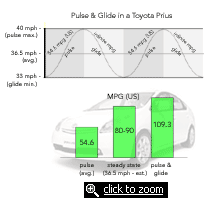
Prius MPG marathoners at the completion of their nearly 48-hour endeavour. (Source: Toyota.com hybrid newsletter)

The secret is in the glide, and it's is best illustrated by the extreme Prius demonstration.

The Prius is particularly excellent at gliding because under most conditions when the the accelerator is released below 40 mph, the gasoline engine shuts off completely and the transmission effectively freewheels in neutral (it's actually slightly more complicated than that, but stick with me). So, while gliding, it's effectively getting infinite mpg - it's using no gas at all.

For that reason, the marathon drivers picked 40 mph as the upper limit of their pulse & glide cycle (33 mph was the bottom). So in order to achieve 109.3 mpg, they just had to average 54.65 mpg while pulsing gently from 33 - 40 mph. And it turns out, in a Prius, you can. So, assuming equal length pulses & glides, they traveled half the total distance of their trip getting 54.65 mpg, and half the total distance using no fuel at all. It averages out to 109.3 mpg.

(Their driving was actually more complex than the simple illustration above, so their pulse vs. glide proportions were not necessarily equal. But for the purposes of understanding the basics of pulse & glide, it helps to think in terms of equal halves. The drivers also took pains to ensure they were pulsing and gliding in a very specific way that minimized the flow of energy to and from the battery pack - they were in effect going to great lengths to avoid using the car's hybrid propulsion while driving. Whenever braking, however, they sought to take advantage of the hybrid system's energy regeneration. Follow the links at the end of this article for detailed Prius-specific pulse & glide info.)

Pulse & glide in a Geo Metro

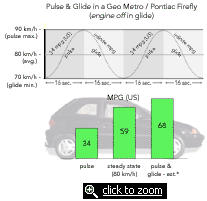
Still skeptical, I went out in my car with the ScanGauge. I really didn't believe it was going to work, but here are the numbers I saw. I went to my "test course" - a nearly perfectly level stretch of 2-lane highway about 6.5 km long - but these numbers aren't meant to be taken as experimentally valid. I only did one run, so consider yourself warned. It's just a snapshot:

  • At a steady 80 km/h (about 50 mph) I was getting 59 mpg (US) (there was a tail wind)
  • "gliding" down from 90 to 70 km/h took 16 seconds
  • "pulsing" back up from 70 to 90 km/h at a rate of acceleration that also took 16 seconds I was getting about 34 mpg (US)
  • So my pulse and glide average would be 68 mpg, vs. 59 at the same average speed. That's a 15% increase over the steady state mpg - theoretically.

I say theoretically because the engine would have to be off in the glide to get that mileage. You could do it, but it adds another step in an already arguably impractical process (remember the engine shuts off automatically in the Prius when you lift off the accelerator).

So I took a couple more readings. With the engine idling, and the car in neutral, the average mpg shown on the ScanGauge in the glide down from 90-70 km/h was 550 mpg. When you average that against the 34 mpg of the pulse, it works out to an average of 64 mpg. Now we're at an 8% increase over the steady-state mpg.

I would name the difference between the two techniques "full" pulse & glide (neutral, with engine off in the glide) vs. "mild" (neutral, with engine idling in the glide).

So, now you know the next time you find yourself cruising down a lonely road at a steady speed, you're not getting the best mileage you could. You could be pulsing & gliding to maintain the same average speed, and saving lots of fuel in the process.

To exceed your steady-state mpg (X), you just have to be able to "pulse" at a rate of fuel consumption that is greater than half of X (assuming equal length pulses & glides; you may be able to increase the proportion of glide to pulse - meaning faster acceleration in the pulse, or glides that are timed to take advantage of descending a grade - and still beat your steady-state mpg for that average speed). You can see how fuel economy instrumentation plays a critical role in determining the best rate of pulse to make this work.

The Pulse & Glide Workout!

But it's not really very practical, is it? When I said off the top that there's nothing special about hybrid technology that makes this work, that's only true in theory. In practical terms, the Prius enables this technique because all of its individual steps are performed through a single control - the throttle pedal.

Contrast that to my manual shift Firefly: in order to duplicate the behaviour of the Prius requires 6 discrete steps using 3 of my limbs... every 16 seconds. Glide: release accelerator, clutch in, key off, pause...key on. Pulse: pop clutch to restart engine, depress accelerator. That's quite a workout, compared to 2 steps in the Toyota accomplished entirely with the right foot: glide - release accelerator; pulse - depress accelerator.

Practical implications

What useful information comes from this for the non-hybrid driver?

  • (Okay, the first one is hybrid related...) Toyota ultra-efficient cruise control! The Prius could potentially have a "pulse and glide" cruise control setting to completely automate the cycle. Set your target speed, and the car pulses & glides around it.
  • For me, the technique simply underlines the importance of maximizing the amount of "glide" (whether engine on or off) in my driving. In other words, time spent in neutral, or with the clutch depressed. For example, when approaching a stop or a forced speed reduction, rather than maintaining a constant speed as I approach, I now try to execute the optimal pulse that permits me to coast half the distance (or more) with as little braking as possible.
  • It causes you to carefully consider the comparitive efficiencies of different ways of accelerating or decelerating. E.G. deceleration efficiency, from best to worst in a non-hybrid (standard liability statement applies - don't do this if it puts you or others at risk): (1) engine off, in neutral (or clutch in); (2) engine idling, in neutral; (3) engine running, in gear (it's true that some cars' fuel injectors shut off when decelerating in gear above a certain engine RPM threshold, but the savings in fuel is cancelled by the faster rate of deceleration from engine braking. Relative to coasting in neutral, it's less efficient.); (4) braking (assumes engine also running, in gear).
  • The pulse & glide downside: it stands to reason that the technique is somewhat harder on the machinery (in terms of wear) than simply maintaining a steady speed. This is even more true in "full" pulse & glide mode, if you are repeatedly using the starter to re-start the engine. For that reason alone I'd be reluctant to use it to boost "steady state" (e.g. hwy) mileage. Its benefits are more practically realized in situations where you have to accelerate and decelerate on a regular basis anyway (e.g. sub/urban driving).

Resources

Register to Reply Off Topic (Score 5)
Power-User

Join Date: Jul 2008
Location: UK
Posts: 142
#19

Re: Making an Older Engine with Disengageable 'Engine Braking'?

10/05/2010 12:36 PM

Thanks for the 10mm plug in a 14mm hole idea Bob - I like! Thanks also to MB for an informative few paragraphs! To Peter, I think I've given the impression of a closed throttle reading back your exhaust valve suggestions, in fact I meant WOT.

NTL I'm converted (halleluya!)! by going for a low in-cylinder pressure with 'all valves closed' conditions - it does seem better - if it can be simple and smooth enough.

I would add though that when I was originally suggesting an inlet-always-open condition, I would be running WOT - Sure air will be whizzing in a out of the cylinders, but I would have thought that the work involved would be only a little more of a drag than bouncing the gas-springs. ....... I do like the suggestion of the late early closing inlet valves (or an equivalent effect) in the no-air-in-or-out design, where the low pressure spring is balancing the momentum of the engine and drive train (have I got that right?).

For the gas-spring mode, I might suggest that fitting dog-clutch on the cam sprocket would allow the re-engaged cam to pick up again in the right place. In theory the whole cam could move away from the head (oops all the shims have fallen out!) and the poppet valves would 'pop' shut against the springs.... I don;t know?!

To clarify: Definitely no fuel would be pump to the engine during such operation (fuel injection -ideally multipoint- will be a mod on the engine before any of this p*ssing around starts anyway).

Register to Reply
Guru

Join Date: Jan 2010
Posts: 2446
Good Answers: 60
#20
In reply to #19

Re: Making an Older Engine with Disengageable 'Engine Braking'?

10/05/2010 12:46 PM
Register to Reply
Guru
Hobbies - RC Aircraft - New Member Hobbies - Automotive Performance - New Member Hobbies - DIY Welding - New Member

Join Date: Jul 2007
Location: Fort Lauderdale Florida
Posts: 5708
Good Answers: 123
#21
In reply to #19

Re: Making an Older Engine with Disengageable 'Engine Braking'?

10/05/2010 1:52 PM

There are some direct injection engines that are very fuel efficient as built. They also have the luxury of adjustable cam timing. If displacement on demand is also used on one of these engines, you would only have to "teach" the engine management system to do some of the things that it already does, ad different times. That could be done with a program writer.

__________________
Bob
Register to Reply
Guru
Engineering Fields - Nuclear Engineering - New Member

Join Date: Sep 2009
Location: Louisville, OH
Posts: 1925
Good Answers: 36
#25

Re: Making an Older Engine with Disengageable 'Engine Braking'?
10/05/2010 11:04 PM

Why bother with open or closed valves and the inherent mechanism to make it happen? Why not use something like the freewheeling on the older overdrive transmissions?

__________________
Lehman57
Register to Reply
Power-User

Join Date: Jul 2008
Location: UK
Posts: 142
#29
In reply to #25

Re: Making an Older Engine with Disengageable 'Engine Braking'?
10/06/2010 8:18 AM

Like the P4 Rovers used to have? -That operate if the car wheels are going faster than the engine speed-

There would be an even worse jolt when the system is moved into the locked position by the Engine Management - the aim of my system cut off fuel at short intermittent periods and rely on carrying the momentum of the flywheel <plus rolling wheels/drivetrain> but against far less pumping losses (gas-spring in pistons).

It could sort of work with a free-wheeler but the engine would stop almost straight away in the 'glide' mode and would need restarting for the 'pulse' giving repeated heavy loads on the starter & battery.

Register to Reply
Register to Reply 31 comments

"Almost" Good Answers:

Check out these comments that don't yet have enough votes to be "official" good answers and, if you agree with them, vote them!
Copy to Clipboard

Users who posted comments:

Andy Germany (2); Bazzer Englander (1); bob c (2); Ca-Vin (5); Lehman57 (1); MoronicBumble (3); peterg7lyq (7); Sheps (8); standarded (1); Tom_Consulting (1)

Previous in Forum: 1993 Jeep Grand Cherokee - How to Disable Security System ?   Next in Forum: Chevy Aveo - Brake Switch Issue

Advertisement