Previous in Forum: Is Leakage Current Test Necessary for Lighting Fixtures?   Next in Forum: Suggest Best VFD to Vary RPM (Max 985/Min) for a 75KW 3 Phase Motor
Close
Close
Close
38 comments
Rate Comments: Nested
Associate

Join Date: Mar 2011
Location: Malaysia
Posts: 46

When Do I Need to Change My Solar battery?

07/05/2011 4:29 AM

When you have a bank of batteries they sometimes need replacing at different times and if there is a weak one, this has to be found and replaced early, to keep the efficiency at maximum. Is it possible to warn that a battery is reaching the end of its useful life before it actually does.

Question: Is there a method to identify when a lead acid battery needs changing while it is in use?

Ideally ALL the batteries should be changed at the same time, but if 1 goes faulty 5 years before the others need changing, you have to change just one.

The criteria for changing the battery is when it only recharges up to only 80% or less of its total capacity when fully recharged.

The batteries are sealed lead acid, 12v 100ah. Deep cycle type. Battery bank is on average 30 of these batteries.

They are charged from a standard, modular, solar controller, which is connected to each battery independently. Each battery can be monitored separately from the others. The batteries are connected via the controller, in parallel but have no direct connection to each other.

Solar Array is 21 Volts open circuit, the ideal voltage chosen to charge a 12v battery directly from a solar panel. (Please, no more ignorant comments that this breaks the laws of physics or I don't know what I am doing)

There is no DC to DC converter and the PV array is capable of charging directly into the battery at a maximum of 5 amps into each 100ah battery. (That is 5 amps maximum short circuit current from the 21 Voc PV)

There is a B10100 Diode in the controller to prevent back flow from the battery into the Solar panel at night.

The solar controller can roughly determine the state of charge of the battery from the voltage and can also measure amp hours into the battery and amp hours out of the battery to roughly indicate Depth of Discharge, DOD. It can not indicate when to change the battery yet.

I would like to give the PV system owner some indication of when a battery or all the batteries need to be changed and indicate this on the controller. The controller is microprocessor controlled and has Bluetooth 4.0 remote access to allow the controller information to be read from new mobile phones, indicating when batteries need changing and all other parameters.

If there is a way to determine the approaching end of life of the battery in situ, I would like to program this into the new controller. I am hoping somebody knows of a method to determine when the battery needs to be changed. (At the moment you know you forgot to change the batteries when you find yourself sitting in the dark)

Register to Reply
Interested in this topic? By joining CR4 you can "subscribe" to
this discussion and receive notification when new comments are added.

Good Answers:

These comments received enough positive votes to make them "good answers".

"Almost" Good Answers:

Check out these comments that don't yet have enough votes to be "official" good answers and, if you agree with them, vote them!
Guru
United Kingdom - Member - Not a New Member Hobbies - Musician - New Member Hobbies - Fishing - New Member

Join Date: May 2006
Location: Reading, Berkshire, UK. Going under cover.
Posts: 9684
Good Answers: 468
#1

Re: When do I need to change my solar battery?

07/05/2011 4:50 AM

With all the batteries connected in parallel (which I think is what you are describing) there is clearly no way of identifying when an individual battery needs changing[1].

However, you have individual connections from each battery to the controller. Would it be practical to introduce a small series resistance in each battery feed, so that (at least) the charge current to each battery could be monitored? This would introduce some power loss (in the resistors), but it could probably be limited to milliwatts.

I haven't done any sums - just throwing in a few thoughts.

[1] Unless possibly something could be done by adding individual temperature monitoring of each battery? I don't know, but maybe someone here does.

__________________
"Love justice, you who rule the world" - Dante Alighieri
Register to Reply
Associate

Join Date: Mar 2011
Location: Malaysia
Posts: 46
#2
In reply to #1

Re: When do I need to change my solar battery?

07/05/2011 5:40 AM

Sorry my descriptions are pretty bad but I am attempting to make them better. Thanks for taking the time to throw in an answer. The controller connections are in parallel but each battery is on a separate pair of wires, so every battery can be isolated and monitored independently by the controller. Amp hours in and out of each separate battery can be monitored and is known and stored by the controller for each and every battery.

The battery is rechargeable and I can measure the state of charge of each battery from the battery voltage as it charges and discharges.

I was looking for a method to identify the point where the battery is no longer able to hold its full charge and needs to be replaced. The battery still indicates the "full charge" voltage when it is at the end of its life but it is no longer holding a full charge. The voltage is no longer indicating the real state of charge. This is when we need to replace it.

Amp hours in and amp hours out also seem to remain within the same range when it is nearing the end of its useful life but the total battery capacity has decreased so it is ready to be replaced. Is there a way to determine this total battery capacity drop while the battery is still in use? What should I measure? This is where I am stuck. No other Solar controller can do this so it may not be possible but I am confident someone here will find a way.

Register to Reply
Guru
United Kingdom - Member - Not a New Member Hobbies - Musician - New Member Hobbies - Fishing - New Member

Join Date: May 2006
Location: Reading, Berkshire, UK. Going under cover.
Posts: 9684
Good Answers: 468
#3
In reply to #2

Re: When do I need to change my solar battery?

07/05/2011 5:59 AM

Is there a noticeable difference in charging current (for a 'duff' battery) when the bank as a whole is near full charge? I don't know much about charging batteries, but I'd have thought that this would be an indicator.

For instance, when trying to charge a completely nackered (sulphated) car battery once, the charger indicated 'full charge' almost immediately (voltage rose to fully charged state and current dropped almost to zero).

Just guessing, but maybe a battery 'on its way out' would draw significantly more or less current than a healthy one.

Another idea - could you do a brief high discharge current test on each battery? Would only need to do it once a week or so, so it wouldn't affect the overall operating efficiency much.

__________________
"Love justice, you who rule the world" - Dante Alighieri
Register to Reply
Guru

Join Date: Sep 2009
Posts: 1056
Good Answers: 88
#4
In reply to #2

Re: When do I need to change my solar battery?

07/05/2011 6:06 AM

The only rational way to detect failing battery is during maximum discharging (at early morning for solar-charged) BUT since your batteries are not directly paralleled the slightest difference in charging and loading among them (e.g. a longer wire, a dull connection or not consistent chargers) will increase possibility of false alarms. Solution is to parallel at or near the batteries if your charger can be configured so. S.M.

__________________
Life is complex. It has a real part and an imaginary part.
Register to Reply
3
Guru

Join Date: May 2010
Location: Liverpool, NY
Posts: 961
Good Answers: 131
#5

Re: When Do I Need to Change My Solar battery?

07/05/2011 4:09 PM

There is an instrument that tests the internal impedance of individual cells in a battery bank, using a small AC signal that is injected into the whole bank, and then measures voltage drop across each cell. It is marketed by Megger under their "BITE" (Battery Impedance Test Equipment) series. I'm sure there are probably other mfrs of similar equipment, but that is the one I'm familiar with.

http://www.megger.com/us/products/ProductDetails.php?ID=11&Description=

Unfortunately it is a test that a person must perform in the field, not some sort of reading you can get off the metering, controller, or charger. The test works best when you have a baseline set of measurements done when the batteries are new and do periodic (annual or so) tests to compare. That is the best way to detect a cell on the way to failure that I know of. Doing the BITE test on an older battery bank can probably detect a failed or nearly so cell, but you might have a hard time picking out a failing cell without something to compare it to.

Probably not an answer you wanted to hear, but it is a possible way to accomplish the result.

__________________
To get the right answers, first you need to ask the right questions.
Register to Reply Good Answer (Score 3)
Associate

Join Date: Mar 2011
Location: Malaysia
Posts: 46
#6
In reply to #5

Re: When Do I Need to Change My Solar battery?

07/05/2011 10:05 PM

PeterT,

I think you got it.

The microprocessor inside the solar controller is capable of producing an AC output which can be directed to each battery independently and read by the controller. This means it can do the measurements and output them via bluetooth, so you can check the batteries without having to open the battery box. Now you can probably guess my next question. What are the parameters and measurements that need to be made? I will look into this and will post the final answer if I achieve it. Let me know if you have more information on how it functions.

Also thank you to the others for the suggestions which I will also look at.

Simple Mind

The only rational way to detect failing battery is during maximum discharging (at early morning for solar-charged. I measured the same discharge from failing batteries as from new ones. The only difference was that the failing one becomes discharged faster than the new one. So I would have to completely discharge it to see.

JohnDG

For instance, when trying to charge a completely nackered (sulphated) car battery once, the charger indicated 'full charge' almost immediately (voltage rose to fully charged state and current dropped almost to zero). I got the same result but by the time this happens, the battery is already causing problems in the system. I will try some more tests and see at what stage this can be measured, to see if we can find the problem before it gets this bad. This may be a simpler method if detection is early enough. That means it will be cheaper as well.

Paul

Register to Reply
Guru
Hobbies - HAM Radio - New Member United Kingdom - Big Ben - New Member Fans of Old Computers - Altair 8800 - New Member Canada - Member - New Member

Join Date: Jun 2006
Location: Toronto
Posts: 3968
Good Answers: 120
#7
In reply to #6

Re: When Do I Need to Change My Solar battery?

07/05/2011 10:56 PM

as batteries fail, their internal resistance changes a little. In a series bank, they all have the same current. As the internal resistance increases, the voltage drop across each cell also increases. With a switchable double pole gang switch you can set them on charge and then record the voltage drop across each cell.

__________________
Per Ardua Ad Astra
Register to Reply
Active Contributor

Join Date: Jun 2011
Posts: 16
Good Answers: 1
#8
In reply to #6

Re: When Do I Need to Change My Solar battery?

07/05/2011 11:21 PM

Batteries nearing their end-of-life have higher internal impedance.

Register to Reply
Guru

Join Date: Aug 2010
Location: Melbourne, Australia
Posts: 740
Good Answers: 24
#9
In reply to #6

Re: When Do I Need to Change My Solar battery?

07/06/2011 12:13 AM

Since your controller is monitoring the voltage and current of each battery, it also knows how much charge has gone in and out.

A good battery has charge and discharge curves something like this <http://www.scubaengineer.com/documents/lead_acid_battery_charging_graphs.pdf>

You therefore have voltage, current and expected state of charge, and from the graphs you now know the approximate relationship for a good battery.

You can add a margin/window to the graphs, and have your software do a comparison to determine the battery condition, and therefore if it needs to be replaced.

Register to Reply
Associate

Join Date: Mar 2011
Location: Malaysia
Posts: 46
#10
In reply to #9

Re: When Do I Need to Change My Solar battery?

07/06/2011 2:28 AM

Wawaus,

A good idea but it would only apply if we had a chance to fully charge the batteries to get the smooth curve. Typically it would take 24 hours to completely charge the battery. In a typical Photovoltaic system, the battery is constantly charging and discharging depending on the Sun, clouds, night time, load variations and many other variables. The graph would look like a rough Sea of ups and downs. A Solar battery will very rarely reach full charge and spends most of its life only partially charged. The graph goes up and down all day long and battery stops charging every night. This left me with too many variables to calculate an accurate result.

The graph you linked to gave some good information and is very useful.

Register to Reply
Power-User

Join Date: Mar 2010
Posts: 101
Good Answers: 11
#11

Re: When Do I Need to Change My Solar battery?

07/06/2011 5:21 AM

Cadex makes a hand-held tester which will quickly test your stationary batteries with a high level of accuracy over many of the other hand-helds I have seen out there, and they are relatively inexpensive at about $3,000. Hey, I said relatively! Here's a link to a "relatively" pedestrian tutorial on their site. Ohmic resistance is the best way to get an idea of the health of a battery. The testing method best suited for your battery may be different than another manufacturer's battery with different electro-chemical characteristics, so always use the same battery from the same company as replacement, and the manufacturer should have the matrix data for that specific battery, along with their recommended testing procedures and testing frequency.

Register to Reply Score 1 for Good Answer
Guru

Join Date: Jun 2010
Posts: 989
Good Answers: 14
#12

Re: When Do I Need to Change My Solar battery?

07/06/2011 8:55 AM

Being a motorcycle nut, I have a lot of 12v batteries, usually closed cell gel types, to keep up. I use a trickle charger, moving it from one bike to another.

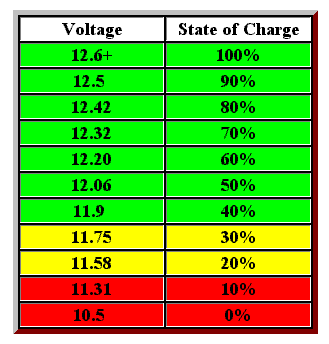
A partially discharged battery will put out a specific voltage within a small range relative to it's percentage state of discharge. I'm trying to find the chart that Harley Davidson puts out for owners to determine when their batteries need charge or have cells going bad.

Point is, all your batteries are getting basically the same charge rate withing a range relative to wire length, connection perfection, etc. They should all put out the same 'averaged' voltage within a small range.

A battery with a cell or cells going bad will have an output noticeably lower(in hundreths of a volt) than this 'average', since one cell usually puts out 2.1-2.2 volts in a fully charged state. Even in partially discharged states, there should be an average voltage output of the 'good' batteries with the voltage output of the 'failing' batteries falling below the battery bank average.

Also, just to argue the 21 volt charging rage, that will work but 'gassing' or boiling of the acid mixture is relative to internal temperature so unless they are in a cold, air conditioned space, you are shortening the life span of the batteries doing this.

These guys put a lot of charging info on this page:

http://www.powerstream.com/SLA.htm

Register to Reply
Guru
Popular Science - Weaponology - New Member Safety - ESD - New Member Hobbies - Fishing - New Member

Join Date: Sep 2006
Location: Near Frankfurt am Main, Germany. 50.390866N, 8.884827E
Posts: 17996
Good Answers: 200
#13

Re: When Do I Need to Change My Solar battery?

07/06/2011 9:30 AM

Firstly, in my limited experience of defective batteries, the internal resistance increases, therefore the best way to measure this change is with a specific load across the battery and watch what happens to the voltage and current. A defective battery will "fail" earlier..

But I can tell you (post#12 mentioned it in passing too), why your batteries are failing, you are overcharging them by connecting the solar cells without either a DC to DC converter between, or some electronics (really simple) that removes the solar cell when a specific voltage across the battery is achieved......

I personally only charge to 13.4 volts to make sure no gassing or rise in temperature happens, its really the only way......

Not doing this will quickly age batteries faster than necessary.

My caravan leisure battery will be 10 years old in August and is running fine, because it never, ever gases......

__________________
"What others say about you reveals more about them, than it does you." Anon.
Register to Reply
Guru
United Kingdom - Member - Not a New Member Hobbies - Musician - New Member Hobbies - Fishing - New Member

Join Date: May 2006
Location: Reading, Berkshire, UK. Going under cover.
Posts: 9684
Good Answers: 468
#14
In reply to #13

Re: When Do I Need to Change My Solar battery?

07/06/2011 9:34 AM

In the OP's defence, he does state "21 Volts open circuit" - we don't know what the terminal voltage is when connected to a bank of batteries.

__________________
"Love justice, you who rule the world" - Dante Alighieri
Register to Reply
Guru
Popular Science - Weaponology - New Member Safety - ESD - New Member Hobbies - Fishing - New Member

Join Date: Sep 2006
Location: Near Frankfurt am Main, Germany. 50.390866N, 8.884827E
Posts: 17996
Good Answers: 200
#17
In reply to #14

Re: When Do I Need to Change My Solar battery?

07/06/2011 4:41 PM

John, this means that as the battery voltage rises, it keeps rising, it will not reach 21 volts as at some point the current supplied will equal the self discharge rate of the battery. This could occur at say 17 volts, that is more than enough to damage the battery....gassing, even on a small scale is bad.

__________________
"What others say about you reveals more about them, than it does you." Anon.
Register to Reply
Associate

Join Date: Mar 2011
Location: Malaysia
Posts: 46
#18
In reply to #14

Re: When Do I Need to Change My Solar battery?

07/07/2011 6:17 AM

JohnDG.

Lack of information on my part again. Here is the missing information for those not familiar with PV systems. Solar panels are rated by:-

Volts open circuit,

Current short circuit,

Rated Watts peak value (do not confuse with watts power produced)

Current at maximum power point

Voltage at maximum power point.

Nominal voltage

All of these values are the laboratory test measurements and are not the output of the solar panel outside the laboratory.

A solar panel of 21 Volts open circuit, would have a nominal voltage of 12 volts. This would be controlled by the solar charger, which is the unit we are attempting to add the "Replace battery" function to.

The terminal voltage will be between 11v and 14.9v on a 21v OC PV panel.

Just a note that Ohms law remains intact but on a solar panel you can not use Voltage open circuit X Current short circuit to get watts peak. None of these are real values.

Voltage open circuit (Zero current) is zero watts. Current short circuit ( Zero volts) is also zero watts.

Register to Reply Score 1 for Off Topic
Associate

Join Date: Mar 2011
Location: Malaysia
Posts: 46
#21
In reply to #13

Re: When Do I Need to Change My Solar battery?

07/08/2011 12:38 AM

Andy,

I did specify that we need to test the battery without intervention or shutting down the system. That means we can not put a load across a single battery in a big system. The other answers considered this.

Andy reply: "therefore the best way to measure this change is with a specific load across the battery and watch what happens to the voltage and current".

But I can tell you (post#12 mentioned it in passing too), why your batteries are failing, you are overcharging them by connecting the solar cells without either a DC to DC converter between, or some electronics (really simple) that removes the solar cell when a specific voltage across the battery is achieved......

The original question included

Paul: "They are charged from a standard, modular, solar controller, which is connected to each battery independently. Each battery can be monitored separately from the others".

So you didn't read the question. There is a solar controller on every battery.

DC to DC converters have no advantage in charging batteries directly but add the risk of failure when they break down. MPPT controllers have an advantage when not charging batteries and are used in Grid connect systems, without batteries, to better advantage.

In temperate climates a solar battery will last 12 years average. In a tropical climate the same battery will only last 5 years. Most manufacturers will give you a cycle life graph for the different temperatures. The controller also has a temperature sensor and controls charging against temperature to prevent thermal runaway. (thermal runaway is not the temperature of the airport landing strip )

Solar controllers for wet, lead acid batteries are designed to ensure an equalisation charge occurs regularly (15v) to gas the battery and equalise the cells. This next text is copy and paste from the manual because I am too lazy to write it all out again. If you want to tell ISPQ it breaks the laws of physics and they should not gas the batteries, tell them directly at your nearest center. http://www.ispglobal.org/regional-licensees/ This is where the printed manual can be obtained.

9.14 Equalisation

During the charge-discharge process, some cells in a battery system may develop a different voltage with respect to the other cells. In order to equalise each cells' SOC, the system is deliberately taken to a full state of charge with a charging voltage of around 2.5 volts per cell. Deliberately overcharging the battery bank will 'equalise' the SOC, and the voltage, of all cells in the battery. (The battery will gas during this process)

9.15 Gassing
Battery cells on charge can dissociate H2O to produce hydrogen and oxygen

This gassing is accompanied by a loss of water in the electrolyte. The hydrogen produced in this process can explode if a spark is produced anywhere nearby, and gassing can even occur in batteries not on charge.

ALWAYS TAKE EXTREME CARE WHEN WORKING NEAR BATTERIES

Gassing, whilst resulting in water loss, also assists in mixing the electrolyte, and can counter the tendency in batteries where, over time, the heavier acid sinks to the bottom of the cell, (Known as stratification).

9.19 Sulphation
When left inactive with low state of charge for long periods, batteries develop lead sulphate in crystalline form on the surfaces of the two electrodes. Self-discharge causes 'sulphation' when batteries do not get occasional charging. Sulphation can result in a permanent loss of capacity as it is difficult to reverse the effect of lead sulphate produced during prolonged periods at low SOC. Batteries usually have other additives to attempt to reduce this problem. However, sulphation can best be prevented by ensuring frequent and complete recharge and by equalising the cell voltages monthly.

Andy: "My caravan leisure battery will be 10 years old in August and is running fine, because it never, ever gases......"

Wrong - Your battery is only used once a year and should last a lot longer. In a real PV system, it must work every day, 24 hours a day, 7 days a week, for 12 years.This must be reliable and batteries must be maintained without shutting down the system. A small home system has 12v batteries, 30 of them, not just 1. The bigger systems have 2 volt batteries, 2volt, 3,000ah, in series at 120v system voltage. There are maybe 500 of these and if 1 goes bad you have a problem finding it. Hence the attempt to include, finding dead batteries, in the functions of a solar controller.

Register to Reply
Guru
Popular Science - Weaponology - New Member Safety - ESD - New Member Hobbies - Fishing - New Member

Join Date: Sep 2006
Location: Near Frankfurt am Main, Germany. 50.390866N, 8.884827E
Posts: 17996
Good Answers: 200
#22
In reply to #21

Re: When Do I Need to Change My Solar battery?

07/08/2011 12:12 PM

Due to the fact that you find it difficult to write "absolute" questions, you cannot expect (well normal folks anyway!) absolute answers.

If you want to always be so inaccurate, that's your problem, not mine.

I and many others here, will always try to supply answers and information as good as the question to anyone who posts, but as always with this world:-

Sh!t in = sh!t out!!

Your personal problem, not ours....

When you finally hit 40 years old or so (in 25 years?), you may finally understand what I am posting here today, just maybe!!

I have seldom met such an obtuse personality as you seem to have.........but there again, you must live with your personality, not me!!!

__________________
"What others say about you reveals more about them, than it does you." Anon.
Register to Reply Score 2 for Off Topic
Anonymous Poster #2
#24
In reply to #22

Re: When Do I Need to Change My Solar battery?

07/08/2011 12:13 PM

How true!

Register to Reply
Guru
Popular Science - Weaponology - New Member Safety - ESD - New Member Hobbies - Fishing - New Member

Join Date: Sep 2006
Location: Near Frankfurt am Main, Germany. 50.390866N, 8.884827E
Posts: 17996
Good Answers: 200
#25
In reply to #24

Re: When Do I Need to Change My Solar battery?

07/08/2011 3:44 PM

Nuff said.

__________________
"What others say about you reveals more about them, than it does you." Anon.
Register to Reply
Power-User
Engineering Fields - Petroleum Engineering - Rig Electrician United States - Member - the Oil Patch Engineering Fields - Power Engineering - Drives & Gen's Engineering Fields - Instrumentation Engineering - Drive Control Popular Science - Cosmology -

Join Date: Jan 2010
Location: Houston off/on-shore @ Oil Patch
Posts: 223
Good Answers: 2
#26
In reply to #22

Re: When Do I Need to Change My Solar battery?

07/08/2011 4:22 PM

Good thing Paulmil hasn't figured out that if he put in a political "view" somewhere (there is room in his posts to add ANYTHING) he good get a few GA's from those fan boys.

__________________
Why do they make manhole covers round? so they won't fall in [before asking "Who is John Galt?"]
Register to Reply Off Topic (Score 7)
Guru
Popular Science - Weaponology - New Member Safety - ESD - New Member Hobbies - Fishing - New Member

Join Date: Sep 2006
Location: Near Frankfurt am Main, Germany. 50.390866N, 8.884827E
Posts: 17996
Good Answers: 200
#27
In reply to #26

Re: When Do I Need to Change My Solar battery?

07/08/2011 4:39 PM

Don't tell him that!! His posts will get even more convoluted and difficult to swallow! !!!!HELP!!!!!

__________________
"What others say about you reveals more about them, than it does you." Anon.
Register to Reply Off Topic (Score 5)
Guru
United Kingdom - Member - Not a New Member Hobbies - Musician - New Member Hobbies - Fishing - New Member

Join Date: May 2006
Location: Reading, Berkshire, UK. Going under cover.
Posts: 9684
Good Answers: 468
#28
In reply to #26

Re: When Do I Need to Change My Solar battery?

07/09/2011 7:28 PM

" ... if he put in a political "view" ..."

Was this included purely to incite a flame war? It has no place in this discussion; you should be ashamed of yourself. It is clear that you haven't been following this thread (apart perhaps for AG's 'contributions'). If you have nothing useful to add, stay out of it.

__________________
"Love justice, you who rule the world" - Dante Alighieri
Register to Reply Off Topic (Score 5)
Power-User
Engineering Fields - Petroleum Engineering - Rig Electrician United States - Member - the Oil Patch Engineering Fields - Power Engineering - Drives & Gen's Engineering Fields - Instrumentation Engineering - Drive Control Popular Science - Cosmology -

Join Date: Jan 2010
Location: Houston off/on-shore @ Oil Patch
Posts: 223
Good Answers: 2
#29
In reply to #28

Re: When Do I Need to Change My Solar battery?

07/09/2011 7:53 PM

OK

__________________
Why do they make manhole covers round? so they won't fall in [before asking "Who is John Galt?"]
Register to Reply Off Topic (Score 5)
Anonymous Poster #1
#15

Re: When Do I Need to Change My Solar battery?

07/06/2011 11:19 AM

This breaks the laws of physics and you don't know what you are doing.

Register to Reply
Associate

Join Date: Mar 2011
Location: Malaysia
Posts: 46
#19
In reply to #15

Re: When Do I Need to Change My Solar battery?

07/07/2011 6:26 AM

This breaks the laws of physics and you don't know what you are doing.

You made me laugh with that line. I think I should give you 10 extra points for that.

Be careful that is Andy's line and he won't like you using it.

Register to Reply Off Topic (Score 6)
Guru

Join Date: Feb 2011
Location: Atlanta, GA
Posts: 1053
Good Answers: 110
#16

Re: When Do I Need to Change My Solar battery?

07/06/2011 1:05 PM

The controller is microprocessor controlled and has Bluetooth 4.0 remote access to allow the controller information to be read from new mobile phones, indicating when batteries need changing and all other parameters.

How does the system indicate when batteries need changing? Are you attempting to say that the system could indicate when batteries need changing, but does not now do so?

There are many battery monitoring systems on the market that will indicate battery aging conditions, internal resistance, etc. It sounds as if your controller can send an AC signal to each battery to measure impedance. I think I would want this test to occur at a particular voltage each time, let's say 12.3V. The values for each battery would be stored, and when the value for a particular battery is 10% different than the others, that battery would be flagged for replacement.

You'd need to find the natural variability in impedance and put the flag point enough outside this range to avoid false alarms.

Monitoring each battery for temperature (and storing a historic record) is another possibility. A failing battery will stay warmer than a good battery. You would need to filter natural differences in temperature that are associated with placement of an individual battery in the string. (In other words, you are not looking for a warmer battery so much as one that has changed in it temperature over time.)

__________________
Think big. Drive small.
Register to Reply Score 1 for Good Answer
Associate

Join Date: Mar 2011
Location: Malaysia
Posts: 46
#20
In reply to #16

Re: When Do I Need to Change My Solar battery?

07/07/2011 6:59 AM

K Fry,

Are you attempting to say that the system could indicate when batteries need changing, but does not now do so?

Yes. The controller does all the other functions of a standard Solar controller, low battery cut off, battery charge control, etc. but is not yet able to inform the owner when a battery needs replacing. I would like to add this function. I am confident the microprocessor is able to handle this. The mobile phone acts as a remote unit and means you can see when your system needs attention without intervention or shutting down the system.

I have not seen this function yet on any other solar controller. Even Morning star don't have it. They have gassing periods at set times, MPPT, Battery charging regimes and everything else you can think of.

Battery temperature is a problem here. It varies from 20C at night to 45C in the day time. This seems to be the biggest drawback to obtaining accurate results from the battery.

I like the idea of making the test occur at the same voltage every time. This would narrow down the errors. I will write an algorithm based on your input and see how accurate I can make it work. Thank you for your valuable information. These modern battery monitors seem to be ideal, if I can just get them built into the Solar controller we have everything in one unit at hopefully lower cost.

Register to Reply
Power-User

Join Date: Feb 2009
Posts: 176
Good Answers: 6
#23

Re: When Do I Need to Change My Solar battery?

07/08/2011 12:12 PM

You state

They are charged from a standard, modular, solar controller, which is connected to each battery independently. Each battery can be monitored separately from the others. The batteries are connected via the controller, in parallel but have no direct connection to each other.

The solar controller can roughly determine the state of charge of the battery from the voltage and can also measure amp hours into the battery and amp hours out of the battery to roughly indicate Depth of Discharge

I have no idea how to program the controler but my thoughts would be If the amp hrs of each battery is monitored indivually & they are all discharging in parallel then each battery should theoretically have close to the same amount of amp hrs discharge. So when 1 battery in particular repeatedly starts having a less than the average amp hrs discharge compared to the rest it would be a fair guess that it is either not getting a full charge or it is starting to fail. So a regular comparason of the discharge amounts of each battery should give a good tell tale that a particular battery needs attention

I don't have a great deal of experiance in the subject so be free to tell me if I am off track with my thoughts

Register to Reply
Associate

Join Date: Mar 2011
Location: Malaysia
Posts: 46
#30
In reply to #23

Re: When Do I Need to Change My Solar battery?

07/12/2011 12:20 AM

Brettj1au,

A reasonable answer and on track, as were all these answers (except for Andy). They are helpful, even if I can not use some of them directly, the information is helping to find the way around the problems.

This idea is good but the result is too late before, I identify the expired battery. The reason this is not accurate enough for me is because the Solar Battery is in a constant state of charge and discharge and the battery is designed to have 5 days back up storage for bad weather. This means it will very rarely discharge below 50% of its energy and I need to know if it ever reaches less than 80% total capacity. In a Hybrid system, with generator back up, the battery only discharges 50% before the gen set kicks in, so I can never see if the battery will discharge 80% of its original capacity. I would like to be able to tell when the battery is down to 80% of its capacity, long before it reaches 50%.

The other factor that gives me problems with this method is the discharge rate. A 100ah battery at a discharge rate of C20 will give me 100ah. The same battery at C5 discharge rate will only give 80ah, so I have to know the discharge rate, to know if it is 20% dead or just 20% down due to the discharge rate. The "C" discharge rating is given at a constant discharge rate. The discharge rate varies so much in a real system that I don't know how to calculate how much I should have left or where on the discharge graph I should rate the ah available.

Then I had the temperature problem. The total discharge available also changes with temperature and the graphs were all given at 25C while the battery temperature was variable at 28C to 40C.

There was a good suggestion that we measure when the battery reaches 12.3 volts, which will happen almost every day. This will reduce errors due to voltage variations. Perhaps we also measure at 30C temperature, which should also happen every day to reduce errors of temperature variations. At the same time we introduce the AC test measurement into the battery, to measure internal resistance changes, instead of total discharge amounts directly. This is what I have gathered from all the information so far.

Register to Reply
Guru

Join Date: Aug 2010
Location: Melbourne, Australia
Posts: 740
Good Answers: 24
#31
In reply to #30

Re: When Do I Need to Change My Solar battery?

07/13/2011 7:37 PM

Paul,

In addition to the other suggestions, since you have control of charge/discharge current/voltage of each battery, with them in a defined state(terminal voltage/temperature), during discharge you could adjust either the current or voltage to a defined level and measure the other. If you do this from new for each battery, you will see a percentage degradation over time which could help identify the optimum time to replace a battery.

Regards

Bill

Register to Reply Off Topic (Score 3)
Associate

Join Date: Mar 2011
Location: Malaysia
Posts: 46
#32
In reply to #31

Re: When Do I Need to Change My Solar battery?

07/13/2011 10:01 PM

Bill,

Please excuse my bad descriptions. I have control over when I take the measurements but the system is live and I have no control over the system. I can not adjust either the voltage or current being used, I can only measure these from each battery.

The temperature will rise and fall slowly during each day. The temperature chosen at which to take the measurement will occur twice each day. Once in the morning and again in the evening. Both times it will probably be in the required temperature range for about an hour.

During these 2 hours each day, the voltage may reach the required test voltage and measurements will be taken when this happens. This only needs to coincide once a month to give reasonable measurements.

This is not off topic and answers my original question. Had I not confused you with my poor explanation it would have been a very good answer.

Register to Reply
Guru

Join Date: Aug 2010
Location: Melbourne, Australia
Posts: 740
Good Answers: 24
#33
In reply to #32

Re: When Do I Need to Change My Solar battery?

07/13/2011 10:18 PM

Paul,

I assume that you have DC-DC converters between your main power busses (PV output, and load) and each battery.

This being the case, it may require only a small change (dependent on the DC-DC converter design) to achieve control of either voltage or current.

I assumed that you would have this capability to be able to share the load equally among the batteries.

Register to Reply
Associate

Join Date: Mar 2011
Location: Malaysia
Posts: 46
#34
In reply to #33

Re: When Do I Need to Change My Solar battery?

07/14/2011 5:45 AM

Bill,

The loads are not shared equally by the batteries and system is live, on line, so output is determined by the loads in use and I can't turn them off without causing problems to the user. I didn't explain the modular system. More details below to show how the batteries have different loads and charging rates. This makes things much more difficult to measure. Your answer would have been different if I had explained all this earlier.

The fuse box has fuses for each output. Example 1 fuse for lights, 1 for TV, 1 for Fans, etc.. The modular controller is able to connect each battery to its own output fuse and load. So the TV has its own battery and the Fan has its own battery and the computer has its own battery. Each battery dedicated to its own job but all connected via the controller, independently. Solar panels are also dedicated to their own battery, independently. This means that if there is a cup final this week and the TV is designed for an average of 10 hours viewing time per day, it will deplete its battery when watching 20 hours of TV each day. When the TV battery reaches a low level, the controller will check the DOD of others in the system and if the owner has been watching TV for 20 hours, then he has not used the computer. So the computer battery is still full. The controller will then take power from the computer battery, so that the owner doesn't miss the final goal when the system shuts down his depleted battery. If the computer battery also reaches 60% depletion then another battery will be used to draw in the power.

When recharging the next day, as each battery reaches full power from its own PV panel and the controller begins pulse charging its battery, instead of losing power during the off pulse, which usually happens, there is no off pulse and instead the power is redirected to the other batteries, by the controller and then back to its own battery on the next pulse, so no power is wasted, 100% goes into the total battery bank.

This modular method of connection means if you short or damage any individual solar panel or battery, the system keeps working and the shorted or broken part remains isolated. Each part will keep working, even if other parts have failed. This avoids any catastrophic failure, which occurs when all batteries or all controllers are joined together without modular controllers.

DC to DC converters are not used in well designed, stand alone, PV systems, because they have no advantage in a correctly designed PV system. 65% of system failures are due to DC to DC converters when used, so I stay away from them. You will note that standard solar controllers do not have DC to DC converters. See an example here from Morning star. This is the type I used before I made my own.

http://www.morningstarcorp.com/en/pro-star

You would use an MPPT only if you had the wrong voltage PV panel due to bad design. MPPT is maximum power point tracker and has losses in conversion. An MPPT is a dc to dc converter with an automatic adjustable input, that would keep the voltage of the solar panel at its maximum power point on the IV-Curve. If you used a 12v battery and a 21 Volts open circuit PV panel you would get the full power of the panel into your battery without any DC to DC converter losses. But... If you had a 36 volts open circuit PV panel, bad design, then you would need to use an MPPT unit to get full power from the panel, minus converter losses, into your 12v battery. In this case you would need the MPPT or you would lose 30% of your energy without the MPPT unit. So design is very important to avoid MPPT losses and breakdown. It also saves you the cost of buying an MPPT unit.

Note we use the open circuit voltage in the system design, not the battery voltage or the charging voltage. ( For Andy- voltage Open circuit, means the voltage of the PV panel when it is exposed to direct Sunlight and is not connected to anything).

This is where the confusion came from on using Ohms law without all the other calculations first. Volts open circuit, Volts maximum power point, volts nominal, volts short circuit, which one do you want to use in Ohms law? Rated watts peak, current short circuit? What do they mean? None of them would be any use in Ohms law. Solar panel output is determined by the amount of Sunlight hitting the Solar panel and not by Ohms law. We do not break Ohms law and Ohms law applies but we can not use it to determine the PV output. (Yes.. yes... Andy, I know you are going to tell me this breaks all the laws of Physics and I expect it will create a black hole and suck us all in next time I connect my solar panels this way but I will risk it)

Example of why you do not use Ohms law to calculate the PV panel output:

In order to use Ohms law you need to know the output of the solar panel first. You can not work out the PV output using Ohms Law. You will need much more information.

1) Test amperes output using Ohms Law with the information given from the PV manufacturer on a 120 watts rated solar panel with maximum power point voltage of 12 volts, time of test midnight. Ohms law, based on manufacturers information, says that we should get 120 watts divided by 12 volts = 10 amps from this solar panel but we get ZERO amps at midnight. Ohms law and PV panel rating is not enough and we get a wrong answer. Ohms law is correct, the information given on the solar panel was not enough. The rated watts of a Solar panel is not what it produces outside a laboratory. It is not what it produces in the rain on a cloudy day. We need more information. We need to know how much Sunlight is hitting the solar panel, The temperature of the Solar panel and how much the power drops per degree Centigrade, How much the atmosphere changes the output, how much the dirt on the panel changes the output, how much cable losses will drop the power and a few other parameters. When you have found all these parameters and calculated the output, then Ohms law will apply correctly but you can't find these parameters using Ohms law. You need to know the IV-Curve and the amount of radiation coming from the Sun.

2) Test amperes output using Standard Solar panel calculations from IV-Curve of Solar panel and Solar radiation measurements (insolation) on a 120 watts rated solar panel with maximum power point voltage of 12 volts, time of test midnight. We need to know how much Sunlight is hitting the solar panel, The temperature of the Solar panel and how much the power drops per degree Centigrade, How much the atmosphere changes the output, how much the dirt on the panel changes the output, how much cable losses will drop the power and a few other parameters. Solar radiation is zero. Calculations say we should get power out proportional to Solar Power input minus losses based on the measured parameters. Solar input at midnight is zero, Solar panel calculations from IV-Curve show output is correct at zero amps. Solar panel calculations show the output is proportional to the solar input and give the correct answer. Ohms law also agrees that 0 volts X 0 amps = 0 watts out. (No black hole appeared)

The rated watts is probably never reached on Crystalline PV, so never applies under Ohms law. Only the derated output can be used. The actual output of the solar panel varies all day long so charging graphs are too complicated to use under such dramatic changes. It is all these variations that make testing the battery unreliable without a dc to dc converter and mean I can not use the method you suggested.

Thank you for your answer and if you have any more input based on this updated information please send it.

Paul

Register to Reply
Guru
Safety - Hazmat - New Member Safety - ESD - New Member Engineering Fields - Transportation Engineering - New Member Popular Science - Evolution - New Member Technical Fields - Procurement - New Member Hobbies - Target Shooting - New Member Popular Science - Cosmology - New Member Engineering Fields - Architectural Engineering - New Member Technical Fields - Marketing/Advertising - New Member Engineering Fields - Food Process Engineering - New Member

Join Date: Dec 2005
Location: Mariposa Ca
Posts: 5800
Good Answers: 114
#35
In reply to #34

Re: When Do I Need to Change My Solar battery?

07/14/2011 10:45 AM

it sounds like you can connect any battery to any load

wouldn't you then want to arrange a rotation so the batteries will each take a turn servicing the more demanding loads & having a nice rest afterwards?

this would also allow you to do the condition of battery tests under close to identical conditions

Register to Reply
Guru

Join Date: Aug 2010
Location: Melbourne, Australia
Posts: 740
Good Answers: 24
#36
In reply to #34

Re: When Do I Need to Change My Solar battery?

07/14/2011 7:46 PM

Hi Paul,

Thank you for your explanation, I now understand your problem more clearly, but I do also have some further questions.

Do you have a diode, or ideal diode (FET) in circuit with each panel or are they directly connected?

Do you switch the panels between batteries with mechanical relays, solid state relays or FET switches?

Presumably all the Batteries and panels will have one common connection (-ve) and you switch only the +ve side?

If you use ideal diodes, FET switches or SSRs in either the Panel or Battery circuits they exhibit a small but measurable voltage drop which is current related, since in the ON state they are all resistive devices (FETs) in the output. If they are all the same type and preferably from the same manufacturing batch their resistance should vary little from device to device. This voltage drop could be used to determine the current, even if only relative and approximate, a pattern could be established for each battery(and perhaps panel).

Since you are determining when a battery is fully charged I assume you are measuring voltage.

Discharge is presumable through a DC-AC converter, or have all the appliances been converted/designed to operate off 12VDC.

The trickiest aspect I see is that while you are charging the appliances may or may not be operating - drawing power from the batteries, so, during the pulse off you may not know whether the battery is idle or under load, and even during pulse on you may not know what proportion of the charging current is going to charge the battery and how much is powering the load.

I was expecting a common bus to which the batteries shared the load - in your system this could perhaps be done with ideal diodes to minimise power loss, then each load could run separately from the common bus.

This would allow easy automatic disconnection of a single battery for testing/measurement and also for replacement without disrupting any other part of the system, although your load swapping will also achieve this.

Register to Reply Score 1 for Good Answer
Associate

Join Date: Mar 2011
Location: Malaysia
Posts: 46
#37
In reply to #36

Re: When Do I Need to Change My Solar battery?

07/14/2011 11:45 PM

Bill,

Do you have a diode, or ideal diode (FET) in circuit with each panel or are they directly connected?

I use a schottky blocking diode in series with each panel. Panels are modern Thin Film PV which work well at high surface temperatures and also in cloudy conditions.

Do you switch the panels between batteries with mechanical relays, solid state relays or FET switches?

I prefer relays but customers want solid state so I use MOSFETs. They are not as good as relays.

Presumably all the Batteries and panels will have one common connection (-ve) and you switch only the +ve side?

I switch the -ve side. MOSFETs have lower forward resistance on the negative side. 3 MOSFETs to each battery.

1. switches the PV to battery connection and controls charging. This one has to handle the open circuit voltage of the panel. Input from other PV panels and batteries, when their battery is full, also comes in through this MOSFET.

2. switches the battery out to its own load. Controls low battery cut off.

3. switches power out to the other batteries if this battery is more than 70% full.

If you use ideal diodes, FET switches or SSRs in either the Panel or Battery circuits they exhibit a small but measurable voltage drop which is current related,

This answer is very good. I use a fixed resistance wire now of 0.002 Ohms which is very expensive. The MOSFET states a forward resistance of 0.002 Ohms also. If this remains fixed it will work to measure the current. I have to try this. Do you have a part number for a low forward loss, 10 amp continuous, 30v FET?

Since you are determining when a battery is fully charged I assume you are measuring voltage.

Yes. The battery manufacturer supplies a graph of voltage against state of charge at 25C. The battery is never 25C but test measurements show a full battery is at 12.75v resting and 14.9v charging.

Discharge is presumable through a DC-AC converter, or have all the appliances been converted/designed to operate off 12VDC.

We supply the complete system so AC to DC adapters on appliances are either removed or new appliances provided FREE without AC to DC adapters fitted. This cost is so much less, that no one ever wastes money buying an expensive inverter.

Example for a solar powered TV: A 29" LCD TV with AC to DC adapter built into the case, uses 120 watts of AC power into the adapter which gives out 60 watts DC power to the TV and this TV costs $300. If you allow the customer to keep this unit with built in AC to DC converter, you will need to buy an Inverter, which costs $500 and has at least 10% losses. On top of this you must provide 120 watts of PV + 10% inverter losses = 133watts AC system at $5 per watt, $665. Total cost to keep the existing TV = $1,165 not including the $300 TV.

My system comes with a FREE TV. Same size same model, same brand but without the AC to DC adapter inside. The TV cost me $300. I need only 60 watts DC power system at $5 per watt = $300. Total cost $600. I sell to the customer at $800 saving the customer $365 and giving him a FREE, brand new, LCD TV. No customer has ever demanded to pay the higher price and use his old AC adapted TV and an Inverter. This costing applies to almost all AC items. Even AC pumps take much more power than a DC pump of the same volume.

I was expecting a common bus to which the batteries shared the load - in your system this could perhaps be done with ideal diodes to minimise power loss, then each load could run separately from the common bus.

I avoid a 100% common bus to ensure that there can never be a complete system failure with all the batteries dead at the same time. If you abuse one part of the system you can get an extra 30% from the other batteries but they stop at 70% DOD, so you always have 70% left for every other appliance and chances of abusing them all at the same time is very low. It does give a lot of problems measuring the batteries all at different levels.

The suggestion of sending an AC pulse into each battery and measuring the internal resistance still seems to be the best option. A bit complicated in the program and I might need more memory in the processor but it makes the most accurate method I can see so far.

Using the resistance of the MOSFET to measure current will save me cost and is less work making the circuit. Thank you for that idea.

Register to Reply
Guru

Join Date: Aug 2010
Location: Melbourne, Australia
Posts: 740
Good Answers: 24
#38
In reply to #37

Re: When Do I Need to Change My Solar battery?

07/15/2011 1:15 AM

Do you have a diode, or ideal diode (FET) in circuit with each panel or are they directly connected?

I use a schottky blocking diode in series with each panel. Panels are modern Thin Film PV which work well at high surface temperatures and also in cloudy conditions.

A Schottky will drop 0.3-0.6V depending on current, even a FET with ≤ 10 milliOhms RDS(on) configured as an Ideal diode would drop 0.3V at 30 Amps.

Do you switch the panels between batteries with mechanical relays, solid state relays or FET switches?

I prefer relays but customers want solid state so I use MOSFETs. They are not as good as relays.

But FETs eliminate a lot of EMI which would be generated by switching relays

If you use ideal diodes, FET switches or SSRs in either the Panel or Battery circuits they exhibit a small but measurable voltage drop which is current related,

This answer is very good. I use a fixed resistance wire now of 0.002 Ohms which is very expensive. The MOSFET states a forward resistance of 0.002 Ohms also. If this remains fixed it will work to measure the current. I have to try this. Do you have a part number for a low forward loss, 10 amp continuous, 30v FET?

For starters you could look at :

N channel:

IRF8734PBF, IRFH8324TR2PBF, IRFH8318TR2PB, IRLHM620TR2PBF, NTMFS4852NT3, FDMC766, IRFH5302TR2PBF, IRFH5250TR2PBF, PSMN1R2-25YLC, IRFH6200TR2PBF, PSMN1R1-30EL, PSMN2R2-30YL, NTMFS4897NFT3.

P Channel:

IRFH9310TR2PB, TPC8128, TPCA812, TPC8120, SI4459ADY-T1-GE3, FDS6681Z.

I was expecting a common bus to which the batteries shared the load - in your system this could perhaps be done with ideal diodes to minimise power loss, then each load could run separately from the common bus.

I avoid a 100% common bus to ensure that there can never be a complete system failure with all the batteries dead at the same time. If you abuse one part of the system you can get an extra 30% from the other batteries but they stop at 70% DOD, so you always have 70% left for every other appliance and chances of abusing them all at the same time is very low. It does give a lot of problems measuring the batteries all at different levels.

The suggestion of sending an AC pulse into each battery and measuring the internal resistance still seems to be the best option. A bit complicated in the program and I might need more memory in the processor but it makes the most accurate method I can see so far.

Using the resistance of the MOSFET to measure current will save me cost and is less work making the circuit. Thank you for that idea.

Remember that you will lose some accuracy doing so, but it will also reduce your losses.

Register to Reply Score 1 for Good Answer
Register to Reply 38 comments

Good Answers:

These comments received enough positive votes to make them "good answers".

"Almost" Good Answers:

Check out these comments that don't yet have enough votes to be "official" good answers and, if you agree with them, vote them!
Copy to Clipboard

Users who posted comments:

129CBRider (1); Andy Germany (5); Anonymous Poster (2); aurizon (1); brettj1au (1); Garthh (1); JohnDG (4); K_Fry (1); kwcharlie (2); Oregoon (1); Paulmil (11); PeterT (1); SimpleMind (1); sulat (1); WAWAUS (5)

Previous in Forum: Is Leakage Current Test Necessary for Lighting Fixtures?   Next in Forum: Suggest Best VFD to Vary RPM (Max 985/Min) for a 75KW 3 Phase Motor

Advertisement