Previous in Forum: Rotating Magnetic Field Electrically   Next in Forum: Power Factor
Close
Close
Close
6 comments
Rate Comments: Nested
Active Contributor

Join Date: Jun 2012
Location: Guwahati,India
Posts: 19

Inductor Coil Design

08/15/2012 3:36 AM

I made a square spiral coil with 10 turns and 10.5*17.5(cm) dimension.the edges were not perfect and there was some smoothening in contrary to perfect edges. Will my self inducatnace will decrease or increase due to this smoothening.

__________________
In search of the truth
Register to Reply
Interested in this topic? By joining CR4 you can "subscribe" to
this discussion and receive notification when new comments are added.

Good Answers:

These comments received enough positive votes to make them "good answers".
Guru
United Kingdom - Member - Indeterminate Engineering Fields - Control Engineering - New Member

Join Date: Jan 2007
Location: In the bothy, 7 chains down the line from Dodman's Lane level crossing, in the nation formerly known as Great Britain. Kettle's on.
Posts: 32175
Good Answers: 839
#1

Re: Inductor coil design

08/15/2012 3:40 AM

What is the material onto which the coil has been wound?

__________________
"Did you get my e-mail?" - "The biggest problem in communication is the illusion that it has taken place" - George Bernard Shaw, 1856
Register to Reply
Active Contributor

Join Date: Jun 2012
Location: Guwahati,India
Posts: 19
#3
In reply to #1

Re: Inductor coil design

08/16/2012 3:32 AM

The coils are air core or u can say core-less.It is used for contactless power transfer.

__________________
In search of the truth
Register to Reply
Guru
United Kingdom - Member - Indeterminate Engineering Fields - Control Engineering - New Member

Join Date: Jan 2007
Location: In the bothy, 7 chains down the line from Dodman's Lane level crossing, in the nation formerly known as Great Britain. Kettle's on.
Posts: 32175
Good Answers: 839
#5
In reply to #3

Re: Inductor coil design

08/16/2012 5:37 AM

So where does the <...smoothening...> come in?

__________________
"Did you get my e-mail?" - "The biggest problem in communication is the illusion that it has taken place" - George Bernard Shaw, 1856
Register to Reply
Active Contributor

Join Date: Jun 2012
Location: Guwahati,India
Posts: 19
#6
In reply to #5

Re: Inductor coil design

08/16/2012 1:34 PM

smoothening is around the corner of the coil.

__________________
In search of the truth
Register to Reply
6
Power-User

Join Date: May 2010
Location: Cambridge, MA
Posts: 390
Good Answers: 82
#2

Re: Inductor coil design

08/15/2012 7:27 AM

Without knowing the details of your square coil, I would say that crudely-speaking, if the enclosed area is increased, the inductance will increase slightly. If your smoothed corner cuts into where the otherwise sharp corner would have been, without a corresponding bulge near the corner, the inductance will decrease slightly. One other thing, many formulas show that the overall perimeter length is a sensitive parameter.

About 80 to 100 years ago some folks took great care to make inductance standards fabricated from square coils. I have seen pictures of these, but I do not know how they dealt with the sharp-corner issue.

The best inductance standards were made from round coils. Here's a short book by J.G. Coffin, published by the Bureau of Standards in 1906, about such a standard coil. It makes interesting reading. As you can see from the math in the book, it's possible to exactly calculate the inductance of your approximately-square coil.

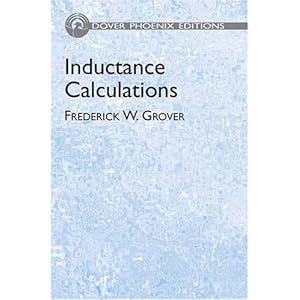
Here's a 1999 paper by Thompson, dealing with square coils. He quotes formulas from Frederick W. Grover's famous book (Dover 1946 edition), pictured at right. This book is the gold standard for calculating inductance.

Thompson also gives three references for more detailed calculations for square planar coils. These are popular for use on printed-circuit boards. If the inner distance Di = 0 (completely-filled coil) the simplified formula is

L ~= 8.5 x 10⁻¹⁰ D N5/3

That formula is by H. Dill, from a Feb 17, 1964 Electronic Design article (whew, I suppose D is in meters and L is in Henrys). Thompson says the 5/3 exponent is thought to be due to end effects. Hah! The other formulas in the literature are not so simple.

A 1974 paper by H.M. Greenhouse shows that five different formulas for a single-turn square coil, by various experts and authorities, gives answers varying from 1.95 (Grover, expanded to include mutual-inductance effects) to 2.4 (Terman) to 3.89 (Bryan). One imagines the best course is to build one and measure it! When this is done Greenhouse says Grover gets the nod.

Here's IN3OTD's interesting web site, comparing formulas, and here's a useful paper, available from MIT. :-)

__________________
Thanks, Win
Register to Reply Good Answer (Score 6)
Active Contributor

Join Date: Jun 2012
Location: Guwahati,India
Posts: 19
#4
In reply to #2

Re: Inductor coil design

08/16/2012 3:54 AM

thanx a lot for ur help.

__________________
In search of the truth
Register to Reply
Register to Reply 6 comments

Good Answers:

These comments received enough positive votes to make them "good answers".
Copy to Clipboard

Users who posted comments:

kislay verma (3); PWSlack (2); Winfield Hill (1)

Previous in Forum: Rotating Magnetic Field Electrically   Next in Forum: Power Factor

Advertisement