Previous in Forum: Water hammer   Next in Forum: ANSI B 16.5 FLANGES
Close
Close
Close
8 comments
Rate Comments: Nested
Member

Join Date: Feb 2007
Location: Allen, Texas (north Dallas)
Posts: 7

Standard Belt Tensioning

05/22/2007 4:38 PM

Is there a standard specification to determine the proper belt tensioning for pulleys mounted on motor shafts (side load)?

Register to Reply
Interested in this topic? By joining CR4 you can "subscribe" to
this discussion and receive notification when new comments are added.
Guru
Engineering Fields - Environmental Engineering - New Member APIX Pilot Plant Design Project - Member - New Member

Join Date: May 2007
Location: Anywhere Emperor Palpatine assigns me
Posts: 2774
Good Answers: 101
#1

Re: Standard Belt Tensioning

05/23/2007 2:44 AM

In my experience, no. The correct tension is what the manufacturer of your equipment says it is. A general rule of thumb would be that there should be no slippage or screeching sound when running, yet will depress slightly when idle up of belt is pressed down. Note that only half of the belt is actually doing work when the machine is running; the other half is just returning.

__________________
If only you knew the power of the Dark Side of the Force
Register to Reply
Anonymous Poster
#2

Re: Standard Belt Tensioning

05/23/2007 5:45 AM

Depends on the belt and application. Most say that the belt tension should only be what is required to move the load without slippage - round belts, v-belts, flat belts. Anything more than that would be unnecessary strain on the belt. If it is a gates power max GT belt (cog belt), you only need to tighten to the point where its not slipping.

Hope this helps

Register to Reply
Guru
Popular Science - Weaponology - New Member Safety - ESD - New Member Hobbies - Fishing - New Member

Join Date: Sep 2006
Location: Near Frankfurt am Main, Germany. 50.390866N, 8.884827E
Posts: 17996
Good Answers: 200
#3

Re: Standard Belt Tensioning

05/23/2007 5:55 AM

Remember also that you are pulling the pulley off center too, you may need to make sure that the pulley is simultaneously pulled in the opposite direction to reduce side loads....

Big side loads + small bearings = bad problems.....

There are various ways to do this properly that a search on the web should help out.

__________________
"What others say about you reveals more about them, than it does you." Anon.
Register to Reply
Anonymous Poster
#4

Re: Standard Belt Tensioning

05/23/2007 7:41 AM

Its the motor bearings that you need to be sure will take a side load, not the belts example: a rotating pump is horizontal/vertical so the bearings on motor an pump will have more of an axial load, the motors designed for belt drive systems are side loaded so the bearings will be designed for side load (usually they will have more surface contact to handle this side load)

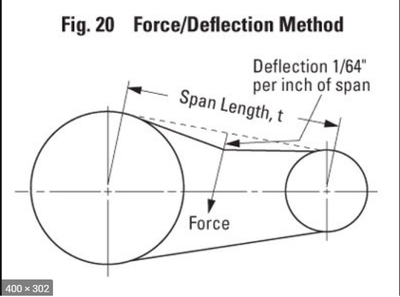
To calculate tensioning : YOU HAVE TO KNOW THE DEFLECTION

after the sheaves have been aligned and the belts installed

measure the span of the sheaves....the distance in inches from the center of the drive shaft to the center of the driven shaft

the deflection height general rule is 1/64" of deflection per inch of span (for a system utilizing 16" of span the deflection would be 16/64" or 1/4"...... but at what TENSION (force) you have to know what the manufacturers recommendation is from their charts for your belts

When this is known you put a striaght edge of some kind resting on across the top edges of both pulleys and using a belt tensioner gage, you set the tension force needed and then you press down with your hand till the mark on your gage reads the 1/4" deflection against the straight edge, then you look at the plunger on gage to see how much the tension was and make necessary adjustments.

You have to know the deflection to be able to get your tension also this is applied for all belts regardless of type............You should also maintain a minimum percentage of belt wrap on pulleys of at least 35%.....................also if you have a system that calls for 2 belts and you decide to add another because of slippage or other reasoning, you will have to reduce the tension of the 3 belts (regardless of the recommendation from manufacturer--remember it's their recommendation and they are in business to sell belts)

example: 100 h.p system designed for 3 belts

@33 1/3 h.p per belt at 20lbs. tension

Your engineer wants to add another belt ????

100 h.p system now has 4 belts at 33 1/3 h.p per belt at the 20 lbs.

So what should the correct tension be for the 4 belts ?

20lbs. X 3belts = 60 / 4 belts = 15lbs. is what you would set the tension

or you will overload the system(over tension)and wear out bearings , pulleys, and posibly bend the shafts.

Register to Reply
Guru
Hobbies - Fishing - Old Salt Hobbies - CNC - New Member United States - US - Statue of Liberty - New Member

Join Date: Mar 2007
Location: Rosedale, Maryland USA
Posts: 5197
Good Answers: 266
#5

Re: Standard Belt Tensioning

05/23/2007 9:58 AM

It has been my experience the rule of thumb is to tension the belt until slack just allows you to push in on the belt at it's center between the two pulleys a 1/4 inch.

__________________
Life is not a journey to the grave with the intention of arriving in a pretty, pristine body but rather to come sliding in sideways, all used up and exclaiming, "Wow, what a ride!"
Register to Reply
Guru

Join Date: Jul 2006
Location: "Dancing over the abyss."
Posts: 4884
Good Answers: 243
#6

Re: Standard Belt Tensioning

05/23/2007 10:44 AM

Machinery' handbook,p1074 for v belts; 1073for use of idlers, 1067 for installation and take up allowance.

my copy is 20th edition

milo

__________________
People say between two opposed opinions the truth lies in the middle. Not at all! Between them lies the problem, what is unseeable,eternally active life, contemplated in repose. Goethe
Register to Reply
Anonymous Poster
#7

Re: Standard Belt Tensioning

05/23/2007 4:26 PM

Hey guys, engineering is pretty specific and details are important. The proper term for the "pulley" in a power transfer situation is sheave. A pulley re directs motion.

Register to Reply
Associate

Join Date: Oct 2019
Location: BANGALORE. INDIA
Posts: 54
Good Answers: 1
#8

Re: Standard Belt Tensioning

05/08/2020 1:04 AM
Re: Belt tension 05/05/2020 5:24 PM
Hi

TejanoBob

The thumb rule is that the deflection for the belt should be 1/64th of an inch per Inch of span (or) 0.0156 Inch/Inch., (OR) 0.156 mm/c.m., and the span is to be measured between the centres of the shaft and parallel to the belt.

Also pl. open the link below and plenty of details available and you can adopt which ever suits you.

https://www.google.com/search?sxsrf=ALeKk02VmlUsBJFiWQ9Ye1L7OpPilGytIA:1588674917365&source=univ&tbm=isch&q=HOW+TO+CHECK+BELT+TENSION&sa=X&ved=2ahUKEwi4u_Ogw5zpAhWGzTgGHVDdA0oQsAR6BAgBEAE

Further you can search in google see this link https://www.google.com/search?sxsrf=ALeKk02VmlUsBJFiWQ9Ye1L7OpPilGytIA:1588674917365&source=univ&tbm=isch&q=HOW+TO+CHECK+BELT+TENSION&sa=X&ved=2ahUKEwi4u_Ogw5zpAhWGzTgGHVDdA0oQsAR6BAgBEAE

DHAYANANDHAN.S

__________________
DHAYANANDHAN.S
Register to Reply
Register to Reply 8 comments
Copy to Clipboard

Users who posted comments:

Andy Germany (1); Anonymous Poster (3); dhayanandhan.s (1); DVader1000 (1); Milo (1); ozzb (1)

Previous in Forum: Water hammer   Next in Forum: ANSI B 16.5 FLANGES
You might be interested in: Flat Belt Pulleys, Round Belt Pulleys, V-belt Pulleys

Advertisement