Previous in Forum: Demolition Method To Spare Embedded Conduit In Concrete   Next in Forum: Concrete Wicking
Close
Close
Close
21 comments
Rate Comments: Nested
Power-User

Join Date: May 2009
Location: S. Louisiana
Posts: 284
Good Answers: 3

Clay Road Problems

03/09/2014 10:31 PM

My son recently installed a road over a 15' sand base. He put down about 4"-6" of clay and then topped it with about 4" of crushed concrete. Although we have heard good reports on the crushed concrete, the product we used seemed to have pretty small aggregate, about 1/4"- 1/2". Over the past several weeks my son has driven his full size truck and 4 wheeler over the road numerous times and it seemed to be packed down pretty good. During this time we have received several inches of rain accompanied by dry periods. Three days ago we got about 1/4 inch of rain and since then, the road seemed to dry out pretty good. In our area, south Louisiana, we receive about 60" of annual rainfall.

Now the problem. Today he attempted to drive his 28' motorhome down the 300' road and the RV got stuck. The wheels were almost down to the axles. It took us quite a while to get it out. Now we have pretty substantial ruts, some 8"-10" deep.

Any recommendations on the remedy? Fill the ruts with crushed limestone? Fill the ruts with dry cement mix? Fill the entire roadbed with additional limestone/crushed concrete?

Thanks,

Don

__________________
The only people who don't make mistakes are those who don't try.
Register to Reply
Interested in this topic? By joining CR4 you can "subscribe" to
this discussion and receive notification when new comments are added.

Good Answers:

These comments received enough positive votes to make them "good answers".
Guru

Join Date: Jun 2009
Location: South of Minot North Dakota
Posts: 8376
Good Answers: 775
#1

Re: Clay Road Problems

03/09/2014 11:37 PM

If it was me I would fill it in with more of what you are using.

We used crushed concrete for my dads farm yard and to hold up to traffic of similar weights the crushed concrete ended up being around 10" - 12" thick.

After that he has never had a machine sink in since no matter how much rain we got.

Register to Reply
3
Guru
Safety - Hazmat - New Member Engineering Fields - Retired Engineers / Mentors - New Member Engineering Fields - Piping Design Engineering - New Member Hobbies - DIY Welding - New Member Fans of Old Computers - PDP 11 - New Member

Join Date: Feb 2007
Location: Stronger Than The Storm
Posts: 2394
Good Answers: 203
#2

Re: Clay Road Problems

03/09/2014 11:49 PM

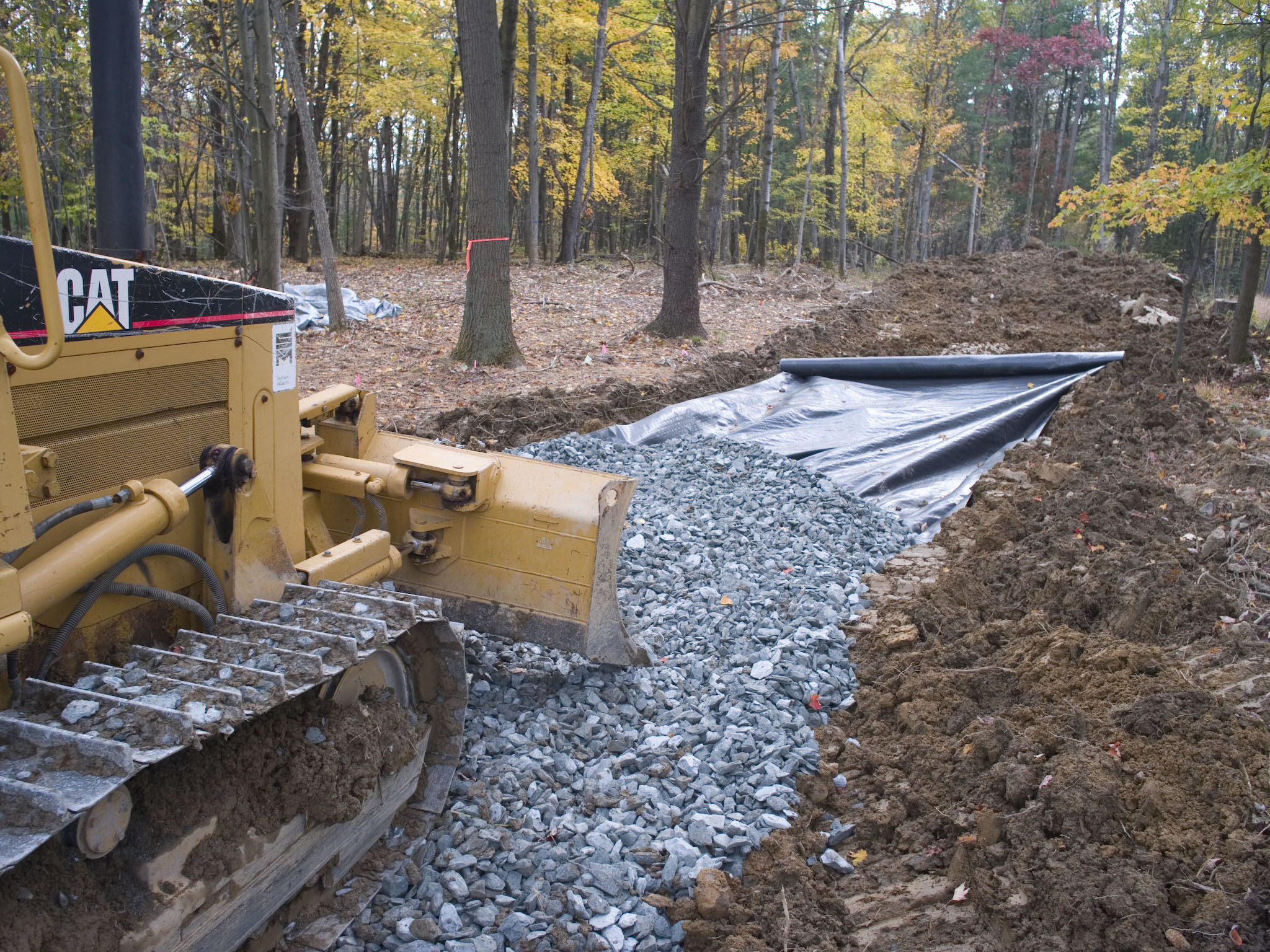
Your son should have used soil stabilization cloth a foot or in at least two of the layers of sand base. This would have prevented/reduced the displacement of the sand by the moisture, the compression and "squeeze out" of the sand. Unfortunately it is most likely to be too late to remedy this now that way. If possible have him take a foot off and put the cloth down. Put some larger aggregate (3/4-1-1/2") on the cloth and place the old materials back on.

This is by no means the only or best way to construct a road but it will be much better than it is now. Tell your son to consult with a civil engineer next time before he puts a 15 ft base down. Home made roads usually have serious problems over a shorter life than if consulted with before being built.

Good Luck, Old Salt

__________________
Any day on the green side of the grass is a GREAT DAY!, --- me +++++++++. I believe creativity is an inherent part of everyone. --- Kermit T. Frog
Register to Reply Good Answer (Score 3)
Guru

Join Date: Oct 2008
Posts: 42355
Good Answers: 1693
#3

Re: Clay Road Problems

03/10/2014 12:36 AM

Your crushed concrete is too small. Especially for a large motor home. It weighs too much for a clay base with only 1/4-1/2 stone.

The clay will just move out of the way with no big stuff in it. I'd put some 1-1 1/2 inch crushed granite or concrete down on top of what's already there.

Clay is slick, small particles that move out of the way when wet. I grew up in Arkansas, I know.

Register to Reply
Guru

Join Date: Apr 2011
Posts: 8006
Good Answers: 286
#4

Re: Clay Road Problems

03/10/2014 12:45 AM

This isn't directly what you are asking for, but now that it is known that the road doesn't support high loads on (presumably) small contact patches, if it becomes necessary to move larger equipment down the road again (like the RV) be sure to let a lot of air out of the tires. The increased contact patch wil provide a better chance the road will support the vehicle.

.

You might consider applying sodium silicate to a test area and see if the reaction binds the crushed concrete into larger aggregate, and if that helps. Water glass, sodium silicate, is fairly benign and reacts with the calcium hydroxide (portlandite) in concrete binding the surface with silicates. This may create larger aggregate clumps and should make the crushed concrete less water permeable. Sodium silicate isn't very expensive as long as your don't purchase it as a name brand concrete sealant.

__________________
Eternal vigilance is the price of knowledge. - George Santayana
Register to Reply
Guru

Join Date: Mar 2007
Location: by the beach in Florida
Posts: 33392
Good Answers: 1817
#5

Re: Clay Road Problems

03/10/2014 1:07 AM
__________________
All living things seek to control their own destiny....this is the purpose of life
Register to Reply
Power-User

Join Date: May 2009
Location: S. Louisiana
Posts: 284
Good Answers: 3
#6

Re: Clay Road Problems

03/10/2014 8:02 AM

Thanks for the info. I sure didn't foresee this problem. I live across the street and have the same 15' sand base (it was put there in the 1950's from river dredging by the corps). I put down clay for my driveway, and topped it with several inches of crushed limestone. Now it will support a loaded dump truck. I guess the difference between my driveway and my son's road is that my driveway had much more time to "settle in" and pack down over a period of several months.

I am thinking that my son will probably fill the ruts with crushed limestone with a couple more inches over the entire road.

Thanks again.

Don

__________________
The only people who don't make mistakes are those who don't try.
Register to Reply
Guru
Safety - Hazmat - New Member Engineering Fields - Retired Engineers / Mentors - New Member Engineering Fields - Piping Design Engineering - New Member Hobbies - DIY Welding - New Member Fans of Old Computers - PDP 11 - New Member

Join Date: Feb 2007
Location: Stronger Than The Storm
Posts: 2394
Good Answers: 203
#8
In reply to #6

Re: Clay Road Problems

03/10/2014 11:17 PM

Don in LA-

Clarification please-

What was the thickness of the sand base that was from dredging spoils and put there in the 50's by the Corp? Was it 15 feet as stated in the original posting or 15 inches?

Thanks for your information in advance.

Good Luck, Old Salt

__________________
Any day on the green side of the grass is a GREAT DAY!, --- me +++++++++. I believe creativity is an inherent part of everyone. --- Kermit T. Frog
Register to Reply
2
Guru
Safety - Hazmat - New Member Engineering Fields - Mining Engineering - New Member Engineering Fields - Construction Engineering - New Member Hobbies - Hunting - New Member

Join Date: Dec 2006
Location: Scottsdale, AZ
Posts: 1014
Good Answers: 12
#7

Re: Clay Road Problems

03/10/2014 10:33 PM

The 15" of sand is your issue since its super saturated now no matter how much crush stone you put on its not going to matter. He should have been put down the sand in 4-6" lifts compacted with geotextiles one layer under one layer above. Then 4-6" of crush concrete at least 1 1/2" minus compact it with at least a jumping jack best bet 15-20 ton vibrating roller. Asphalt millings might be a good substitute for the crush concrete.

__________________
John J Baker
Register to Reply Good Answer (Score 2)
Guru
Popular Science - Weaponology - New Member Safety - ESD - New Member Hobbies - Fishing - New Member

Join Date: Sep 2006
Location: Near Frankfurt am Main, Germany. 50.390866N, 8.884827E
Posts: 17996
Good Answers: 200
#9

Re: Clay Road Problems

03/11/2014 5:52 AM

I am not a road builder of any real sort, certainly not for the loads your son is giving it, though our forest road has trucks several times a year to move the cut timber, but only when its dry = no problems at all....

I think that you were right when you mentioned that your road had been given more time to stabilize before usage, which helps, although reading the other posts here seems to indicate some questionable construction methods as well....I do not disagree with those posts....

Here we make sure that water has a good runoff and cannot gather anywhere on or near the road itself, is that the case for both you and your Son's roads? The road needs to be shaped to force water to run off quickly (we get more than you do by the way), I would call it "domed", but I bet there is a better technical term that the CEs use.....

We believe (the construction Engineers here will correct me if I am wrong!) that too much water (what is too much???) can soften/lubricate the base of the road and allow unwanted movement. Years ago we would even mix concrete powder into the base, though I do believe that is not allowed anymore (citation required) in certain areas.

Sorting out the water may be a cheaper alternative to completely re-building the road and if easily done, maybe also quicker...we even run 100mm pipes under a road to allow the water to disperse quicker from the high to the low side....just where needed of course.....

Just a thought as it may explain any differences between the two roads...but a proper solid construction is still the best way to go as many here (including yourself!) have already said AND give time for it to settle and dry out where water/clay/sand are concerned..

I hope you manage to get it right for your son without too much expense and work.....he won't make that mistake again will he?

Best of luck and do keep us updated, good or bad.....

__________________
"What others say about you reveals more about them, than it does you." Anon.
Register to Reply
Power-User

Join Date: May 2009
Location: S. Louisiana
Posts: 284
Good Answers: 3
#10

Re: Clay Road Problems

03/11/2014 6:56 AM

The actual depth of the sand is 15 feet, at least. When I built my home I had soil borings done to help determine the best foundation. The borings showed 17 feet of sand and the engineer stopped there. The Army Corps of Engineers deposited the sand here from the river dredging in the 1950's. I don't think the river has any effect on the soil. The road is about 300 feet from the river and 15 feet higher.

I think the road drains OK. When there is rain the water mostly runs off the road and off to the edges, which are all sand, where it percolates down. I guess putting more of a crown on the road would help. There doesn't seem to be any standing water on the edges of the road after a rain. When we got the RV stuck and made the big ruts, we could see that the clay seemed to still be pretty moist. So, I guess at this point we need to put additional, and larger, aggregate on the road??

Thanks,

Don

__________________
The only people who don't make mistakes are those who don't try.
Register to Reply
Guru
Popular Science - Weaponology - New Member Safety - ESD - New Member Hobbies - Fishing - New Member

Join Date: Sep 2006
Location: Near Frankfurt am Main, Germany. 50.390866N, 8.884827E
Posts: 17996
Good Answers: 200
#11
In reply to #10

Re: Clay Road Problems

03/11/2014 7:32 AM

It would be great if that water was captured in some manner, stopping it going down under the road in the sand, but that is probably impossible.....what do the CEs here think?

__________________
"What others say about you reveals more about them, than it does you." Anon.
Register to Reply
Guru
Engineering Fields - Nuclear Engineering - New Member

Join Date: Sep 2009
Location: Louisville, OH
Posts: 1927
Good Answers: 36
#12

Re: Clay Road Problems

03/11/2014 9:35 AM

I'm not a road builder either. When my driveway in front of the garage out back was done, he took the sod off, put down several inches of large slag--guess 3" size, then crushed stone. The oil well road next to me was done by grading the road, then crushed tile, again a large size. I'm not sure if any smaller stuff put on top.

Settle-in time would be important. Then quite a bit of use with lighter vehicles before the large ones. The vibratory roller would be great if available. My antique tractor pulling track had clay; when wet it was gooey, sticky, and very slippery--you could easily fall on your butt.

Without rebuilding the road, I suspect you need more, maybe a lot more, crushed concrete. Go over it before and after with a vibratory roller if possible.

__________________
Lehman57
Register to Reply
Power-User

Join Date: May 2009
Location: S. Louisiana
Posts: 284
Good Answers: 3
#13

Re: Clay Road Problems

03/11/2014 11:23 AM

A cement contractor just left here and gave me his opinion on the road. He said if we leveled the road again he could lay down 6 to 8 inches of lime kiln dust, then we would work it in with a disc and he said he would be able to drive on it with his 9 yard cement trucks. I have a box blade but no disc. He said that would be OK. I'm not sure about being able to effectively mix in the lime kiln dust with a box blade. He said, long term, we should put additional crushed concrete or limestone on top but it wouldn't be necessary for him to drive on. Anyone familiar with this method of using lime kiln dust?

Thanks,

Don

__________________
The only people who don't make mistakes are those who don't try.
Register to Reply
Guru
Safety - Hazmat - New Member Engineering Fields - Mining Engineering - New Member Engineering Fields - Construction Engineering - New Member Hobbies - Hunting - New Member

Join Date: Dec 2006
Location: Scottsdale, AZ
Posts: 1014
Good Answers: 12
#15
In reply to #13

Re: Clay Road Problems

03/11/2014 12:57 PM

Yes I am. It won't last long and you'll still have the ruts. 6-8" that's a lot of dust with little to no strength maybe he means cement dust. The problem with the clay is it holds water and becomes softer. From you example it sounds like its pumping up. It would be much better to have your 15' of compacted sand base covered in geotech then your crushed aggregate compacted. Even compacted the crushed stone is open graded enough to allow the water to penetrate through it to the geotech then out through the sides of your driveway. The clay right now is preventing this. If the driveway had something permeable like millings concrete or asphalt then I would put a slight crown. Most designers would never put one in because it actually leads to rutting after time. Most new roads and drives are sloped to one side or the other for water run off. Just my two cents from 20 years working the field.

__________________
John J Baker
Register to Reply
Guru
Popular Science - Cosmology - Let's keep knowledge expanding Engineering Fields - Retired Engineers / Mentors - Hobbies - HAM Radio - New Member

Join Date: Dec 2006
Location: North America, Earth
Posts: 4528
Good Answers: 106
#14

Re: Clay Road Problems

03/11/2014 11:59 AM

I'm not a road expert either, but I think sand and clay are both a bad idea. Here they use something called "road base" which is probably a loam and contains a lot of rocks. To fix your problem, I would just fill in the holes with the crushed concrete and give it time to settle. Going over it with a "roller" is recommended.

__________________
“I would rather have questions that can't be answered than answers that can't be questioned.” - Richard Feynman
Register to Reply
Power-User

Join Date: May 2009
Location: S. Louisiana
Posts: 284
Good Answers: 3
#16

Re: Clay Road Problems

03/11/2014 2:04 PM

This is from Gilmore Lime www.gilmorelime.com :

The concept of stabilizing soils with lime or cement is well documented. Lime Kiln Dust (LKD) is a lime-based admixture that can be a very effective stabilizer in many soil types.

LKD's blend of lime, silicates and other reactive and inert constituents work together with many soils to increase the durability and load-bearing strength of the soil.

LKD goes beyond simple lime treatment because it contains very fine materials, which can modify the particle size distribution of soil. This, along with the active lime content, makes LKD suitable for stabilizing a range of problematic soils.

Opinions??

__________________
The only people who don't make mistakes are those who don't try.
Register to Reply
Guru
Safety - Hazmat - New Member Engineering Fields - Mining Engineering - New Member Engineering Fields - Construction Engineering - New Member Hobbies - Hunting - New Member

Join Date: Dec 2006
Location: Scottsdale, AZ
Posts: 1014
Good Answers: 12
#17
In reply to #16

Re: Clay Road Problems

03/11/2014 2:29 PM

They talking soil stabilization. Your concrete contractor was talking about applying it to the aggregate. Apples oranges.

__________________
John J Baker
Register to Reply
Power-User

Join Date: May 2009
Location: S. Louisiana
Posts: 284
Good Answers: 3
#18

Re: Clay Road Problems

03/12/2014 10:15 AM

Is anyone familiar with using enzymes to help stabilize/harden clay soil? I was viewing info at www.pacificenzymes.com

Thanks,

Don

__________________
The only people who don't make mistakes are those who don't try.
Register to Reply
Associate

Join Date: Nov 2011
Posts: 32
Good Answers: 3
#19

Re: Clay Road Problems

03/17/2014 4:50 AM

Maybe I'm just repeating others' remarks, but as a South African architect, I find it strange that anyone would deliberately lay a road on a clay bed (unless the definition of 'clay' is different in the States). In S.A. we have regions with clay ground conditions, and without special foundation precautions, it's almost guaranteed that houses/roads crack severely. That's because clay has the characteristic of swelling when water-saturated, resulting in what we call 'heaving clay'. Another characteristic of clay is that it doesn't permit water to drain through it, leading to waterlogged conditions. So the deterioration of the road's concrete surface bed doesn't really surprise me. Another factor of course, is whether the concrete mix was correct for the purpose.

Register to Reply
Guru
Popular Science - Weaponology - New Member Safety - ESD - New Member Hobbies - Fishing - New Member

Join Date: Sep 2006
Location: Near Frankfurt am Main, Germany. 50.390866N, 8.884827E
Posts: 17996
Good Answers: 200
#20
In reply to #19

Re: Clay Road Problems

03/17/2014 6:18 AM

I am not a CE, so my comment may be off key, but many years ago, in the RN, they built new accommodation blocks on what was basically a drained marshland. Prone to strong movement....they had no other choice other than expensive pilings....

They built simply a huge concrete block, which they called a "raft", so strongly, that it would not break easily and built the buildings on those. The could lose level to some degree ( which I forget how much) without being damaged......mid 60's.

Last time I looked they were still there (90's).....They had been refurbished, better windows, doors and insulation but that was all.

__________________
"What others say about you reveals more about them, than it does you." Anon.
Register to Reply
Power-User

Join Date: May 2009
Location: S. Louisiana
Posts: 284
Good Answers: 3
#21
In reply to #19

Re: Clay Road Problems

03/17/2014 11:48 AM

In my area, south Louisiana, USA, for the purposes of small private roads and driveways, using clay as a base is pretty common. Actually, there is not much available locally besides clay, sand and swamp muck. For my 200 foot driveway I used about 8 inches of clay over a 15 foot deep existing sand base and put about 4 inches of crushed limestone over that. In the first 6 years I just had to even out the limestone a few times with my box blade. I haven't touched it in 4 years. However, there is an adequate slope which allows for water drainage. For my previous home, about 70 miles north, the ground was almost entirely of sandy clay, under a few inches of top soil, which made for a great house base and road base. The sandy clay allowed for good water percolation, which was good for my septic system, and it packed down well for the road base. Trucking in enough of that material would be extremely expensive. Maybe it would be worth the expense if that would solve the problem.

I understand your concern about using clay for a concrete slab base. My brother-in-law had his 10 year old concrete slab crack open about an inch due to clay swelling and contracting.

Under the current conditions, limestone and clay over sand, do you think mixing in lime dust would firm up the road? Or, do you think bringing in sandy clay would work?

Thanks,

Don

__________________
The only people who don't make mistakes are those who don't try.
Register to Reply
Register to Reply 21 comments

Good Answers:

These comments received enough positive votes to make them "good answers".
Copy to Clipboard

Users who posted comments:

Andy Germany (3); bakerjohn (3); daveh (1); Don in LA (6); Lehman57 (1); lyn (1); old salt (2); SolarEagle (1); StandardsGuy (1); tcmtech (1); truth is not a compromise (1)

Previous in Forum: Demolition Method To Spare Embedded Conduit In Concrete   Next in Forum: Concrete Wicking

Advertisement