|
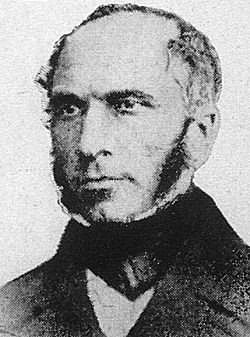
Hydrology, hydrogeology, soil science, civil engineering, petroleum engineering, and chemical engineering all benefit from Henry Darcy's discoveries and innovations in fluid flow.
Darcy was born on June 10, 1803 and spent most of his life in France. He was educated in science and engineering at the L'Ecole Polytechnique. In 1823 he entered L'Ecole des Ponts et Chaussee's, or the school of bridges and roads.
He was employed by Le Corps des Ponts et Chaussées to support France's infrastructure. In 1828, one of his first assignments was to conduct a feasibility study of his town's public water supply. Darcy discovered that deep well drilling could not adequately support the town's water needs. He created a plan for a system to deliver water from a nearby spring using an aqueduct and reservoir system. It was gravity-driven, requiring no pumps or filters. A system was built based on his recommendation and was second only to Rome at its time (1840).
He later worked as Chief Director for Water and Pavements in Paris. He researched flow and friction loss in pipes, contributing to the Darcy-Weisbach equation for pipe flow. Darcy also worked to improve the design of the Pilot tube, a pressure instrument used to measure fluid flow velocity. Darcy modified the 17th century design of Henri Pitot to a form still used today.
The discovery of Darcy's Law was found in Note D, an appendix of his book Les Fontaines Publiques de la Ville de Dijon (The Public Fountains of the City of Dijon), published in 1856. Through sand experiments he described the flow of fluid through porous media.
Henry Darcy had been in poor health for several years by the time his book was published. He died of pneumonia in Paris on January 3, 1858.
Resources:
Oklahoma State: Henry Darcy and His Law
Wikipedia: Henry Darcy [image]
Wikipedia: Pitot tube
| 


 Re: Henry Darcy (1803 - 1858)


