|
Elevators have an unusual relationship with the macabre.
 Really, stick with me here. Some of people's most irrational
fears are exploited by an elevator: heights, enclosed spaces; decapitation; a
terrifying free fall (see The Tower of Terror). Really, stick with me here. Some of people's most irrational
fears are exploited by an elevator: heights, enclosed spaces; decapitation; a
terrifying free fall (see The Tower of Terror).
There's more. Have you ever seen The Shining? (Yes, of course you have.) Little Danny
Torrance envisions elevators
unleashing waves of blood to recolor the walls of a haunted hotel. In
similar bloody remembrance, let's not forget The Departed's brutal homicides (graphic)
. Heck, they made an entire
B movie about a killer elevator.
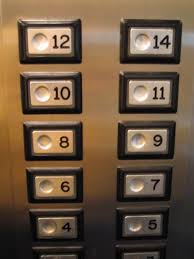 In real life, many structures skip numbering the 13th
floor or designating a 13th floor button in elevators. In real life, many structures skip numbering the 13th
floor or designating a 13th floor button in elevators.
I don't know about you, but
elevators can be an inconvenience for me-at most. Ugh, I have to make boring small talk/listen to terrible elevator
music. Elevators are an essential part of building design however and the
likelihood of an elevator malfunction is rather low. Despite their customized
prevalence throughout the world, and the idiosyncratic nature of their name (yes, Britons we know it's called a lift),
elevator designs vary minimally and are cursed for their perceived
shortcomings.
Remarkably, Italy has over 900,000 elevators installed
within its buildings, meaning there is one elevator for every 67 of its
citizens. By comparison, the USA has the second most, but with one elevator for
every 445 of its people. It makes some sense that Italy has the most, if only
because Roman scientist Vitruvius was reputed to have invented a vertical
ascension mechanism in 236 B.C.  Elevators appeared in variation through the
rest of history until the early 19th century when hydraulic systems
began appearing in Britain and the United States. Though modernized with better
safety protocols, smaller parts, and worldwide popularity, elevators designs
have remained largely unchanged since the traction design was invented shortly
thereafter. Elevators appeared in variation through the
rest of history until the early 19th century when hydraulic systems
began appearing in Britain and the United States. Though modernized with better
safety protocols, smaller parts, and worldwide popularity, elevators designs
have remained largely unchanged since the traction design was invented shortly
thereafter.
Elevators
are essentially limited to four types:
- traction hoists employ high strength cables, a counter weight, and an electric
motor
- hydraulic
pistons and their associated pumps push hydraulic elevators skyward
- a
hybrid traction-hydraulic elevators has an attached counterweight, but still
relies on the linear power of hydraulics
- climbing
elevators are self-powered and are reserved for towers, masts, and other exceptional
structures
Structures
with just a handful of stories are best served by traction-hydraulic elevators,
while skyscrapers and other tall buildings tend to use traction designs.
 Depending upon the traffic pattern and the demographic the
elevator serves, some very intuitive functions are built into the devices. In
halls where multiple elevators serve riders (also called an elevator bank),
cars are concentrated at lower levels in the morning, and at higher levels in
the afternoon to better accommodate the flow of traffic. In Jewish communities,
elevators on the Sabbath may run automatically-opening at every floor, to
accommodate those who observe electrical prohibition on that day. Emergency
patterns are common in nearly every lift and allow firefighters, police, and
medical personnel to select the elevator's actions. Depending upon the traffic pattern and the demographic the
elevator serves, some very intuitive functions are built into the devices. In
halls where multiple elevators serve riders (also called an elevator bank),
cars are concentrated at lower levels in the morning, and at higher levels in
the afternoon to better accommodate the flow of traffic. In Jewish communities,
elevators on the Sabbath may run automatically-opening at every floor, to
accommodate those who observe electrical prohibition on that day. Emergency
patterns are common in nearly every lift and allow firefighters, police, and
medical personnel to select the elevator's actions.
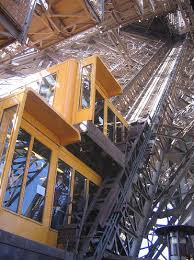 Many peculiar structures incorporate specialty elevator
designs. Notably, in skyscrapers extending dozens of stories, a skylobby will
be built. Here high speed elevators directly take passengers to an intermediate
floor providing riders with access to a new elevator bank. Another interesting case
is the Gateway Arch in St. Louis that uses a tramway with enclosed,
self-leveling cars to account for the structure's unique shape, and the
elevators that serve the Eiffle Tower's concave legs function similarly. Many peculiar structures incorporate specialty elevator
designs. Notably, in skyscrapers extending dozens of stories, a skylobby will
be built. Here high speed elevators directly take passengers to an intermediate
floor providing riders with access to a new elevator bank. Another interesting case
is the Gateway Arch in St. Louis that uses a tramway with enclosed,
self-leveling cars to account for the structure's unique shape, and the
elevators that serve the Eiffle Tower's concave legs function similarly.
Finally, those who perceive
elevators as unsafe or dangerous need to have a look at the safety record of
elevators. In 1852, Elisha Otis debuted the safety elevator which would not
fall if the traction cable broke. Brake pads grasp the vertical running rails,
slowing the elevator if it descends faster than which it was intended. In fact,
until the 9/11 attacks, the only record of a traction elevator in absolute free
fall was in 1945 when a plane struck the Empire State Building, severing the
cables. Hydraulic elevators are much more likely to fail, but mostly because
older designs excluded a failsafe and relied upon a single cylinder to support
the elevator.
 So it's 5:30 p.m. on Friday. You just packed your desk and
are so ready to end your workweek.
You arrive at the elevator bank and hit the call button so you can take your
ride from the 67th floor to the lobby and get on your way home. Ugh, of course the elevator is going up. All
the elevators are going up! Clearly there is a conspiracy to keep me here as
long as possible! So it's 5:30 p.m. on Friday. You just packed your desk and
are so ready to end your workweek.
You arrive at the elevator bank and hit the call button so you can take your
ride from the 67th floor to the lobby and get on your way home. Ugh, of course the elevator is going up. All
the elevators are going up! Clearly there is a conspiracy to keep me here as
long as possible!
A more common complaint is a bias against riders travelling
downwards from high floors after work. Riders in high floors will complain that
elevators servicing their floor will most often be travelling up, while riders
in lower floors will receive the benefit of elevators already on their way
down. The truth is that it's only the perception that some floors receive
better service.
If someone were to observe an elevator's ascending and
descending pattern for a long  period of time, they would count an equal number
of passes in each direction. However, it's more common for riders to approach
elevators at need and be subjected to waiting. Assuming the elevator
distributes its passengers evenly, the elevator will be more likely to be
coming from the bottom of the building for riders on high floors simply because
the elevator spends more time where there are more floors. The same is true for
riders on low floors, who can expect to travel downwards on an elevators first
pass, just because they are unlikely to encounter the elevator in the slim
interval where it is below their floor and then ascends. It's called the
elevator paradox. Make sense? Perhaps the graph on the above right helps. period of time, they would count an equal number
of passes in each direction. However, it's more common for riders to approach
elevators at need and be subjected to waiting. Assuming the elevator
distributes its passengers evenly, the elevator will be more likely to be
coming from the bottom of the building for riders on high floors simply because
the elevator spends more time where there are more floors. The same is true for
riders on low floors, who can expect to travel downwards on an elevators first
pass, just because they are unlikely to encounter the elevator in the slim
interval where it is below their floor and then ascends. It's called the
elevator paradox. Make sense? Perhaps the graph on the above right helps.
So, not only have we debunked the ideas that elevators are
unsafe, we've also eliminated the supposed rider bias the snobby executives
often complain about.
What can I say? HUSH looks out for the little guys when it
comes to elevators.
Resources
(Images credits: Wikipedia; Pseudo Paranormal; Time Marches On; P. Seale; Elevator Bob's; Unsuck DC Metro)
Wikipedia - Elevator; Elevator Paradox
| 


 Re: Elevators--Perception Going Up


