|
Hello CR4 reader and ambitious holiday reveler!
 Are you tired of hours at the crowded mall? Sick of cute
children singing at your door? Do your eyes ache at the sight of suspended LED
lights? If that is how you feel, well, it
used to snow in December too, so get over it. Are you tired of hours at the crowded mall? Sick of cute
children singing at your door? Do your eyes ache at the sight of suspended LED
lights? If that is how you feel, well, it
used to snow in December too, so get over it.
No matter what holiday you observe, or what religion to
which you devote, you probably are familiar with Santa Claus (a.k.a. St. Nick,
a.k.a. Kris Kringle, a.k.a. Father Christmas). And if not, let me wrap it up
for you: a fat, red elf sneaks into your house and eats cookies every Christmas
leaving behind gifts or coal, and whose elected vehicle is a sledge
powered by a team of flying reindeer.
While the truthiness of this legend is in dispute, the plausibility is absolutely not; Santa certainly
could be real. In one of my most monumental tasks yet, here is why Tim Allen may actually
be delivering gifts this December 25, with no magic involved, just good ol'
fashioned commerce!
St. Nicholas was Real
 A balding, bearded man in the 3rd Century, St.
Nick was a Christian bishop known to deliver gold coins, food, and gifts to
those in need in the streets of Lycia. He reputedly staved off famine in Myra,
rescued women from prostitution, and saved children from a cannibalistic
butcher--alas, only his generosity is accepted fact. A balding, bearded man in the 3rd Century, St.
Nick was a Christian bishop known to deliver gold coins, food, and gifts to
those in need in the streets of Lycia. He reputedly staved off famine in Myra,
rescued women from prostitution, and saved children from a cannibalistic
butcher--alas, only his generosity is accepted fact.
American fictionist Washington Irving first Americanized
Santa Claus in 1809, when he merged Britain's mythical Father Christmas with
the generous saint. Though Dutch and
outfitted in green, this Father Christmas/St. Nick hybrid appeared much more
frequently in the years that followed, eventually donning red and a full belly.
Cold climates are well-known to increase lifespans, but true
immortality has yet to be reached. In order to keep there from being a
disruption of Christmas service and to dwell on centuries of wisdom, let's
assume that Santa is immortal, in line with my November 2012 post on immortality.
Essentially we're left with Zombie Santa.
Santa Doesn't Live at the North Pole
The idea that Claus lives at the North Pole was the
invention of Thomas Nast, an illustrator for Harper's Weekly in the 1860s. In
fact, many Scandinavian countries  attribute his home to the Korvatunturi
Mountains in Finland. This makes the logistical support of an isolated toy
factory and airstrip much more feasible. attribute his home to the Korvatunturi
Mountains in Finland. This makes the logistical support of an isolated toy
factory and airstrip much more feasible.
The reason for this location is the sound
resonation of the mountains that allows Clause to hear every conversation in
the world. It's a very unique proposition, but it makes even more sense with
today's availability of communications intelligence software. Many intelligence
satellites possess the capability to intercept radio broadcasts as well as
phone calls. Santa's mountaintop position is further explained for the superb
reception of microwave signals . With this information he can dissect where the
call is coming from, as well as what bad little Tommy has been up to. While
Santa isn't playing the role of "Big Brother," he is most definitely playing
"Eavesdropping Sister."
Numbers and Employment
 How does Santa attend to every child's wishlist on
Christmas? Let's do some rough math. Santa delivers gifts to Christian children
of the western world. That restriction
dwindles his customer base to about 200 million kids. Then let's say Santa is a
stickler for the naughty/nice list, and only about half of them get presents (and he just mails the coal via FedEx). That
means his toy factory needs to produce about 160 tons of toys, if each
well-behaved child were to receive one medium-sized toy. If each elf can
produce five pounds of toys for each day worked, while working about 260 days
each year, he'd need to employ nearly 250 toy makers. How does Santa attend to every child's wishlist on
Christmas? Let's do some rough math. Santa delivers gifts to Christian children
of the western world. That restriction
dwindles his customer base to about 200 million kids. Then let's say Santa is a
stickler for the naughty/nice list, and only about half of them get presents (and he just mails the coal via FedEx). That
means his toy factory needs to produce about 160 tons of toys, if each
well-behaved child were to receive one medium-sized toy. If each elf can
produce five pounds of toys for each day worked, while working about 260 days
each year, he'd need to employ nearly 250 toy makers.
Now accordingly, each home has on average 2.67 children so
Santa needs to visit about 38 million homes before Christmas morning. With an
average distance of 1.6 miles between stops, Santa has to cover about 61
million miles. Santa has 31 hours to deliver these presents when you factor in
an average of seven hours of sleep and various time zones. To reach each
destination Santa would need to travel a scorching (literally scorching) 1,967,741 miles per hour, and that is if he
spends but nanoseconds at each house. So yes, that's quite impossible.
Propose each house takes approximately two minutes between
stops: ten seconds to enter the residence; ten seconds to place presents; ten
seconds to bite a cookie; and  90 seconds to get to the next house, which is on
average 1.6 miles away. Santa must travel at least 66 mph between stops, a rate which
isn't unreasonable of a technologically advanced flying machine. 90 seconds to get to the next house, which is on
average 1.6 miles away. Santa must travel at least 66 mph between stops, a rate which
isn't unreasonable of a technologically advanced flying machine.
Simply put, Santa needs help. He needs about 42,000 delivery
elves to make the present delivery successful. Each employee is going to
deliver less than 8 pounds of toys, so we have a very manageable sled size.
Goods news since we need to get this sled--and a team of reindeer with a fake
Santa--airborne.
When you include support staff (accounting, IT, human
resources, naughty/nice spies), Santa Inc. would employ something around 45,000
elves--a company nearly double in size as Mattel, the world's foremost toy
maker. Obviously, Zombie Santa would be the corporate CEO.
The Reindeer and Sledge
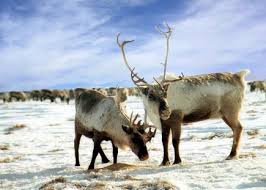 Distribution of reindeer is limited to arctic and sub-arctic
climates and of course that includes Finland. These animals exist as both
wildlife and livestock, yet there are notable exceptions of reindeer being used
as draught animals. Alaskan post offices regularly utilized reindeer to run
mail routes between outposts between 1894 and 1905. Post Masters found the
animals agreeable and hearty-so much so that the teams would traverse more than
3,300 miles each winter. So yes, a team of eight or nine reindeer (depending
upon your mythos) can certainly tow a heavy sledge. Distribution of reindeer is limited to arctic and sub-arctic
climates and of course that includes Finland. These animals exist as both
wildlife and livestock, yet there are notable exceptions of reindeer being used
as draught animals. Alaskan post offices regularly utilized reindeer to run
mail routes between outposts between 1894 and 1905. Post Masters found the
animals agreeable and hearty-so much so that the teams would traverse more than
3,300 miles each winter. So yes, a team of eight or nine reindeer (depending
upon your mythos) can certainly tow a heavy sledge.
But the more pressing matter is the whole flight aspect. How
do 200-400 lb. wingless deer fly? Well, this is as much of a misunderstanding
as it is fiction. L. Frank Baum's 1902 book
The Life and Adventures of Santa Claus is the first imagining of a team of
reindeer, except Baum's reindeer didn't fly-they leapt. And the research of
zoologist Tony Vecchio confirms that reindeer have quite the long jump. "A
600-pound reindeer can clear a river with a jump and a glide because it has a
very elastic tendon like a gazelle that allows it to bounce and maintain a leap
by keeping its legs stiff and strong."
Of course, reindeer aren't going to jump the sled at 66
miles per hour, so they'll just be there for aesthetic and to move the sled
when on the ground. They'll need some kind of lift propulsion of their own, so
we'll give each of them their own ducted fan backpack and we'll use similar
technology to provide lift to the actual sleigh. The best news is that we can
maintain the classic imagery of a reindeer team pulling a fat guy in a big red
sleigh.
The Business Model
 This is the only part of the
Santa Claus legend for which I cannot find a reasonable explanation. No matter
which economics texts I resource, I can't find a reliable "cookies as payment"
business model. Any help here? This is the only part of the
Santa Claus legend for which I cannot find a reasonable explanation. No matter
which economics texts I resource, I can't find a reliable "cookies as payment"
business model. Any help here?
------------------------------------------------------------
It's true; this is far from your traditional Santa Claus.
Yet if Santa were real, the logistics of one man delivering so much in so
little time is impossible. It's clear why the explanation was always 'magic,'
or as we call it here on CR4: mumbo-jumbo. And taking a small look at some other non-traditional Santa
Clauses, this is probably the best any engineer could do.
So, to recap. Zombie Santa runs Santa Inc., the largest toy
delivery company in the world, employing 45,000 Finnish elves. Toy delivery
takes place in approximately 31 hours, with 42,000 delivery teams consisting of
Santa imposters, a red sleigh, and a team of reindeer powered by a series of
ducted rotor fans. A mysterious force turns cookies into euros.
And it looks something like this...

Resources
Images credits: Ugly Christmas Lights; St. Nicholas Center; Outdoors Finland; AMWP Games; Comments Junkie; Good News Weekly; Sincerely Blog)
Wikipedia -Saint Nicholas; Santa Claus; Father Christmas;
Ducted Fan
UPI - Animal Tales: Do reindeer really fly?
DA Clarke.org - The Physics of Santa
Pop Sci - How Long Would it Take Santa to Deliver Presents to Every Kid on Earth?
Larry Silverberg - On the Technical Explanation for Santa Claus's Ability to Deliver Presents Worldwide in a Single Night
| 


 Re: Engineering Santa's Delivery


