|
3D printing has been weekly news for the past couple of
months. It is revolutionizing products and industries as we know them. Additive
manufacturing (aka 3D
printing) is the process of making three-dimensional solid objects from a
digital model. It is achieved by using additive process, where an object is
created by laying down successive layers of material. This differs from
traditional machining techniques which are subtractive processes.
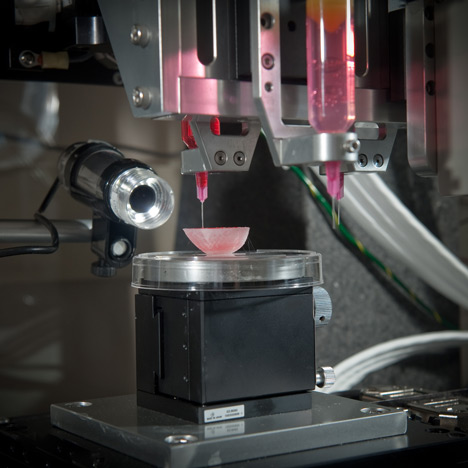
Image Credit:
Dezeen.com
3D printing has been getting a bad rep in the past couple of
weeks after stories of a fully functional 3D printer gun were released. Sure,
that's one thing (along with the millions of others things) that the printers
can be used for, but they can also be used to help people. In the field of
biomedicine, 3D printers are paving the way for building fully functional components
that can be used to replace defective human organs. For example, Princeton
University has designed and printed a bionic ear
that can hear better than human ears. The printed ear intertwines embedded
electronics by printing cells and nanoparticles, and then combining a small
coil antenna with cartilage to create the ear.
Another amazing feat of 3D printing has been creating a splint for
a baby who had severe tracheobronchomalacia, a condition that causes a collapse
of the windpipe, blocking the body's flow of air. The splint was molded from a
scan of the baby's windpipe and after it was printed the stent was sewn around
the baby's airway, which helped open up his bronchus and aided his breathing. 
Image Credit:
Mashable.com
Other
ways that 3D printing can help health care include cutting down the kidney
transplant list, regulating diabetes by creating new organs, grafting skin for
burn victims, addressing dental health needs, and printing
medicine.
| 


 Re: 3D Printing Saving Lives


