|
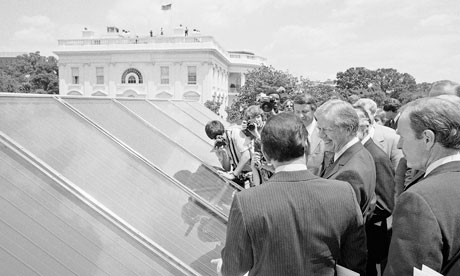 The history of solar panels at the White House is somewhat convoluted. Back in 1979, President Jimmy Carter made his political intentions clear when he ordered a solar water heater to be installed on the White House roof. It's an unsightly design but was cutting edge for the era; up to 17% of American energy is expended on heating water. The history of solar panels at the White House is somewhat convoluted. Back in 1979, President Jimmy Carter made his political intentions clear when he ordered a solar water heater to be installed on the White House roof. It's an unsightly design but was cutting edge for the era; up to 17% of American energy is expended on heating water.
At the time he said, "In the year 2000 this solar water heater behind me ….will still be here supplying cheap, efficient energy…. A generation from now, this solar heater can either be a curiosity, a museum piece, an example of a road not taken or it can be just a small part of one of the greatest and most exciting adventures ever undertaken."
Carter may have been ahead of his time, but he clearly was no oracle: Ronald Reagan would order the panels taken down as a symbol of his own policies--14 years shy of Carter's. The solar water heater was donated to the cafeteria of Unity College in Maine, and there would be no reminder of "the road not taken." It's rumored that Reagan also considered the system an eyesore, which is subjective, but a common complaint.
Who knows if President Obama's new solar array will remain beyond his term, but it's hard to see a modern politician openly shun alternative energy by taking them down. The installation was completed last week and is expected to generate a modest 6.3 kW each day. Yet the eyesore problem still exists. This video published by the White House portrays another ugly solar installation.
Perhaps it's time to reevaluate the aesthetics of our arrays, as much as our use of them. Here are some of the most innovative designs for PV panels, and how we can make them more attractive as we immerse them in our environment.
PV Highways
About 18 months ago I examined the concept of "smart highways," but this Indiegogo campaign promises to replace asphalt roads with PV panels. The creators say Solar Roadways has attracted the attention of the Federal Highway Administration, GE, and Google. Prefabricated, hexagon-shaped PV panels interlock to create customizable walkways and roadways. Each panel can sustain a 250,000 lb. load, while also collecting solar energy and routing it through solar boxes and inverters.
It's the additional features that really set Solar Roadways apart. Integral heating elements prevent the panels from icing over in the winter. Since you can't paint lines on the panels, road-powered LEDs identify lanes and direct drivers. Broken panels are easily identified and repaired. There are even designs which collect rainwater or emit Wi-Fi.
Concealed Panels
 Panels are built into walls or basements with fiber optic wiring exposed to the sunlight. The cables are coated with zinc oxide, and they refract light to the panel. While each cable is rather inefficient, transmitting just 3.3 percent of accumulated light, they are quite cheap to manufacture and also very small. Thousands of PV cables could be run around buildings and structures without being an eyesore. This technology is still burgeoning, as researchers are hoping to improve the efficiency. But it remains an excellent effort to combat the unattractive solar panel. Panels are built into walls or basements with fiber optic wiring exposed to the sunlight. The cables are coated with zinc oxide, and they refract light to the panel. While each cable is rather inefficient, transmitting just 3.3 percent of accumulated light, they are quite cheap to manufacture and also very small. Thousands of PV cables could be run around buildings and structures without being an eyesore. This technology is still burgeoning, as researchers are hoping to improve the efficiency. But it remains an excellent effort to combat the unattractive solar panel.
Solar Shingles
As another example of hiding in plain sight, solar shingles are prefabricated roof shingles which replace typical asphalt shingles. They're rather expensive, but the cost is expected to go down as more companies produce and install PV shingles. Many of these shingles can be applied by nail and screw guns.
Colorize
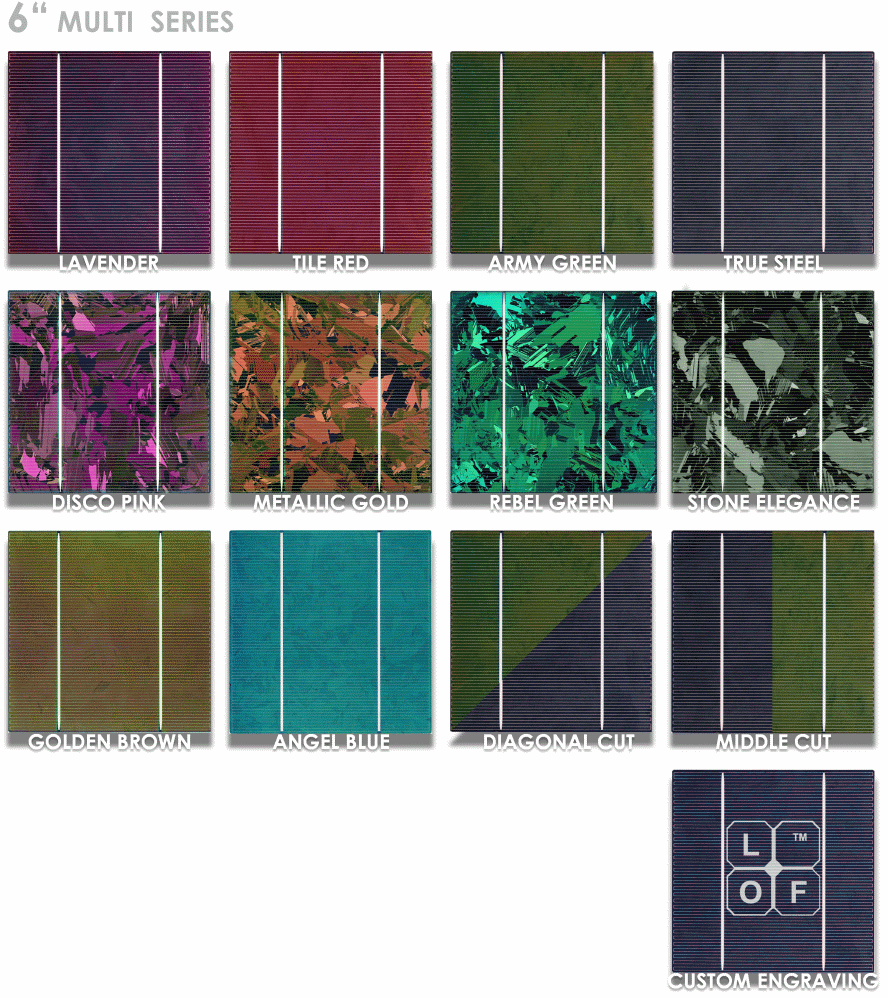 Well, this may not be an attempt at concealment, but offering PV panels in different colors is at least an improvement. Lof Solar offers a variety of colors, including designs that resemble camouflage or can be engraved with messages. Additionally, these panels are 30% more efficient than conventional solar panels. Well, this may not be an attempt at concealment, but offering PV panels in different colors is at least an improvement. Lof Solar offers a variety of colors, including designs that resemble camouflage or can be engraved with messages. Additionally, these panels are 30% more efficient than conventional solar panels.
When does the ugly solar cell turn into the beautiful swan known as architecture? Only when it becomes a serious solution to everyone's energy needs.
| 


 Re: Pretty PV Panels


