Elasto Proxy's Sealing Solutions Blog Blog

Elasto Proxy's Sealing Solutions Blog

Elasto Proxy's Sealing Solutions Blog is the place for conversation and discussion about the design and manufacturing of rubber and plastic parts and products. In addition to regular content from Elasto Proxy, you'll hear from companies across the rubber and plastics industry.

Previous in Blog: How to Select Green Rubber Products   Next in Blog: Would You Travel by Vacuum-Tube Train?
Close
Close
Close
30 comments
Rate Comments: Nested

How Safe Are Your Tires?

Posted August 04, 2014 10:46 AM by Doug Sharpe

Doug Sharpe
President of Elasto Proxy

Did you drive to work today? Maybe you carpooled, or traveled by van or bus instead? If your method of transportation was a motorized vehicle with tires, you may want to track a rubber-related investigation by the National Highway Safety Transportation Board (NHSTB). Earlier this year, the independent federal agency launched an inquiry into two tire-related incidents that resulted in injuries and loss of life.

First, the NHSTB announced it was investigating the fatal highway crash of 15-passenger van in Florida. The incident occurred when the driver lost control of a 2002 Ford E350 XLT after the tread separated from the left rear tire, a two-year old BF Goodrich model that was part of a product recall initiated by the U.S. tire maker.

Next, the independent agency announced a probe into an incident involving a 10-year-old Michelin tire that was not the subject of a product recall. The Lousiana accident claimed four lives and injured 36 when the driver of a 2004 Kia Sorrento lost control and collided with a school bus. In that crash, the Kia's left rear tire suffered sidewall separation and rapid air loss.

Do Tires Have an Age Limit?

According to ABC News, the NHSTB's inquiry into these "tire-initiated events" is the first of its kind. The investigative agency will analyze numerous factors, but tire age-degradation is a special focus because of the accident involving the 10-year old tire. According to Don Karol, the NTSB's lead investigator for this initiative, "aging does potentially play a role in the degradation of the internal structure of the tire".

Sean Kayne, a safety consultant who testifies on behalf of plaintiffs in tire-related lawsuits, agrees. He also criticizes the tire industry's opposition to date codes for tires. "They did not want to give the impression that tires might have a service life," Kayne says. For "a universal practice that inherently keeps you safe," he adds, replacing tires that are more than six years old is "a good place to go".

Dan Zielinski of the Rubber Manufacturers Association (RMA), an industry trade group for tire makers, disagrees. Arguing that the six-year limit is "arbitrary", Zielinski says "it's more important how a tire is used, whether it's maintained, and how it's stored". The RMA's Executive Director opposes legislation that would establish age limits on tires, and is lobbying against mandatory inspections of tire age.

Cracking the Code

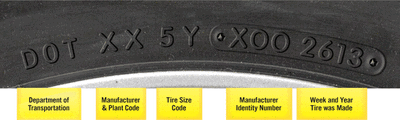
For motorists who wonder if there's a way to determine the age of their vehicle's tires, the code that Sean Kayne mentions holds the key. Located on the wall of your tire, this four-digit identifier contains two sets of numbers. The first two digits indicate the week, and the second two digits indicate the year. So a tire with a date code of 2108 was manufactured in the 21st week of 2008 - making it 6 years old.

Would you feel safe in a vehicle with six-year old tires? Should tires have an expiration date, even if they've never been used, to avoid tread separation and accidents like the ones in Florida in Louisiana? Alternatively, do you believe that a six-year age limit is arbitrary, and that motorists need to consider how a vehicle's tires are used, stored, and maintained?

Elasto Proxy doesn't manufacture tires, but the company that Donna Sharpe and I founded 25 years ago does custom-fabricate industrial rubber products such as specialty seals and custom insulation. Do you have questions about how rubber ages, or how a rubber part's usage and storage can affect its service life? Do you need help choosing the right type of rubber for your specific application?

I hope you'll comment on this CR4 blog entry and join the conversation.

About the Author: Doug Sharpe is the President of Elasto Proxy, Inc. (Boisbriand, Quebec, Canada), supplier of sealing solutions and custom-fabricated rubber and plastic parts to a variety of industries, including green power, mass transit, and building and construction.

Reply

Interested in this topic? By joining CR4 you can "subscribe" to
this discussion and receive notification when new comments are added.

Good Answers:

These comments received enough positive votes to make them "good answers".

"Almost" Good Answers:

Check out these comments that don't yet have enough votes to be "official" good answers and, if you agree with them, vote them!
Guru
Technical Fields - Technical Writing - New Member Engineering Fields - Piping Design Engineering - New Member

Join Date: May 2009
Location: Richland, WA, USA
Posts: 21017
Good Answers: 795
#1

Re: How Safe Are Your Tires?

08/05/2014 1:53 AM

Sir Laurence Olivier wants to know....

__________________
In vino veritas; in cervisia carmen; in aqua E. coli.
Reply
2
Guru
Popular Science - Weaponology - New Member Safety - ESD - New Member Hobbies - Fishing - New Member

Join Date: Sep 2006
Location: Near Frankfurt am Main, Germany. 50.390866N, 8.884827E
Posts: 17996
Good Answers: 200
#2

Re: How Safe Are Your Tires?

08/05/2014 5:54 AM

As far as I can tell, and I have seen quite a few tyre blowouts, only one of them on my own vehicle firsthand, every single one of them could be either 100% due to incomplete inflation, a slow puncture or simple overloading/running at the wrong pressure for the load onboard at the time.

Shedding of tread, sidewall separation and the like, are often the result of overheating. The German language has a name for it when something is flexed too much and overheats!!! Maybe in English too, please help me out?

I have never seen a tyre damaged by too much pressure, nor seen one with extra wear in the middle of the tread due to this either (many car handbooks show old pictures with such wear).....I can only guess that tyre pressures within the range of those recommended, do not cause this problem. Maybe when you have a pressure say at double the norm it can happen, I can only surmise....Someone somewhere has probably seen it happen, but not me personally.

A quick test that anyone can do, that I developed for my own usage many years ago, is to drive say 10 miles or so, stop when safe to do so and check the flank of each tyre with the back of your hand (when travelling on holiday, fully loaded, I have two Autobahn halts, one going north and the other going south that I use!). If the tyre feels warmer than your hand does, then it needs one or more of the following:- more air/slower driving/less load. More air is usually the easy way....

It should run at the speeds and loads you want to use and stay relatively cool to the touch, max your blood temperature....not more.

These are not F1 race tyres that run hot by design.

Which basically means that I run on all my vehicles, the maximum legal pressure recommended for a full load. This makes the springing a bit hard at first, but you get used to it. Also, it makes braking and steering simply "better" to my mind....

I cannot be bothered to change the pressures depending upon load changes.....few of us do I feel.

I am of the opinion, correctly or not, that the standard pressures recommended by a car manufacturer are ONLY possibly fully correct FOR THE ORIGINALLY FITTED TYRES! Once these are replaced, then these recommended pressures for unloaded driving, maybe are a too low, but probably not dangerous, with another manufacturer's tyres. BUT, then you go for a long drive with the family, all fatties, lots of luggage very heavy, same tyre pressures, OHO!! The fun starts....

I maintain that its too little pressure, not too much that destroys tyres and gives a short working life at best.

If you want a longer (and safer) tyre life, then run with the higher recommended pressures for your vehicle, it works best for all legal tyres that I have seen over the last 40 odd years (aprox!). Nothing Chinese though.....all bets are then off....

I forget who it was that instructed me then about tyre pressures , it could have been in the RN, I have forgotten.....

I have boosted trailer tyres above the recommended, due to too much load, till the tyres were running cool again. I was not responsible for the load, and its easy to pump more air in, even if the trailer was almost running on "concrete" tyres, BUT NOT ONE EVER BLEW OUT ON ME!!! Most important. But this is patently illegal and not to be recommended.

The police in Germany watch out for vehicles and trailers with "depressed" tyres, not to warn about blowouts, but to weigh and charge the owner for having too much weight!! Higher pressures preclude that!! Illegally of course!!! I cannot recommend overloading ever.....nor the fix really!!

Best of luck.

__________________
"What others say about you reveals more about them, than it does you." Anon.
Reply Good Answer (Score 2)
Guru
Hobbies - DIY Welding - New Member

Join Date: Sep 2007
Posts: 1601
Good Answers: 58
#4
In reply to #2

Re: How Safe Are Your Tires?

08/05/2014 7:44 AM

I would be delighted to help you out. Which way did you come in? Seriously, is the term you are looking for called "fatigue"?

Reply
Power-User

Join Date: Nov 2012
Location: Boisbriand, QC, Canada
Posts: 176
Good Answers: 1
#8
In reply to #2

Re: How Safe Are Your Tires?

08/05/2014 9:56 AM

Thanks for your comment, Andy Germany. As you've noted, improper tire inflation can present problems. For example, underinflated tires reduce fuel efficiency and result in uneven wear on the inside of the tread. Overinflated tires can be stiff and unyielding.
Improper inflation is a different issue than rubber that's too "old", but there are some interesting points of comparison between tires and inflatable seals, an industrial rubber product that we do provide. For example, some inflatable seals are reinforced to prevent bursting. For manufacturers who depend on these seals, a "blowout" is as unacceptable as a car accident.

Reply
Guru

Join Date: Oct 2008
Posts: 42355
Good Answers: 1693
#10
In reply to #2

Re: How Safe Are Your Tires?

08/05/2014 11:19 AM

Andy,

Afraid I have to disagree with some of your statements.

Your first statement about "100% due to" is pure speculation on your part, not fact.

The word for overheating is.......................overheating.

As to your "back of the hand" test, there is no way is this a valid test. Where I live the pavement temperature can easily exceed 140°F. Try putting the back of your hand on a tire after you've just run 50 miles at 70 MPH. You'll have blisters with the pattern of the tread on the back of your hand.

I believe the best inflation pressure is the one that gives the best tread contact pattern with the road, and that might be at a higher than normal inflation pressure, I wouldn't know. I run the tire pressure recommended by the tire manufacturer for my particular vehicle.

Reply
Guru
Popular Science - Weaponology - New Member Safety - ESD - New Member Hobbies - Fishing - New Member

Join Date: Sep 2006
Location: Near Frankfurt am Main, Germany. 50.390866N, 8.884827E
Posts: 17996
Good Answers: 200
#15
In reply to #10

Re: How Safe Are Your Tires?

08/05/2014 3:33 PM

If your tyres are getting that hot (which I doubt!), you are severely shortening their life span at best, or putting your and your families life at risk. Normal tyres should NEVER run at the temps you are quoting....

Usually the air around the tyre is doing a good cooling job, no matter what the pavement temp is....even in a really hot climate.

In Australia 40 years ago, we tied the beer cans to the front of the car, then when driving at around 50-70 MPH, the beer, even in hot sunlight, got really cold after 30-60 minutes. Ask any Ozzie over 50 years old!!! Maybe they still do it....

This may change your mind:-

As established by NHTSA (the National Highway Traffic Administration of the USA) and ASTM (Association for Standardization of Testing Methods), keeping a tire at 65°C under certain defined harsh conditions for 5 weeks may represent the aging a tire might experience in an extremely hot climate over 4 to 6 years.

Now are you convinced that the temps you are talking about are actually downright dangerous?

You are talking about 140°F = 60°C.........just below that figure they quoted. You can find the above here:-

temperature-impact-on-tyres

The 100% I quoted, may only be 95% or even 90%, but are you confident with betting 9:1 against? Bad odds!!

I can state again, each and every tyre I have personally seen that "exploded", was overheating at the time it exploded, some were actually seen "smoking" (which we all know is bad for your health!!), but I have no idea what temp that was....some were probably leaking (had a nail in for example), some were overloaded, some were both....some were simply being driven too fast for the load and pressure.

Hot Lorry tyres can sometimes be smelt, several miles before the lorry is seen when wind speed conditions are around zero. I have managed to stop several over the years before anything bad happened, some continued on to their own fate, what ever that was.....they did not want to stop!! Not my problem....

Whatever.

You (everyone!) drive how you want, you have received good valid infos from me that err on the safe side, what you do with that is your problem one way or another.....certainly not mine!

__________________
"What others say about you reveals more about them, than it does you." Anon.
Reply
Guru

Join Date: Oct 2008
Posts: 42355
Good Answers: 1693
#16
In reply to #15

Re: How Safe Are Your Tires?

08/05/2014 4:20 PM

You are free to believe whatever you want.

Please tell me how a tire running on 140°F pavement, creating quite a bit of friction, I might add, through 120F° air at 5% relative humidity is going to be cool to the touch. Let's also not forget that disk brakes never completely release, so they are also adding heat.

Here are some facts for you: It's now 1:20PM MST here in Mesa AZ. The temperature, at the airport, is 100°F. Air temperature is measure very carefully, in the shade, at weather stations.

I own two non-contact IR thermometers. One inexpensive, one not so inexpensive. I actually have a third one, but it is packed away.

The asphalt street I live on is now at either 160.4°F or 155.5°F depending on which thermometer you trust.

At rest tire temperatures are 128.2°F/125.6°F, in the sun. I'm not going to go for a drive just to prove my point.

Reply
Guru
Popular Science - Weaponology - New Member Safety - ESD - New Member Hobbies - Fishing - New Member

Join Date: Sep 2006
Location: Near Frankfurt am Main, Germany. 50.390866N, 8.884827E
Posts: 17996
Good Answers: 200
#18
In reply to #16

Re: How Safe Are Your Tires?

08/06/2014 4:19 AM

Lyn, if you do not have some smattering of physics knowledge to draw on at your age, I am sure that nothing I could say would be either understood or acted upon.....

I have told you how it really is, you can either accept it or deny it, (or even go for a drive with just one of the thermometers and PROVE IT!) its your choice. Either way, I don't care in the slightest.....There is a great German saying for such things, but few here would understand it...if anyone...

Its summer here, just how I like it, up to 50°C is fine with me! Though Germany as far I know, never ever gets that hot sadly!

Even your thermometers have not fully agreed with each other, so how could I expect it from you!!!

(At least one of them needs tossing or calibrating!!! Think about it!!)

Have a great day anyway.

__________________
"What others say about you reveals more about them, than it does you." Anon.
Reply
Guru

Join Date: Oct 2008
Posts: 42355
Good Answers: 1693
#19
In reply to #18

Re: How Safe Are Your Tires?

08/06/2014 9:03 AM

"I have told you how it really is"

Andy, nothing you have said here, indeed nothing you have ever said here, gives me reason to believe that you know, "how it really is"!

Your lack of knowing "how it really is" is proven by your statement about the two thermometers. Even you should know that unless you are dealing with highly precise, calibrated instruments no two will ever exactly agree. Not to mention that different locations in the pavement and tires were sampled.

You are delusional. But, if it makes you happy......................................

Reply
Guru
Popular Science - Weaponology - New Member Safety - ESD - New Member Hobbies - Fishing - New Member

Join Date: Sep 2006
Location: Near Frankfurt am Main, Germany. 50.390866N, 8.884827E
Posts: 17996
Good Answers: 200
#21
In reply to #19

Re: How Safe Are Your Tires?

08/06/2014 3:33 PM

DUUUHHHH!!!

__________________
"What others say about you reveals more about them, than it does you." Anon.
Reply
Guru

Join Date: Oct 2008
Posts: 42355
Good Answers: 1693
#22
In reply to #21

Re: How Safe Are Your Tires?

08/07/2014 11:13 AM

Well, are you going tell me how a tire running on 140°F pavement, creating heat through friction, and running through 120F° air at 5% relative humidity is going to be cool to the touch? Never mind heat of the brakes.

I'm waiting for you to rewrite the laws of physics, oh learned one!

Reply
Guru
Popular Science - Weaponology - New Member Safety - ESD - New Member Hobbies - Fishing - New Member

Join Date: Sep 2006
Location: Near Frankfurt am Main, Germany. 50.390866N, 8.884827E
Posts: 17996
Good Answers: 200
#23
In reply to #22

Re: How Safe Are Your Tires?

08/07/2014 12:52 PM

Firstly, I have already told you (and everyone here who reads my comments with ANY degree of understanding, who did not know that before!) how the tyres are kept cool while driving, in spite of hot days, hot roads and hot brakes.....

How many times do you need to be told before you start to understand VERY simple/normal physics?

I personally have no need to rewrite them (as you suggested), just to know and understand them is enough for me....

Please try and understand better....

By the way, if your personal cars brakes put such heat into your tyres as you state/think it does, you have a VERY badly designed car or you are driving so badly, that you are constantly using the brakes far too often and far too hard, more than the car was designed to handle.....

By the way, did you watch that excellent YouTube video (somebody else posted if I remember correctly) showing what happens when too much heat gets into a tyre/wheel combination? Its not even very much heat!!!

But Tyres simply explode if it happens. Welding on a wheel is another way to get tyres to explode in a few minutes from cold AND catch it easily on a video.....so here it is again, just for you personally:-

Hot wheels!!

IS THIS HAPPENING TO YOUR TYRES JUST WITH THE HEAT FROM THE BRAKES? Surely not?

Do not forget that this tyre is not "cornering", not "braking", its just lying there!!!

A tyre under normal road conditions, will explode at far lower temperatures due to a) the WHOLE tyre has taken on heat over a far longer period and b) loads imposed by driving.

As has been stated several times here already, generally speaking normal car tyres are VERY "heat sensitive/sensitive to heat" and must be protected from being so damaged....

Do be more careful when driving please!

Now can we stop arguing about something that you apparently simply do not understand in the first place....?

But still I wish you a great day.

__________________
"What others say about you reveals more about them, than it does you." Anon.
Reply
Guru

Join Date: Oct 2008
Posts: 42355
Good Answers: 1693
#24
In reply to #23

Re: How Safe Are Your Tires?

08/07/2014 3:28 PM

You've backed yourself into a corner, smack up against the laws of physics, from which there is no escape.

You have provided only your misguided interpretation of the laws of thermodynamics to save face.

If what you are saying is true I could cool my beer in an air circulating oven set at 120°F. If it's all the same to you, I'll keep using my refrigerator.

Reply
Guru
Popular Science - Weaponology - New Member Safety - ESD - New Member Hobbies - Fishing - New Member

Join Date: Sep 2006
Location: Near Frankfurt am Main, Germany. 50.390866N, 8.884827E
Posts: 17996
Good Answers: 200
#25
In reply to #24

Re: How Safe Are Your Tires?

08/07/2014 7:09 PM

Back in the days when the air movement alone was available was used to keep things cool, few cars had fridges, or even A/C....except in the USA maybe, but the rest of the world really only got a lot of cars built with A/C started after the 80's....

Your (and my!) tyres get cooled by the same effects, the physics of such air cooling have been understood for many years. Simple physics.

Think of your cars radiator as well, no matter how hot the air, it still removes heat from the rad!!!

Just moving, even warm air, still gives a cooling effect, think of fans in houses when its hot!!! Ones with no A/C.....

It is called the wind chill factor (among many names), I am sure you have heard about it, but just forgotten, eh?

You can read more about its useful effects here:-

Wind_chill_factor

Every power supply, with a cooling fan uses this effect to keep things cooled....

You can see this excellent graph of its effects, though for a lower range, but the effects remain similar even at higher temperatures:-

__________________
"What others say about you reveals more about them, than it does you." Anon.
Reply Score 1 for Off Topic
Guru

Join Date: Oct 2008
Posts: 42355
Good Answers: 1693
#26
In reply to #25

Re: How Safe Are Your Tires?

08/07/2014 7:50 PM

Without some mechanism to remove heat, as in evaporation of moisture from a surface, the object being cooled cannot be cooler than the air surrounding it.

"Wind chill" is the effect caused by evaporation of moisture from the human body, or other surface.

From your Wiki site,"Wind-chill or windchill, (popularly wind chill factor) is the perceived decrease in air temperature felt by the body on exposed skin due to the flow of air, the opposite is heat index."

Our tire can only get cooler than the surrounding air if the can lose heat througn evaporation of moisture. Thats' how convection works. There is no convection in a vacuum.

Now, on to conduction and radiation. Due to those pesky laws, an object cannot give off heat into a warmer object. Thermal equilibrium is reached and no heat flows in either direction.

Automotive radiators give off heat because there is always an excess of heat being put into the system by the ICE which is only 25% efficient, the rest of the energy is given off as heat. The air just removes some of the excess heat. If the radiator is at 120°F and the air is at 120°F with no humidity, no heat will be transferred. It's exothermic, not neutral or endothermic.

Same with power supply radiators.

The exception to this is heat pipes, but they are not in play here, and even they rely on phase change (evaporation/condensation) to do the cooling.

It's time for football practice.

Reply
Guru
Popular Science - Weaponology - New Member Safety - ESD - New Member Hobbies - Fishing - New Member

Join Date: Sep 2006
Location: Near Frankfurt am Main, Germany. 50.390866N, 8.884827E
Posts: 17996
Good Answers: 200
#27
In reply to #26

Re: How Safe Are Your Tires?

08/08/2014 6:19 AM

Picky, picky......this is a functioning method of cooling (blowing air around a hot object!) almost everywhere that I have heard of.....

I simply get the impression that you feel you have a right to publicly deny how some physics actually function! Surely not?

So are you saying that your local air is HOTTER than the surrounding objects?and that this cooling method therefore does not function.

So please explain better than you are at the moment, maybe I simply misunderstood you!

You could be right, but where do you live, in HELL?

I have lived and worked in the tropics and although the cooling effects were reduced, and maybe rads had to be dimensioned to improve efficiency, THEY STILL WERE COOLED BY THE AMBIENT AIR TEMPERATURES.....

Why don't you accept that generally speaking,the air is usually cooler than objects that needed to be cooled and therefore such air can be used to remove heat? For instance, car tyres, car radiators, A/C systems and and and and and.....

(unless you really do live in Hell of course, the physics there could be different I suppose!!)

Stay with us Lyn, you are losing ground at a really high rate now.....lets see just how long you fight on after the war is lost!!!

__________________
"What others say about you reveals more about them, than it does you." Anon.
Reply
Guru

Join Date: Oct 2008
Posts: 42355
Good Answers: 1693
#28
In reply to #27

Re: How Safe Are Your Tires?

08/08/2014 9:48 AM

"So are you saying that your local air is HOTTER than the surrounding objects?and that this cooling method therefore does not function." No, that's what you seemed to be saying about cooling beer. You can't get a dry object cooler than the air around it. That's what I've been saying all along, but you can't seem to comprehend it.

I never, ever said, "that your local air is HOTTER than the surrounding objects", although that would be the case here in Arizona with the human body, now wouldn't it. But, it's cooled by EVAPORATION.

You are too dull to understand.

Reply
5
Guru
Technical Fields - Project Managers & Project Engineers - New Member

Join Date: Jun 2014
Posts: 623
Good Answers: 33
#3

Re: How Safe Are Your Tires?

08/05/2014 6:42 AM

We do not need more laws to follow here. This is ridiculous. The NHSTB is on the prowl for two tire companies. They will be fined and the money disappears into the DNC reelection fund.

And I am leery of experts who only testify for plaintiffs. What kind of expert is that? Why can't expert testifiers be objective which may bring him more work?

Can you imagine getting a ticket on your windshield because your tires are "expired" and new ones must be installed. That would not be a pleasant day.

If your tires are too old replace them, if they are damaged, replace them. If they are worn out, replace them. If you are not sure of the condition of your tires, ask some one who can tell you the condition of your tires. And stop making ridiculous laws that make no sense whatsoever.

__________________
Hey Isaac, catch! ...oops, that's gonna leave a mark...
Reply Good Answer (Score 5)
Guru
Technical Fields - Project Managers & Project Engineers - New Member

Join Date: Jun 2014
Posts: 623
Good Answers: 33
#5

Re: How Safe Are Your Tires?

08/05/2014 9:07 AM

As long as we are talking about tire safety, make sure you never weld on the wheel with a tire inflated. It starts a chain reaction that is virtually invisible until disaster strikes:

http://youtu.be/jBUVzgCHHuA

__________________
Hey Isaac, catch! ...oops, that's gonna leave a mark...
Reply
Guru
Hobbies - DIY Welding - Wannabeabettawelda

Join Date: May 2007
Location: Annapolis, Maryland
Posts: 7940
Good Answers: 458
#6
In reply to #5

Re: How Safe Are Your Tires?

08/05/2014 9:15 AM

I don't think I would ever weld on a wheel period. So much cheaper just to replace the rim considering the possible consequences. I might make an exception for a hay wagon that only travels a dirt road between the field and the barn.

Reply
Guru
Technical Fields - Project Managers & Project Engineers - New Member

Join Date: Jun 2014
Posts: 623
Good Answers: 33
#7

Re: How Safe Are Your Tires?

08/05/2014 9:45 AM

Wheel weights, rim removers for those that are 'frozen' on and also using an oxy/acetylene torch to remove 'frozen' lug nuts would be some reasons for heating up a rim. But I am getting off topic, just thought I would mention a safety hazard that some may not be aware of. - Thanks.

__________________
Hey Isaac, catch! ...oops, that's gonna leave a mark...
Reply
Power-User

Join Date: Nov 2012
Location: Boisbriand, QC, Canada
Posts: 176
Good Answers: 1
#9
In reply to #7

Re: How Safe Are Your Tires?

08/05/2014 10:10 AM

Thanks for sharing those tire safety tips, Massey. The video about what happens when the rims are overheated is excellent!

Reply
Guru

Join Date: Jun 2008
Posts: 859
Good Answers: 33
#11

Re: How Safe Are Your Tires?

08/05/2014 11:21 AM

I had a set of "brand new" Michelins installed on my Chevy Tahoe 3 years ago. After 2 months (approx 2000 miles), I was driving down a California freeway, in the fast lane, doing about 70, when I noticed something REALLY wrong with the handling of the vehicle. I looked around to seek an exit from my lane to the shoulder, and noticed that all the vehicles behind me had seen the problem, and had slowed to clear a path for me to get off the freeway. I got off safely and waved a thanks to the 10 or so vehicles as they went by me, and got out to look at what had happened. The drivers' side rear tire had THREE holes in the sidewall, approx 3" apart with exposure to the middle . The whole tire exploded at one time, in three locations. The AAA guy who changed the tire for me said he had never seen anything like that, and that i must have hit something in the roadway. There was nothing on the road or next to the median that could have caused it. (HE also went back to look over the last 2-3 miles, to remove any debris that could affect other vehicles.) If there had been something, I would have hit it with my Front wheel (s) first, and whatever was big enough to have caused that amount of spontaneous damage would have had to be big and heavy, and easily spotted. I took pictures, and the tire went back to the shop. Michelin said to replace all the tires, they came and picked up the tire, and I never heard a word from them again, nor did I have to file a pro-rated warranty form, or anything else. It just "went away". I am fortunate to be alive, and am lucky that my fellow drivers were so cautious and courteous . I still wonder what cold have caused it. Any ideas?

Reply
Guru

Join Date: Oct 2008
Posts: 42355
Good Answers: 1693
#12
In reply to #11

Re: How Safe Are Your Tires?

08/05/2014 11:32 AM

My uneducated guess would be that you, or someone else, hit a curb with that tire while turning a corner and damaged the sidewall, prior to that freeway trip. Then the heat and stress of running 70 caused the failure.

This is not uncommon on trailers towed by inexperienced drivers. I've seen it happen.

I'd say Michelin makes a very high quality tire. Maybe even the very best. That may be why the gave you a new set.

Reply
Guru

Join Date: Aug 2007
Location: Earth - I think.
Posts: 2143
Good Answers: 165
#13
In reply to #11

Re: How Safe Are Your Tires?

08/05/2014 1:09 PM

To paraphrase what Lyn said: "Damage to the tire from some source".

Once while driving on vacation some id10t in a caddy cut into the lane that my sister was in and hit the right front HARD. It caused my sister who was driving our Gremlin to get knocked into the dirt in the median. When she corrected to get back on the pavement, as soon as the right front touched pavement the car swung 180, and slid across 4 lanes of traffic. Same as you the people behind saw what was going on and slowed down.

The car didn't seem to be damaged, so I took over driving (80 mph interstate). About 45 minutes later I was blocked in on both sides by cars when the front left tire disintegrated. I kept in my lane and got over, but it was a bit hairy.

My guess at the time, and I have no reason to doubt now, is that when he hit the right front fender, it pushed all the weight onto the left front tire, and damaged the sidewall.

__________________
TANSTAAFL (If you don't know what that means, Google it - yourself)
Reply
Power-User

Join Date: Nov 2012
Location: Boisbriand, QC, Canada
Posts: 176
Good Answers: 1
#14
In reply to #11

Re: How Safe Are Your Tires?

08/05/2014 3:04 PM

Do rear driver's side tires fail more frequently than other tires? Given the incidents in the blog entry and C-Mac's own experience, I've done some more digging. This article indicates that Ford engineers have been looking at the problem, which appears to affect larger passenger vehicles (perhaps even C-Mac's Chevy Tahoe).
This quote is especially interesting.
Ford spokesman Mike Vaughn said engineers were investigating several theories, including whether the location of the Explorer's fuel tank on the left side of the vehicle could put more weight on that wheel. The rotation of the Explorer's drive shaft might place more force on the left side than the right. And American roads might radiate more heat from the center of the pavement than they do from the edges, increasing the heat transferred to the driver's side tires.
Thoughts?

Reply
Power-User

Join Date: Jan 2007
Location: Maritimes
Posts: 264
Good Answers: 2
#17

Re: How Safe Are Your Tires?

08/05/2014 10:35 PM

Why in heavens name, would tire manufacturers object to people buying more tires? This would be a money maker for them. And if there truly is a higher chance of failure as tires age, then they are relived of a potential liability issue when an owner of their tires fails to comply with yet one more this new law.

I have blown-up a number of tires over the years. The biggest was a $70,000 dollar Michelin with only 5 months on it. The explosive force when one of these fails is said to be about the same as for 12 sticks of dynamite.

In every case over loading, under-inflation and speed combined to weaken the tires. Delamination and a relatively prompt failure is the result.

I GA'd AG for his review of the 3 factors. Dead-on.

The shop where I blew the Hauler tire still has a policy of overloading, and high speed - although they watch inflation pressure like hawks.

I found out that monitoring air pressure alone doesn't resolve all matters. Temperature is the best fore-warning.

__________________
Out in a Bowt
Reply Score 1 for Good Answer
Guru
Popular Science - Weaponology - New Member Safety - ESD - New Member Hobbies - Fishing - New Member

Join Date: Sep 2006
Location: Near Frankfurt am Main, Germany. 50.390866N, 8.884827E
Posts: 17996
Good Answers: 200
#20
In reply to #17

Re: How Safe Are Your Tires?

08/06/2014 3:31 PM

You have learnt it all "first-hand", the best (many would say "the ONLY way"!!) way to fully understand these problems. I am totally impressed with your comments, Brilliant.

You are probably 1 in 10,000 or less. Welcome aboard!!

And many thanks for your accurate comments.

__________________
"What others say about you reveals more about them, than it does you." Anon.
Reply
Guru

Join Date: Oct 2008
Posts: 42355
Good Answers: 1693
#29

Re: How Safe Are Your Tires?

08/08/2014 10:37 AM

I ran a test this morning.

Ambient air temp.=86°F.

Tire temp at start=86.3°F.

Tire temp after 10 minute, stop and go driving at 45 MPH max= 102°F.

Ambient air temp.=86°F.

<unsubscribe>

Reply
Guru
Popular Science - Weaponology - New Member Safety - ESD - New Member Hobbies - Fishing - New Member

Join Date: Sep 2006
Location: Near Frankfurt am Main, Germany. 50.390866N, 8.884827E
Posts: 17996
Good Answers: 200
#30
In reply to #29

Re: How Safe Are Your Tires?

08/08/2014 12:02 PM

Notice that in spite of the weight of the car (load), the energy put into tyres from simply driving (you neglected to mention how!), braking (you neglected to mention how!) and cornering (you neglected to mention how!) etc., the temperature of the tyres was only slightly raised.....? Not even 20°F, only 16°F that is nothing!!!!!!

Now do you see how the warm air STILL removed heat from the tyres while driving.....believe me, if the air had not been doing its job, those tyres could have been at 3-400°F.....and could have possibly let go.....though the exact temperature is difficult to calculate as there are so many variables....

The major variable that we do have in OUR hands is tyre pressure, setting this correctly, or even a tiny tick higher, reduces the "working" of the rubber. Its this "working" that can make it so hot that it actually gives off smoke. Proper control of the pressure therefore makes the tyres safer to use and this control is fully within our grasp.....if we take it seriously enough!

Here is a video of what can happen to a truck when a tyre overheats and explodes on an Autobahn:-

Overheating Truck Tyre

I was surprised that more videos have not been placed on YouTube showing such tyre problems........

Also, there is a lot of rubbish online about Tires, but a reasonable place for good advice can be found here (probably not completely alone!):-

http://editorial.autos.msn.com/article.aspx?cp-documentid=434704

Have a great day anyway.

__________________
"What others say about you reveals more about them, than it does you." Anon.
Reply
Reply to Blog Entry 30 comments

Good Answers:

These comments received enough positive votes to make them "good answers".

"Almost" Good Answers:

Check out these comments that don't yet have enough votes to be "official" good answers and, if you agree with them, vote them!
Copy to Clipboard

Users who posted comments:

Andy Germany (9); Brave Sir Robin (1); C-Mac (1); Doug Sharpe (3); Kilowatt0 (1); lyn (9); Massey (3); snowboy (1); Tornado (1); welderman (1)

Previous in Blog: How to Select Green Rubber Products   Next in Blog: Would You Travel by Vacuum-Tube Train?

Advertisement