|
High
beam headlights are a pretty common cause of accidents, blinding
drivers of oncoming cars through the glare they create while driving
at night. While the use of high beams can make driving at night
safer, as they provide distant illumination, they also reduce
visibility for oncoming drivers, blurring their vision for several
minutes after passing. That's why many countries have rules regarding
high-beam use while driving at night, requiring drivers to dip their
headlights to low beam when an oncoming vehicle gets within 500 or
600 feet.
But,
while these laws help raise the awareness about the risks of improper
use of high beams, they don't quite eliminate motor vehicle crashes
caused by headlight beams, and it continues to be a major threat to
traffic safety. Many car makers have been working on creating more
efficient headlights that wouldn't create these types of traffic
problems, but a technology that is currently under development at the
Carnegie Mellon University may be the most promising one.
A
team of researchers from Carnegie Mellon University's Robotics
Institute have created a system that can improve driver vision during
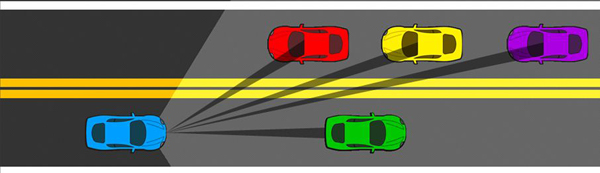
nighttime, as well as while driving in snow or rain. The so-called smart headlight technology involves a system that is mounted on top
of a car's hood, and includes a camera that monitors surrounding
traffic, along with a projector instead of a traditional headlight,
and an on-board computer.
With
the system's camera, oncoming vehicles are being constantly tracked,
so that the computer can react and dim only the parts of the
headlight beam that usually shines onto oncoming drivers' eyes, as
the researchers explain in a press release. On top of that, these
headlights - which instead of a cluster of LEDs employ a Digital
Light Processing (DLP) projector - can block parts of the headlight
beam that usually illuminate raindrops and snowflakes when driving in
rain or snow, reflecting off them and creating glare, temporarily
blinding drivers approaching from the opposite direction.
Another
added benefit of the smart headlights is that they highlight traffic
lanes, which can help drivers stay in their lane in case lane
markings are not clearly visible or there are no markings at all. If
this kind of innovative technology is installed in all vehicles,
driving in snow or rain would be much safer, and the number of
accidents that occur in these types of weather conditions would be
significantly reduced. It should be noted, though, that for now, the
smart headlights can only be installed on trucks and buses, as the
headlights employed are much larger than standard headlights, but
researchers are working on reducing the size of the parts used in
this system, so that they can be mounted on smaller cars, as well.
This
system is currently undergoing testing, and if it proves to be
reliable and effective in a real-world environment, it could improve
traffic safety considerably, given that it specifically addresses
issues that cause accidents at night, which is when a large portion
of all motor vehicle crashes occur. "Even
after 130 years of headlight development, more than half of vehicle
crashes and deaths occur at night, despite the fact there is much
less traffic then," said Srinivasa Narasimhan, associate
professor of robotics.
| 


 Re: Innovative Headlight Technology Aims to Improve Nighttime Driving Visibility


"Almost" Good Answers: