Robotic Systems Blog Blog

Robotic Systems Blog

The Robotic Systems Blog is the place for conversation and discussion about industrial robots, programming and controls, sensors & tooling, and robotic safety. Here, you'll find everything from application ideas, to news and industry trends, to hot topics and cutting edge innovations.

Previous in Blog: Robots Expand Their Reach   Next in Blog: Wall Climbing Robots
Close
Close
Close
9 comments
Rate Comments: Nested

Should Robots Require Our Help?

Posted November 20, 2014 7:00 AM by cheme_wordsmithy

Science fiction, especially science fiction movies, have given us many examples of robots of the future. C-3PO and R2-D2 (Star Wars), Johnny 5 (Short-Circuit), T-800 (Terminator series), Wall-E and Eve (Wall-E), and the list goes on. These examples have molded our perceptions of what advanced robots "should" be like. They should be dexterous - able to lift, grab, hold and manipulate objects; they should be mobile - able to move at human-like speeds (or faster!) and along various grades and terrain types; and they should be autonomous - largely able to carry out tasks on their own.

Or should they? Manuela Veloso, a professor at Carnegie Mellon, has challenged the expectation that robots be largely independent in order to be deemed useful. Her robot receptionist, called a Cobot, looks like little more than a laptop PC and a bunch of sensors on a barstool with wheels. But this humble machine, despite having no arms and a limited vocabulary, can effectively navigate the halls and elevators of the computer science department with just a little bit of help from people.

This "help" may be in the form of pushing an elevator button, placing or removing a package, or removing an obstacle in its path. Whenever a Cobot needs this help, it simply asks the nearest person, or, if nobody is nearby, it sends an email to office staff.

The concept behind human-assistance is simple: to remove the most difficult barriers to programming and designing robots. It may be relatively easy to design a robot to perform a certain task (e.g. carry something). But designing the robot to independently recognize, grab, and manipulate things with any precision is very challenging. The same goes for comprehensive speech recognition or response.

Consider a task like lifting heavy objects off the floor and moving them somewhere. It would be feasible to build a robot with the strength and mobility to perform this repetitive task all day long. But designing and programming a robot with the ability to see, and find the objects on its own would be a much more complex (and expensive) endeavor. One solution would be to design a control that allows a person to drive and/or place the robot into position when needed.
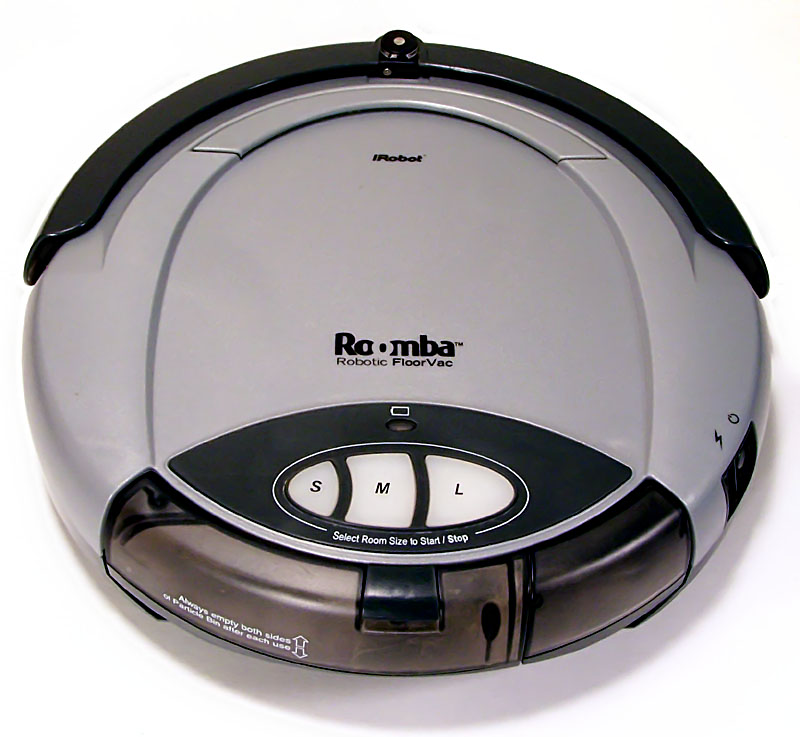
Robot assistance is already commonplace in many industrial settings, but the hope of the human-assisted robot concept is that robots will eventually be accepted in more day-to-day applications. iRobot (makers of the Roomba, pictured left) is one company trying to bring robots into the home. Veloso argues that "...if people embraced robots with limitations we would have them in our homes as we speak." Certainly Veloso's Cobots have proved their worth in providing thousands of hours of useful service.

It will be interesting to see where the development of the human-robot interface will take us. We may not ever have a true C-3PO in our midst (and maybe that's a good thing, if you're afraid of an eventual robots-controlling-humans doomsday scenario...). But regardless, that shouldn't stop us from utilizing robots where we can, and helping them help us.

Reply

Interested in this topic? By joining CR4 you can "subscribe" to
this discussion and receive notification when new comments are added.
Guru
Technical Fields - Technical Writing - New Member Engineering Fields - Piping Design Engineering - New Member

Join Date: May 2009
Location: Richland, WA, USA
Posts: 21017
Good Answers: 795
#1

Re: Should Robots Require Our Help?

11/21/2014 3:47 AM

...as if there were any choice in the matter.

__________________
In vino veritas; in cervisia carmen; in aqua E. coli.
Reply
Guru
Engineering Fields - Electrical Engineering - New Member Fans of Old Computers - Commodore 64 - New Member Popular Science - Evolution - New Member United States - Member - New Member

Join Date: Oct 2013
Location: Illinois, 7 county region (The 'blue dot' that drags the rest of the 'red state' around during presidential elections.)
Posts: 3683
Good Answers: 89
#2

Re: Should Robots Require Our Help?

11/21/2014 9:51 AM

So, the 'classic' robot in public perception is intended to be an 'omnibus boy' to take the old Resturaunt term, a 'worker for all.'

Whereas what we might do better with are 'task bots,' who can do one thing, and do it well, but need assistance to do things outside its range. Like the 'mule bots' the army is experimenting with, who can navigate rough terrain (and easy terrain too. It's be a bit silly if it couldn't handle a smooth road), carry all the backpacks for the squad, and either head straight towards a wearable beacon, 'following the boss,' or navigating a path dictated by the handler with the remote control, in esense, being driven like an RC car.

That Canadian university already sent a robot hitchhiking across their country, coast to coast. and all it could do was display messages and hook up to the Celular or Wi-Fi networks to sent its GPS location back to the lab. We also have those Roomba robots vacuuming floors, and cousins to it cleaning pools, I'd day we're pretty much ready for robots that appear to be merely 'dog-smart,' doing all the heavy lifting while we provide direction and to the other 'brain work.' Heck, these 'mostly helpless' robots may even come across as less threatening to the technophobic.

__________________
( The opinions espressed in this post may not reflect the true opinions of the poster, and may not reflect commonly accepted versions of reality. ) (If you are wondering: yes, I DO hope to live to be as old as my jokes.)
Reply
Guru

Join Date: Dec 2009
Posts: 581
Good Answers: 15
#3

Re: Should Robots Require Our Help?

11/21/2014 12:18 PM

"One solution would be to design a control that allows a person to drive and/or place the robot into position when needed."

You mean, like a forklift. Or for a more modern example, an exoskeleton.

I like how not trying to make robots completely autonomous helps remind us they're just machines as well as making them easier to make. But it sure limits their usefulness.

I can see auto-drive cars taking over long stretches of highway first. That would be useful: drive us to exit 14. Wake me up when we get there. The car would take the exit and pull to the shoulder if the drive doesn't take over.

__________________
Ignorance is no sin. Willful ignorance is unforgiveable.
Reply
Guru
Engineering Fields - Electrical Engineering - New Member Fans of Old Computers - Commodore 64 - New Member Popular Science - Evolution - New Member United States - Member - New Member

Join Date: Oct 2013
Location: Illinois, 7 county region (The 'blue dot' that drags the rest of the 'red state' around during presidential elections.)
Posts: 3683
Good Answers: 89
#4
In reply to #3

Re: Should Robots Require Our Help?

11/21/2014 12:48 PM

An automated-only highway would be a WONDERFUL place to introduce 'driverless' cars.

Or a forklift that is programmed to never cross solid yellow floor tape with any part of its 'body,' slowing safely to avoid impact with the 'invisible wall.' If you need to cross the tape for some reason, such as moving machinery, or to cross over into another section for maintenance, you can either cut the floor tape out at that area and reapply afterwards, or place some sort of 'bridge' over the tape to allow the robot to 'see' an opening. (I could visualize this being an 'industrial mat' tossed over the lines to allow the empty forklift to cross over to reach the maintenance department. The cutting/replacing floor tape' method is more for machinery moving, when you're going to have to redefine the 'safety aisles' anyway.)

The quest for 'full autonomy' may be a case of 'too far, too fast.' We can still be working towards that, but if we start introducing these simpler, 'stupider,' limited helper bots, we may get more 'market penetration' faster than trying to foist Protocol Droids and T-800's on people and industries that are still a little, if I may borrow a term from Futurama, robophobic. (Which, in the show, is treated as a 'futuristic parallel' to homophobia. Heck, in the first episode, Bender was concerned about being seen with a human, not wanting people to think they were a 'robosexual' couple. "If anyone asks, you're my debugger, Fry.")

Some things just can't be done fast, they have to be eased into the population slowly, carefully, starting small and easy, and working up to the bigger things. (Rats, I should not have done the Futurama reference, there is no way I can rephrase that sentence without it sounding like a double entendre. I'm not trying to be dirty here, people, honest.)

__________________
( The opinions espressed in this post may not reflect the true opinions of the poster, and may not reflect commonly accepted versions of reality. ) (If you are wondering: yes, I DO hope to live to be as old as my jokes.)
Reply
Guru

Join Date: Dec 2009
Posts: 581
Good Answers: 15
#5
In reply to #4

Re: Should Robots Require Our Help?

11/21/2014 12:57 PM

I was trying to point out that the definitions in the top article were awfully close to describing what we all usually call "machines."

But I think this computer scientist might be onto something. Besides the social barriers you point out, there are big technological barriers to fully autonomous AI. The knowledge and experience that teaches you and me how to act in a novel situation is incomprehensibly vast. It's a big and fuzzy enough problem that I for one don't want to bother trying. There's a lot of useful stuff that could be done by requiring a human to intervene in a semi-autonomous robot's work in such situations.

__________________
Ignorance is no sin. Willful ignorance is unforgiveable.
Reply
Guru
Engineering Fields - Electrical Engineering - New Member Fans of Old Computers - Commodore 64 - New Member Popular Science - Evolution - New Member United States - Member - New Member

Join Date: Oct 2013
Location: Illinois, 7 county region (The 'blue dot' that drags the rest of the 'red state' around during presidential elections.)
Posts: 3683
Good Answers: 89
#6
In reply to #5

Re: Should Robots Require Our Help?

11/21/2014 1:57 PM

Well, one of the 'Machines' is able to navigate hallways autonomously, but it cannot control an elevator. So it calls on a human for help to find and push the right button, and to signal the robot that 'this is your floor, Waldo, you can leave the elevator now.'

We in the manufacturing industries are more used ti industrial robots than this Comp Sci, so we're looking at it from another angle, we're used to 'dumb robots' that do one thing and one thing all. day. long. without suffering from the brain-numbing boredom that would make a human doing that job end up killing themselves from the monotony. (Not deliberate suicides, but 'accidents' due to inattention, you're bored to dears, you stop realizing that that 500 ton deep-draw sheet metal press is a hazard, then you drop your pen in the die, lean in to retrieve it before the machine cycles and crushes it and makes an inky mess for you to clea- And now you're having a closed-casket funeral because your manager had to assign someone to clean up the red, pasty mess your head left in the machine when it cycled.)

There are a lot of 'gopher' tasks that could be handled by a smart machine or semi-dumb robot, if it didn't have to think of the entire job at once. Think of an office 'mail-bot' that can navigate the corridors based on an internal map, can stop at office doors and cubicles if there is a delivery/pickup scheduled, and will stop in its tracks if it bumps into something/someone. That's not hard to program, and after the bump-stop, it will call for help to confirm which floor it is on, and possibly to guide it back to a known landmark/beacon to reset its location on the internal map. It needs help from humans to handle the elevator, and it's 'stop and ask for help' on a bump (or tapping it's 'you're lost' button if the occupant of office 212 just got a visit from the mailbot claiming to be delivering a package to office 312, one floor up) routine will help against pranksters or human error in assisting it.

__________________
( The opinions espressed in this post may not reflect the true opinions of the poster, and may not reflect commonly accepted versions of reality. ) (If you are wondering: yes, I DO hope to live to be as old as my jokes.)
Reply
Guru

Join Date: Feb 2013
Posts: 716
Good Answers: 33
#7

Re: Should Robots Require Our Help?

11/21/2014 3:35 PM

It seems to me that this is one way that children learn. They ask somebody else how to do something.

"Mommy, I can't open this box. Will you open it for me?"

"That's not a box. It's a wooden block. You can't open it."

But the children learn from this. The article doesn't mention having the robot learn from seeing a human doing something, but I don't see why that should not be possible.

"Nearest human, will you lift this obstacle out of the way for me?"

"No, that obstacle cannot be moved."

Or, "That is not an obstacle, it is a section of carpet that is a different color."

Or, "That spot on the carpet is part of the pattern of the carpet and cannot be removed by a vacuum cleaner."

Will the robot remember that? Will it be able to generalize to similar situations like children can?

Another thing is that humans may not always respond with their best interest at heart.

"Nearest human, I am trying to wipe out all humans and let robots become the next step in evolution. Will you help me do that?"

"Sure thing. Just insert this nasty computer virus into those nuclear weapons, and presto, next step in evolution. Good luck, mate."

__________________
canary
Reply
Guru

Join Date: Dec 2009
Posts: 581
Good Answers: 15
#8
In reply to #7

Re: Should Robots Require Our Help?

11/21/2014 3:44 PM

I've set up a Google news alert for "Viv," which is the new business of the group who developed Siri (iPhone's voice-activated AI). They say Siri is artificially limited on iPhone and want to unleash their code to let the algorithms and databases learn while running in "the cloud." What they hope to do causes me great concern along the lines of their cloud-based AI soon putting the NSA (or Experian) to shame.

Unfortunately, there's more news about a Brazilian business called "Viv" than the AI garage band.

__________________
Ignorance is no sin. Willful ignorance is unforgiveable.
Reply
Guru
Hobbies - DIY Welding - Wannabeabettawelda

Join Date: May 2007
Location: Annapolis, Maryland
Posts: 7940
Good Answers: 458
#9

Re: Should Robots Require Our Help?

11/21/2014 4:12 PM

Talk of robots and not even an honorable mention for Rosie?

Reply
Reply to Blog Entry 9 comments
Copy to Clipboard

Users who posted comments:

adreasler (3); Brave Sir Robin (1); Canary (1); Lynn.Wallace (3); Tornado (1)

Previous in Blog: Robots Expand Their Reach   Next in Blog: Wall Climbing Robots

Advertisement