|
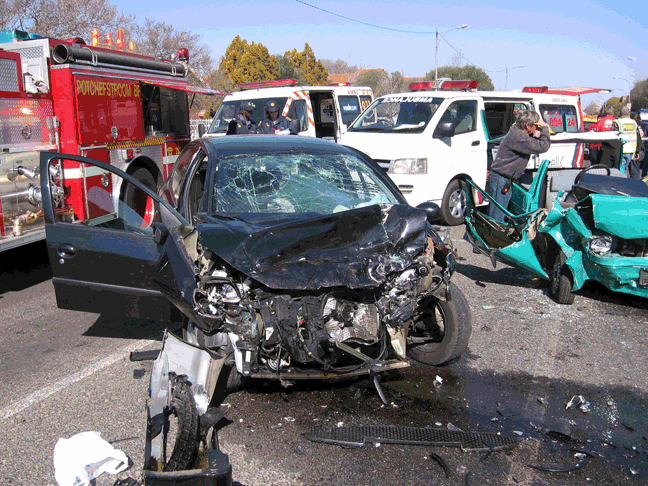 According to the National Highway Traffic Safety Administration (NHTSA), drunk
driving was involved in 31% of all fatal car crashes in 2013. Roughly
10,000 die each year in drunken-driving related accidents. Despite all
the statistics, warnings, and harsh punishments for driving while
impaired (DWI) and driving under the influence (DUI), every day people
still make the choice to drive after drinking too much, and put
themselves and others in danger. As with other safety concerns,
researchers are always looking for technology's help to minimize the
risk of DWIs and DUIs. According to the National Highway Traffic Safety Administration (NHTSA), drunk
driving was involved in 31% of all fatal car crashes in 2013. Roughly
10,000 die each year in drunken-driving related accidents. Despite all
the statistics, warnings, and harsh punishments for driving while
impaired (DWI) and driving under the influence (DUI), every day people
still make the choice to drive after drinking too much, and put
themselves and others in danger. As with other safety concerns,
researchers are always looking for technology's help to minimize the
risk of DWIs and DUIs.
 One
form of technology in use today is the ignition interlock. Ignition
interlocks are sometimes mandated for past DUI offenders and on rare
occasions have been used voluntarily by concerned parents or others
seeking driver accountability. The devices basically utilize a
breathalyzer that integrates with the car's ignition. The driver must
blow into the breathalyzer in order to start the car; if his blood
alcohol content (BAC) is above a pre-determined level, the car will not
start. The device will also request additional breaths at random times
while driving to prevent the driver from deciding to drink after
starting the car (if the driver is caught, the vehicle gives a warning
and time to pull over before the car shuts off). BAC and operating
information is monitored and can be reviewed by the judge, parent, etc.
For DWIers or unruly teenagers, this device can be a good accountability
tool, and in many U.S. states it is a requirement for first-time DUI
offenders One
form of technology in use today is the ignition interlock. Ignition
interlocks are sometimes mandated for past DUI offenders and on rare
occasions have been used voluntarily by concerned parents or others
seeking driver accountability. The devices basically utilize a
breathalyzer that integrates with the car's ignition. The driver must
blow into the breathalyzer in order to start the car; if his blood
alcohol content (BAC) is above a pre-determined level, the car will not
start. The device will also request additional breaths at random times
while driving to prevent the driver from deciding to drink after
starting the car (if the driver is caught, the vehicle gives a warning
and time to pull over before the car shuts off). BAC and operating
information is monitored and can be reviewed by the judge, parent, etc.
For DWIers or unruly teenagers, this device can be a good accountability
tool, and in many U.S. states it is a requirement for first-time DUI
offenders
While effective,
ignition interlocks would not work well for the everyday driver. If you
think about it, who really wants to have to blow into a tube in order to
start their car? If we could remove the intrusiveness of the
technology, the benefits would be worth considering. That's what the
NHTSA and Automotive Coalition for Traffic Safety (ACTS) have been
working on since 2008, and it's called the Driver Alcohol Detection
System for Safety (DADSS). [Yes, this industry loves their acronyms...
bear with me].
 Like an ignition
interlock, the DADSS uses sensors (in this case both breath and touch)
to determine the user's BAC and regulate ignition accordingly. The
difference is that DADSS does the work passively: sensors on the
ignition switch would screen for alcohol on the skin's surface using
infrared light, and sensors in front of the driver would measure BAC
from his/her breath. These sensors are able to read and trip very
quickly, so it does not inconvenience the driver in any way. And the
price for the modification to new cars would be $150 to $200 currently,
which is not a bad price, all things considered. On these items alone,
it seems like an easy win for safety. Like an ignition
interlock, the DADSS uses sensors (in this case both breath and touch)
to determine the user's BAC and regulate ignition accordingly. The
difference is that DADSS does the work passively: sensors on the
ignition switch would screen for alcohol on the skin's surface using
infrared light, and sensors in front of the driver would measure BAC
from his/her breath. These sensors are able to read and trip very
quickly, so it does not inconvenience the driver in any way. And the
price for the modification to new cars would be $150 to $200 currently,
which is not a bad price, all things considered. On these items alone,
it seems like an easy win for safety.
Unfortunately,
there are many other factors that need to be considered. For instance,
can we be sure the technology is reliable enough not to fail during the
life of the car, or will it add to the list of possible points of
failure in the vehicle? What about emergencies (confrontations, medical
issues, and the like) where someone had a couple drinks beforehand but
needed their car to start fast -- can we excuse those instances in the
name of safety? What about the slippery slope of privacy, assuming the
data can (and if it can it will) be recorded -- would we be OK if it
became linked to our insurance rates, driving history, or vehicle
inspections?
This is an
engineering forum, and I write this post because I am intrigued by the
technology that we have available today, particularly the computing
power in our vehicles and the ways that capability is opening doors
(albeit closing others for the traditional car enthusiasts). The DADSS
is one of those doors. But as with all new tech, we must look at not
just the "Can we?" but the "Should we?" and the "How?". These are the
questions worth asking, ones I hope the community asks as this effort
develops.
References:
DrinkingandDriving.org
DADSS.org
| 

 6
6


 Re: Car Tech that Combats Drunk Driving


Good Answers: