|
 Even as an adult, I love small-scale radio-controlled
vehicles. As a kid I had tons of RC cars, trucks and even a hovercraft. Today,
my RC collection is limited to a sole hobby-grade monster truck, as pictured. I
used to take mini Bigfoot to a friend's house that held impromptu competitions
several times a year. Even as an adult, I love small-scale radio-controlled
vehicles. As a kid I had tons of RC cars, trucks and even a hovercraft. Today,
my RC collection is limited to a sole hobby-grade monster truck, as pictured. I
used to take mini Bigfoot to a friend's house that held impromptu competitions
several times a year.
These days Bigfoot does driveway runs a couple of times a
summer, a part breaks (because it always does), and then I get to spend the
winter cleaning and fixing it. It's a hobby that I've sunk roughly $750+ into
over the last 7 years, mainly on repairs, but also on upgrades to things such
as a higher turn electric motor, stronger steering servos, new radios, new
gearings, better shock systems, and higher capacity batteries. And I haven't
even got to the LEDs or waterproof electronic servo speed control (ESC).
(No .gif? Refresh!)
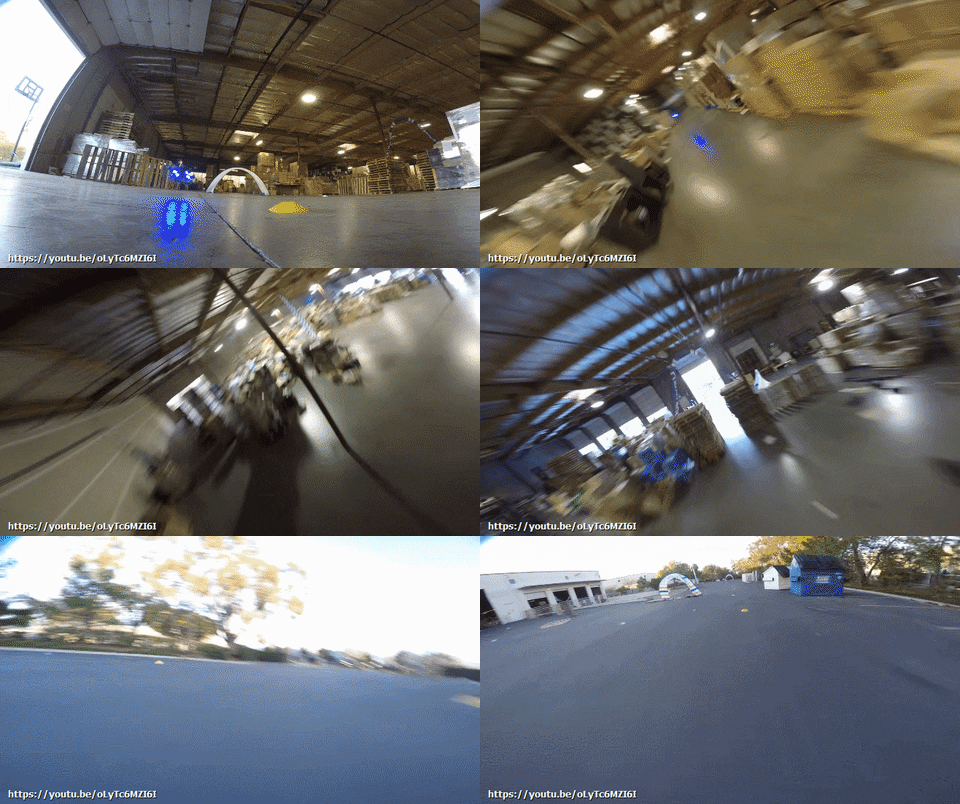 I will not be taking my talents to drone racing however.
Last weekend I spotted several individuals racing quadcopter drones at a park
in Schenectady, N.Y. These aren't the consumer camera drones that people have
been flying into the White House and stadiums for the past couple years. These
are high-tech, fast flying, race drones. I will not be taking my talents to drone racing however.
Last weekend I spotted several individuals racing quadcopter drones at a park
in Schenectady, N.Y. These aren't the consumer camera drones that people have
been flying into the White House and stadiums for the past couple years. These
are high-tech, fast flying, race drones.
One of the most notable aspects of drone racing is that
flyers typically stare at a small LCD screen mounted into the controller the
entire time or wear linked first person view goggles. The drones are outfitted
with a small forward-facing camera that the operators use to navigate a
racecourse. Since playing video games is now considered a sport, obviously
flying drones is a sport too; one that gets
shown on ESPN and that the Aerial Sports
League deems part X-Games, part NASCAR, and part MMA. Okay then. Others
have compared
it to pod racing, a la Star Wars, which seems much more apt. This year, winner of the World Drone Prix in Dubai will win $1 million.
Courses typically need to be wide open spaces, as drones
regularly accelerate to over 70 mph in some leagues and race classes. Drone
flyers navigate courses by the use of flags or pylons positioned around the
race area, and often arrows positioned on the ground or wall; obstacles, such
as ledges, hoops or other hazards are also common. Drone races last minutes, as
powering four small electric motors, an ESC, RF transceiver, and camera drains
the lightweight batteries quite quickly.
 Beginner's racer drones start
for less than $200, but this
guide recommends that to be competitive racers need to mod and customize
their drones to their racing style, with a minimal investment of $800. Speed,
power and maneuverability are the specifications racers are most concerned
about. Speed and power are directly related to the motors and props used. Small
electric motors range in power from 900 Kv - 2,300 Kv. Props mostly differ by
material, number of blades, and blade angle of attack. Power-to-weight ratios
of 10/1 are common on higher end drone racers. Beginner's racer drones start
for less than $200, but this
guide recommends that to be competitive racers need to mod and customize
their drones to their racing style, with a minimal investment of $800. Speed,
power and maneuverability are the specifications racers are most concerned
about. Speed and power are directly related to the motors and props used. Small
electric motors range in power from 900 Kv - 2,300 Kv. Props mostly differ by
material, number of blades, and blade angle of attack. Power-to-weight ratios
of 10/1 are common on higher end drone racers.
Maneuverability is also key, as turns often decides which
flyer has the best technique and equipment. Having more power available helps
the drone accelerate out of turns, but maneuverability is also a result of
response time between the controller and drone, as well as the processing speed
of the flight control software.
Drone sports is growing beyond just racing too. Flight
Club is drone combat-the drones ram each other until the one can't fly. Drone
dogfighting is next on the docket.
The world of e-sports continues to grow. While I'm not sure what constitutes a 'sport'
anymore, drone racing has absolutely become mainstream, when just a few years
ago it was exclusive to technocrats.
| 


 Re: High-Stakes Racing is the Newest Drone Application


