|
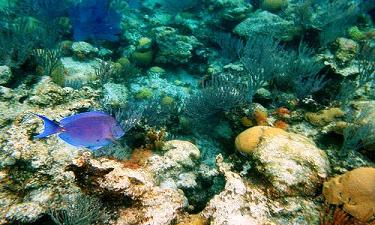
Snorkeling along part of Bermuda's coral
reef was one of the highlights of my recent trip to the island. Given the dire
state of corals around the world, spending a little time amongst robustly
healthy corals, and the resident fish, was a pleasure and a privilege. Why is
Bermuda's reef in such good shape? Why are others, from the Great Barrier Reef
to locations in the Florida Keys, dying? What, if anything, can we do to save
what's left? Big questions, and articles abound that describe problems and
potential solutions.
Rather than regurgitate a summary of the
plethora of virtual ink dedicated to coral, I'll look at one less-obvious
stressor of coral ecosystems. I'll also look at some ideas for coral
restoration and ways to prevent further damage.
Coral Bleaching: Symptom of Stress
This year's El Nino event sparked the
biggest coral die-off since 1998's El Nino. Pictures of swaths of bleached
Great Barrier reef coral - estimated at one-third of the entire reef - show up with dismaying frequency. A number of news outlets published stories
as I was writing this post. This phenomenon occurs when stressed corals expel
the algae, called zooxanthellae, that live symbiotically within coral tissues.
The algae are the coral animal's major food source, as well as the source of
its color. NOAA's infographic below demonstrates this process. Soft corals are particularly prone to bleaching.

Infographic: NOAA
Stressors: Obvious and Not-So-Obvious
Those of you who are reading this can
undoubtedly list some obvious anthropogenic environmental stressors.
- Global warming and increased ocean
temperature
- Changes in ocean water chemistry -
salinity levels and acidity
- Pollution from waste runoff
- Heat pollution from power plant cooling
water discharge
- Overexposure to humans via recreational
scuba diving
- Overfishing and use of destructive
fishing methods
- Loss of fish which clean seaweed from
reefs
An additional and more subtle culprit is
the chemicals in most sunscreens. The oldest research I found in a cursory web
search is an from Environmental Health Perspectives published in 2008, "Sunscreens Cause Coral Bleaching by
Promoting Viral Infections." The role of sunscreen hasn't gotten much attention until this latest episode of
massive bleach-outs, though. At the time of publication, the authors estimated
that 4,000 to 6,000 metric tons of sunscreen washes off swimmers in oceans
worldwide. The more swimmers and divers cluster around reefs, the higher the
concentration of washed-off Coppertone. And even a vanishingly small amount of
the bad stuff can wreak havoc. Ironic that the stuff that protects humans from
sunburn and skin damage helps cause coral to lose color and die.
The sunscreen chemicals that cause
damage are paraben, a preservative; cinnamate and a camphor derivative, UVB
blockers; and benzophenone, a UVA blocker. These chemicals do their dirty work
by causing dormant viruses in coral's symbiotic algae

to wake up and replicate,
eventually causing the algae to explode. The explosion propels the viruses into
surrounding seawater where they can infect other corals. There is also evidence
that chemicals alter the DNA of juvenile coral polyps, causing deformities and unviability.
Sunscreens with non-chemical UV blockers
don't harm coral - at least, as far as we know today. These non-chemical
blockers are our old friends zinc oxide, the stuff lifeguards paint on their
noses, and titanium dioxide. Together these provide broad spectrum protection.
A lot of websites advertise reef-safe and reef-friendly sunscreens and
sunblocks.
An Aside about European Sunscreens
Recently I'd read that European and
Australian scientists have access to much more effective sunblocking chemicals that
are unavailable to those of us in the US. The story of why they are unavailable, despite 20 years' worth of user data
demonstrating their safety and effectiveness, is too long for this post.
Suffice it to say that testing takes money, either from the FDA or the product
manufacturer, and evidently no one's interested enough to pony up.
I wondered if these FDA-banned
ingredients are safer for coral than the three UV blockers listed above. I was
thinking hey, not only are US citizens unnecessarily deprived of more effective
sunscreens, we're also killing coral. Sure enough, as far as we know, none of
the ingredients listed below harm coral or humans, at least not European and
Australian humans. To add a touch of irony, a factory in South Carolina
manufactures sunscreen with banned ingredients and ships it all to Europe.
- Tinosorb M (UVA blocker)
- Mexoryl XL (UVA blocker; SX available in
the US but less effective)
- Uvinul T 150
- Uvinul A Plus
- Uvasorb HEB
- Parsol SLX
Coral Preservation and Growth
Stressed coral dies quickly and in large
quantities. However, coral reefs grow agonizingly slowly. Large corals, like
brain corals, grow 0.3 to 2 centimeters per year; soft corals, up to 10
centimeters a year. At this rate, a reef takes 10,000 years to form.
A large barrier reef or an atoll can take 100,000 to 30 million years to form. Given
this timeframe, preservation efforts are far more important than attempts to
create new reefs, although there are ongoing efforts to provide structures,
like sunken ships, for coral polyps to latch onto. Mr. Best in Show and I saw
coral starting to grow on a shipwreck on our snorkeling trip; Bermuda has
plenty of wrecked ships, most or all of which ran afoul of the reef.
Individuals can help keep coral healthy
by using the right sunscreen and by refraining from touching coral when snorkeling
or SCUBA-ing. Creating marine preserves where harmful activities are banned and
human access is regulated is mandatory. Bermuda's government has passed laws to
protect the island's reefs since the 1600s; this protection is one key factor
in Bermuda reef health. Each of the factors leading to reef death can be
addressed if enough political and ecological interest exist. For example,
restoring populations of reef-cleaning fish directly improves reef health.
Diligent monitoring programs, such as those managed by the Bermuda Reef Ecosystem Analysis and Monitoring (BREAM), discover potential threats and
can avert significant damage - at least, that's what we hope. Global warming and
carbon dioxide levels have already killed irreplaceable swaths of coral
world-wide; what the future holds, we can't know.
References
http://coexploration.org/bbsr/coral/html/reef_formation.htm
https://en.wikipedia.org/wiki/Coral_reef#Formation
http://oceanservice.noaa.gov/education/tutorial_corals/welcome.html
Image credits
Bermuda_attractions.com
NOAA
SEOS
| 


 Re: Coral Bleaching


