|
This month's IEEE GlobalSpec Newsletter Challenge:
Scientists analyzing data from the Transiting Exoplanet Survey Satellite (TESS) are convinced they have discovered an Earth-like world orbiting another star. But upon further inspection by other observatories, it is determined that there are actually no planets orbiting the star. What might have gone wrong in the initial analysis?
And the answer is:
TESS and earlier planet hunting missions like Kepler find planets beyond our solar system by using the transit method. With this technique, scientists capture multiple images over time of distant stars. They then look for changes in star brightness, watching for periodic dips in brightness that could correspond to an orbiting planet blocking a fraction of the star’s light.
Researchers analyzing data from these missions perform careful calibration operations on raw data from the instruments in an attempt to eliminate false positives. But there are many factors that can lead scientists to conclude an exoplanet exists in a system where none are present. These include astrophysical phenomena, stellar variability, non-astrophysical instrument effects and other artifacts.
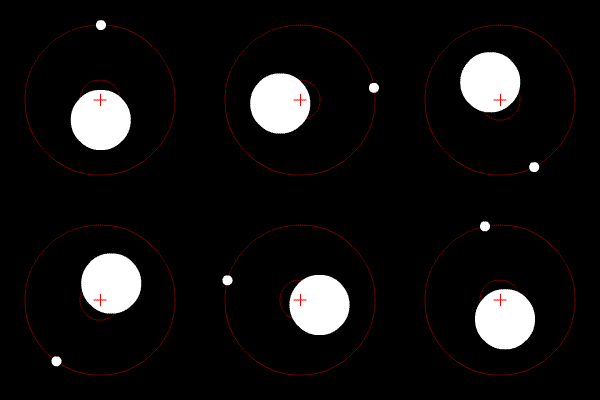
Astrophysical phenomena that contribute to false positives include eclipsing binaries. These dual star systems contain one star orbiting another, producing a transit light curve that mimics a planetary transit. Eclipsing binaries can also occur in the background behind a target star, polluting the brightness data of the target.
Instrument effects that must be corrected for include traditional CCD issues like bias, dark current, flat field, and gain/linearity. Calibration at the level of individual pixels must be performed to correct for varying pixel sensitivities and to correct for cosmic rays. On TESS, smear signals resulting from the cameras’ lack of a shutter must be removed. There are many other artifacts, both of stellar and instrumental origin, which can lead to false positives. For this reason, follow-up observations beyond the initial data acquired by TESS are required to verify the existence of exoplanets.
| 



 Re: Suspicious Signals: Newsletter Challenge (July 2018)








"Almost" Good Answers: