|
Did you know that the supercomputer IBM Watson required 85,000 watts to challenge and ultimately vanquish two Jeopardy! champions? But Watson’s conqueror, Congressman Rush Holt, relied on a far more efficient machine – the human brain – which functions on a mere 20 watts.
My research goal is to build computing systems inspired by the brain that can learn and adapt in the real world. Machine learning algorithms can now perform complex cognitive tasks such as controlling self-driving cars and language interpretation, but their use in mobile devices and sensors embedded in the real world requires new technologies with substantially lower energy and higher efficiency.

Bipin Rajendran, associate professor of electrical and computer engineering at NJIT (right), along with S. R. Nandakumar, a graduate student in electrical engineering.
At the heart of these algorithms are artificial neural networks – mathematical models of the neurons and synapses of the brain – that are fed huge amounts of data so that the parameters of the network are autonomously adjusted to learn the hidden relationships that underlie different parts of the data.
However, the implementation of these brain-inspired algorithms on conventional computers is highly inefficient, consuming huge amounts of power and time. The reason is that in current configurations, the data storage unit (memory) and the data processing unit (processor) are physically separated, and data continually shuttles back and forth. Furthermore, while the brain encodes and processes information in the time domain using electrical spike signals, popular machine learning algorithms use memory-less models of neurons for computing.

Ph.D. students Anakha V. Babu, Shruti Kulkarni, PI Dr. Bipin Rajendran and NJIT undergraduate student John Alexiades at the NJIT research showcase event.
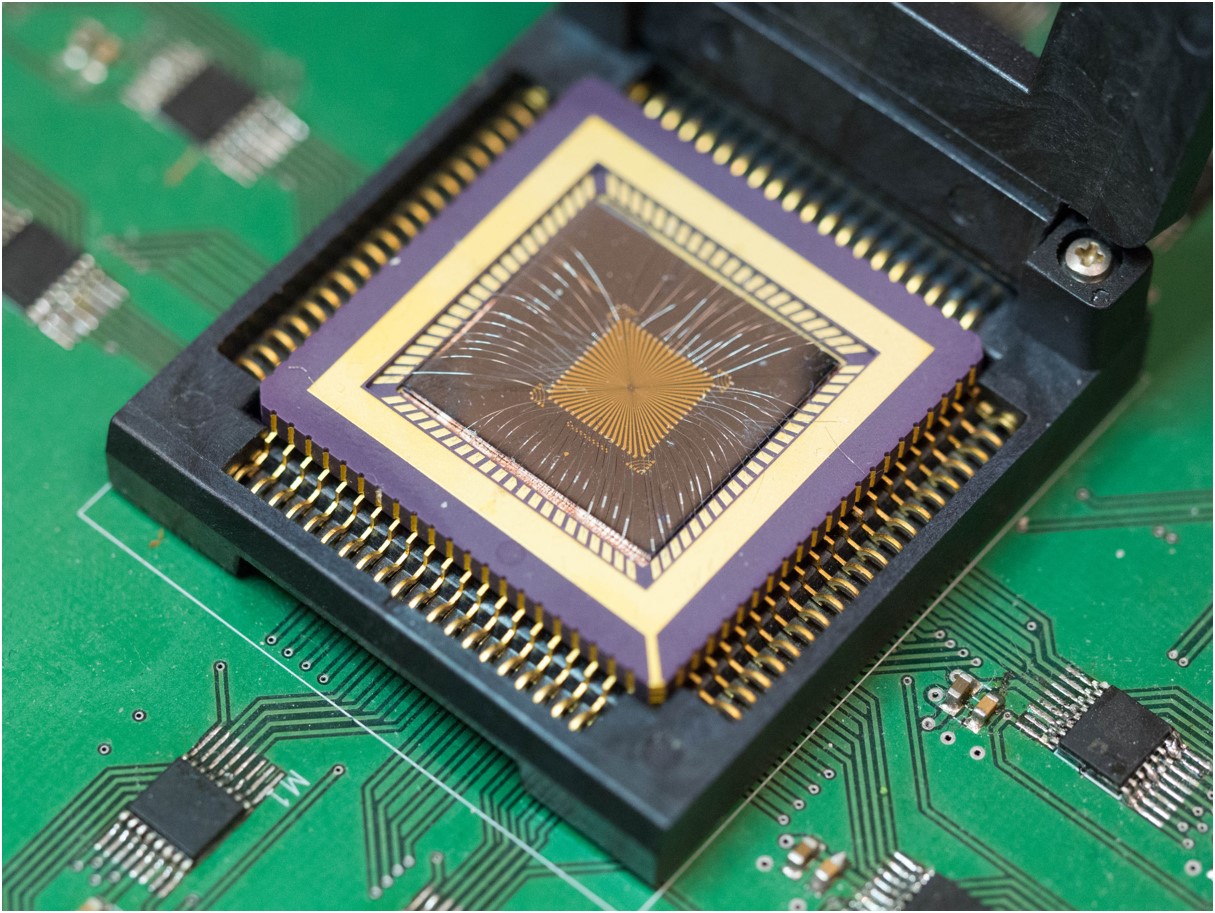
Hence, we can improve the efficiency of computation by designing systems that seamlessly integrate storage and data processing functions and naturally capture timing-based correlations. Memristive devices, whose conductivity depends on prior signaling activity, are ideally suited for building such "in-memory computing" architectures. Our challenge is to optimize algorithms, system architectures and device technologies to build these systems based on nanoscale devices that overcome current reliability hurdles.
Editor's note: This is a sponsored blog post from the New Jersey Institute of Technology.
| 


 Re: Building Brain-Inspired Computing Systems. Xmission Line Memories for Massively Parallel Processors